
Structured Data SEO: How Schema Markup Helps Search Engines Understand Your Website
Sep 12, 2026


It is no news that the marketing landscape is dynamic. Changing every second with diverse customer needs and wants.
So, in order to thrive and connect with the target audience, businesses need to hit the right chords with a potential business strategy.
That’s why they need to know the core functions of marketing.
Whether it is a small firm or an enterprise with years of experience, without the foundational marketing functions, it can be difficult to attract customers and future leads.
Moreover, these functions encompass a varied range of processes and strategies.
Determining the entire process from how the products and services are designed to how they are delivered to the customers. So, they play a critical part in a business strategy.
Now, in this blog, I will delve into these core marketing functions, focusing on—
Stay tuned!
Before diving into the core functions of marketing, let’s take a look at what these functions actually aim at.
To explain in simple terms, a marketing function is a business activity that connects potential customers to the brands.
Making it easier to attract an audience and sell products or services.
Moreover, the marketing functions revolve around the entire process of understanding the customers, developing the products, and delivering them to the customers.
So, these functions can be put together to create a specialized marketing system. Driving customers and growing the business.
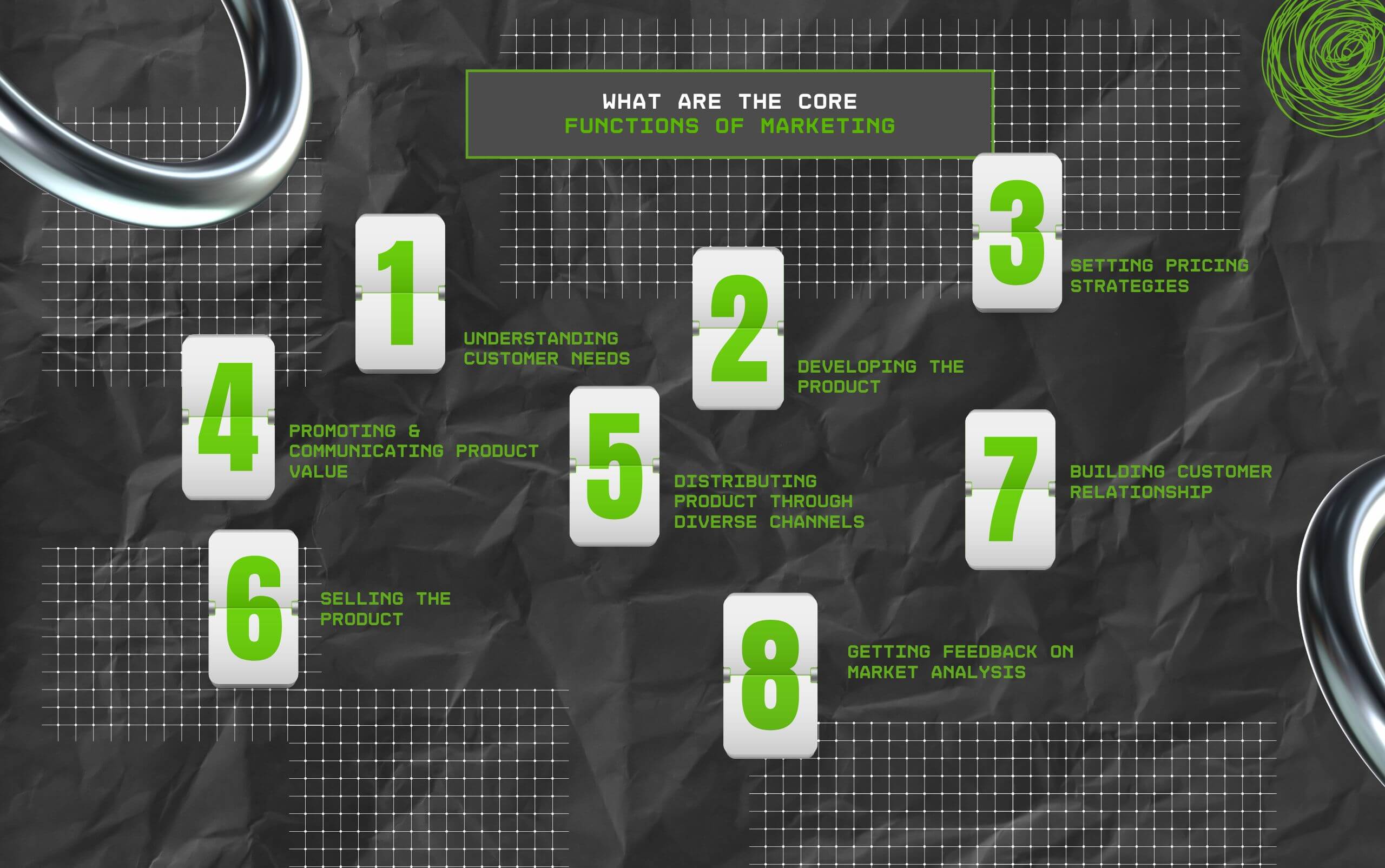
Generally, there are seven core functions of marketing that are interconnected to drive business success. So, these marketing functions include—
Firstly, understanding the needs and preferences of the target customer is the key to building a marketing strategy.
That is, knowing what your customers need and want can help in developing a product that directly addresses their concerns with a solution.
So, this market research helps businesses to develop products and services according to the needs and wants of the target customer base.
Now, with this knowledge of the customer base, the next function involves developing the products and services.
That is, it revolves around the entire ideation, designing, and procurement of these brand products. So, the brands can satisfy their target customers with the perfect solution.
Simply creating the product is not enough. So, comes the next function of marketing — setting the pricing for the products and services.
That is, businesses determine the pricing based on their value, production costs, and profitability of the firm. So, it is easier to gain market access with the right pricing.
Moreover, these products and services need to be promoted to attract potential customers.
That is, the promotional campaigns, launch events, and other marketing media help in communicating the value of these products and services.
So, the businesses can spread brand awareness, generate interest, and finally drive sales for the developed items.
Post promotion, distribution of the products and services is a crucial element. That is, the businesses need to use diverse distribution channels to help the products reach the customers.
So, businesses can combine the various channels — retailers, wholesalers, digital platforms, and direct sales — to distribute the items.
Moreover, they need to ensure the logistics are streamlined and properly managed. So, it can help the brand’s products and services reach the intended markets efficiently.
At this stage, the interests of the customers are converted into purchases. So, it creates a direct interaction between the businesses and their customers.
Now, this can involve having representatives to sell the products or through e-commerce platforms. But the aim is to ensure the buying process is smooth, simple, and hassle-free.
This way, brands can ensure that customers can purchase the products and services without needing guidance or external help. Becoming potential leads and driving sales.
Now, selling the product is not the final step. That is, maintaining a strong relationship with the customer helps in bringing them back. So, keeping them satisfied, even post-purchase.
For instance, a good customer support system, along with the loyalty programs, can foster customer satisfaction, drive future leads, and retain customers.
So, the business can grow by addressing customers’ constant needs with potential solutions.
Finally, conducting market analysis and getting customer feedback on the products can help businesses modify their strategies.
That is, they can identify the issues, find potential solutions, and modify their marketing strategies with data-driven insights. So, they can stay relevant in the competitive landscape.
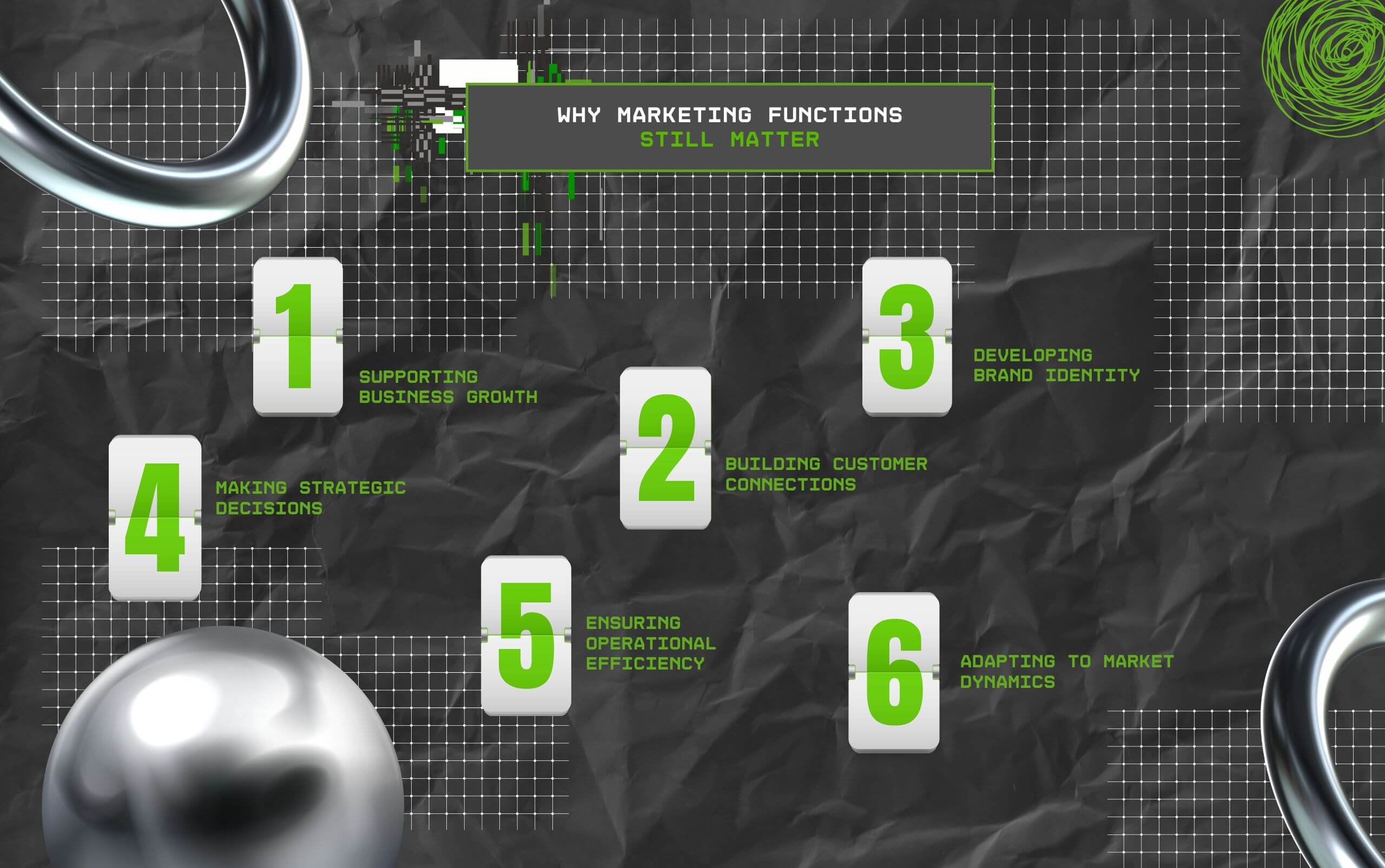
Given that marketing functions are foundational to any business strategy, they are still relevant in the modern marketing scenario. So, here are the key reasons—
Now, mastering these functions can turn any business indispensable. That is, they can establish a strong brand presence in the dynamism of the market.
So, learn about these functions to create a strong foundation for your business. Driving success and growth while traversing through the changing markets.
Here, I have brought you a complete set of some of the common questions around the various functions of marketing.
Generally, there are seven core functions of marketing — understanding customers, developing products, pricing, promotion, distribution, selling, and financing.
That is, each of these functions serves a distinct purpose. So, they are interrelated and play an equally important role in the overall marketing success.
Since the marketing functions focus on how the products are designed, developed, priced, promoted, and delivered, it massively impacts the business strategy.
That is, when businesses implement all seven core functions of marketing, they meet the consumer demands and achieve a competitive edge.
Generally, the buying and selling in marketing is referred to as the exchange function. So, it is an integral part of the marketing functions.
Moreover, it is central to the idea of transferring the products and services from the warehouses to the customers. Keeping them satisfied and building customer relationships.
Leads are crucial in any kind of marketing. That is, it refers to both individuals and organizations in the marketing reach that interact with your brand.
So, they can either be a direct customer buying your products and services, or they can be potential future customers who interacted through campaigns and service sign-ups.
Chandrima is a seasoned digital marketing professional who works with multiple brands and agencies to create compelling web content for boosting digital presence. With 3 years of experience in SEO, content marketing, and ROI-driven content, she brings effective strategies to life. Outside blogging, you can find her scrolling Instagram, obsessing over Google's algorithm changes, and keeping up with current content trends.
View all Posts

Structured Data SEO: How Schema Markup Helps ...
Sep 12, 2026
TikTok Downloader For Content Marketing Resea...
Sep 12, 2026
AI Content Optimization: How To Make Your Con...
Sep 11, 2026
AI Citations: How To Get Your Content Referen...
Sep 10, 2026
Top Enterprise AI Cloud Platforms for RAG, AI...
Sep 08, 2026