
How To Audit Your Search Visibility In 2026: Google Rankings, AI Overviews, And Where Your Traffic Really Comes From
Sep 30, 2026
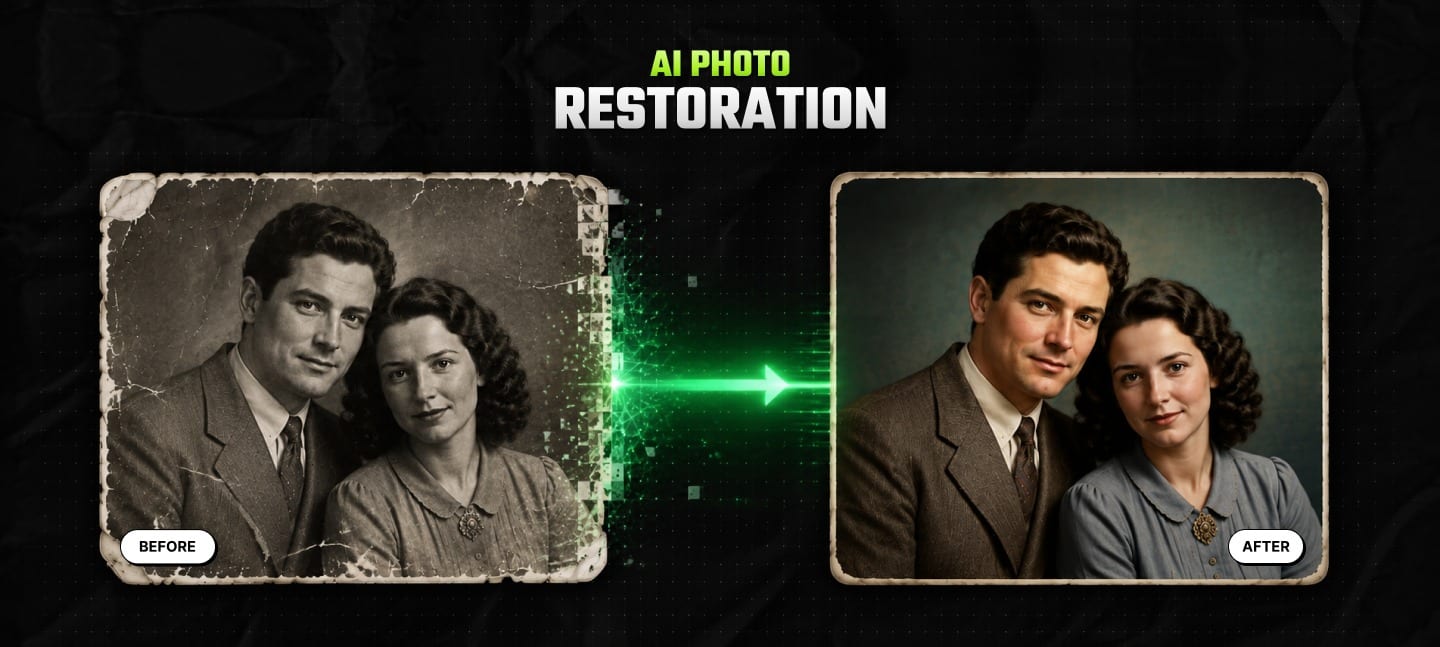

Have you ever stared at a black-and-white family photograph and tried to guess the exact shade of your grandmother’s wedding dress?
Or perhaps the precise blue of an old vintage car your father owned? For decades, capturing life meant stripping away its natural color.
But history was never truly black and white. Today, machine learning has changed how we interact with historical media.
If you are eager to turn faded gray tones into rich, realistic hues, you can instantly kolorize your vintage snapshots online.
Using an AI photo restoration tool no longer requires specialized editing skills or complex software.
Let us dive into how this technology works, how to get the cleanest results, and why this shifts search visibility patterns for digital media platforms on the web.
Photo restoration is all about repairing, recovering, and improving a degraded or damaged photograph.
So, the purpose is to restore an image to its original condition, as closely as possible. In certain cases, this can improve the quality of the image beyond the original quality of the capture.
Conventionally, restoration would happen manually. Skilled retouch professionals would use different tools, including Adobe Photoshop, to restore an image layer by layer.
Needless to say, the process was super expensive, slow, and on top of that results depended on the professional’s skills.
As a result, the emergence of AI in photo restoration has been a game-changer. Instead of spending a lot of time to apply edits manually, you can depend on the AI to detect and fix degradation patterns. And that too automatically.
Moreover, the AI model identifies color shift, physical damage, blur, and noise. Then, reconstructs the different plausible details instead of masking the issue.
While these two terms are related, they aren’t the same. Hence, it is crucial to distinguish between the two.
Photo enhancement is about improving the quality of an image beyond its original quality. It includes increasing resolution, refining color vibrancy, and sharpening detail.
In this case, the point of reference isn’t historical accuracy – rather, it’s the ideal quality.
In contrast, photo restoration is more about repairing damage – and this includes yellowing, tears, fading, cracks, and scratches.
The point of reference is your actual photo. Remember, good restoration is about making an image look like how it did when it was initially taken.
In practice, a good AI tool will combine both, considering photo restoration pipelines usually repair first before moving to enhancement.
Old-school photo editing forced designers to manually paint digital layers over a monochromatic image. It was a tedious process.
If a technician guessed the lighting wrong, the entire portrait looked fake.
Modern old photo restoration relies on generative deep learning models. Think of the artificial intelligence as a digital historian that has studied millions of colorful real-world objects.
When you upload a grayscale file, the engine executes a rapid structural analysis across the frame:
[Grayscale Upload] ──► [Texture & Object Identification] ──► [Semantic Color Mapping] ──► [High-Res Output]
The software recognizes a specific shape as a tree leaf, a jacket lapel, or human skin. It then references its vast data library to apply the most natural hue.
The system also automatically removes physical surface scratches, balances uneven shadows, and fixes blurry facial features in a single unified step.
If you want to achieve studio-grade color profiles on your first try, follow this clean, actionable sequence.
Do not just take a quick smartphone photo of an old glossy print on your desk. The room glare will confuse the AI algorithm. Use a flatbed scanner at a minimum resolution of 300 DPI, or use a mobile scanning app with glare-reduction features under natural light.
Before adding vibrant color, fix the underlying canvas. Use an engine that specializes in old picture restoration to remove cracked emulsion lines, dust spots, and deep creases. Cleaning the base contrast helps the colorizing engine distribute paint lines evenly.
Upload your repaired file to an intelligent colorizer tool. The system will process the semantic layers of the image. It will output a vibrant color portrait within seconds.
Examine the results closely under good lighting. Check if the skin tones look natural and look for any bleeding colors around the background edges. Save your final output as a PNG file to protect the restored clarity from losing data over time.
Automated picture repair offers immense speed, but relying entirely on computers comes with specific operational trade-offs that every archivist must keep in mind.
| Pros (Why it works beautifully) | Cons (Where it hits limitations) |
| Incredible Speed: Processes complex historical images in seconds instead of days of hand-painting. | Historical Guesswork: The tool cannot know the true color of a specific family heirloom dress; it guesses based on statistical likelihood. |
| Accessible Price: Lowers financial barriers, making archiving affordable for families without custom studio budgets. | Artifacting Risks: Low-resolution inputs can sometimes create weird glowing halos or color bleeds around fine hair edges. |
| Comprehensive Correction: Combines upscaling, color injection, and physical scratch repair into a single workflow click. | Loss of Texture: Over-aggressive processing can sometimes smooth out authentic skin grain, making faces look slightly plastic. |
At Search Engine Magazine, we look at how changes in content creation affect search behavior.
The rise of sophisticated AI photo restoration directly impacts how search engines crawl, interpret, and display visual information across the web.
Google’s advanced multimodal models do not just read surrounding page text anymore; they analyze the structural components of your embedded images.
When a page hosts a crisp, accurately colorized historical photo with descriptive metadata, search engines can easily build contextual connections.
This makes your content highly eligible to appear in rich visual answer formats.
If you run a media site, structuring your image guides into clean thematic blocks is critical.
Modern discovery platforms often pull specific instructional paragraphs directly into AI Overviews.
Using explicit headers like “Characteristics of High-Quality Image Scans” gives engines a clear semantic signal to index your page as a high-authority resource.
Check out the most frequently asked questions about AI photo restoration below.
No, as long as you work on a digital copy. Always keep your original, unedited grayscale scan tucked away safely in a separate folder as a master backup before you run any algorithmic color tests.
For clean semantic analysis, aim for a minimum resolution of 1200 pixels on the shortest side. High-resolution files provide the algorithm with the sharp grain definitions it needs to separate background objects from human subjects.
Severely yellowed prints should be converted to a clean digital black-and-white format first. Removing the sepia chemical stains uncovers the true underlying contrast values, allowing the software to apply realistic hues more accurately.
Yes. Modern models are trained on diverse historical formats, including tintypes and classic sepia plates. The system evaluates light density variations to reconstruct rich color depths regardless of the original chemical base.
AI photo restoration works very well on defined sets of damage types. Moreover, it reliably performs well on:
However, it doesn’t work very reliably on serious physical tears, especially where large portions of image data happen to be entirely missing. Also, in case of extreme overexposure and heavy damage by water, it might not work as well.
Frankly, the reality is that with AI photo restoration, you can reconstruct every plausible detail. However, you cannot recover information which doesn’t exist anymore.
Plus, for any moderate damage, results are usually indistinguishable from manual restoration, but for any severe damage, AI offers a solid foundation that might benefit from skilled manual finishing.
Barsha is a seasoned digital marketing writer with a focus on SEO, content marketing, and conversion-driven copy. With 8+ years of experience in crafting high-performing content for startups, agencies, and established brands, Barsha brings strategic insight and storytelling together to drive online growth. When not writing, Barsha spends time obsessing over conspiracy theories, the latest Google algorithm changes, and content trends.
View all Posts

How To Audit Your Search Visibility In 2026: ...
Sep 30, 2026
What Is Google Lighthouse? A Practical Guide ...
Sep 30, 2026
When Can You Save A Public Instagram Story?
Sep 30, 2026
Google Looker Studio: What It Is, How It Work...
Sep 30, 2026
What Is Google Tag Manager? A Practical Guide...
Sep 30, 2026