
Architecting Different Types Of Online Courses For Maximum SEO Impact
Aug 07, 2026


Do keywords matter anymore? Are they important anymore?
Keywords – starting from complex phrases and long-term queries to single words – continue to be essential for using website content to improve relevant and organic traffic from search results.
Moreover, these are instrumental for connecting with your website’s target audience.
But the question is: how much? Just how important are keywords? Let’s find out.
Of course, I don’t have a brief answer for all of you. So, if you think that adding keywords forcefully to relevant queries to meet informational needs, then the answer is ‘no.’
However, if you ask me whether keywords are important for Google’s retrieval and indexing system, then the answer is yes!
On that note, let’s look at this closely.
Keywords are primary phrases that are commonly used by consumers in order to determine what they are seeking online.
Moreover, users often depend on their search bar for typing in terms and phrases usually made of either one or multiple words that can describe what they actually want.
Also, there are several types of keywords. This includes:
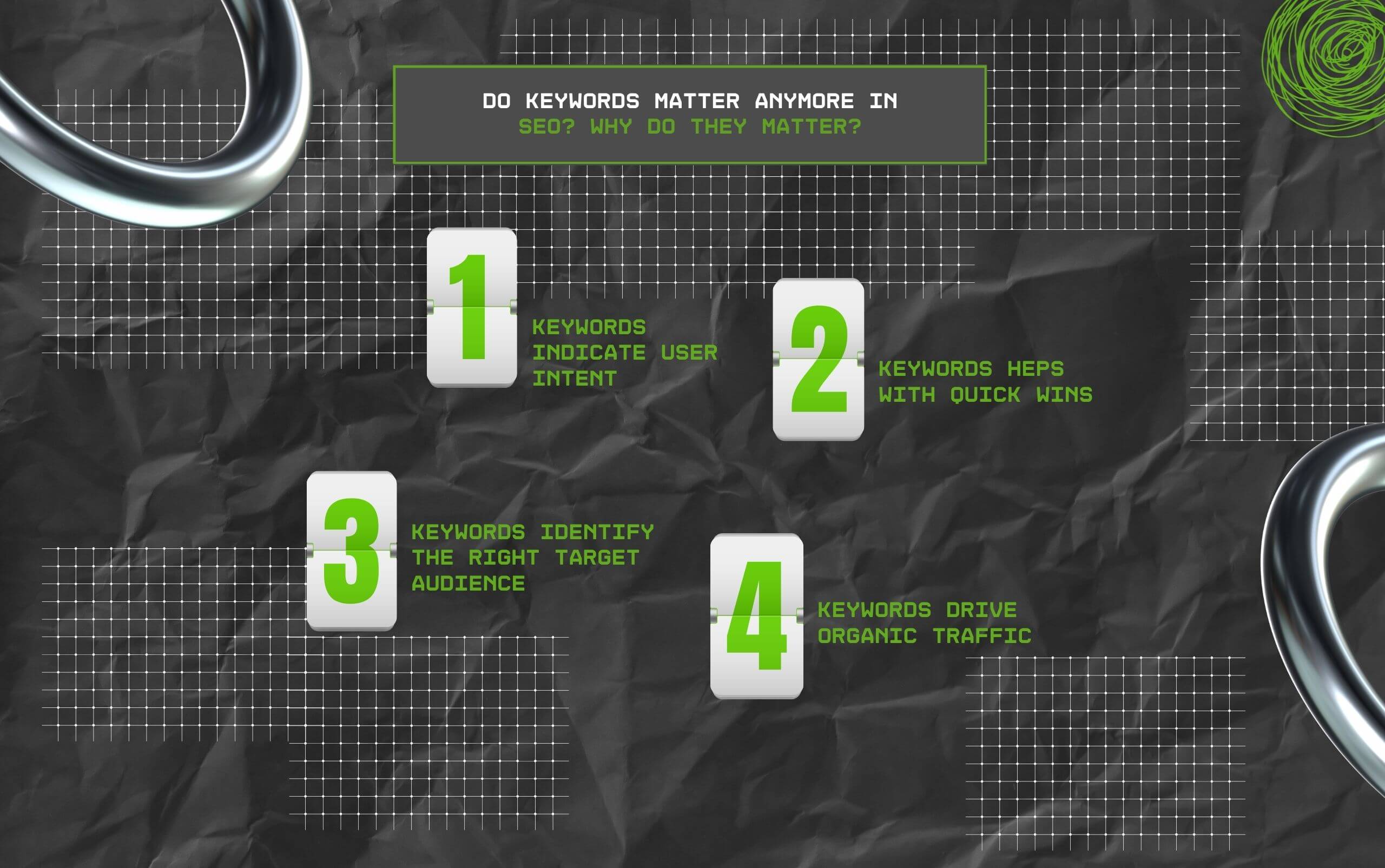
On that note, here are four important ways in which keywords can help brands.
Keywords are actually directional. They can offer excellent clues that point out the type of content a searcher is trying to obtain.
However, it is possible to encounter vocabulary problems between end users and the index system, and this happens because users have different ways of asking the same thing or even something similar.
This is precisely why Google or even other search engines have a difficult time with advanced query-related expansion technology.
For instance, if you type ‘do keywords still matter’ into the search box, you might come across a blog on the importance of keywords – something helpful and relevant – that meets your requirements.
In that case, another page with a direct match for the phrase ‘do keywords still matter’ might not qualify for it.
In addition, timestamps are attached to keywords – and that too in the index. Why? For temporal analysis, it detects the freshness of a keyword.
You can detect trends and even check under the news results for event detection. Plus, there’s so much more – I’m merely touching upon the basics to answer your question.
So, yes, the point is to get your search query to match relevant content – and keywords play an essential role in getting your queries to match with helpful content.
Having said that, remember that users usually don’t know what they are seeking – if they knew, then they would not need any search engine.
As a result, a search engine needs to be sophisticated enough with definitions and the subsequent discovery of anything related.
The fastest path to boosting organic visibility is to find keywords that offer opportunities for quick conversions.
And I’ve applied this strategy while I was working on the Search Engine Magazine post, the 2024 March Update.
So, once we fixed the technical problems and modified existing content on the site, our health scores improved.
But we still didn’t have sufficient traffic for monetization – we wanted the website to go back to its former glory, where contributing $10K monthly was an easy feat.
And this is where we made a strategy aiming at quick wins only – we published around 30 blogs in a span of 30 days.
All these blogs were written using keywords that had a high search volume but low keyword difficulty.
This means while the keywords came with significant traffic potential, there wasn’t much content available on the topic.
Once we identified the gaps, we started creating content around the same keywords. The result? Nearly 10K traffic with more than 50% of the published blogs performing within a month.
But if you are going to do this, avoid using fishing keywords.
When I do competitive analysis and check out keyword visibility for a current or prospective client versus the competition, I also spend time exploring the content gap.
And I saw one common pattern in most of the content I checked out – either there was a lack of related content on a particular topic or the existing content wasn’t optimized.
In some cases, I saw the content was failing to rank. For instance, I have a website on modern relationships and love, A.K.A Swipe Right Stories.
The website exclusively focuses on dating apps and the swiping culture.
After checking out my competitors, I found out that while they were ranking for broader terms like app reviews and modern dating trends, there was a huge gap.
I couldn’t find competitors discussing safety, privacy, and legality on dating apps, particularly in queries related to safety and privacy.
So I created an entire content calendar covering all possible queries associated primarily with safety and privacy on popular dating apps, specifically Tinder, Bumble, and Hinge.
Also, I linked each query with the other, and within a few months, the site had 300 organic keywords ranking and nearly 400 organic traffic on the website.
Currently, I am working with queries, and while the pace of growth is somewhat slower, the idea is to increase traffic gradually and not focus on a strategy that aims at quick wins.
Most of Google’s organic traffic comes from the first page. Interestingly, the top search result alone takes around 28.5% of the total clicks (source: search engine journal).
So, if you can successfully increase your website’s visibility on Google’s first page, then your website can easily drive a significant amount of organic traffic. This can potentially boost sales for keywords that come with a high search volume.
Moreover, being on top for a low-volume keyphrase isn’t meaningful – at least not always. Instead, you can prioritize keywords that boost business value.
Also, ensure these keywords have the right blend of two – holistic content and some search volume that can answer queries which end users might find helpful.
Additionally, too many articles and clients prioritize counting keywords and success stories, instead of tracking the impact of the same successes – or not.

While some SEO experts are still prioritizing keyword density, the truth is: keyword density doesn’t really matter anymore.
So, there’s no point stuffing keywords into your content – it will not help you to rank higher on SERPs, even if your focus keyword’s KD is at 12%.
Instead, the whole game has become all about writing content that can satisfy the user’s informational needs, giving users what they are looking for.
Also, I see websites that continue to use meta tags for keywords – Google has devalued meta tags long ago. Plus, it doesn’t have any ranking value and won’t help you grow.
Finally, using the exact match as an anchor text for most of your links isn’t a great idea. Your anchor text should blend both brand and non- brand aspects, including different keyword variations.
Google is pretty sophisticated and advanced. As a result, if you have multiple keywords that match your anchor links, it can send an alarm, putting your website at a penalty risk.
And I’ve been here with Search Engine Magazine – once penalized, getting back on tracks can easily take an year or even more. In some cases, you might never get your site back to normal.
Before you can start using a variety of tools for doing keyword research, pause for some time and think like your customer.
Ask yourself, “what is my website’s purpose? How can I help my target audience – what problem am I going to solve? Can I satisfy the information need of my target audience?”
So, if you get the answer to this question, you are absolutely on track towards defining your target audience and content strategy, including your keywords.
For me, one of the things that I do for keyword research is use Ahrefs and Google Trends – combine both to create keyword clusters that are relevant, trending, and have a good traffic potential.
Also, you can use other tools like KW Finder, Moz Keyword Explorer, Long Tail Pro, Google Keyword Planner, and Semrush. All these tools offer diverse functionalities that will help you find the right set of keywords.
After all, SEO is about delivering quality organic traffic that can convert potential customers into actual ones.
Also, if your website has a lot of organic traffic but zero conversions, then what is the point of doing anything, really?
(Unless, obviously, if your site depends on affiliate traffic, ad revenue, or some other advertising-focused model.)
Do keywords matter anymore? Should you even track them anymore? YES, absolutely!
Keywords continue to offer value by delivering visibility, traffic, conversions, sales, and that too in core positions.
Moreover, for the enterprise-level businesses with several products and services, it can get expensive to monitor keywords because there can be hundreds or thousands of keywords to track across mobile and desktop.
Also, it is an excellent idea to keep a list of golden keywords that offer the most value for your business.
This list should have a mixture of product, brand, and non-brand keywords that are crucial for being on the first page of search results.
Moreover, all you need to know is what the search volume of the keyword is and how much traffic potential does it has – trust me, that is the only information you need.
Barsha is a seasoned digital marketing writer with a focus on SEO, content marketing, and conversion-driven copy. With 8+ years of experience in crafting high-performing content for startups, agencies, and established brands, Barsha brings strategic insight and storytelling together to drive online growth. When not writing, Barsha spends time obsessing over conspiracy theories, the latest Google algorithm changes, and content trends.
View all Posts