
Master The Rich Result Test: Fix Your Broken Schema Markup
Oct 08, 2026


Most content problems are not about quality. They are about coverage.
So, you publish regularly. Also, you optimize pages. But traffic stalls. That usually means one thing.
You are not covering what your audience is actually searching for. This is where SEO content gap analysis helps.
It shows what you are missing, not just what you have.
A content gap is a topic, keyword, or question your audience searches for, but your site does not cover well.
Moreover, it is vital to understand that a content gap can take a few forms:
1. You have no content on the topic.
2. You have content, but it is outdated.
3. You rank poorly compared to competitors.
4. You miss key questions within a topic.
Each gap is a missed opportunity.
Gaps don’t happen because you ignore SEO. Instead, they happen because content grows in pieces.
One blog here. One landing page there. A few updates over time. There is no full map. So you end up with clusters that are strong, and areas that are empty.
Over time, this creates an imbalance. And search engines notice that. Moreover, users feel it too.
A proper SEO content gap analysis gives you direction.
Moreover, note that it answers three simple questions:
In addition, it replaces guesswork with clear priorities.
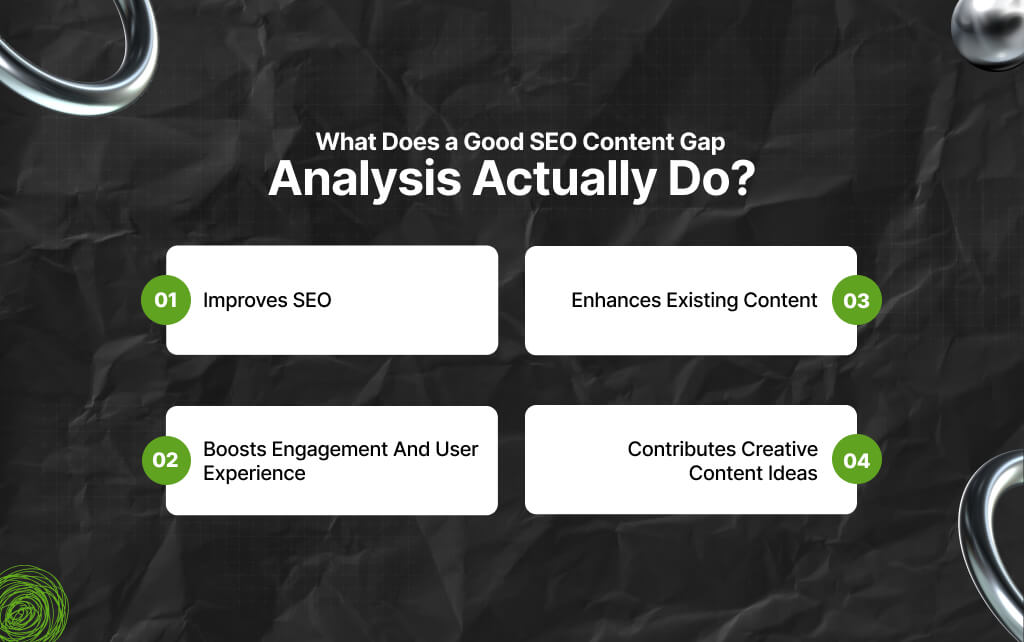
On that note, let’s check out how an effective SEO content gap analysis can help you.
One obvious benefit of doing a SEO content gap analysis is improving your site’s overall SEO.
When you are continuously identifying gaps within your content, you become more equipped to create compelling and valuable content.
Also, analyzing competitors’ content will only help you boost the quality and helpfulness of your content.
That way, you will be in a better spot to outrank your competitors and perform better on SERPs.
Why do people spend so much time browsing the internet, moving from one web page to another?
TBH, it could be because they are not happy with the responses or answers they are getting. Some of the results might be too shallow, outdated, or even complex.
Moreover, publishing content like it’s some sort of formula might lead to rising bounce rates, a drop in search rankings, and a bad user experience.
However, with the help of an effective SEO content gap analysis, professionals can easily identify lapses within their content – gaps that are negatively impacting their experiences.
Moreover, armed with this data, you can easily make the necessary adjustments to improve user experience.
Just changing a boring introduction to something more engaging might make a significant difference for everyone visiting your website.
One of the best things about effective SEO content gap analysis is that you do not have to publish anything new.
Sometimes, your existing blogs might need a little work to perform well on search results while driving traffic consistently to your website.
With the help of effective gap analysis, anyone can easily identify all underperforming content on their website.
Moreover, you can target secondary keywords, answer queries, delete outdated statistics, and break complex sentences into simple language.
This will help you make the most of your content strategy without wasting time and resources on new content.
Effective SEO content gap analysis includes identifying the unmet needs of your audience and satisfying those particular needs with valuable content.
This is a sort of goldmine if you have been struggling with creating new content.
Moreover, with content gap analysis, anyone can easily identify in-demand topics by analyzing competitors’ strategies and revisiting their existing content strategy to identify gaps.
There are various types of loopholes in content creation. As a result, there is more than one way to do an effective SEO content gap analysis.
While some gaps arise because there were some unaddressed queries in existing content, other gaps happen because you entirely overlooked topics.
Then, at times, it is also possible that the gaps are actually buried deep within the content of your competitors.
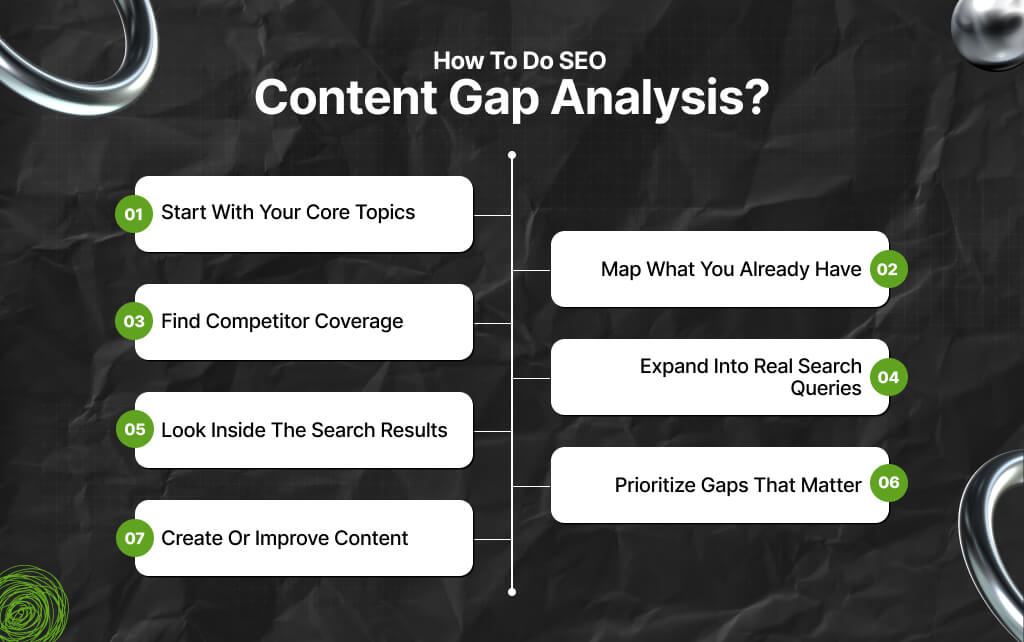
Depending on what you need to prioritize, I have a step-by-step guide to help you get started.
So, start by listing your main areas. Not keywords yet. Topics.
For example, if you run a marketing site, your topics may include:
Also, remember the point is to keep it simple. These topics will guide everything else.
Now audit your content. Then, group your existing pages under each topic. Soon, you will start seeing patterns.
Some topics will have many pages. Others will have very few. This is your first signal. Also, strong areas and weak areas become clear.
Now look outside your site. Then, identify 3 to 5 competitors who rank well in your space. Next, study their content.
While doing so, look at:
You don’t need to copy them. Instead, you need to understand where they are ahead.
Now move from topics to queries. Here, use keyword tools to find what people actually search.
Moreover, focus on:
These reveal intent.
For example, instead of “SEO tools,” look at:
These are gaps that matter.
This step is often skipped.
So, it is best not to rely only on tools. Instead, search the queries yourself. Then, look at the top results.
Notice:
You will often find gaps within ranking pages. Maybe they miss examples. Maybe they stay too basic.
This is where you can win.
Not all gaps are worth filling.
Instead, focus on:
Also, avoid chasing volume alone. Instead, relevance matters more.
Now take action.
For each gap, decide:
Keep your content focused. Moreover, answer the query clearly, add depth where needed, and avoid using fillers.
Many teams run an SEO content gap analysis but get poor results.
Here’s why that happens:
1. They chase competitors blindly. More importantly, they copy topics without adding value.
2. They focus only on keywords. And while doing so, they miss the intent behind searches.
3. They ignore existing content. Also, they create new pages instead of improving old ones.
4. They don’t prioritize. Instead, they try to fix everything at once.
So, if you avoid making these mistakes, then your work becomes sharper.
A SEO Content gap can change over time.
So, you will see new topics emerging, competitors growing, and search behavior shifting. As a result, review your gaps every few months.
Of course, you don’t need a full audit each time. Even small updates help.
But what exactly do you gain from a detailed SEO content gap analysis? You stop guessing what to write. Moreover, you start building content with purpose.
Also, you cover your space more completely. And over time, your site becomes more useful.
In addition, search engines reward it, while users will trust you as a credible source of information.
At the end of the day, SEO content gap analysis is not about filling every space. Instead, it is about filling the right ones.
When you focus on what your audience needs, the results follow. Not instantly. But steadily.
Barsha is a seasoned digital marketing writer with a focus on SEO, content marketing, and conversion-driven copy. With 8+ years of experience in crafting high-performing content for startups, agencies, and established brands, Barsha brings strategic insight and storytelling together to drive online growth. When not writing, Barsha spends time obsessing over conspiracy theories, the latest Google algorithm changes, and content trends.
View all Posts

Master The Rich Result Test: Fix Your Broken ...
Oct 08, 2026
Does vnROM Bypass Still Work? A Realistic 202...
Oct 08, 2026
Event Pages That Rank And Convert: A Practica...
Oct 06, 2026
KeywordStat Review: Keyword Research, Cluster...
Oct 03, 2026
How Corda Turns Authority Data Into Campaigns
Oct 01, 2026