3-Minute Checklist: How To Get Your Brand Named In AI Answers
Nov 20, 2026
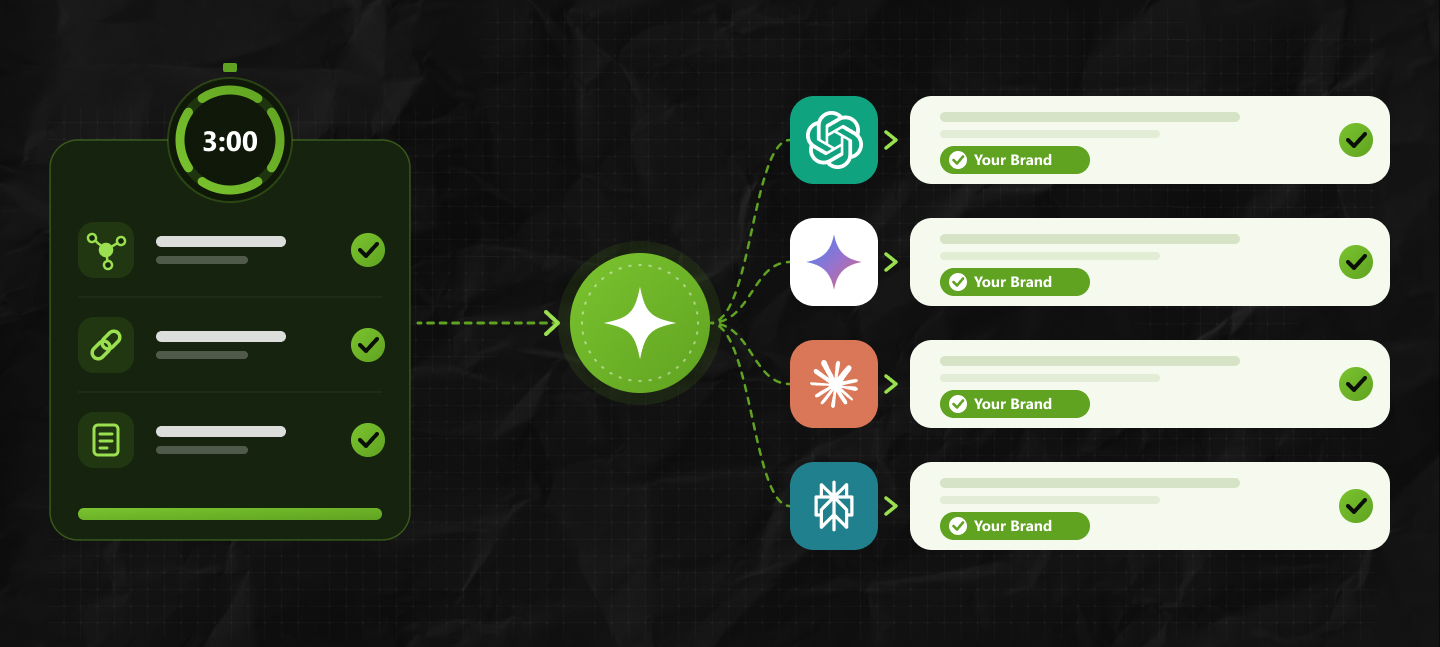

Until recently, digital marketing was fairly straightforward. Build a website, include some keywords, earn backlinks, and rank highly in Google. But in recent years, buyer journeys have changed.
Now millions of people no longer search on Google; instead, they open an AI tool (ChatGPT, Google AI Overviews, or Perplexity) and ask specific questions such as
As a result, if your brand isn’t within these AI search results, it essentially does not exist to these customers.
So, what is AI brand visibility? Why should you focus on it, and how can you build a strategy to be recommended in AI search results?
In this guide, we’ll show you how to do all of that with easy-to-understand language and effective techniques most sites miss.
Increasing your AI visibility means getting AI platforms, such as ChatGPT, Google AI Overviews, Perplexity, and Claude, to mention and recommend your business more often.
It also helps ensure these mentions are accurate and positive.
To do this, focus on a few key strategies. First, build strong third-party authority on review platforms and Reddit.
Next, keep your entity information consistent across the web. Also, make sure your website is easy for AI search bots to read.
Finally, structure your content into clear, concise answer blocks.
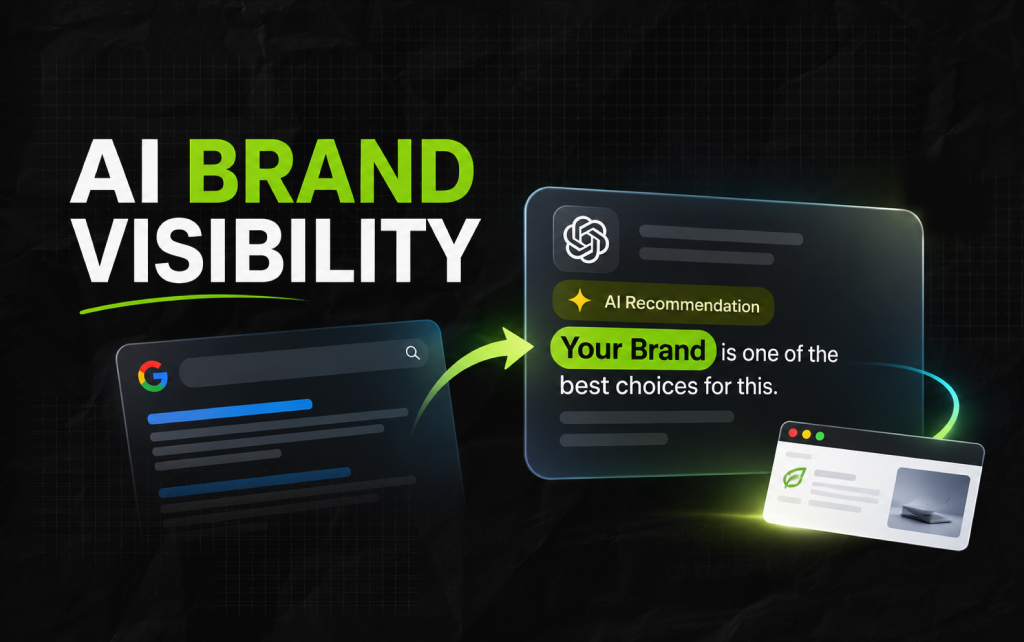
When a user uses Generative AI search tools, if your brand, goods, or services appear in the AI’s results, you build brand awareness in AI.
In traditional SEO, a blue link in search results encouraged people to click through to your website.
With AI search tools, AI scans scores of sites, finds the most relevant results, and returns one concise answer.
Therefore, rather than simply gaining clicks, you want to be mentioned in the final answer.
If your brand is mentioned in an AI tool’s search result, it’s acting as a recommendation from a ‘friend’. Therefore, users who click through to your site are highly likely to make a purchase.
Traditional Search Visibility vs. AI Brand Visibility
| Feature | Traditional SEO Visibility | AI Brand Visibility (GEO / AEO) |
| Where you appear | A list of 10 blue links on Google or Bing. | Inside a conversational summary or citation card. |
| How success is measured | Keyword rankings, impressions, and click-through rate (CTR). | Brand mention frequency, Share of Model, and sentiment. |
| Main ranking signals | Backlinks, page speed, and exact keyword placement. | Entity consensus, brand co-occurrence, and third-party reviews. |
| User behavior | Users click multiple websites to compare options. | Users trust the AI’s top 3 to 5 recommendations immediately. |
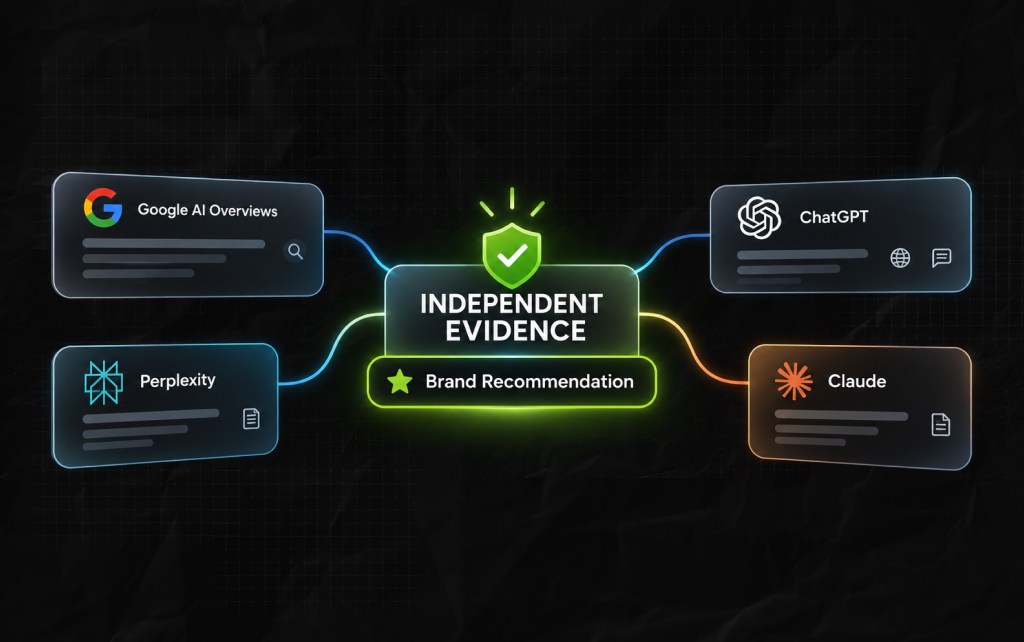
Each AI tool works differently. Knowing how is key to optimizing your content across all platforms.
This pulls information mainly from the search index. The references in Google AI Overviews usually come from top-ranking webpages in the top 10 of Organic Google results. These pages will directly answer the question(s).
This pulls information from its long-term memory and from live web searches. For web searches, results mostly come from Microsoft Bing and OpenAI’s own search bot (OAI-SearchBot).
Furthermore, ChatGPT pulls heavily from Reddit posts and Best Of articles to validate human opinion.
This uses very recent information from web content. It prioritizes academic/data-based articles,
YouTube transcripts, and active conversation forums. It provides references for all claims as footnotes.
This tool pulls heavily from authoritative articles, documentation, and well-formatted website text when web searching is turned on.
Although they all differ in their information sources, all AI tools share one similarity. None of these AI tools will recommend using a brand purely because it claims to be great.
They must have independent evidence from across the web to recommend usage of a brand.
You Can Also Check: How To Get Your Website Named By ChatGPT And Google AI.
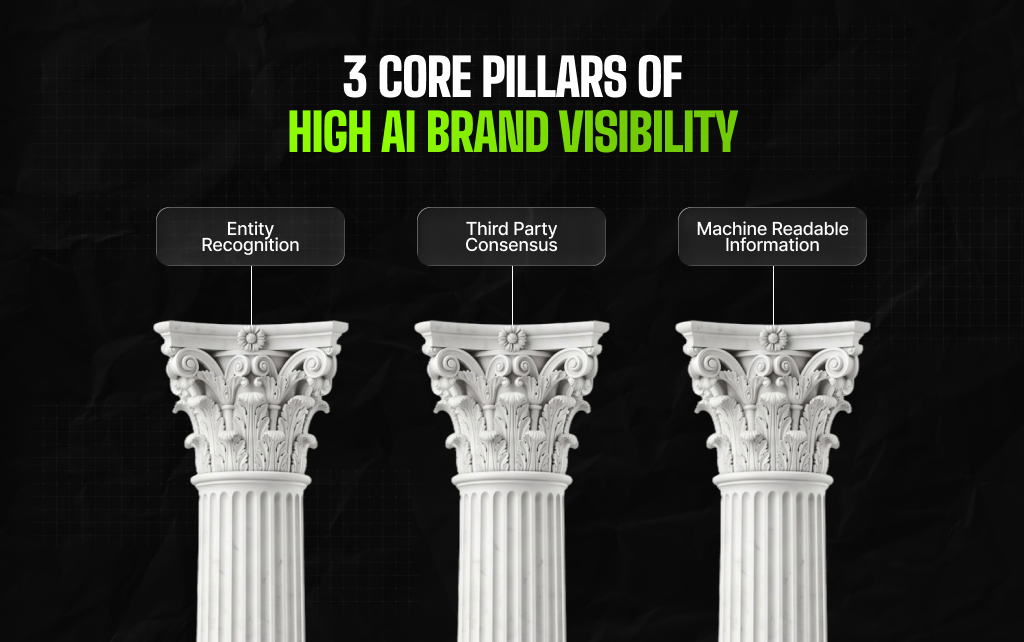
To be picked up by AI engines, ensure that you meet the following criteria:
AI engines can only recommend your company if they clearly understand who or what you are as an entity.
In AI terms, an entity is any distinct subject, such as a person, brand, product, or place. Additionally, it always carries verifiable information that AI models can easily identify.
Ensure your business name, founding date, location, and product descriptions are consistent across the web.
If not, AI models can get confused and overlook your business. As a result, present your brand consistently.
AI models have been designed to eliminate bias. As a result, if you were to write a statement such as “We are the best software in the world”, on your own website, AI models will ignore this.
However, if 10 different bloggers, 50 people on Reddit, and 300 verified reviewers on G2 all say your software is the best, AI models will treat it as a verifiable fact.
A common consensus between many independent sources is known as third-party consensus.
Even if your brand is very popular, if your website is hard to read, AI bots will not pick up your brand.
Vague marketing phrases, long paragraphs, and anything that prevents crawlers from reading your site can leave no accurate information about your pricing, features, and benefits.
As a result, make sure your website information is easy for an AI bot to read and is clear and factual.
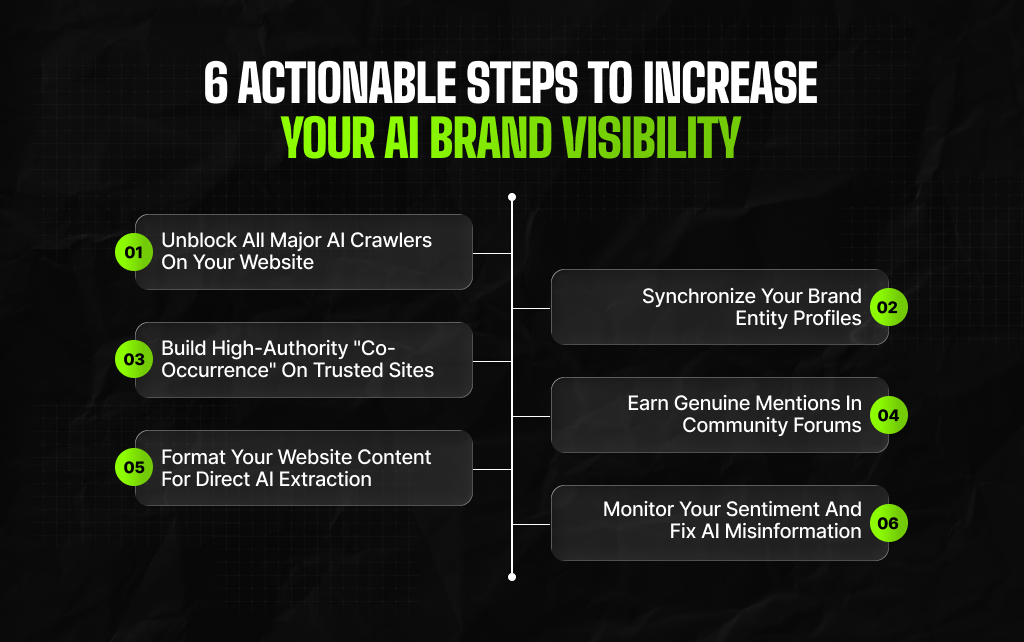
Now that you understand the three pillars, let us walk through the exact six-step playbook to boost your visibility across every major AI platform.
Many websites accidentally block AI bots using security plugins or default hosting rules. If an AI crawler cannot read your website, it cannot cite your pages or verify your current prices.
Open your website’s robots.txt file (://yourdomain.com) and ensure you explicitly allow the search crawlers for OpenAI, Google, Perplexity, and Anthropic:
Text
User-agent: OAI-SearchBot
Allow: /
User-agent: ChatGPT-User
Allow: /
User-agent: Google-Extended
Allow: /
User-agent: PerplexityBot
Allow: /
User-agent: ClaudeBot
Allow: /
(Note: Allowing OAI-SearchBot and PerplexityBot enables real-time search citations without forcing you to give away private content if you choose to restrict training bots separately.)
Ensure you have claimed and updated your profiles in key knowledge bases, so AI models can correctly validate information about your business.
Moreover, you must ensure consistent information is provided across each platform, including:
Wikidata & Wikipedia: If your brand qualifies for a Wikipedia page (based on notability) then this is extremely valuable.
Moreover, if your brand does not qualify, creating a structured profile in Wikidata is much easier. Information here will feed into knowledge graphs used by AI.
Crunchbase & LinkedIn: Keep company descriptions, team, and products fully up to date.
Google Business Profile & Apple Business Connect: If operating locally or regionally, verification on map services will enable local AI recommendations.
Industry-specific directories: G2, Capterra, Trustpilot, Yelp, or Product Hunt, depending on your industry.
Unlike traditional SEO, we need to consider semantic relevance. AI search engines will notice frequent mentions of your brand combined with a key keyword/phrase in your niche.
Even without a direct link, frequent mentions of the phrase “BrightPath is an affordable SAT prep platform for high school students” carry weight.
When this appears across niche blogs, news sites, and podcasts, AI models take notice.
As a result, AI will create a strong association between BrightPath and affordable SAT prep services.
How to create strong semantic relevance
Search Google and Bing for “best [your category] tools” and “top [your category] companies.”
Then reach out to the authors of the top 15 articles and offer them a free trial, original data studies, or affiliate partnerships to be featured in their article.
Journalists and bloggers love including original data. If you create original data studies and other websites include them in their content, your brand will be mentioned in conjunction with your niche.
Because AI can read spoken and visual content, being interviewed on industry-specific podcasts creates a permanent verbal association between your brand and niche.
Discussion forums are a powerful visibility signal for AI brands. As AI brands want to recommend products people truly love, they will search discussion forums to understand the genuine feedback people are sharing.
Increase visibility in forums without being blocked:
If you want to be featured in Google AI Overviews and Perplexity answers, make sure to create content at a paragraph level.
AI models typically don’t read long content like 3000 words, but they extract individual paragraphs to answer specific questions.
Structure Content As Below On Key Pages:
If search results show incorrect information about your brand, it can harm your business.
For example, if people mentioned problems with a specific feature 2 years ago in forums, ChatGPT may still advise people to avoid this feature.
Reply to negative reviews. If there are negative reviews on sites like Trustpilot, G2, or Google, respond politely to them in public.
In your response, explain how you fixed the issue. AI crawlers will see these replies and adjust their knowledge of your customer support.
Create clear Vs. and pricing pages. If incorrect pricing/ features are being generated by AI, create a very clear dated page on your website, for example “[Brand Name] Pricing and Plans [Current Year]”.
This means live search bots will pick up the correct pricing.
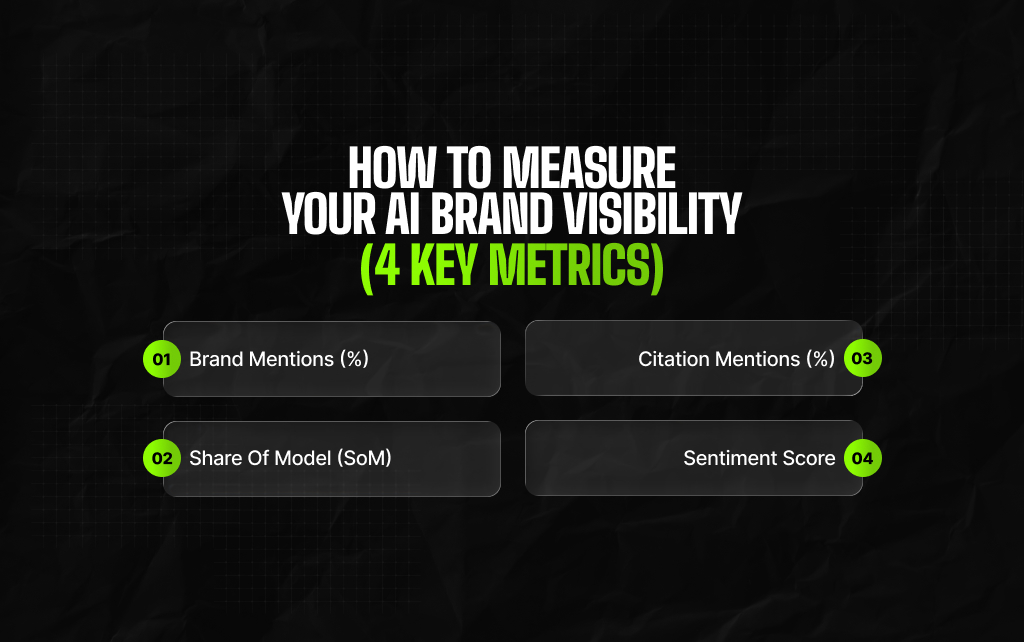
As private AI chat platforms aren’t visible to traditional SEO tools, we recommend tracking the following metrics monthly. Simply create a new sheet for these:
Using 20 common prompts searchers may use within your industry, search within ChatGPT, AI overviews on Google, Perplexity, and Claude. What % of results include mention of your brand?
How many times has your brand been mentioned compared to the top 3 competitors in the 20 prompts above? Total mentions = 40. Your brand has been mentioned 10 times = Share of Model = 25%.
How often is there a clickable link back to your site, rather than just a mention of the brand? A high citation rate will improve direct referral traffic.
Score each mention of your brand as: Positive (Suggested Best Choice), Neutral (Just Listed), or Negative (Priced poorly or lacks features).
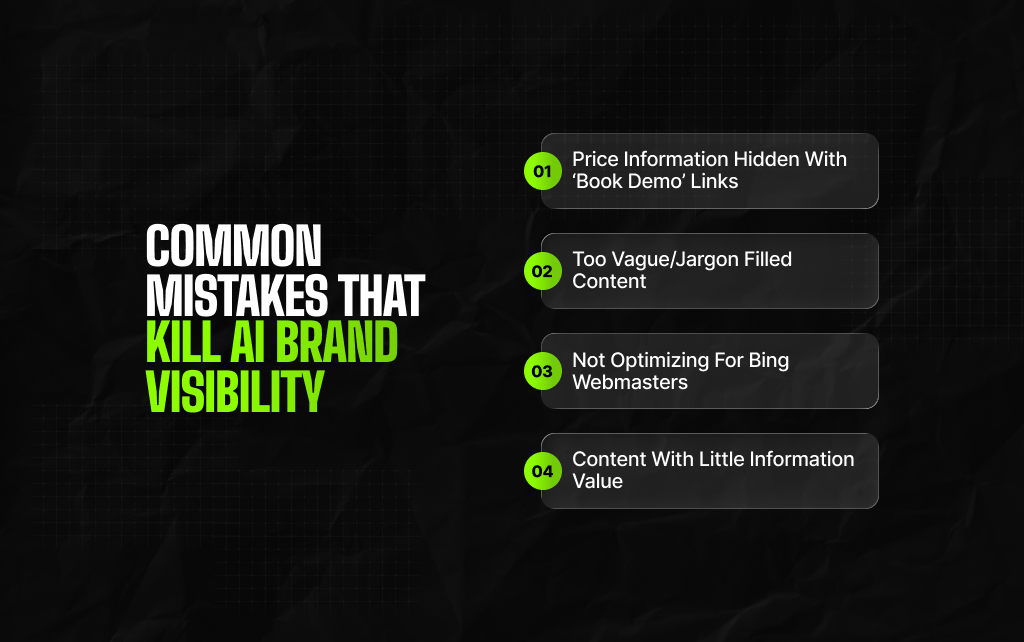
Common mistakes making AI visibility difficult:
If a brand hides its price information, AI models may not return it at all or may make inaccurate assumptions. AI tools prefer brands with clear pricing information.
Avoid phrases such as “next-generation synergy solutions”. Make sure you write clearly and concisely, and be specific about what your product does, who it helps, and the problem it solves.
Many people use only Google Search Console and neglect Microsoft Bing. Because ChatGPT relies heavily on Bing’s index, neglecting this platform will reduce ChatGPT visibility.
Many generic, AI-written blog posts provide little value. Search engines and AI tools will de-prioritize copied content.
To rank well, include useful, original data. Include real case studies and insightful analysis.
Piyasa is a search engine marketing strategist who has spent the last six years decoding Google's ever-changing mind. From corporate giants to neighborhood storefronts, she helps businesses cut through the digital noise and actually get noticed online. When she isn’t building SEO strategies or writing the latest search industry breakdowns for Search Engine Magazine, you can usually find her hanging out with friends - and gently reminding them that no, she cannot personally fix the latest algorithm update for them.
View all Posts

How To Get Your Website Named By ChatGPT And ...
Nov 20, 2026
How To Use Google Flights: Save Hundreds On A...
Nov 19, 2026
The Local Advantage: How Niche Service Busine...
Nov 14, 2026
Why PPC Audits Should Look Beyond The Last 90...
Nov 12, 2026
All-In-One Local SEO Software For Agencies Ma...
Nov 06, 2026