
The Ultimate Guide To Competitor Backlink Analysis: An Actionable SEO Blueprint To Steal Your Rivals’ Traffic
Oct 23, 2026


Link building is one of those things everyone knows they should be doing. But very few people actually enjoy doing.
Not because it’s complicated, but because it’s tedious.
You either spend hours sending cold emails or rely on random inbound requests that are usually low-quality.
So when I first tried Rankchase, a link building platform focused on helping you get backlinks through link exchanges, the question was simple:
Is this just another SEO tool… or does it actually solve the problem?
What is Rankchase?
Rankchase is a link-building platform that helps you find partners, automate outreach, and secure backlinks through link exchanges.
The onboarding is almost suspiciously simple. You land on the homepage, drop your domain, and wait a few seconds.
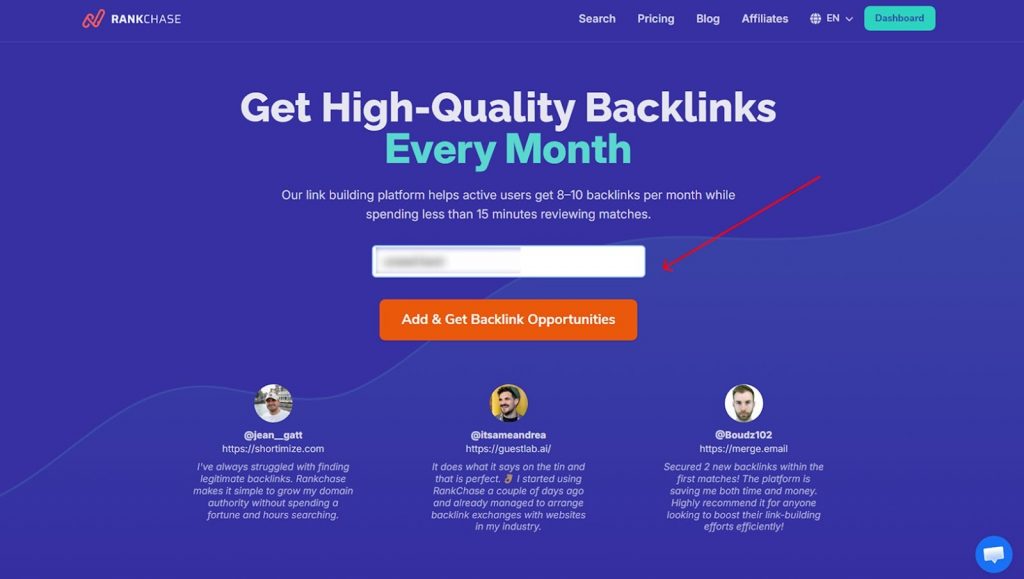
Then Rankchase immediately shows you real websites you can exchange links with and get backlinks from.
Not examples. Not placeholders. Actual opportunities.
That alone is already different from most tools in this space.
You don’t get the usual “empty dashboard” feeling. You instantly understand what the product does, and more importantly, that it has supply.
Once you add your site, it appears in your dashboard, and the platform continues to find new matches over time.
To view all link exchange opportunities, simply click the “Manage Backlink Matches” button for each domain in your dashboard.
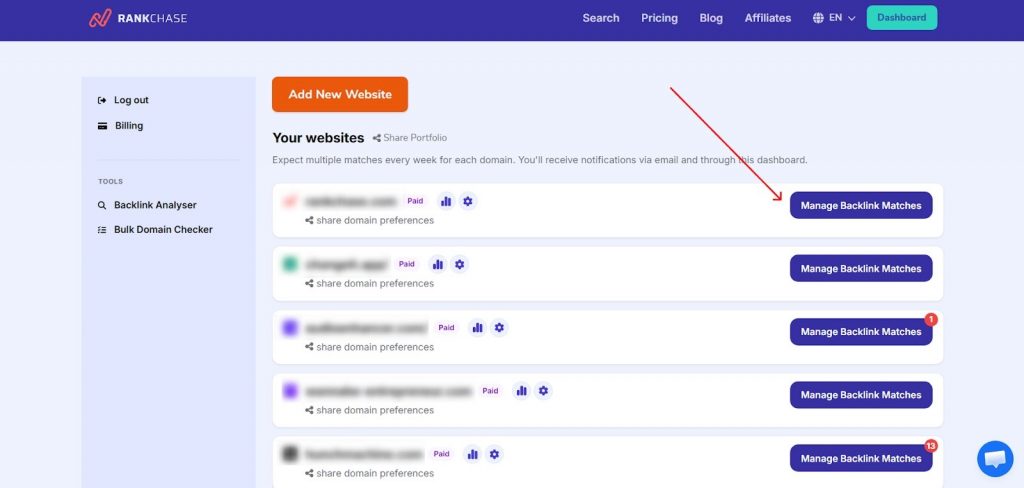
All new link-building opportunities will appear here.
This opens a table where you’ll find a list of potential partners with useful context:
From there, the workflow is basically:
“Does this look like a good partner?” → click “Request Exchange.”
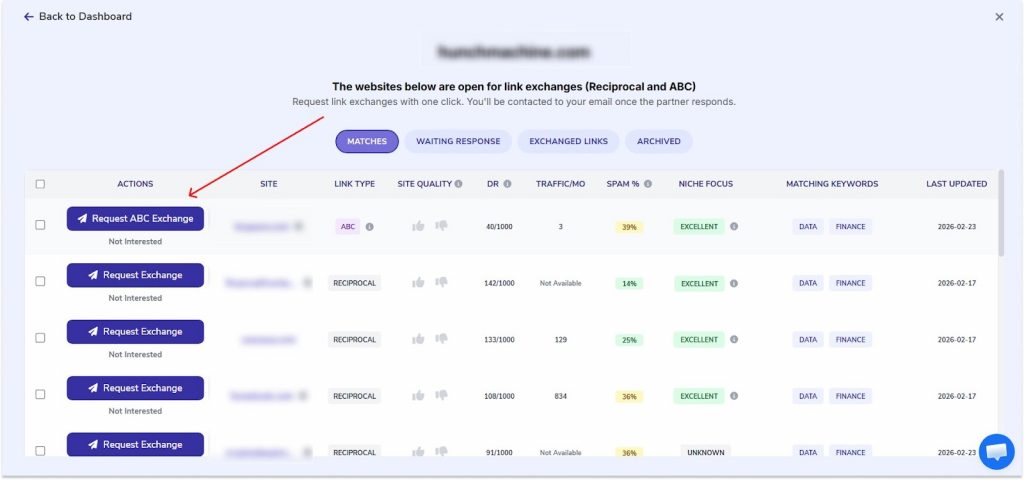
That’s it.
No complicated setup. or long forms. At the same time, there are no sequence builders. This is just a simple way to get backlinks.
When you send a request, Rankchase emails the partner and CCs you in.
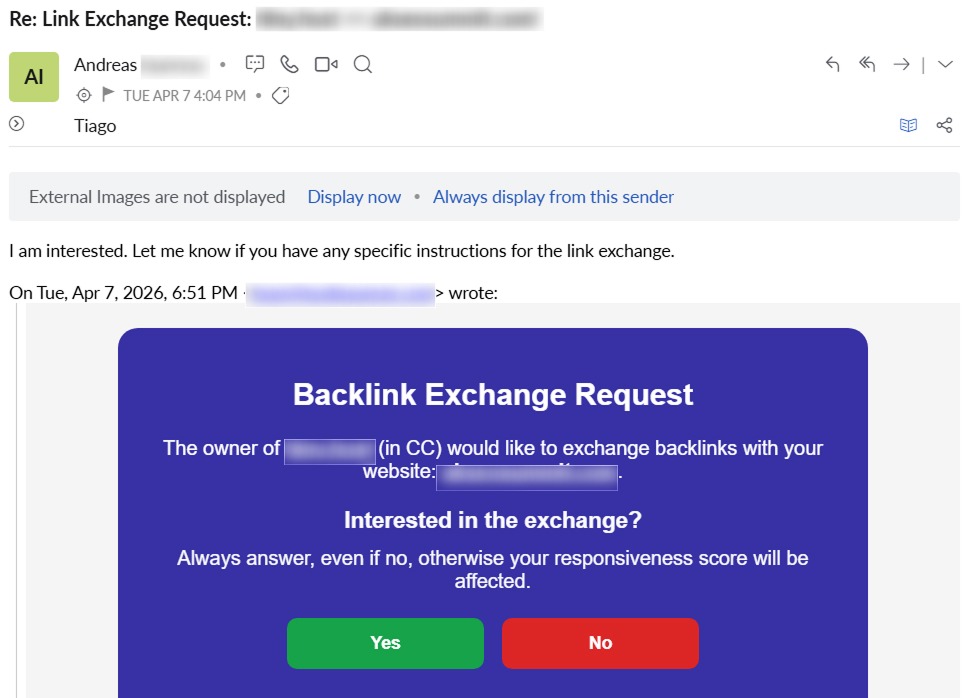
From that point on, the conversation happens over email.
This might sound basic, but it’s actually a smart choice.
Most tools try to build their own messaging systems, and they usually end up unused. Here, everything happens in a channel people already check daily.
There’s also automatic follow-up if the partner doesn’t reply, which quietly solves one of the biggest problems in link building: people just don’t respond.
Over time, the platform starts surfacing partners who actually reply, which makes the whole process feel faster.
One thing I didn’t expect to matter as much as it did is the responsiveness score.
At first, it just looks like another metric.
But in practice, it’s probably one of the most useful signals in the whole product.
Instead of chasing “perfect” sites that never reply, you can quickly identify:
“Who is actually active and closing exchanges right now?”
That alone saves a lot of wasted time.
There’s also support for ABC exchanges, where you don’t link directly back to the same site.
If you’re running multiple domains, this becomes interesting.
You can use stronger sites to push authority toward newer ones, without creating obvious reciprocal patterns.
This is especially useful if you’re using link building as part of a broader SEO strategy across multiple sites.
It’s not something you need to use on day one, but it’s there if you want to get more strategic.
Any discussion around link exchanges eventually leads to the same question: Is this safe?
Google’s guidelines don’t ban link exchanges outright. But they do discourage large-scale, manipulative patterns designed solely to pass PageRank.
That’s where execution matters. To clarify, Rankchase operates in a gray area most SEOs already work within. It is marked by editorial relevance, discretion, and moderation. Most importantly, remember that you’re not buying links, using blasting templates, or spinning content. Instead, you’re choosing partners manually, assessing niche alignment, and placing links contextually.
Features like ABC exchanges help reduce obvious reciprocal footprints. Meanwhile, metrics such as spam score and relevance enable smarter filtering. For experienced SEOs, this makes Rankchase less about shortcuts and more about controlled, intentional link acquisition.
When used responsibly, it aligns with how modern link building actually works.
Rankchase isn’t a replacement for tools like Ahrefs, Semrush, or Screaming Frog. In contrast, it actually complements them.
Think of it this way: Traditional SEO tools tell you what you need. Again, Rankchase helps you act on it faster.
Once you’ve identified pages that need authority, Rankchase becomes the execution layer for off‑page SEO. The best part is that it works for anything, whether they’re commercial landing pages, content hubs, or new blog posts. It shortens the gap between analysis and action.
For teams already tracking DR, traffic, and keyword movement, the platform plugs neatly into existing workflows. You still plan links strategically. Meanwhile, Rankchase simply removes the friction of prospecting and follow‑ups.
That makes it especially useful for teams scaling content who don’t want link building to become the bottleneck.
Rankchase doesn’t try to reinvent link building.
It just removes one of the most frustrating parts.
Instead of:
You get:
It’s one of those tools where the value isn’t in complexity, it’s in reducing friction.
If you’ve ever felt like link building is more about persistence than strategy, Rankchase is probably worth trying.
Not because it does something completely new, but because it makes something painful feel… surprisingly easy.
If you’re looking for a simple link building platform that removes the friction from getting backlinks check out Rankchase.
Here are some of the questions that people often ask when it comes to this topic. Take a look at them:
Primarily, yes. The platform focuses on reciprocal and ABC link exchanges, not guest post marketplaces or paid placements.
No. Single-site owners can still get value. But ABC exchanges become more powerful if you manage multiple domains.
That depends on the agreement between partners. Rankchase facilitates the connection. However, placement terms are still human-led.
You choose partners manually based on metrics such as DR, spam score, niche relevance, and responsiveness. To sum up, nothing is automatic.
Above all, people who benefit are the SEOs who already understand link-building fundamentals and want a faster, more predictable way to execute without relying on cold outreach or low-quality inbound offers.
Barsha is a seasoned digital marketing writer with a focus on SEO, content marketing, and conversion-driven copy. With 8+ years of experience in crafting high-performing content for startups, agencies, and established brands, Barsha brings strategic insight and storytelling together to drive online growth. When not writing, Barsha spends time obsessing over conspiracy theories, the latest Google algorithm changes, and content trends.
View all Posts

The Ultimate Guide To Competitor Backlink Ana...
Oct 23, 2026
How To Land High-Authority Editorial Backlink...
Oct 23, 2026
Why Your Website Traffic Dropped Suddenly And...
Oct 23, 2026
How Do The Physical Google Review Tools Redef...
Oct 23, 2026
How To Get Your Brand Cited In AI Search Resu...
Oct 22, 2026