
The Traffic-to-Revenue Gap: Why More Website Visitors Don’t Always Create More Customers
Sep 17, 2026
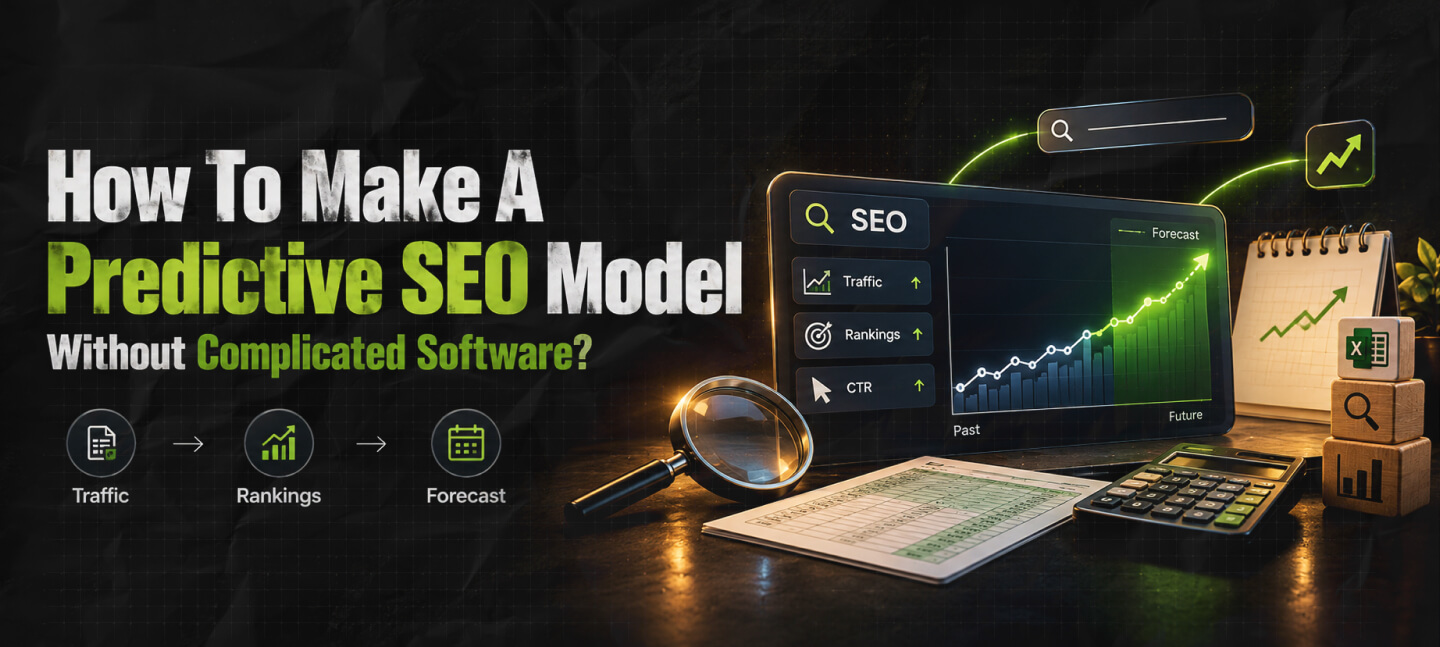

It’s easy to think that predictive SEO modeling requires the same level of sophistication as dashboards, automation platforms, and enterprise-level analytics tools.
And all of which are very popular in the industry.
A lot of marketers think they need expensive data platforms or advanced data science skills to make accurate predictions about performance.
In reality, though, you can actually make a surprisingly accurate predictive SEO model with just structured thinking, easy-to-find data sources, and a few simple spreadsheets.
Knowing how to predict future organic trends gives you strategic clarity, whether you’re working with a small business, a new brand, or a national organization.
It also gives you the confidence to push for SEO investment – even brands that hire outside help like Perth SEO services can get a lot out of having an internal forecasting system that helps them make decisions at the business level.
Let’s go over how to make a simple, no-software predictive SEO model that still gives you useful information.
You need to know where you’ve been before you can guess where your SEO performance is going.
Start by getting the most important numbers from the last 12 to 24 months, or as far back as your data will let you go:
Put these all in one spreadsheet. The goal here isn’t to make the process too complicated; it’s just to show how it has changed over time.
Identify patterns once your data is all in one place.
Have certain months in the past had higher demand? Are clicks going down, but impressions going up? Does conversion behavior change with the seasons?
These early signs help you understand what your baseline is like so that any future predictions are based on facts rather than guesses.
A good predictive SEO model needs to show how different types of keywords act over time.
Not all changes in rankings have the same effect on traffic, so sort your keywords into clear groups:
Then, use free tools to estimate the level of competition in each category, assess the complexity of the SERP layout, or manually check the strength of each page to gauge how hard each category is.
From here, guess which categories are most likely to change their rankings with some planning.
For instance, informational keywords usually move faster, while commercial terms with a high intent often take longer and need more work to build authority.
This categorization framework is the most important part of your forecasting model because it recognizes that not all SEO gains happen at the same rate.
Instead of trying to guess how well things will go each month, give different keyword groups conservative growth rates based on what you’ve seen in the past.
For instance:
These rates don’t have to be perfect – predictive modeling is more about being clear about the direction than being exact with maths.
What matters is that things are logical and consistent.
Begin by using baseline growth on impressions, and then use historical Search Console data to figure out an expected CTR.
You can figure out how many sessions you can expect without having to use special modeling tools with this method.
If you know where your keywords are ranked today, you can guess how they will change over time if you keep optimizing them.
Use a system with levels:
A) Positions 11-20: You could get to the first page in 3-6 months.
B) Positions 4-10: You could move up slowly but surely with high-quality content.
C) Positions 1-3: You could move up very little, but you should focus on keeping your position.
Based on your planned SEO work, give each tier a possible ranking shift, like +3 spots or +5 spots.
After that, use these predictions and CTR benchmarks for each ranking position to guess what the click-through rates will be in the future.
This easy method makes a strong directional prediction of how ranking improvements will affect organic traffic, and it doesn’t need any complicated modeling software.
Traffic is only part of the story; you need to figure out how the business will be affected by this model in order for it to be useful to stakeholders.
Find out what your current organic conversion rate (or micro-conversion rate) is, and use this rate to figure out how much traffic you expect to get in the future.
This shows:
With these numbers, you can easily tell a story that shows how SEO actions affect business results, which is something leaders really care about.
To ensure your model commands authority during budget or board meetings, use this unified formula to calculate the exact monetary value of your projected organic gains:
Monetary Value of Organic Gains = (Delta Organic Volume * Conversion Rate * LTV) – Organic CAC
Example: If your model projects 25,000 sessions for your Commercial segment in Month 6, your historical organic conversion rate (CR) is 2.5%, and your AOV is $120, your calculation is:
Projected Organic Revenue = 25,000 Sessions * 2.5% Conversion Rate * $120 AOV = $75,000
Presenting data this way transforms SEO from an ambiguous marketing expense into a predictable revenue driver that stakeholders can easily justify.
When you add scenario ranges to predictive models, they become more realistic. Instead of giving one clear prediction, make three:
This makes the forecast more believable and gives stakeholders a better idea of the risks, upsides, and performance variability.
If a predictive model doesn’t change, it loses value. Every month, compare the numbers you thought would happen with what actually happened:
Use what you’ve learned to change your assumptions about your growth rates, keyword categories, and rankings.
Your model gets better and more useful over time, not because of software, but because you keep making it better.
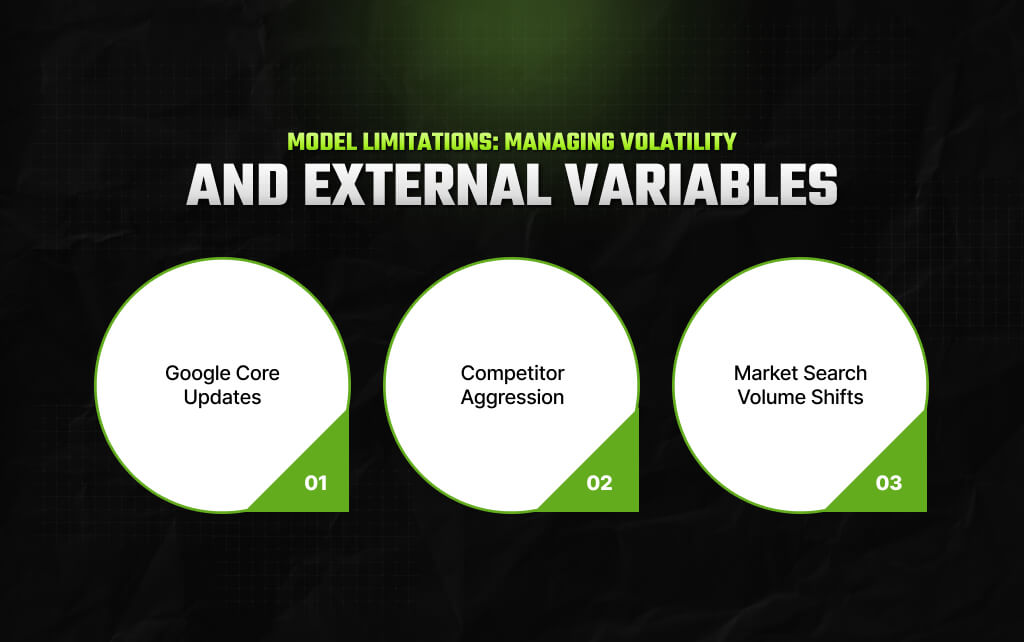
While a spreadsheet-based predictive SEO model provides an excellent strategic compass, it cannot account for sudden, chaotic shifts in the search ecosystem.
Keep these three external variables in mind to maintain realistic expectations with stakeholders:
Major algorithm updates can instantly shift search layout presentation or ranking weights, making historical patterns temporarily irrelevant.
A competitor suddenly launching a massive digital PR or backlink campaign can disrupt your projected ranking timelines.
Global macroeconomic factors or sudden industry trend changes can lower total search impressions, even if your rankings improve exactly as planned.
Treat your model as a fluid guide for direction and velocity, not an unchangeable financial guarantee.
A lot of marketers think that the more complicated a predictive model is, the better it is.
In reality, though, systems that use structured logic and consistent data inputs often work better than systems that are too complex.
Easy forecasting:
Most importantly, it helps you make smarter long-term decisions without getting bogged down in technical details.
As you can see, you don’t need machine learning, advanced analytics platforms, or high-end software to accurately predict how well SEO will work.
You simply need a clear structure and a way to do things over and over again.
Also, you can make a useful and accurate forecasting system that helps you make decisions with confidence by using historical data, logical ranking assumptions, and conservative growth rates as the basis for your model.
Barsha is a seasoned digital marketing writer with a focus on SEO, content marketing, and conversion-driven copy. With 8+ years of experience in crafting high-performing content for startups, agencies, and established brands, Barsha brings strategic insight and storytelling together to drive online growth. When not writing, Barsha spends time obsessing over conspiracy theories, the latest Google algorithm changes, and content trends.
View all Posts

The Traffic-to-Revenue Gap: Why More Website ...
Sep 17, 2026
The Volatility Trap: What Crypto Position Siz...
Sep 17, 2026
Schema Markup: How To Use It Without Turning ...
Sep 17, 2026
Turn A Search Question Into A Watchable Expla...
Sep 16, 2026
Agency Guide To YouTube Growth: Wholesale Pri...
Sep 15, 2026