Agency Guide To YouTube Growth: Wholesale Pricing For Multiple Clients
Sep 15, 2026
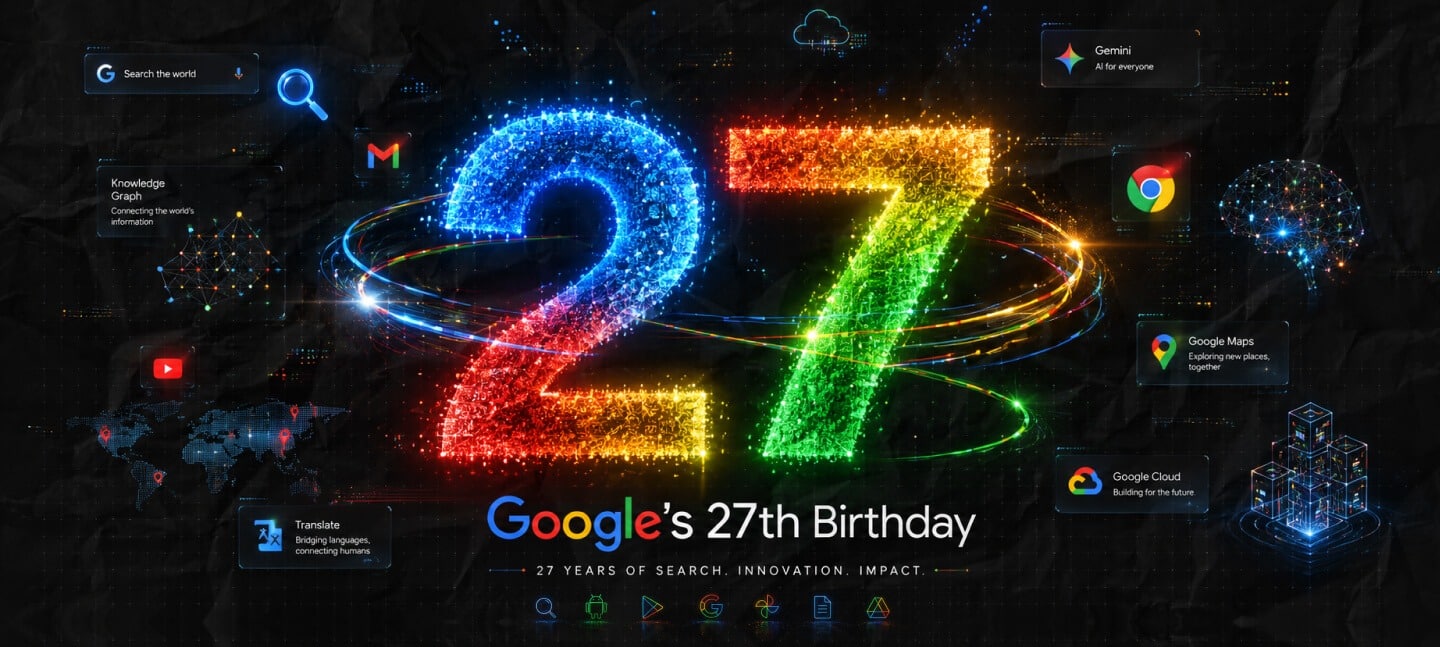

For a company whose whole mission is organizing the world’s information, Google has a surprisingly messy story when it comes to its own birthday.
Try searching for it sometime, and you’ll notice the dates don’t line up.
A few sources say September 4. Others go with September 7. And yet, for years now, Google itself has thrown its birthday party on September 27, including Google’s 27th birthday.
In that case, when is Google’s actual birthday?
The short answer is that it depends on how you trace Google’s beginnings, back when it was less a company and more a research project two students were tinkering with at Stanford.
I’m going to solve this problem once and for all – Google’s birthday, and more importantly, what does Google’s 27th birthday mean for the future of search?
Stay tuned.
Google didn’t come into existence all at once. It grew out of a handful of milestones spread across months, not a single day you can circle on a calendar.
It really started in 1996, when Larry Page and Sergey Brin, both PhD students at Stanford at the time, began building a search engine they called BackRub.
BackRub looked at the links connecting websites to figure out which ones mattered most, and that core idea later became Google’s PageRank system.
Also, a few dates tend to come up whenever people talk about Google’s origins:
| Date | Significance |
|---|---|
| 1996 | BackRub project launches |
| September 4, 1998 | Google Inc. is formally incorporated |
| September 7, 1998 | Often cited as an early public launch milestone |
| September 27 | Google’s long-standing official birthday celebration date |
The reason there’s no clean answer is that people simply can’t agree on what counts as the “birth.”
Was it the day the research project got going? The day the company was legally incorporated? The moment the search engine went public? Or just whenever Google decided to celebrate?
Pick a definition, and you’ll land on a different date.
To be fair, if you check Google’s birthday trajectory, you will be surprised. The search engine giant has a habit of moving around its birthday – and that’s really weird.
Early on, the company marked it on a few different September dates before things eventually settled. Over time, September 27 became the one everyone associates with Google’s birthday.
The explanation you’ll hear most often is that September 27 is tied back to a milestone in how many pages Google’s engine had indexed. Google has never spelled out the official reason, but the date stuck, and it’s stayed pretty consistent ever since.
For most people now, September 27 is simply Google’s birthday, earlier milestones notwithstanding.
So really, Google’s birthday has less to do with a legal incorporation date and more to do with the day the company picked to celebrate how far it had come.
When Google launched in 1998, the internet was a completely different space.
Of course, search engines existed in the late 90s. But honestly, the generation familiar with AI Overviews and ChatGPT would lose their shit trying to find valuable information on the internet.
Moreover, search results weren’t always accurate or even relevant.
At the time, we would frequently go through page after page, checking multiple links just to find one piece of information. Needless to say, it was super frustrating.
Google’s ranking system changed that.
Instead of simply counting keywords, it evaluated the authority and relevance of pages based on links from other websites.
The approach worked.
And as we all witnessed, Google’s significant growth and expansion in the past decade have made it completely synonymous with search itself.
Today, when we discuss SEO and the search engine landscape, there’s no way we can ignore Google’s overbearing presence.
10 years ago, digital marketing courses would focus on ranking on search engines.
But today, the same courses focus on ranking solely on Google – because it doesn’t matter where else you are ranking.
If your content doesn’t perform on Google’s search engine, then it’s a waste of your time and energy.
| Year | Milestone |
|---|---|
| 1998 | Google founded |
| 2000 | Launch of AdWords |
| 2004 | Gmail introduced |
| 2005 | Google Maps launched |
| 2006 | Acquisition of YouTube |
| 2008 | Google Chrome released |
| 2015 | Alphabet was created as the parent company |
| 2023–2026 | Rapid expansion into AI-powered search |
Looking back, Google’s growth mirrors the growth of the modern internet. As the web expanded, Google expanded with it.
Most company birthdays are little more than marketing moments.
But this one feels a little different, mostly because Google happens to be standing at another big turning point.
For decades, Google’s formula remained largely the same: A user entered a query. Google returned a list of links. The user clicked through to find answers.
Today, artificial intelligence is reshaping that experience. Users increasingly expect direct responses instead of lists of webpages.
As a result, search is becoming more conversational. People ask complete questions rather than typing a few keywords.
Also, AI-generated summaries, conversational search, the ability to mix text and images and voice in a single query, all of that is becoming normal.
It’s arguably the biggest shift in search since Google first showed up.
In a lot of ways, the 27th birthday lands right at a crossroads. Google isn’t just defending its spot as the world’s biggest search engine anymore. It’s trying to redefine what searching even means.
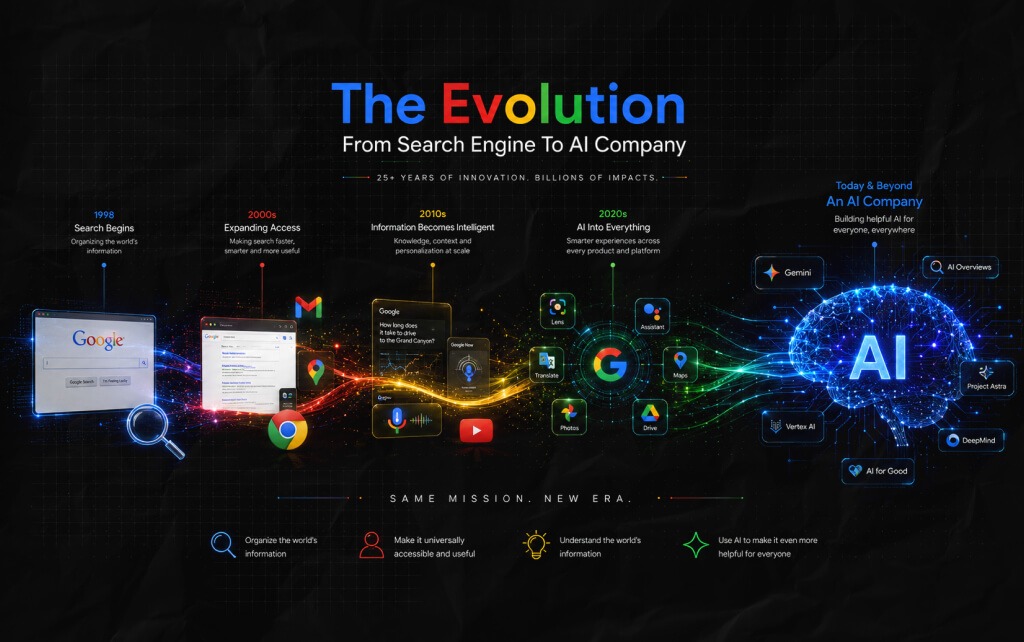
For a long stretch, Google called itself a search company. That label doesn’t really cover it anymore.
These days, Google has a hand in:
But AI is where the real fight is happening.
The arrival of generative AI has pushed every major tech company to reconsider where it’s headed, and Google is no exception.
Things like AI-powered search summaries point to a much bigger change in how information gets delivered.
Instead of pushing you out to a bunch of different websites, search engines are increasingly trying to just answer the question on the spot.
That opens up real opportunities and real problems at the same time.
Of course, making a random prediction about Google or the search landscape is perhaps the most unhinged thing that someone can possibly do.
However, considering I’ve spent nearly a decade in the search landscape, it is gradually becoming where Google is heading.
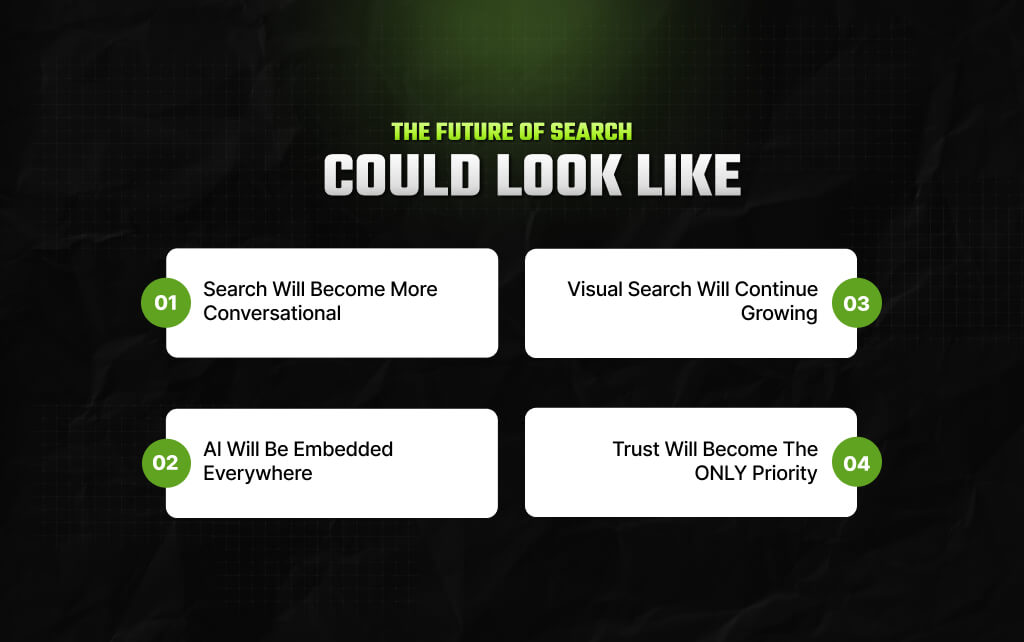
On that note, here are some of the most significant trends you need to check out:
People want answers, not just links. Search down the road may feel less like a query box and more like an actual conversation.
Expect AI to become a standard layer running underneath Google’s products rather than some separate, bolt-on feature.
Images, videos, voice queries, real-world objects—they’re all becoming part of how people search. The future of search will likely stretch well beyond typed-in keywords.
With AI-generated content becoming increasingly popular, people will be more careful about the source of their information. Can you trust the source? No? Then, Google will not prioritize that source, and vice versa.
To conclude, I can tell you that Google’s birthday isn’t just a date on a calendar – it’s more than that.
For me, it acts like a reminder of how much the internet has evolved over the years.
It changed how we find information, how businesses reach their customers, and how all of us move around the digital world.
And now, heading into its 27th year, Google’s facing a challenge that rhymes with the one it faced back in the late 1990s.
The internet is changing all over again, only this time it’s artificial intelligence driving the shift. Whether Google’s next act turns out as well as its first is anyone’s guess.
But this much is clear: the 27th birthday isn’t only a look back at what’s been built. It’s a peek at where search itself might be going.
Read Also:
Barsha is a seasoned digital marketing writer with a focus on SEO, content marketing, and conversion-driven copy. With 8+ years of experience in crafting high-performing content for startups, agencies, and established brands, Barsha brings strategic insight and storytelling together to drive online growth. When not writing, Barsha spends time obsessing over conspiracy theories, the latest Google algorithm changes, and content trends.
View all Posts

Agency Guide To YouTube Growth: Wholesale Pri...
Sep 15, 2026
Top 5 Reputed SMM Panels To Buy Social Media ...
Sep 15, 2026
How Is Social Media Marketing Changing The Wa...
Sep 15, 2026
Structured Data SEO: How Schema Markup Helps ...
Sep 12, 2026
TikTok Downloader For Content Marketing Resea...
Sep 12, 2026