The Ultimate Guide To Competitor Backlink Analysis: An Actionable SEO Blueprint To Steal Your Rivals’ Traffic
Oct 23, 2026


Is Ahrefs more accurate than Moz? Ask 10 SEO professionals whether Ahrefs is more accurate than Moz, and you’ll get eleven opinions.
Everyone has a favorite, everyone has a horror story about a metric that turned out to be wildly off.
Also, almost nobody has actually put the two tools side by side on the same websites and checked the numbers against reality.
That’s a problem, because ‘accuracy’ is the entire value proposition of an SEO platform.
You are not paying $50 to $450 a month for a pretty dashboard. Rather, you are paying for data you can bet a content budget on.
If the search volumes are inflated, you write articles nobody’s looking for. Similarly, if the backlink index misses half your competitor’s links, your outreach strategy is built on sand.
So here’s the honest answer up front, and then we’ll earn it: for most serious SEO work in 2026, Ahrefs is the more accurate tool. But Moz remains more accurate on the specific things it invented, and for beginner or budget-constrained workflows it’s still perfectly viable.
The gap isn’t uniform – it’s wide in some places, narrow in others, and in a couple of areas it actually reverses.
Today, let’s go category by category and do a real-world comparison of both tools in the context of the evolving search landscape of 2026.
Stay tuned.
This matters more than people realize.
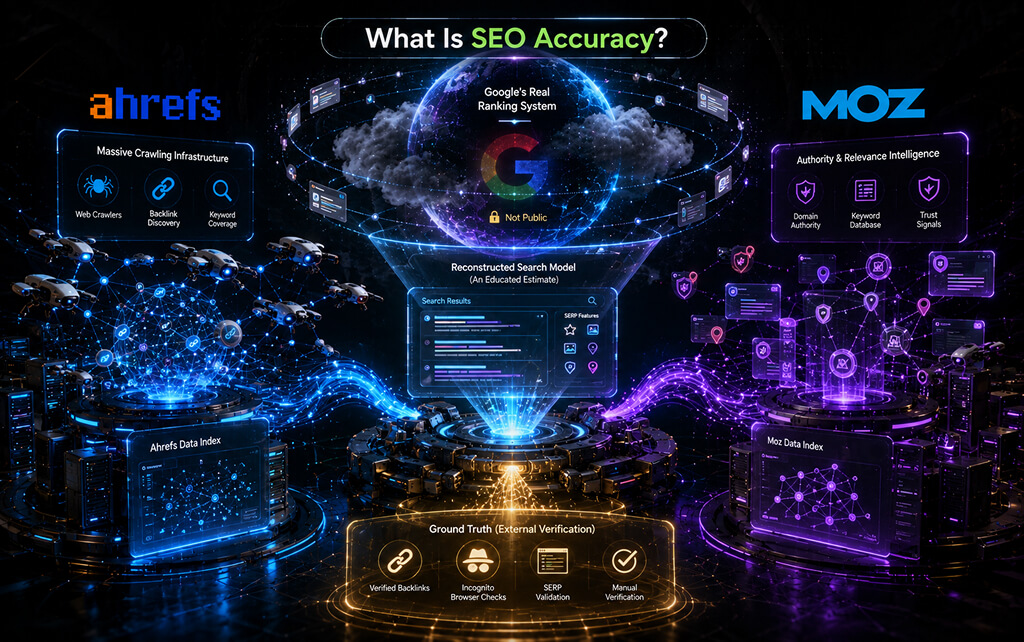
Third-party SEO platforms don’t have access to Google’s internal algorithms or complete databases. They estimate everything by deploying massive web crawlers, aggregating clickstream data, and continuously sampling SERPs. AnyViewer
So neither Ahrefs nor Moz is ‘accurate’ in an absolute sense. Both are educated guesses built on different infrastructure.
Each maintains independent link indexes, authority scoring systems, and keyword databases built on distinct crawling setups. Neither is universally more accurate. Instead, they are differently calibrated.
The only fair way to judge them is against external ground truth: known backlinks you can verify manually, search volumes from Google’s own Keyword Planner, and rankings checked by hand in an incognito browser.
That’s exactly what the independent tests published this year did, and it’s the data this comparison leans on.
If the entire decision came down to backlinks, this article would be three paragraphs long.
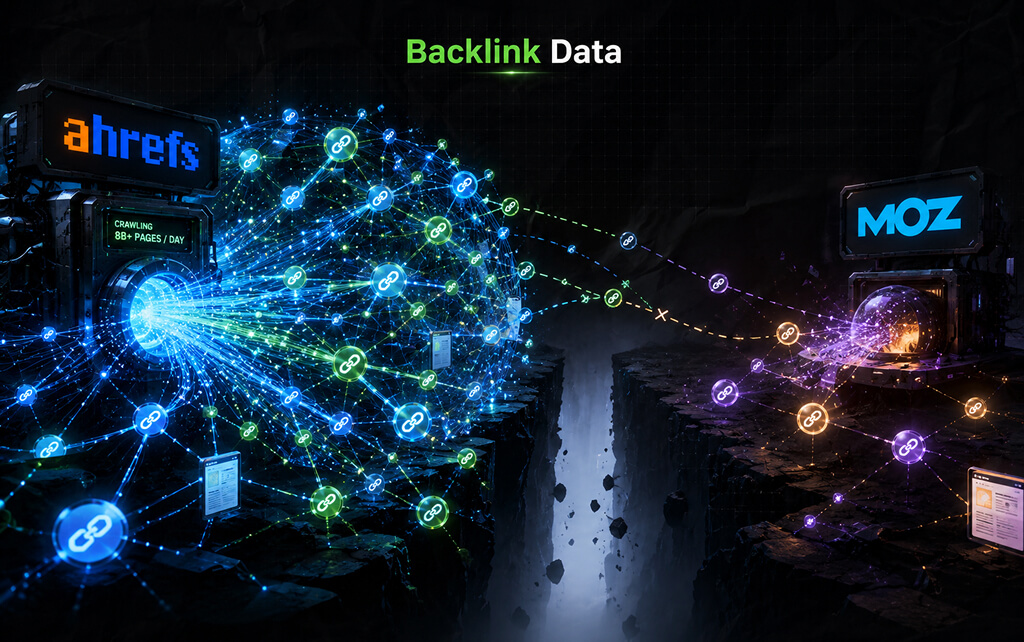
Ahrefs was built as a backlink tool first, and it shows. Its crawler processes roughly 8 billion pages a day, and its index holds around 35 trillion known backlinks, refreshing every 15 to 30 minutes.
Moz’s crawl is smaller and updates on a weekly-to-biweekly cycle.
That difference in freshness alone changes what you can do: spotting a competitor’s new link the same week it goes live versus finding out a month later are two different sports.
Moreover, the coverage gap shows up starkly in head-to-head testing. In a structured 2026 test across twelve live websites – verified against manual outreach records and client link-building reports – Ahrefs found 33% more known backlinks than Moz.
Practitioners running both tools on client work report even larger differences: on identical domains, Ahrefs routinely surfaces 40 to 60% more links than Moz.
One tester running both tools simultaneously on the same niche site found Ahrefs reporting more than three times as many referring domains as Moz in the same window – a gap so large he rechecked the numbers twice.
To be fair to Moz: missing links isn’t the same as reporting false links.
Moz’s index tends to be strong on relevancy, and some tests find the two tools surprisingly close on link quality even when Ahrefs wins clearly on raw coverage and freshness.
So, if you only need a directional read on a link profile, Moz gets you there.
But if you are doing competitive link analysis, digital PR, or disavow work – where a missed link is a missed opportunity – the verdict is hard to argue with.
Also, for professionals who need an exhaustive, rapidly updated link database, Ahrefs is the more reliable choice.
Winner: Ahrefs, decisively.

Here’s where a lot of ‘accuracy’ arguments quietly fall apart. People compare Moz’s Domain Authority against Ahrefs’ Domain Rating as if they measure the same thing – they don’t.
Moz’s DA is a predictive quality score – it estimates how likely a domain is to rank. But Ahrefs’ DR is a descriptive link equity score – it describes the strength of a link profile.
The two are not interchangeable, and understanding that difference is critical for link prospecting.
So asking ‘is DR more accurate than DA?’ is a category error. What you can say is that DA remains the number the industry speaks.
When a client asks about domain authority, they mean Moz’s metric. But when a guest-post marketplace lists site quality, it’s usually DA.
Moz invented the scoring convention, and on Domain Authority itself, Moz is the more accurate tool. TBH, it’s their metric.
Also, in this case, the caveat worth knowing is that a growing number of SEO professionals view Domain Authority as increasingly disconnected from actual Google rankings.
It’s a useful shorthand for humans. However, it is not a ranking factor, and neither is DR. So, treat both as conversation tools, not gospel.
Winner: Moz for DA benchmarking, Ahrefs for link-equity analysis. Know which one you actually need.
Keyword research is where inaccuracy gets expensive fastest.
Remember, overstated volumes send you chasing phantom traffic, while understated ones make you skip terms that would have converted.
Moreover, on raw database size, it’s not close.
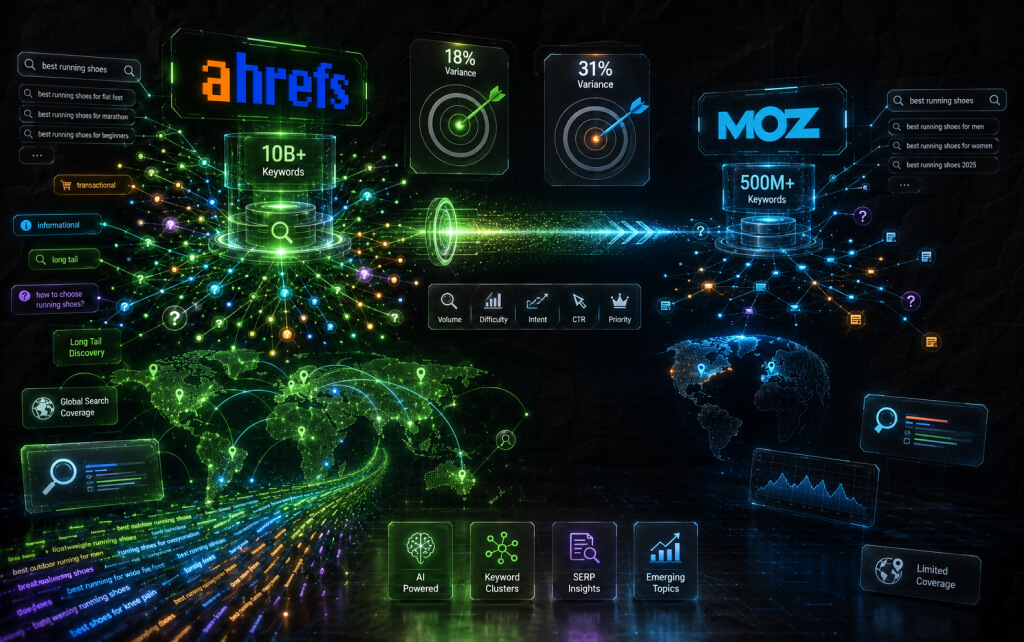
Ahrefs runs a keyword database in the billions (around 10 billion terms), while Moz’s sits at roughly 500 million or more, which means Moz simply doesn’t see large stretches of the long tail.
For head terms in US English, both tools have you covered. Moreover, for obscure question keywords, niche B2B phrases, or emerging topics, Ahrefs finds things Moz never indexed.
Also, on volume accuracy, the twelve-site test again gives us hard numbers.
Measured against Google Keyword Planner data, Ahrefs showed 18% variance from actual volumes while Moz showed 31% – Both are estimates. But one estimate is meaningfully tighter.
Two honest caveats cut against Ahrefs here:
1. Its long-tail volumes can lean overly conservative. It often reports ‘0’ or ‘10’ searches for zero-volume keywords that actually get real traffic below the clickstream sampling threshold. So, if you build topical authority on zero-volume terms, don’t let an Ahrefs ‘0’ talk you out of a keyword your audience genuinely uses.
2. On keyword difficulty, the picture is murkier: Moz is arguably more accurate on US English keyword difficulty scores, and Moz’s Priority score, which folds volume, difficulty, and organic CTR into a single number.
Internationally, there’s no contest.
Ahrefs covers 243 countries with usable data, while Moz focuses on the US, UK, Canada, Australia, and major EU markets. Also, for SEO work in India, Brazil, or Southeast Asia, Moz’s data is often too thin to be useful. nenawow
Winner: Ahrefs for volume accuracy, database depth, and anything outside major English-speaking markets. However, Moz holds its own on difficulty scoring for US keywords.
This is the category where the ‘Ahrefs destroys Moz’ narrative gets overstated.
In tracking 600 keywords against manual incognito checks, Ahrefs’ exact positions matched 78% of the time versus Moz’s 71%.
But within three positions, both tools matched 96 to 97 percent of the time. Read that second number again.
For strategic decisions, both tools are accurate enough that the difference won’t change your conclusions. nenawow
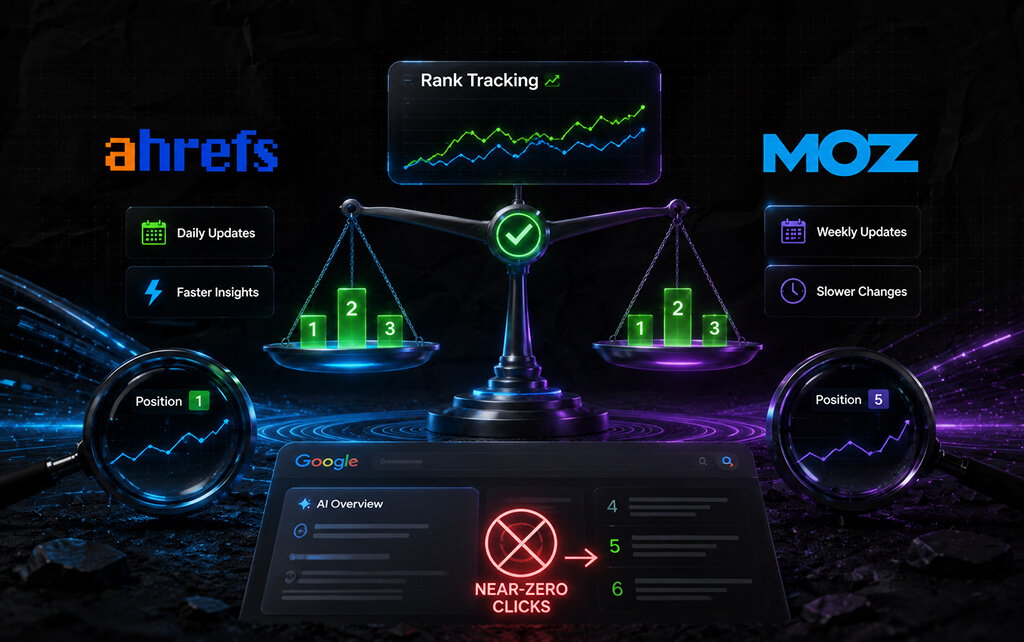
Where the gap becomes practical is update frequency and SERP context. Moz’s rank tracking has historically run on a weekly cycle at standard tiers, while Ahrefs offers a daily upgrade path.
And if you’re managing volatile SERPs or reporting to anxious clients, that cadence matters. More interesting is what tracking a position even means in 2026.
One head-to-head tester found several keywords ranking positions 4 to 6 that generated near-zero clicks because AI Overviews occupied the entire visible page.
And Ahrefs surfaced that immediately, while the rankings looked perfectly healthy on paper.
Winner: Ahrefs, but narrowly on positions — the real edge is SERP-feature context.

If you are choosing a tool partly for the AI-search era, temper your expectations for both.
Both platforms detect whether an AI Overview appears on a SERP, but neither accurately reports whether your page is cited inside it.
That’s a growing gap in 2026 that neither has fully addressed. Ahrefs annotates SERP features including AI Overviews but doesn’t analyze the citation sources within them.
Interestingly, this is one frontier where Moz has moved first in a specific direction: Moz offers ChatGPT brand mention tracking.
And that’s a different signal entirely from Google AI Overviews, more about brand awareness inside AI chat than click-through via an AI Visibility feature currently in beta.
It’s early and covers fewer platforms than Ahrefs’ equivalent efforts, but it exists, and for some brands that visibility signal matters more right now than another rank tracker.
Neither tool is where the market needs them to be here. Factor that into how much weight you put on this comparison at all.

Accuracy costs money, and the pricing gap is real.
Moz Pro starts at $39 per month on annual billing. And that’s the lowest entry price among the three major platforms.
While Ahrefs Lite starts at $99 per month with no free trial (Ahrefs sells a limited $29/month trial plan instead of a free one), Moz offers a genuine 7-day full-access trial, which Ahrefs killed off years ago.
Also, at the top end, the gap widens in Moz’s favor again: at the enterprise level, Moz runs 40 to 60 percent cheaper than Ahrefs. And that too for large agencies tracking 5,000+ keywords across multiple clients.
When you think about it, that’s a saving of $500 to $2,000 a month, paid for with smaller data depth and slower rank tracking.
That framing is exactly right: you are not choosing between accurate and inaccurate. Instead, you are choosing how much accuracy margin you’re willing to pay for.

On the evidence available in 2026: yes, on most of the metrics that decide campaigns.
Ahrefs:
But ‘more accurate overall’ is not ‘more accurate at everything,’ and it’s definitely not ‘the right choice for everyone.’
Moz is more accurate on Domain Authority because it’s:
Choose Ahrefs if link building or competitive link analysis is central to your strategy.
Also, if you work in international or long-tail-heavy niches, or you are an agency/in-house team where a missed data point costs real money. Then, the accuracy margin justifies the price.
However, you must choose Moz if you are newer to SEO, budget matters more than the last 20% of data depth, your clients and reports live in the DA ecosystem, or local SEO is a big slice of your work.
And you can also consider running both if you have the budget. Because there are top agencies who use both – Ahrefs for the analysis and Moz for client-facing DA reporting. The point? To play each tool to its verified strength.
The one mistake to avoid is treating either dashboard as ground truth: Both tools estimate.
Google Search Console is the only free look at what Google actually sees, and the sharpest teams triangulate: tool data for discovery and competitive intelligence, GSC for reality checks, and manual verification for anything a real budget rides on.
Whether Ahrefs is more accurate than Moz matters less, in the end, than whether you’re accurate about what each number can and can’t tell you.
Barsha is a seasoned digital marketing writer with a focus on SEO, content marketing, and conversion-driven copy. With 8+ years of experience in crafting high-performing content for startups, agencies, and established brands, Barsha brings strategic insight and storytelling together to drive online growth. When not writing, Barsha spends time obsessing over conspiracy theories, the latest Google algorithm changes, and content trends.
View all Posts

The Ultimate Guide To Competitor Backlink Ana...
Oct 23, 2026
How To Land High-Authority Editorial Backlink...
Oct 23, 2026
Why Your Website Traffic Dropped Suddenly And...
Oct 23, 2026
How Do The Physical Google Review Tools Redef...
Oct 23, 2026
How To Get Your Brand Cited In AI Search Resu...
Oct 22, 2026