Master The Rich Result Test: Fix Your Broken Schema Markup
Oct 08, 2026

Any AI-backed system usually generates compact answers. And then there are times when the answers are even impressive – so much so that you don’t even need to proofread or do any fixing.
But at the same time, an AI system can also generate answers that are inaccurate, incomplete, or just outdated.
One of the biggest reasons behind this is that language models don’t know everything about a topic automatically – for instance, ChatGPT has no idea about your company’s latest information or even private documents.
This is where retrieval-augmented generation, better known as RAG, comes in.
RAG gives an AI system access to relevant external information before it generates an answer.
Instead of asking a model to answer entirely from what it learned during training, a RAG system can first retrieve useful information and then use that information to construct its response.
That sounds technical.
Frankly, the basic purpose behind RAG is simple: First, find the relevant information and then generate a response.
And to be honest, this distinction matters – especially for businesses, SEO professionals, publishers, and even developers.
RAG is changing how companies build AI assistants, search experiences, knowledge bases, and internal tools.
Also, it does raise a super important question for anyone creating content: If AI-backed systems retrieve information before generating any response, what makes your content valuable enough for retrieval?
And that is precisely why I’m here – to help you understand how retrieval-augmented generation works and why it matters for search in 2026.
Stay tuned.

Retrieval-augmented generation is an AI architecture that combines two processes:
A traditional language model receives a prompt and generates a response based primarily on its learned parameters.
A RAG system adds another step.
The system searches a connected knowledge source first. And it might retrieve information from:
The retrieved information is then supplied to the language model as context. The model uses that context to generate its response.
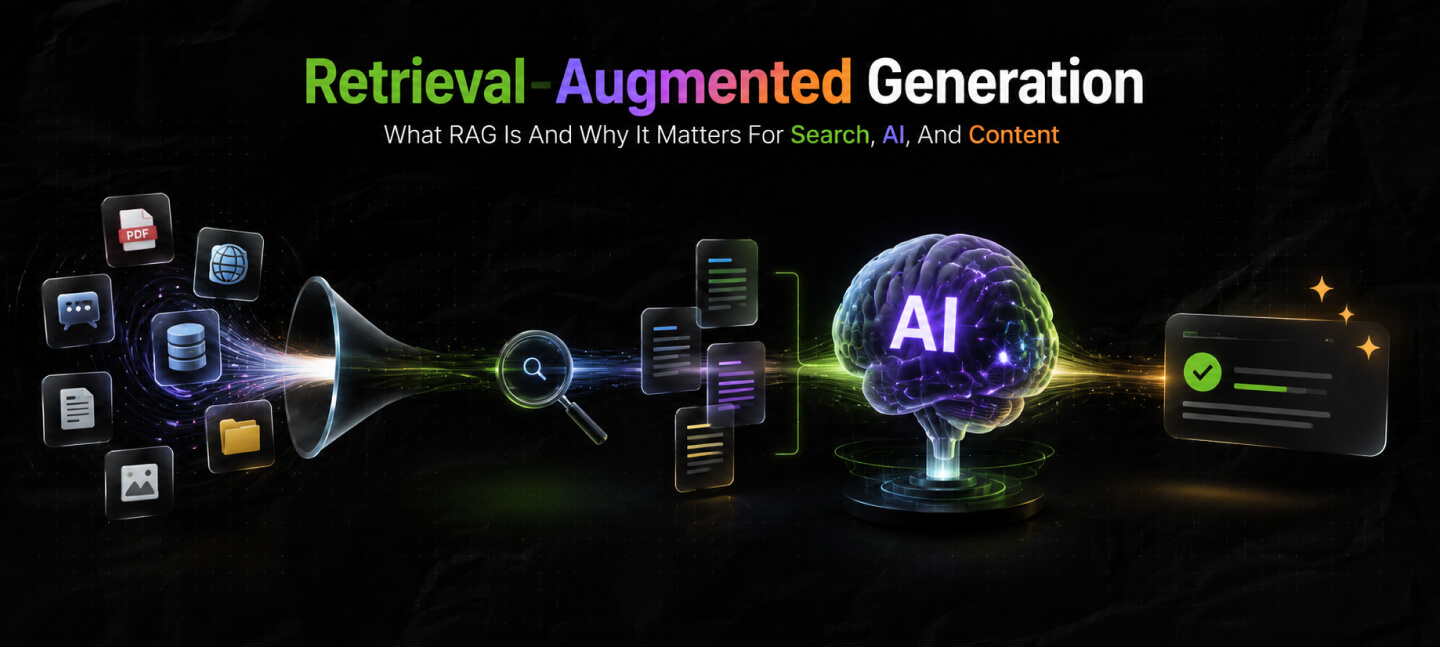
So the simplified process looks like this: Question → Retrieve relevant information → Add context → Generate answer
That extra retrieval step is what gives RAG its name.
Large language models are powerful, but they have limitations.
A model’s training data has a cutoff.
Even when a model can access newer information through other mechanisms, it does not automatically have access to every private or constantly changing information source.
So, imagine a company has a customer-support chatbot. The chatbot needs to answer questions about:
That information may change regularly.
Also, retraining a large model every time a policy changes would be impractical. RAG offers another option – the company can update its knowledge base.
The AI system retrieves the relevant information when someone asks a question. Then, the model uses the retrieved material to formulate the answer.
The model does not need to memorize every update. It can retrieve the latest available information when needed.

A basic RAG system usually has two major stages:
But several steps happen inside those stages.
Let’s walk through a simplified example. So, imagine you ask a company’s AI assistant: Can I return a laptop after 45 days?
The system needs to find the company’s current return policy.
The system receives: “Can I return a laptop after 45 days?” The question becomes the input for the retrieval process.
The system looks for information related to the question. It may search documents containing concepts such as:
Also, modern RAG systems can use semantic retrieval, keyword retrieval, or a combination of approaches.
The system identifies the most useful sections of its knowledge base.
For example: Laptops can be returned within 30 days of delivery if they meet the conditions listed below.
The relevant passage becomes context.
The model receives the original question along with the retrieved information. It can now answer using the company’s policy.
The AI might respond: “No. The standard return period for laptops is 30 days from delivery, so a return after 45 days would normally fall outside the policy.”
The answer is generated by the language model. But the information comes from the retrieved source. And that is the central idea behind RAG.

A traditional language model relies heavily on information encoded during training. A RAG system adds an external information layer.
So, think of it this way.
The second approach gives the model access to information that may not exist in its original training data.
That can be particularly useful for private, specialized, or frequently changing information.
This is a common misunderstanding.
Adding a document to a RAG knowledge base does not necessarily mean you are retraining the underlying language model.
The document is typically stored separately.
As a result, when a user asks a question, the system retrieves relevant information and provides it to the model as context.
That makes RAG much easier to update than retraining the model every time the knowledge base changes.
For example, a company can update, “Our refund period is now 60 days.” The retrieval system can start returning the updated policy.
The underlying model does not necessarily need to be retrained.

A RAG knowledge base is the collection of information the retrieval system can search. It could contain thousands or millions of pieces of information.
For a software company, it might include:
Similarly, for a law firm, it could contain:
Also, for an ecommerce business, it might include:
The quality of this knowledge base directly affects the quality of retrieval.

This is one of the most important parts of understanding RAG. So, imagine a customer asks, “Can I cancel my subscription after renewal?”
The system retrieves an old cancellation policy.
The language model generates a perfectly written answer based on that outdated document. The response may sound convincing.
It can still be wrong.
This is why RAG quality depends heavily on:
Good generation cannot compensate for bad retrieval.
Not every search should rely entirely on semantic similarity. Metadata can provide additional signals.
Imagine a company’s knowledge base contains:
A user asks, “What is the current return policy for Product X?” Metadata could help restrict the retrieval process to:
This can reduce irrelevant results. Also, it demonstrates an important principle: Good RAG systems are not simply giant piles of embeddings.
The retrieval layer needs structure.

This is where the topic gets particularly interesting. RAG systems need information to retrieve. And that means the web still matters.
AI systems do not create useful answers from nothing.
So, when they rely on external sources, those sources need to contain relevant, understandable information.
For publishers, the question becomes: Is your content easy for retrieval systems to identify and use?
That does not mean writing for AI instead of humans. Instead, it means creating content with clear information, logical structure, and useful context.
It changes some of the questions marketers should ask.
Traditional SEO often focuses on: Can this page rank for the query? With AI-powered retrieval, another question becomes relevant:
Could this information be retrieved and used when an AI system answers a related question?
Those are not identical goals.
Also, a page can rank for a keyword while still providing little useful context. Or, a strong resource may cover a broader concept and become relevant to multiple related questions.
That makes comprehensive, well-structured content increasingly valuable.

There is no guaranteed formula. You cannot write an article and force an AI system to retrieve it. But you can make your content more useful for retrieval.
Don’t bury the answer under 500 words of introduction. So, if the question is, “What is a canonical URL?” then define it clearly near the beginning.
And then explain it. This helps both readers and machines identify the core information.
Instead of ‘A Few Things to Keep in Mind,’ write, ‘How Canonical URLs Affect Duplicate Content?’
The second heading tells readers and retrieval systems what follows.
Each section should have a clear purpose. One section can explain the definition. Another can explain how it works. And then another can cover examples.
This creates clearer information units.
Don’t simply list related terms. Rather, explain how they connect. For example: Canonical tags → duplicate URLs → indexing signals → preferred page selection
Moreover, a reader can understand the relationship. A retrieval system has more contextual information too.

RAG is powerful. But that does not mean it is perfect. On that note, here are some of the biggest limitations of retrieval-augmented generation.
1. Retrieval can fail: The system may not find the right information.
2. Sources can be outdated: Retrieved content is only as current as the knowledge base.
3. Poor documents create poor answers: Messy or contradictory information makes generation harder.
4. Access control can become complicated: Private information needs careful permission handling.
5. The model can still hallucinate: Retrieved context reduces some risks but does not guarantee accuracy.
6. Retrieval adds complexity: A RAG system requires additional infrastructure, monitoring, testing, and maintenance.
So RAG should not be treated as a simple plug-in that automatically makes every AI application reliable.

These two approaches are often confused.
RAG gives a model access to external information. However, fine-tuning changes the model’s behavior by training it further on specific examples.
So, now imagine a customer-support AI.
If you want the system to know the company’s latest return policy, RAG may be appropriate.
But if you want the model to consistently follow a particular response style or perform a specialized task, fine-tuning may be more relevant.
Also, they can be used together – the right choice depends on the problem.
RAG is particularly useful when your AI system needs access to information that is:
Also, in this context, the most common examples include:
Not every AI application needs it.
So, if the task is simple and does not require external information, adding a retrieval layer may introduce unnecessary complexity.
For example, you probably don’t need RAG to ask an AI system, “Write me a three-line birthday message for my friend.”
There is no specialized knowledge that needs to be retrieved. To be honest, the best architecture depends on the task.

A system should not be judged only by whether its answers sound good.
You need to ask:
1. Did it retrieve the right information? If not, the problem may be retrieval rather than generation.
2. Was the retrieved information sufficient? The system may find a related document without finding the exact answer.
3. Did the answer accurately reflect the sources? A model can misunderstand even good context.
4. Did it invent unsupported information? This helps identify hallucination problems.
5. Did it respect permissions? This is especially important for internal systems.
6. Was the answer useful? Technical accuracy is not enough if the response does not actually solve the user’s problem.

RAG is likely to become less visible to users. You probably will not think, “I am now using a retrieval-augmented generation system.”
Instead, you’ll simply ask a question. The system will search its available information. Then it will give you an answer.
The interesting development is not RAG as a buzzword.
Instead, it is the shift toward AI systems that can retrieve, reason over, and use external information rather than relying entirely on what the model already knows.
That creates opportunities for companies with valuable proprietary information.
Also, it creates new responsibilities. The information needs to be accurate. Plus, the sources need to be maintained.
The retrieval system needs to be tested. And users need to understand where answers come from.
Retrieval-augmented generation creates an important shift in how we think about content. Your content is no longer necessarily consumed only by someone visiting a webpage.
Also, it may become part of a retrieval layer.
An AI system may retrieve a paragraph from a help article. A customer may never see the original page. An internal assistant may retrieve a section from a company document. Also, a chatbot may use product documentation to answer a question.
That does not make traditional SEO irrelevant. It makes information quality and accessibility even more important.
Content needs to be clear enough to stand on its own. It needs useful context. It needs accurate details. And it needs to answer real questions.
Frankly, retrieval-augmented generation sounds complicated because the technology behind it is complicated.
The basic idea isn’t.
Don’t make the AI remember everything. Instead, let it retrieve the information it needs and then generate the answer from that context.
That simple change can make AI systems more useful for specialized and frequently changing information.
But RAG is only as good as the information it retrieves.
A sophisticated model cannot fix an outdated knowledge base. A beautiful interface cannot compensate for poor retrieval. And a clever prompt cannot replace accurate source material.
For businesses and content teams, that creates a useful takeaway: The future of AI answers depends not only on better models, but also on better information.
As a result, if your content is accurate, specific, well-structured, and genuinely useful, it has value beyond traditional search.
Read Also:
Barsha is a seasoned digital marketing writer with a focus on SEO, content marketing, and conversion-driven copy. With 8+ years of experience in crafting high-performing content for startups, agencies, and established brands, Barsha brings strategic insight and storytelling together to drive online growth. When not writing, Barsha spends time obsessing over conspiracy theories, the latest Google algorithm changes, and content trends.
View all Posts

Master The Rich Result Test: Fix Your Broken ...
Oct 08, 2026
Does vnROM Bypass Still Work? A Realistic 202...
Oct 08, 2026
Event Pages That Rank And Convert: A Practica...
Oct 06, 2026
KeywordStat Review: Keyword Research, Cluster...
Oct 03, 2026
How Corda Turns Authority Data Into Campaigns
Oct 01, 2026