How To Get Your Brand Cited In AI Search Results In 2026
Oct 22, 2026


As technology evolves rapidly, the digital landscape transforms its garb every now and then. Making it impossible to stick to a single strategy for decades.
Now, with AI search engines in the market, the digital horizon has completely changed for brand marketing.
That is, ranking on these AI models is the only way to boost online visibility.
So, incorporating the new SEO practices to rank on the generative search engines is the need of the hour.
Here, I have compiled all the steps for generative engine optimization by focusing on—
Stay tuned!

First things first, generative engine optimization, or GEO, is a set of principles that help optimize content to rank on AI models.
That is, it offers a gospel with the best SEO practices to boost brand visibility on generative search models — ChatGPT, Perplexity, Copilot, or Google Gemini.
So, when users search for products, services, or expert advice on a brand’s niche field, the AI model displays snippets of content from their websites.
For companies using ai technology as part of their business model, optimizing for these AI-driven platforms is becoming increasingly essential for market visibility.
This way, brands can improve their visibility, website discoverability, and attract organic traffic in the AI-powered digital market.
Although traditional SEO provides a comprehensive set of practices to rank websites on SERPs, GEO tweaks these strategies with relevant practices.
As the study from Search Engine Land highlights—
“SEO primarily targets traditional search engines like Google, whereas GEO is designed for the dynamic world of generative AI and answer engines. These engines use advanced algorithms to gather and present information in a more contextually relevant way.”
That is, in a way, GEO adds an extension to the already existing SEO practices.
So, here are some of the common differences between GEO and traditional SEO practices—
| Generative SEO (GEO) | Traditional SEO |
|---|---|
| 1. GEO, primarily, aims to signal AI search models to cite the website content. | 1. SEO focuses more on SERP rankings and driving website clicks with the content. |
| 2. It targets diverse AI-driven search engines and LLM-powered tools. | 2. It targets traditional search engines like Google and Bing to rank on their SERPs. |
| 3. Prioritizes semantic depth, structured data, and conversational tone to directly provide the answers for AI models to collect. | 3. Mainly focuses on key ranking factors to signal to Google and other search engines the relevance of the content. |
| 4. Low direct traffic on the website, but higher visibility and a pre-qualified traffic opportunity. | 4. High direct traffic on the website, usually measured with the click-through-rate of the website. |
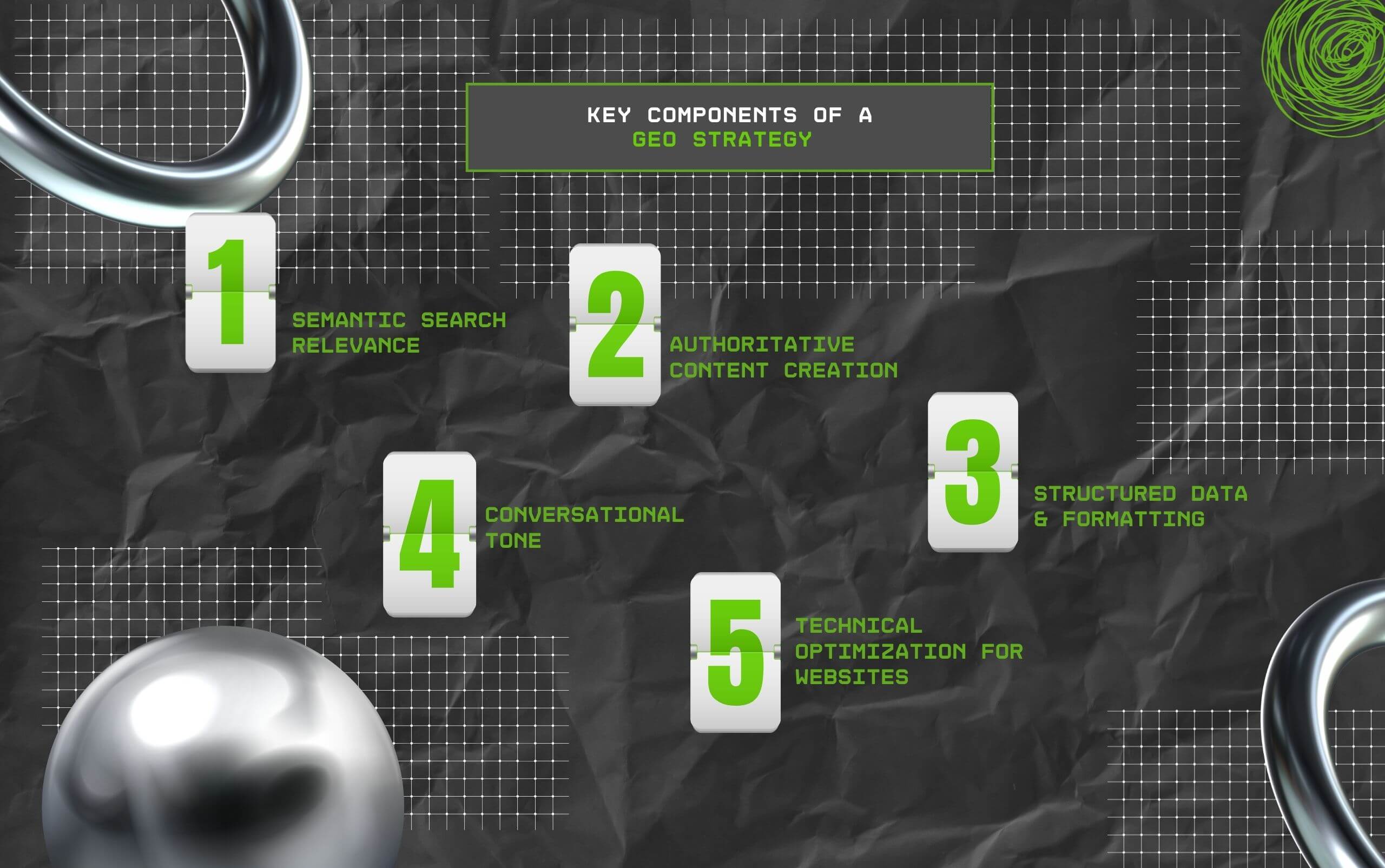
Given that the GEO is a tweaked version of the SEO strategy, its components are slightly different. So, here are the core components of a GEO strategy—
Firstly, GEO focuses on optimizing the content based on the high user search intent.
So, the strategy includes practices that ensure the content is high-quality, valuable, and researched in depth.
This way, it aligns the content with the contextual understanding of the AI models.
Additionally, GEO practices ensure the content is highly authoritative. So, apart from the backlinks, it optimizes the brand mentions to boost credibility and relevance in the niche market.
This way, brands can build their online credibility through local backlinks that help build trust with users and AI search engines.
Given that AI search engines prefer clean, scanable, and structured data, the GEO practices include formatting and structuring the website content.
That is, it includes the use of schema markup, headers, and canonical tags to segregate the content into understandable blocks.
Unlike a traditional SEO strategy, GEO focuses on optimizing the content with a conversational tone. So, AI models can take the snippets and display them for user queries.
Moreover, the natural conversational tone helps the AI models to incorporate the answers from the content directly.
Finally, the GEO practices optimize the content to ensure it ranks on AI models. That is, it optimizes the content so AI bots can crawl and index the webpages.
So, it includes optimizing the site for mobile devices, offering a secure network connection, and a structured site architecture.

Now, implementing the GEO strategy is quite easy. That is, you just need to incorporate some practices along with the traditional SEO.
So, here is how to integrate a GEO strategy in brand marketing—
Since AI models pull snippets from diverse online sources, managing a proper online presence for the brands is essential.
That is, you need to audit and maintain consistency in brand mentions, voice, and positioning. So, when the AI models pull information, it is consistent.
To do this effectively, brands can leverage specialized tools like Findrix – an AI visibility platform that measures each AI engine separately, turns visibility gaps into prioritized fixes for human review, and checks what changed after implementation. Tracking these specific metrics ensures your brand remains accurately represented across all AI discovery channels.
Along with traditional keyword research, you need to focus on AI-driven keyword research that helps content gain visibility on generative search engines.
That is, include query-based keywords, develop clusters of keywords, and target specific questions. So, AI models directly pull snippets from your content.
Given that AI models prioritize expertise and deeply researched content, brands need to create authoritative and informative content.
That is, your content should include the following—
In addition to this, the content needs to be properly structured and formatted. That is, it should include headers, canonical texts, and other formatting elements.
So, the AI models can scan through the content and understand the context of the page. Helping it pull snippets for user search queries.
Finally, measure the GEO performance of the content based on the key metrics. That is, track the brand mentions in AI citations, conversion rates, and frequency of AI rankings.
So, you can modify the strategies and optimize the perfect set of practices that help your brand top the AI models in a jiffy.
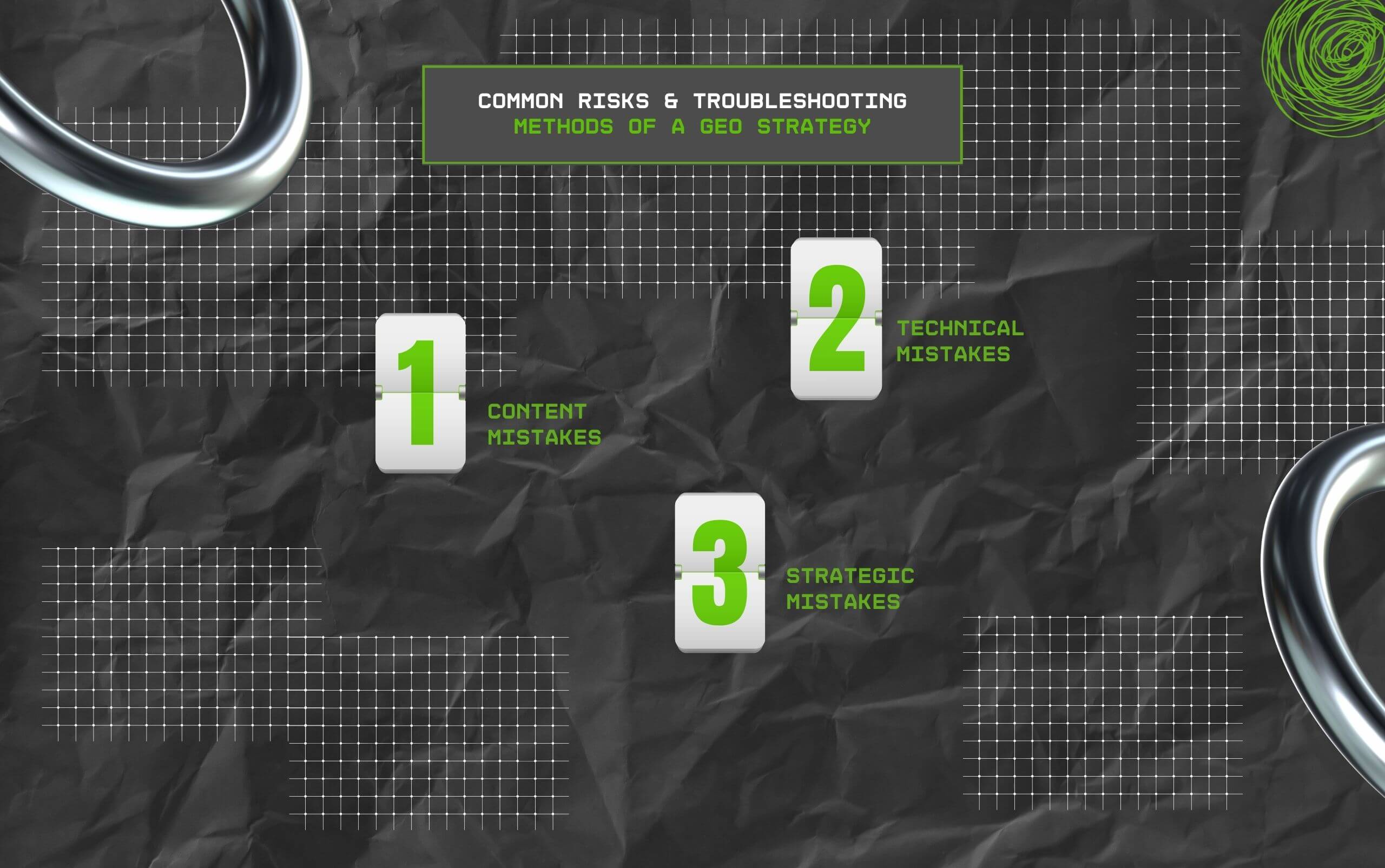
Although the implementation of a GEO strategy is next-level easy, making mistakes can adversely impact it. So, here are some common mistakes to avoid—
Now, when you avoid these mistakes, you can build a fool-proof GEO strategy that skyrockets your brand visibility.
So, in this AI-powered digital marketing landscape, snatch your brand position by implementing the right strategy. Ranking on both traditional and AI search engines.
Here, I have brought you some of the common questions around the generative engine optimization for better online visibility.
Unlike traditional SEO, GEO offers numerous benefits to businesses and brands that enable them to rank on AI search pages. So, some of these benefits include—
• Accessing the target audience with high-quality content that addresses their search intent promptly.
• Establishing online authority with early adoption of GEO practices compared to competitors.
• Helping brands to build credibility with the snippet highlights from AI search engines.
• Reduced competition with ad-driven SEO models through valuable content.
Generally, GEO strategies focus more on clean, high-quality, and structured content. So, the generative engine optimization follows these core principles—
• Clean, scannable, and structured content with headers and bullet points.
• Including expert quotes, credible statistics, and authoritative citations.
• Maintaining a conversational tone with high authoritative content.
• Creating valuable content that AI engines can collect snippets from.
Among the diverse available tools on the market for generative engine optimization, you can choose these to optimize content, evaluate their performance, and more.
• AI Search Grader — Offers a free tool to evaluate the performance of the website compared to the competitor sites’ ranking on ChatGPT.
• Goodie AI — Provides the prompt intelligence that allows brands to optimize the citation and cross-model visibility.
• Profound — Offers a specialized model for monitoring and optimizing brand visibility across multiple AI search engines.
• Otterly.ai — Comes with an affordable and simple tool that monitors brand mentions across diverse major AI search engines.
• SEMrush — Provides the “Brand Presence Explorer” that tracks both brand visibility and AI traffic for the brand websites.
Unlike the common misconception, Generative SEO cannot replace traditional SEO.
Rather, it can improve the SEO practices, provide enhanced strategies for AI rankings, and combine the traditional practices with the modern tweaks.
So, brands can implement a highly curated practice that helps them to rank both on traditional SERPs and AI search results.
Chandrima is a seasoned digital marketing professional who works with multiple brands and agencies to create compelling web content for boosting digital presence. With 3 years of experience in SEO, content marketing, and ROI-driven content, she brings effective strategies to life. Outside blogging, you can find her scrolling Instagram, obsessing over Google's algorithm changes, and keeping up with current content trends.
View all Posts

How To Get Your Brand Cited In AI Search Resu...
Oct 22, 2026
The Ultimate Blueprint For Broken Link Buildi...
Oct 16, 2026
The Ultimate Guide To Stealing Your Competito...
Oct 15, 2026
Beyond The Basics: Master Guest Posting For H...
Oct 15, 2026
Best Generative Engine Optimization (GEO) Com...
Oct 14, 2026