How To Get Your Brand Cited In AI Search Results In 2026
Oct 22, 2026
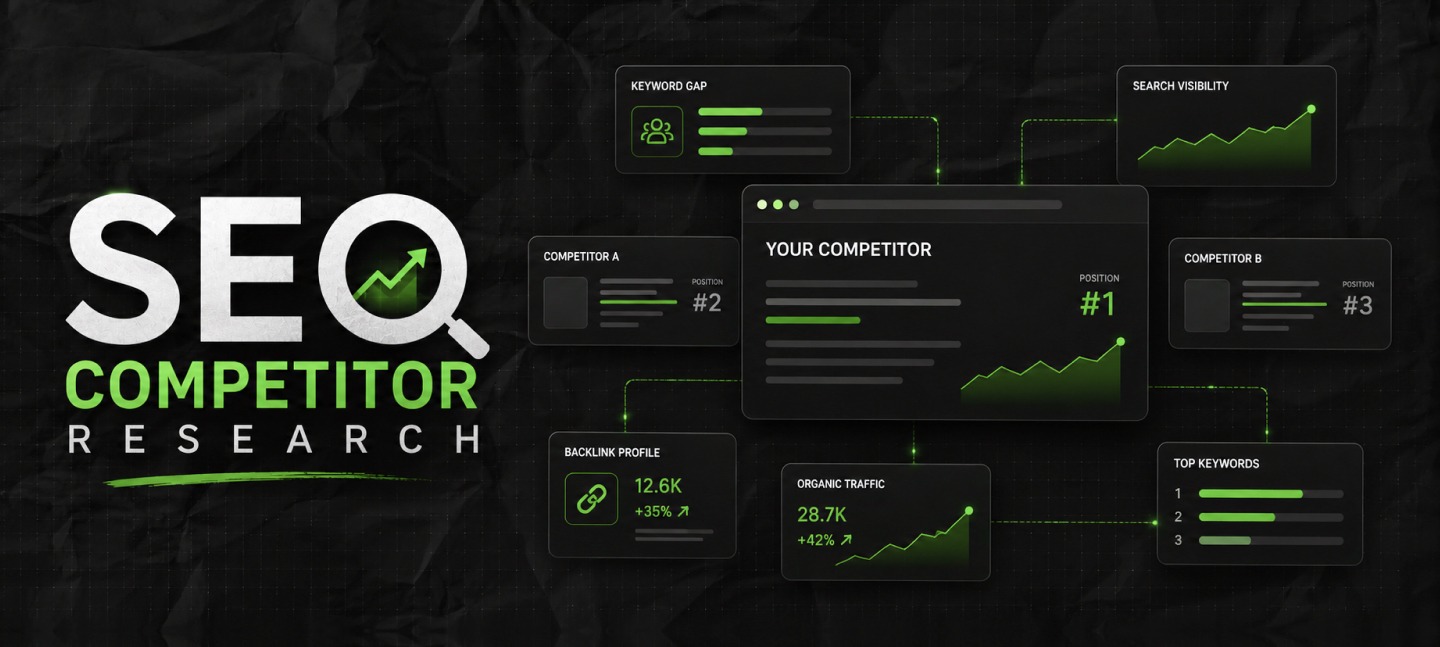

As a digital marketing professional for nearly a decade, I can tell you something very important – your competitors are sitting on a goldmine of data that you can take advantage of to boost your SEO strategy.
And while it is something simple that everyone always knows, most brands fail to do accurate SEO competitor research.
For instance, only copying your competitors’ top-performing blogs or social media reels won’t give you the same reach.
The digital landscape is evolving so quickly that the more you try to templatize everything, the fewer chances you have of getting traffic or going viral.
Ranking keywords alone will not tell you who you are competing with – SEO competitor research in 2026 is deeper and more detailed.
And while it is time-consuming, it is worth the time and effort. Whenever I’m working on something new, I start with a comprehensive competitor analysis – and it always makes my strategies so much more insightful, thanks to the data at my disposal.
In my blog today, I will discuss how to do a detailed competitor analysis – and not just for your SEO, but also for your content.
Stay tuned.
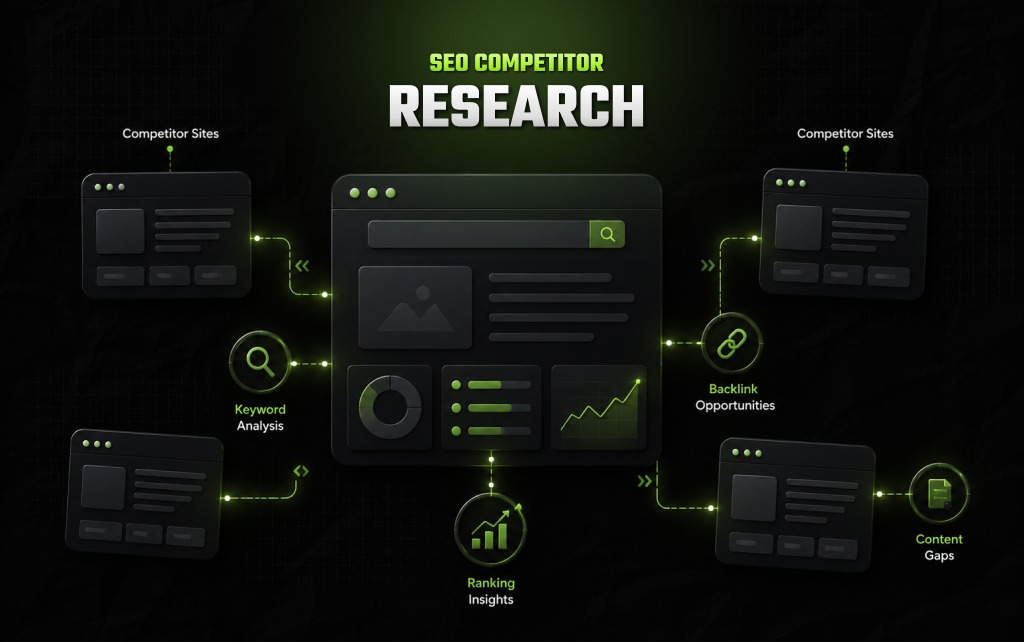
A SEO competitor research or analysis is the process by which marketing professionals deep dive into the content and SEO strategies of their competitors.
The purpose of the competitor analysis is to find the different strengths, weaknesses, and related data of competitors and use the information to outrank them.
Performing a SEO competitor analysis is crucial because it will help you to:
So, I’ll not waste time being vague and jump straight to the point. You should opt for a detailed SEO competitor research and analysis when:
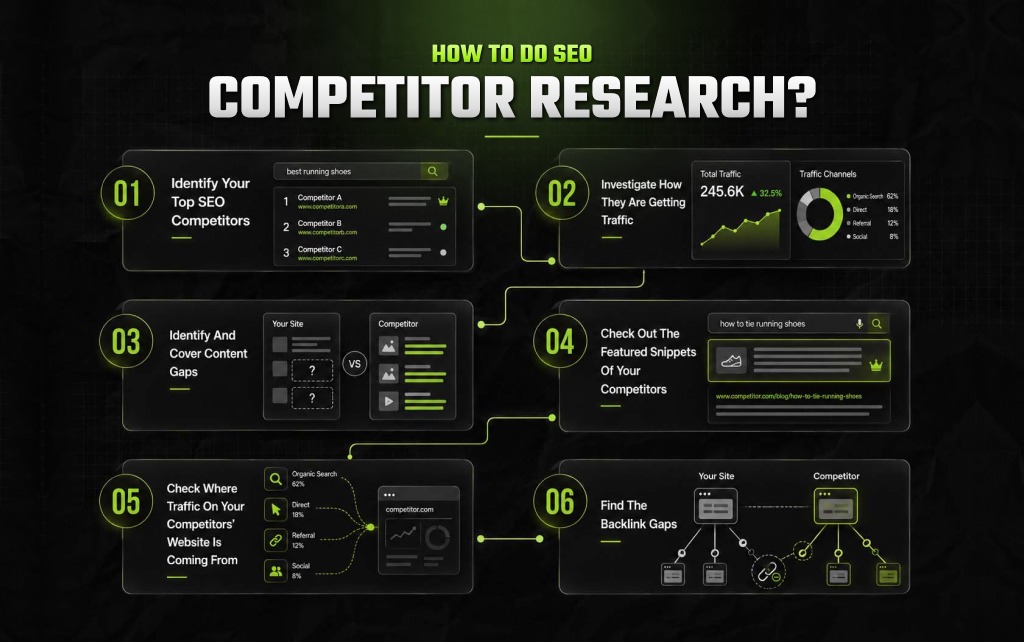
To simplify matters, let’s assume I’m a new website on modern love and relationships. In that case, this is how my SEO competitor research and analysis will turn out.
Frankly, your top SEO competitors are usually sites that are competing for the same target keywords in search results.
Having said that, it is essential to understand that these SEO competitors might not be our direct competitors from a business and revenue perspective.
For instance, OpenMityRomance ranks for ‘how to spice up a relationship?’ even though the site isn’t a business competitor to my modern love blog directly.

On that note, here’s how to identify your top SEO competitors quickly:
This report will highlight your competing sites that are presently ranking within the top ten results, and that too for the same organic keywords that your site is targeting.
So, these sites are your competitors from an SEO perspective.
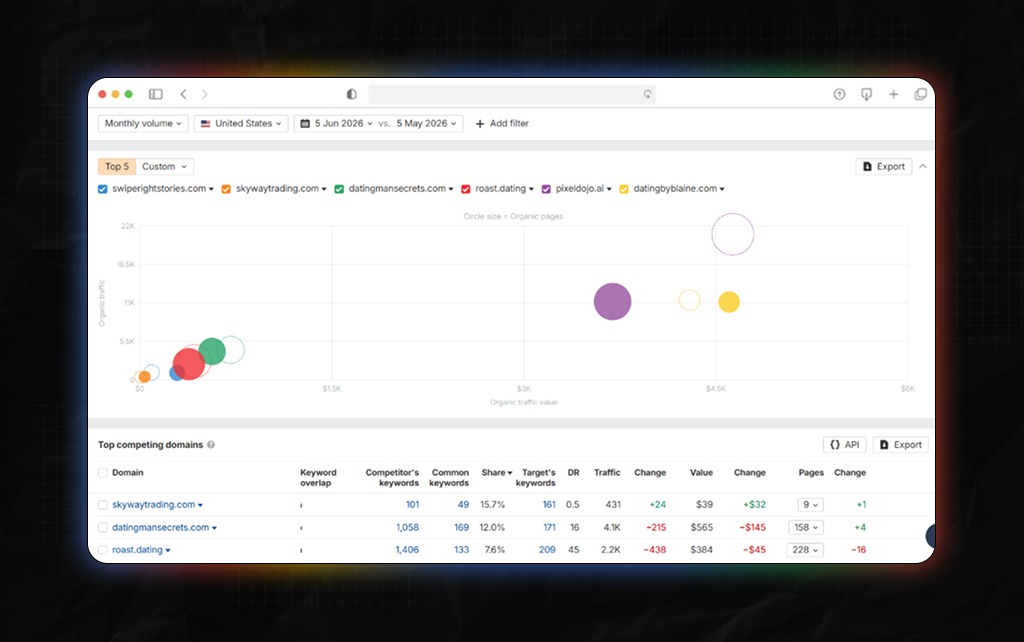
However, if you have a new website, then this activity might not fetch you any major results. In that case, you can follow these steps instead:
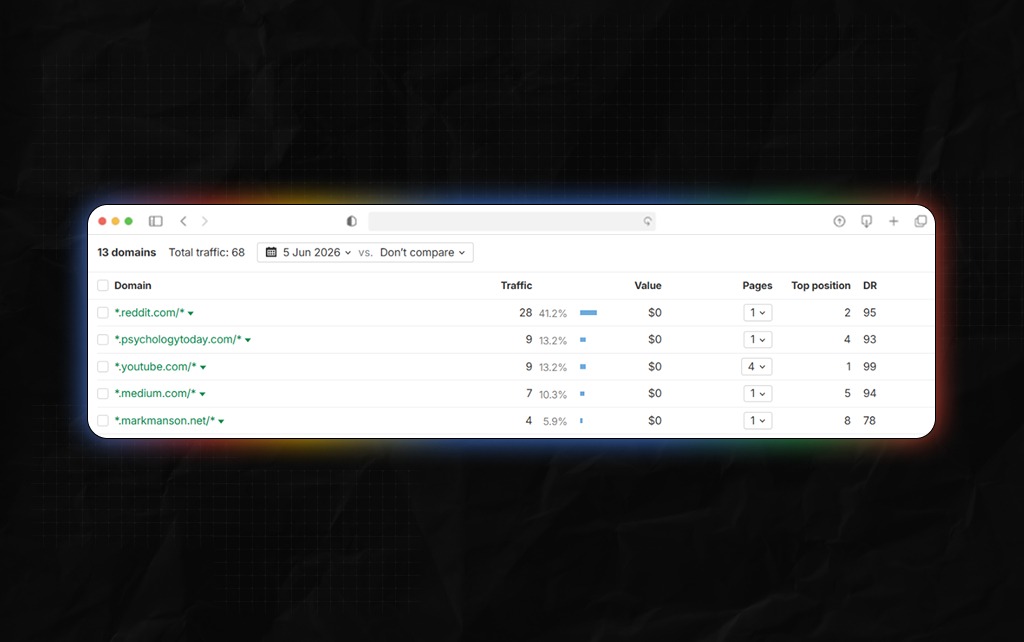
For this instance, it is visible that our top-ranking competitors are websites like Reddit, Psychology Today, YouTube, Medium, and Mark Manson.
So, you can easily check out any of your competitor’s site to find out where they are getting most of their organic traffic from.
On that note, here’s how you can check the website structure of your competitor.
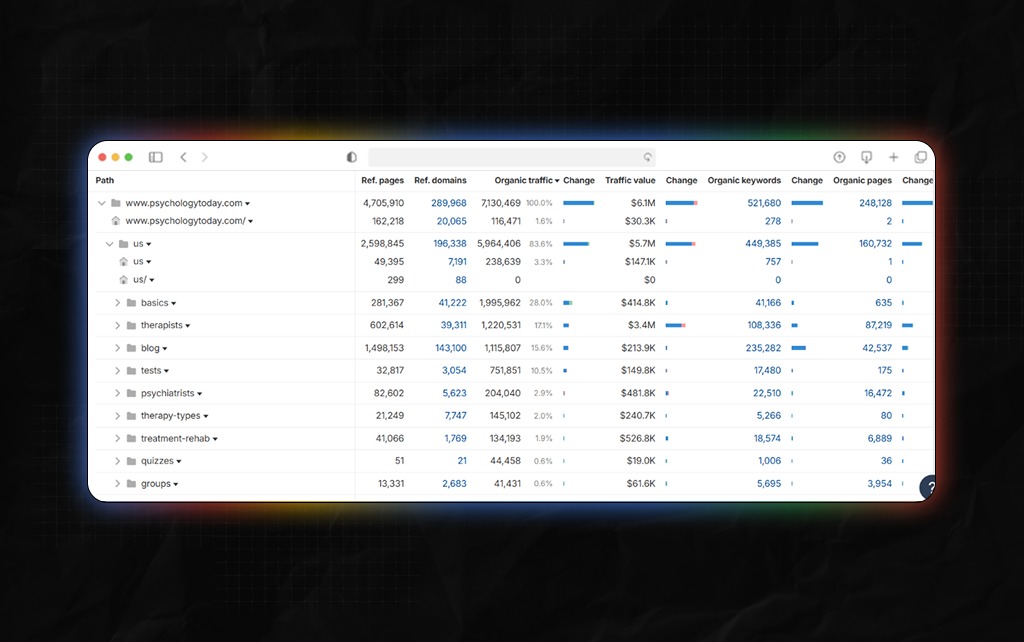
For instance, it is visible that Psychology Today has an estimated organic traffic of 1,115,807 in its blog folder, which is a significant chunk of the total traffic.
Also, if you click on the levels, you can go deeper and even find the kinds of templates that are getting the site traffic.
Content gaps or keyword gaps are basically keywords that competing sites are using to rank, but you do not use them.
So, here’s how you can identity the content gap for your website:
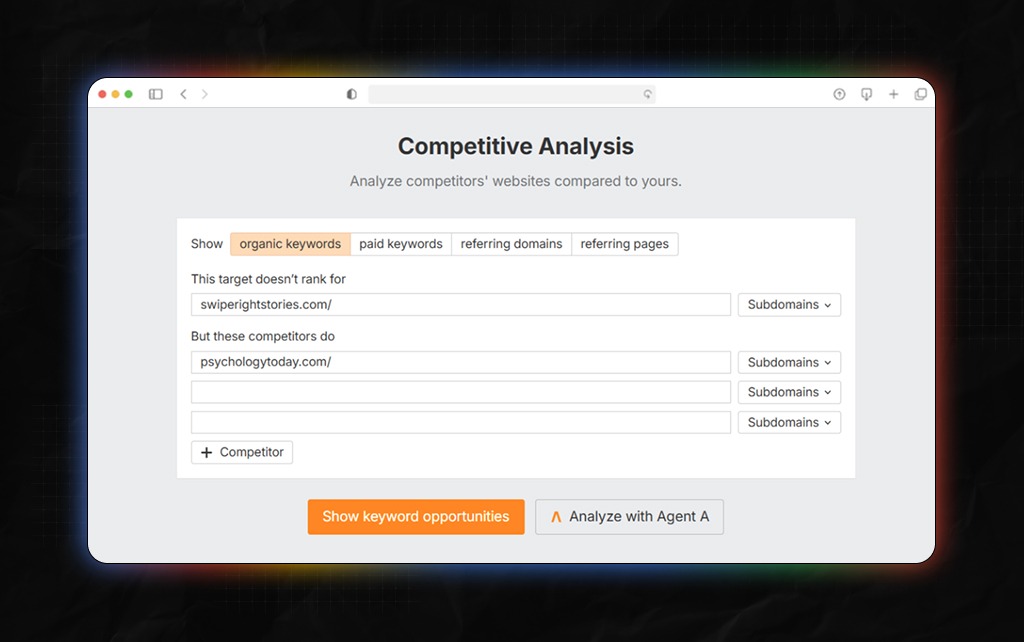
Also, you can enable the Main positions only filter to remove rankings that appear in SERP features such as image results and Top Stories, allowing you to focus on standard organic positions.
Additionally, review the keyword list and highlight terms that align with your website’s content, audience, and search goals.
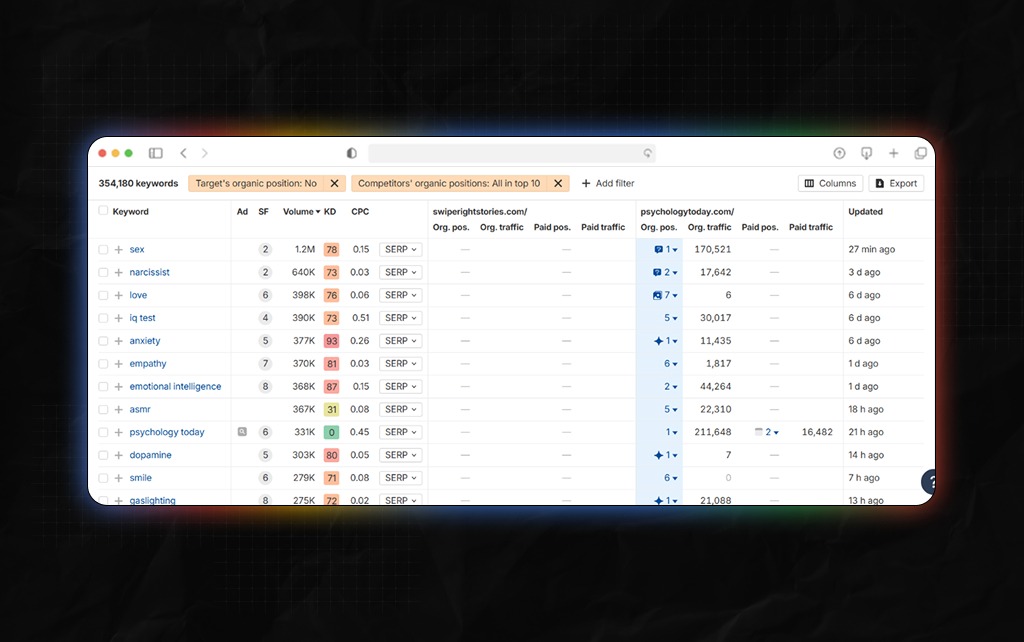
Featured snippets (in case you still don’t know) are a type of quick answers that are all over search results – Google pulls out these answers from the content ranking on the first page.
As a result, you need to find out what your competitor is ranking for to get featured in this section – once you do, you can steal these opportunities to rank instead.
On that note, here’s how to identify these opportunities.
Analyze the keyword data for opportunities where a current page can be optimized to capture the featured snippet position.
Having an understanding of where your competitors are getting organic traffic can certainly give you an edge.
The point? To find out which countries the traffic is coming from, that way, you can take a call on whether you need to create content in different languages or translate existing content.
So, here’s how you can do this:
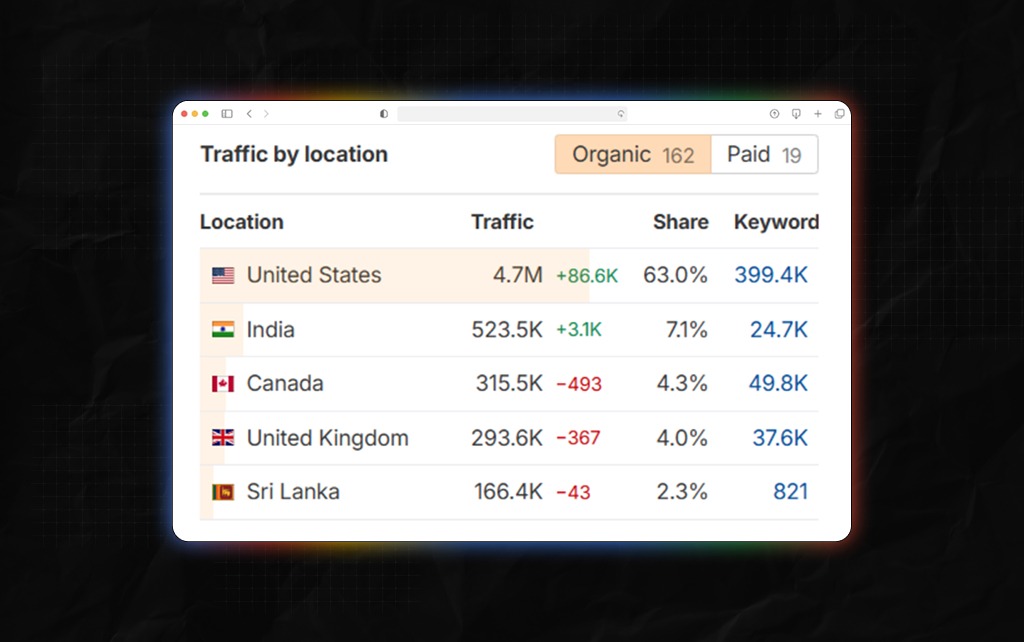
It is obvious that Psychology Today gets most of its traffic from the United States, with India and Canada in the second and third spots, respectively.
As a result, it is only natural to want to focus on content in the English language.
Also, there are some opportunities for the United Kingdom and Sri Lanka. So, looking at the top five countries, you can also consider experimenting with Hindi, Spanish, etc.
Links happen to be a super important ranking factor for Google. Generally, if you have more links, then it means Google will rank you higher on search engine result pages.
Also, if you can find out how your top competitors have been obtaining links, then you can easily replicate a similar strategy.
To get this done, just follow the steps below:
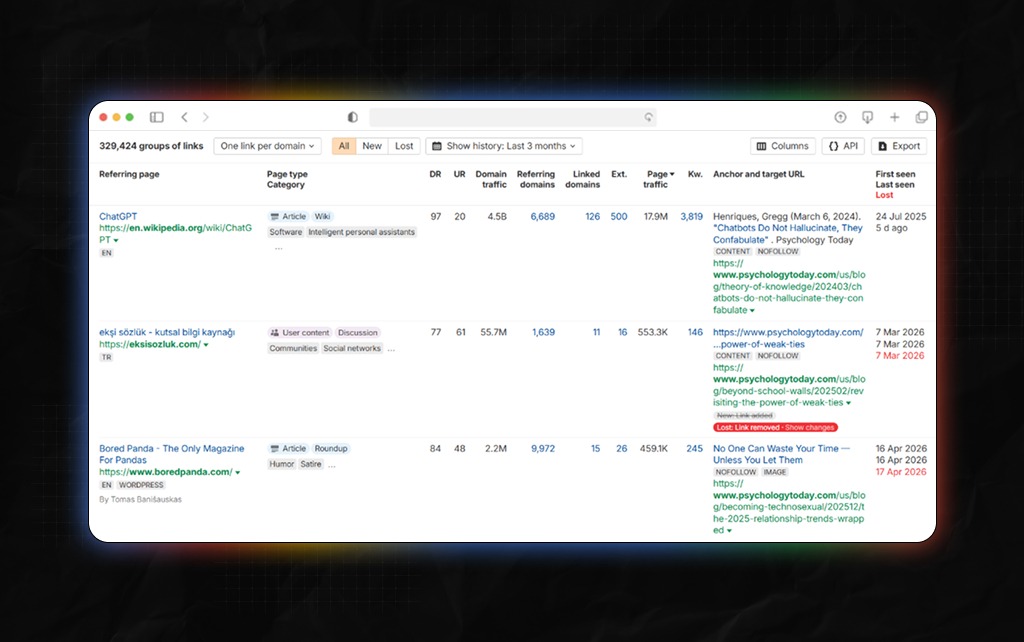
This report highlights the sites that have been linking to competing domains – but not to you. As a result, in such cases, you have to look for replicable links that might get you value.
When a competitor has broken pages that still attract backlinks, they present a valuable link-building opportunity.
So, you can create a high-quality replacement for the missing content and then reach out to websites linking to the broken page, suggesting your resource as an alternative.
To uncover these opportunities in Ahrefs:
This will reveal dead pages that continue to earn backlinks, helping you identify prospects for broken link building campaigns.
Also, the report will display broken pages on your competitor’s site that still have backlinks pointing to them.
Review these pages carefully and identify any that are relevant to your audience or content strategy.
So, if you find a worthwhile opportunity, consider creating a stronger, up-to-date version that can attract similar links and traffic.
Core Web Vitals are a set of metrics Google uses to evaluate page experience and overall user satisfaction.
Since they contribute to Google’s ranking systems, monitoring them is an important part of SEO.
To understand how your site stacks up against competitors, compare their Core Web Vitals and broader technical performance with your own.
One simple way to do this is to analyze competitors’ URLs in PageSpeed Insights.
Enter each page individually to review its performance metrics and identify areas where your site may have an advantage, or room for improvement.
Also, manually checking pages in PageSpeed Insights can quickly become time-consuming, especially for larger websites.
A more efficient approach is to crawl your competitor’s domain with Ahrefs’ Site Audit.
As a result, by connecting the PageSpeed Insights API, you can review Core Web Vitals data across the site while also uncovering technical SEO issues that may be affecting performance.
Of course, there’s more to a detailed SEO competitor research than the eight points I’ve mentioned above.
But to be honest, this is all you need to kickstart your journey with competitive analysis.
I have intentionally not discussed PPC and paid keywords, but with Ahrefs, you can analyze both for your competitors.
However, since I avoid working on any paid SEO or channels, it’s not something I recommend for beginners with new domains.
This is good enough to start your journey – my two cents? Just walk through the process I’ve broken down in detail above and use the insights for improving your site’s SEO strategy.
At the end of the day, execution is everything! Also, if you have any comments or questions, you can connect with me on LinkedIn.
Barsha is a seasoned digital marketing writer with a focus on SEO, content marketing, and conversion-driven copy. With 8+ years of experience in crafting high-performing content for startups, agencies, and established brands, Barsha brings strategic insight and storytelling together to drive online growth. When not writing, Barsha spends time obsessing over conspiracy theories, the latest Google algorithm changes, and content trends.
View all Posts

How To Get Your Brand Cited In AI Search Resu...
Oct 22, 2026
The Ultimate Blueprint For Broken Link Buildi...
Oct 16, 2026
The Ultimate Guide To Stealing Your Competito...
Oct 15, 2026
Beyond The Basics: Master Guest Posting For H...
Oct 15, 2026
Best Generative Engine Optimization (GEO) Com...
Oct 14, 2026