How Corda Turns Authority Data Into Campaigns
Oct 01, 2026

It’s just one battle after another! How long is it going to stretch?
Running searchenginemagazine.com through Google’s update cycle over the past two years has been one of the most humbling experiences of my career.
March 2024 hit us hard. After that, 2025 set our next step.
The good part is that we recovered from both. But here’s the thing that I feel matters the most. Surviving one update doesn’t protect you from the next one.
The 2026 Core Update is rolling out right now. Are you a content writer, a blogger, or someone trying to gain popularity through search queries?
What you do in the next few months will either set you up or set you back. It’s also the same for me.
I want to use my own story to highlight the top Google ranking factors that worked for me. I feel that they should work for your site too.
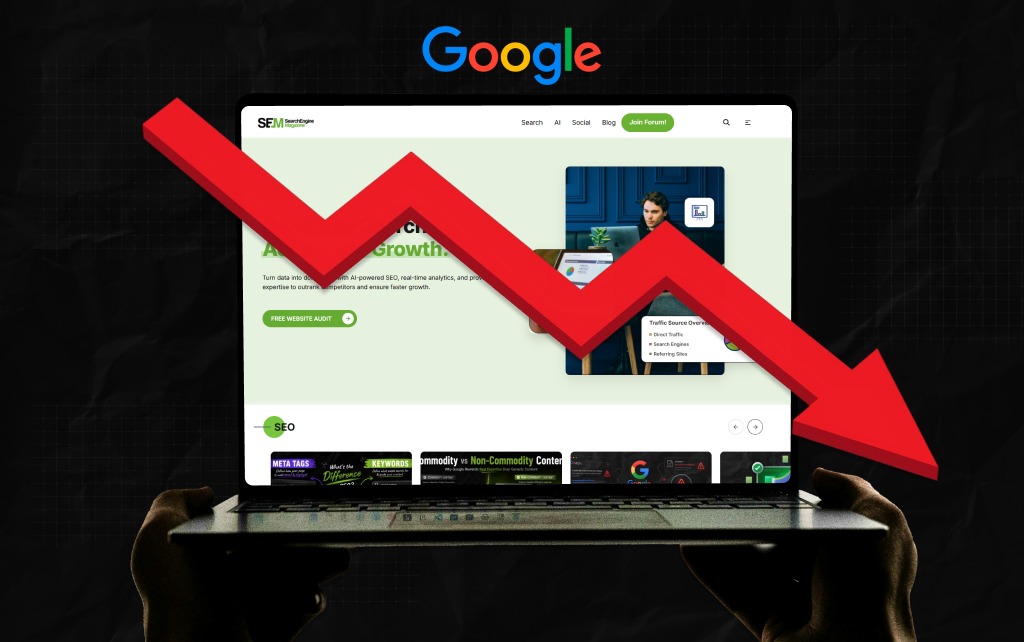
March 5, 2024. I still remember opening Google Search Console that morning and watching our impressions graph fall off a cliff.
Searchenginemagazine.com lost nearly 40% of its organic traffic in four days. Classic articles ranking for low-KD, high-volume keywords like “how many seo keywords should i use” and related queries for over three years were just gone.
A lot of articles just dropped from page 1 to page 4, almost overnight.
So who was to blame? Obviously me. But I was not wrong as well. Google was prioritizing articles with detailed analysis, semantic SEO, and coherent flow. So we thought about nothing else.
My SEO analyst, Jerry, would just search for high-search-volume keyword clusters. Trust me, most of them worked! On top of that, we had been publishing fast.
Now, when I look at them, I can clearly see some downsides which I must discuss here:
Google’s Helpful Content system finally caught up with us. No wonder we were hit! But it was a surprise for us back then.
The first thing I did was panic. But I somehow believed there had to be a way out of this. Then I audited every single post published between 2022 and early 2024.
What I found is something I’m not proud of. However, every new content creator must listen to this. About 60 pages had zero original insight. They were essentially paraphrases of information already available on bigger sites. We had no business publishing them.
The recovery Strategy That I Immmdiately Launched After Talking To Jerry:
By August 2024, we were back to 80% of pre-March traffic. Yes, we were not fully recovered. But I was certainly hopeful again.
I thought we had figured it out. By early 2025, searchenginemagazine.com was growing again. We were producing genuinely useful content.
Meanwhile, our E-E-A-T signals were stronger. Above all, our average session time had climbed from 1:40 to 3:20. I really felt good again!
Then March 2025 arrived. But this time, the damage was different! It wasn’t about content quality. It was about structure.
To clarify, Google’s algorithms became remarkably good at evaluating on-page signals at a granular level. In other words, Google flagged issues related to:
At this point, I needed to question myself:
“Were our articles actually covering a topic the way a genuine expert would? Or were they covering the parts of a topic that ranked easily?”
We lost about 22% of traffic in the March 2025 update. Certainly, the hit was smaller than in 2024. But it had a greater impact because we thought we did everything right.
So, what did 2025 teach us? For the first time, I understood that technical on-page signals, not just content quality, were now weighted heavily. We had to treat every page like a product, not just a piece of writing.
As I write this, the google may 2026 core update is actively rolling out. We’ve already seen volatility in rankings across the SEO and digital marketing verticals in which searchenginemagazine.com operates.
Early signals suggest Google is pushing harder than ever on three things:
But what is content completeness? Well, it is the idea that a page should resolve a reader’s intent fully, without them needing to go elsewhere.
So here are the 20 Google ranking factors that are most relevant to your on-page content right now, shaped by everything I’ve learned through two years of being knocked down and getting back up.
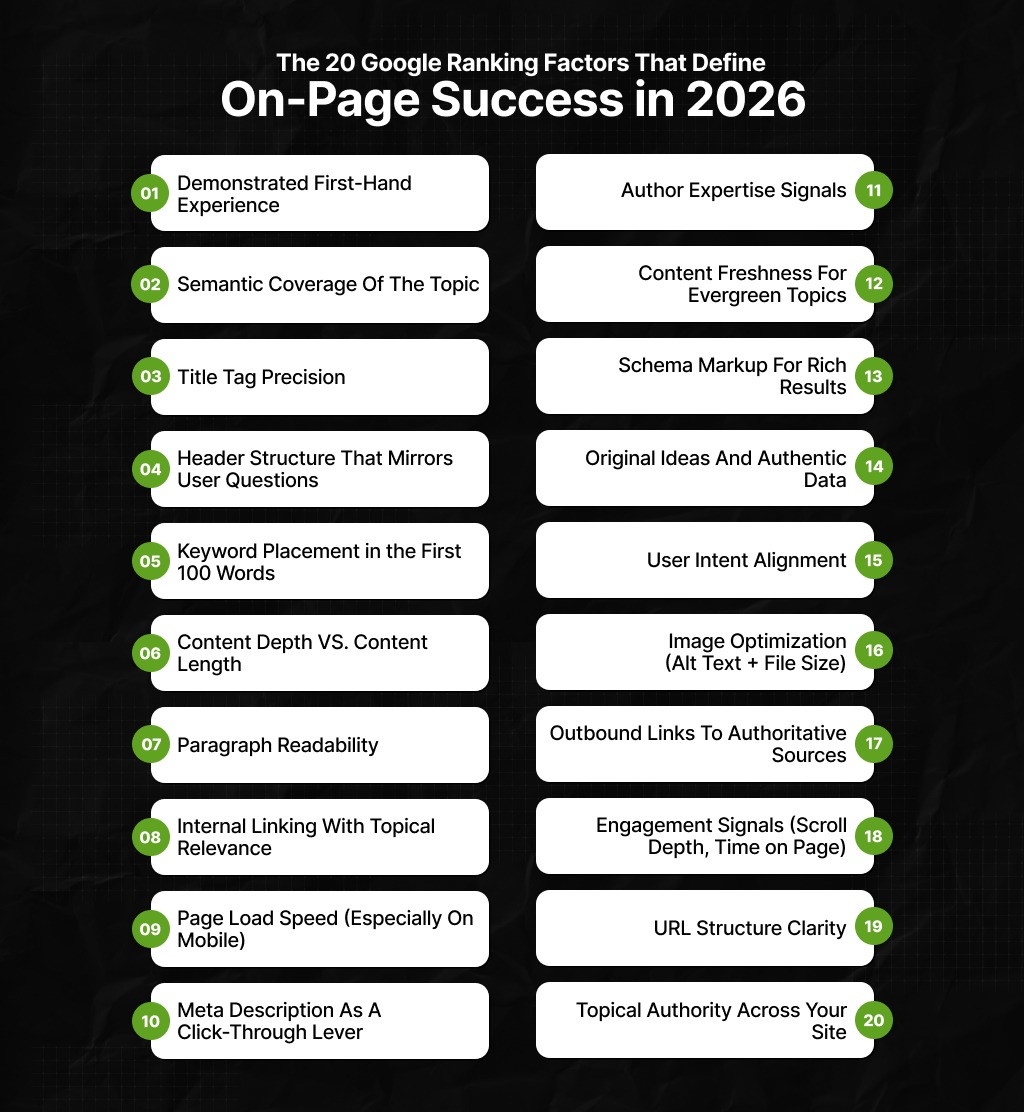
These factors are not only based on research. I also speak from personal experience.
This is the “E” that was added to E-A-T back in 2022, and in 2026, it carries enormous weight. Google wants to know: have you actually done the thing you’re writing about?
On searchenginemagazine.com, when we write about recovering from a core update, we cite our own traffic data. When we discuss on-page SEO, we use our own pages as examples. That specificity signals experience. Meanwhile, generic advice does not do that.
Google’s natural language systems now evaluate whether you’ve covered a topic’s full conceptual territory.
If someone searches “Google ranking factors” and your article only discusses backlinks and meta descriptions, you’re missing what an expert would include. Use your article to answer the full question, not just the easy parts.
Your title tag still matters. But not in the keyword-stuffing way it used to. It should be specific, honest, and match what’s actually in the article.
When we changed one of our titles from “Google Ranking Factors 2024” to “How We Recovered Our Rankings After the March 2024 Core Update,” click-through rate went up 31%.
As a result, I realized that I need to be more specific and credible.
Your H2s and H3s should read like questions a real person would ask. So don’t rely only on “Off-Page SEO Techniques.” Instead, focus on “What Off-Page Signals Does Google Actually Use?”
This is based on how people search and how Google extracts featured snippets. We restructured 18 articles this way during our 2025 recovery and saw measurable improvements within six weeks.
This is an old advice that still works well. Your primary keyword should appear naturally within your opening paragraph.
However, this time you have to add it semantically. Google will instantly flag forced keyword inclusions.
Again, do not stuff keywords unnecessarily. I used it just once, and certainly in context.
Search engines use early signals to understand the page topic before they’ve processed the full document.
These are not the same thing. A 4,000-word article stuffed with repetition is thin content. On the other hand, a 1,400-word article with sharp, specific insights is deep content.
Google measures engagement signals. If people read your whole article and don’t bounce, article length is not the problem. So, it is more important that you focus on the density of value.
What does paragraph readability mean? It is defined by features like:
Reading level should match your audience, not impress an academic committee. Honestly, that is my understanding so far, reading the core 2026 update.
On searchenginemagazine.com, our best-performing articles average 2–3 sentences per paragraph. In other words, our goal is to allow the readers to scan before they read. So we simply help them scan!
Every internal link you add is a vote you cast for another page on your site. But the link must be contextually relevant. Linking from an article about core updates to one about keyword research makes sense.
However, it does not make sense to link to a recipe page. That’s where the main difference is. We now map out link clusters in a spreadsheet before publishing. It has changed how Google crawls our content.
After our 2025 audit, we found that three of our most important articles had mobile LCP scores above 4 seconds. Those pages had dropped the most.
So what did we do? We compressed images, deferred non-critical JavaScript, and removed a widget we loved but didn’t need. After that, the scores went from 4.1s to 1.8s. Rankings followed within two months.
Google may rewrite your meta description. But that doesn’t mean you should ignore it. Write it like an ad.
For my site searchenginemagazine, I always focus on one specific benefit. Or I answer one implicit question. But I always keep it under 160 characters.
In our recovery phase, we A/B tested meta descriptions on 12 pages in late 2025. Consequently, we saw CTR improvements of 15–28% simply from clearer, more direct descriptions.
Who wrote this? Google wants to know. Therefore, my author bio is not just a name. Rather, it establishes why that person is qualified to discuss the topic.
Our author bios now include:
Pages with strong author bios consistently outrank those without them in our own testing.
Updating an article with a 2023 publication date and way older stats is a ranking killer. Therefore, we now audit every article older than 12 months.
In this connection, note that even small updates signal to Google that the page is maintained. For instance, a new statistic, a fresh example, or a corrected claim.
Some of our biggest traffic gains in 2026 have come from modified old content, not new posts.
I always stress three schemas in 2026:
They help Google understand your content’s structure and unlock rich result features in SERPs. Most importantly, avoid any silo structure.
In the same vein, we added the FAQ schema to 30 articles in Q4 2025. Eleven of them picked up featured snippet positions within 90 days.
Original data is a ranking superpower. For example, you can launch a survey. Or include a case study. In my work, I also used my own analytics.
For example, one of our articles used our own traffic data as the centerpiece. It earned 47 backlinks organically. Therefore, it is important to note that nobody can replicate your data.
Is your article informational, navigational, or transactional? The answer should match what the searcher actually wants. Someone searching “Google ranking factors” wants to learn, not buy.
So, pitching your services in three paragraphs shows that you could not understand the user intent. As a result, your article’s bounce rate will increase. At the same time, the ranking will be lower. It’s a simple loop.
Alt text isn’t just for accessibility. On the contrary, it’s a contextual signal. Every image on a page adds or subtracts from topical relevance.
Also, a poorly named image file (for ex., IMG_3847.jpg) contributes nothing. On the other hand, an image with alt text “google ranking factors checklist 2026” contributes to the page’s semantic footprint.
Lastly, you must remember that oversized images kill load speed. So you can fix this problem too, with the same strategy.
Linking out to credible sources has been my strategy from day 1. Without that, the secabrio would have been worse after the core Google updates.
Google interprets outbound links to high-authority domains as a quality signal. It shows you’ve done research.
We cite Google’s own Search Central blog, peer-reviewed research where applicable, and respected industry publications.
Google uses Chrome data and indirect behavioral signals to assess how much people engage with your page. On that note, short dwell time sends a bad signal.
After our content rewrites in 2024, average time on page jumped from 1:40 to 3:45 on our top articles. The rankings improved just after that. It means that if you engage readers, you naturally improve this metric.
Google favors short, readable URLs that reflect the topic. Again, this is not only good for SEO. In fact, users also trust clean URLs more.
They’re more likely to click, share, and remember them.
This is the most important one. A single great article on Google ranking factors helps readers. A site with 40 deeply useful, interconnected articles on SEO, content strategy, and search marketing is even more helpful.
That said, topical authority is the long game. Google rewards sites that clearly own a subject. We doubled down on a narrower topic scope in 2025. It’s the single biggest factor behind our 2026 growth.
Here’s the hardest truth I can tell you after running searchenginemagazine.com through four major Google updates. The 2026 update is live right now, and some of our pages are fluctuating as I type this.
The trend says that the updates are recurring. However, content creators should not be scared of them.
Personally, I was much scarier after the 2024 March update than I am now. Do you know why?
I have realized that Google actually rewards valuable content. Again, here is a quick formula that you can use to make content that Google rewards:
1. Make original human content
2. SMEs who actually understand a topic should write on it.
3. Make your webpages quick and navigable
The 20 Google ranking factors I discussed above are the ultimate roadmap you need. If your pages reflect all of them, your site will be less impacted by the Google updates.
Build that foundation. Then build it again after the next update breaks it. That’s the job.
Barsha is a seasoned digital marketing writer with a focus on SEO, content marketing, and conversion-driven copy. With 8+ years of experience in crafting high-performing content for startups, agencies, and established brands, Barsha brings strategic insight and storytelling together to drive online growth. When not writing, Barsha spends time obsessing over conspiracy theories, the latest Google algorithm changes, and content trends.
View all Posts

How Corda Turns Authority Data Into Campaigns
Oct 01, 2026
How To Audit Your Search Visibility In 2026: ...
Sep 30, 2026
What Is Google Lighthouse? A Practical Guide ...
Sep 30, 2026
When Can You Save A Public Instagram Story?
Sep 30, 2026
Google Looker Studio: What It Is, How It Work...
Sep 30, 2026