SEO Dashboard: What To Track, What To Ignore, And How To Make It Useful
Sep 25, 2026
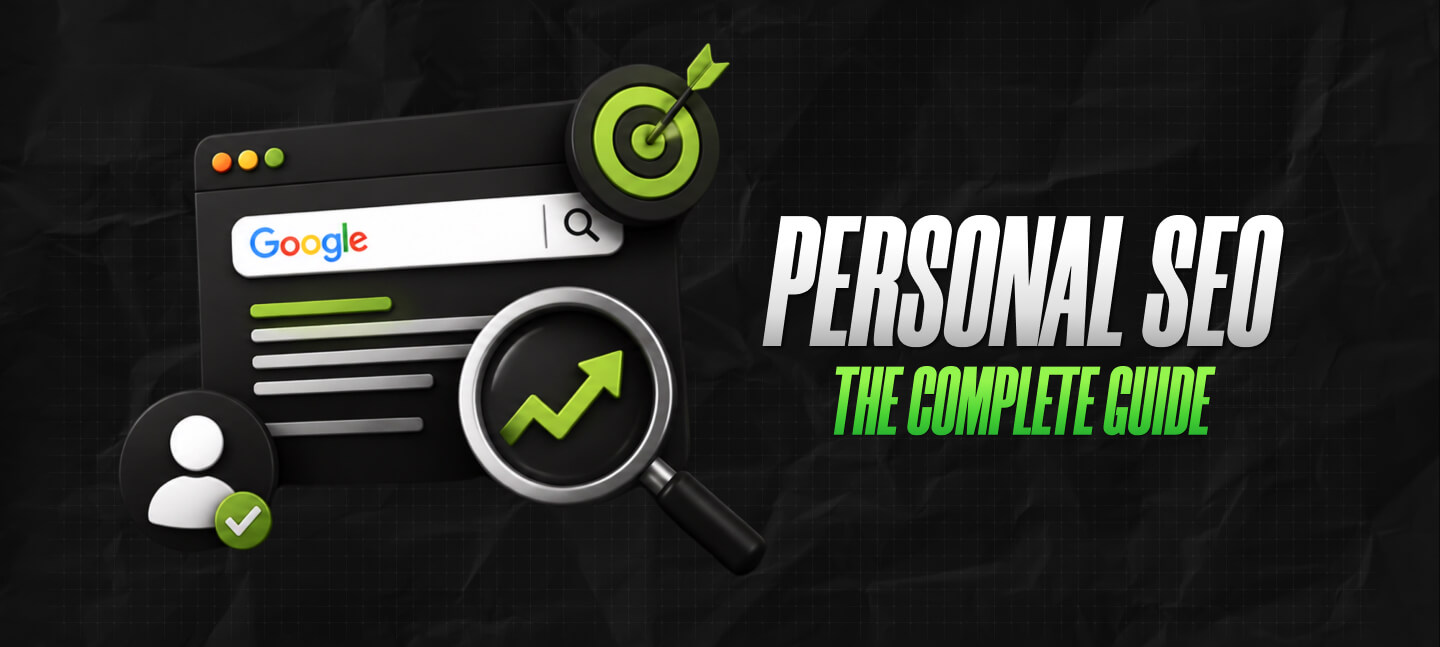

Try this before reading any further: Open Google and search for your name.
What do you see? Maybe it’s your LinkedIn profile. Maybe it’s your Instagram account, or some social media account that you haven’t touched in years.
Or, you might find others who go by the same name as you. But if you are super lucky, then your website might appear on top of the SERPs.
But if you have a website and it doesn’t appear at the top of search results, then your personal SEO needs work.
Now search for someone well-known in your industry. You will be surprised to see how this search result reveals a clear story – you will see their social media profiles, websites, conferences,
That difference isn’t accidental. It’s the result of a strong digital presence, and in many cases, good Personal SEO.
For many people, SEO is only applicable to their sites – while that used to be true for roughly a decade, things have changed now.
In 2026, your name itself is a search query. Employers search it before interviews. Clients search it before signing contracts. Journalists search it before requesting quotes. Investors search it before meetings.
And not just that, even AI-powered tools use the same information available on the internet just to answer queries about someone. As a result, your digital presence is now a significant portion of your complete professional identity.
Personal SEO focuses primarily on helping a search engine understand:
When implemented accurately, this will help you create a consistent digital presence that makes it easy for search engines, including AI-powered tools, to know about you.
Today, I’ll break down how personal SEO works in 2026, highlighting the actionable steps you can take to become the most credible result for your own name.
Personal SEO is the process of improving your online presence so search engines clearly understand who you are, what you do, and where your expertise lies.
At first glance, it sounds similar to personal branding. The two ideas are closely connected, but they aren’t the same.
Personal branding shapes how people perceive you.
But personal SEO helps search engines and AI tools to understand who you are – it includes three steps:
So, think of it this way.
While your personal brand is the story you want people to remember, personal SEO makes sure that story appears when someone searches for your name.
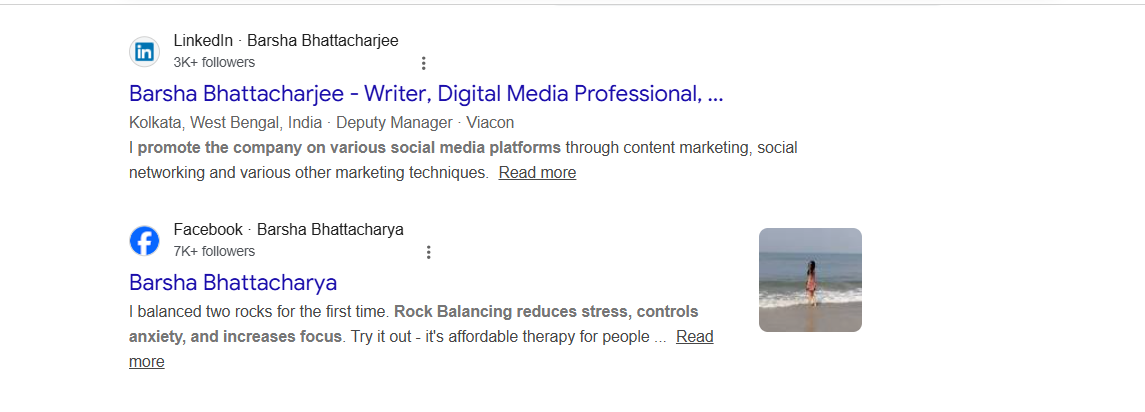
For instance, I am a freelancer who creates content for several websites, apart from Search Engine Magazine.
To establish myself, I wrote consistently for several websites, built a strong LinkedIn profile, worked on my other social media, and shared my work online.
That really contributed to reputation building for me. But the problem was that my information was scattered all over the internet.
As a result, search engines were struggling to connect all the dots and give out all the necessary information at one go. As a result, my expertise became less visible than it deserves.
This is where personal SEO becomes essential.
It creates consistency across your digital presence so Google can confidently recognize you as the same person everywhere you appear. Plus, it includes everything – your website, LinkedIn, socials, podcasts, etc.
Many people use these terms interchangeably, but they focus on different goals.
| Personal Branding | Personal SEO |
|---|---|
| Shapes public perception. | Improves search visibility. |
| Focuses on messaging and reputation. | Focuses on discoverability and credibility. |
| Helps people remember you. | Helps search engines recognize you. |
| Builds trust through communication. | Builds trust through consistent digital signals. |
| Influences human audiences. | Influences both people and AI-powered search systems. |
The strongest professionals invest both in personal branding and SEO. This is because a compelling personal brand can attract attention, while a solid personal SEO will ensure people can actually find it.
Of course, a decade ago, it didn’t matter whether your name was appearing at the top of search results. It wasn’t really a priority at the time for most people.
However, in 2026, ranking on your own name is more important than ever, thanks to the evolving nature of search.
While people have been using Google for years, things are different now with the entry of AI literally everywhere.
Today, people ask AI for everything – from recommendations and decision-making expert queries to accurate information about their favorite hotels.
More importantly, it is about getting this information within seconds.
So, imagine if someone asks AI: ‘Who is Barsha Bhattacharya?’ and ‘What Does Barsha Bhattacharya does?’
The response won’t be a single reply from one website. Instead, AI will gather information from multiple trusted sources. If all the sources are consistent with the information, only then AI will get the confidence to reply.
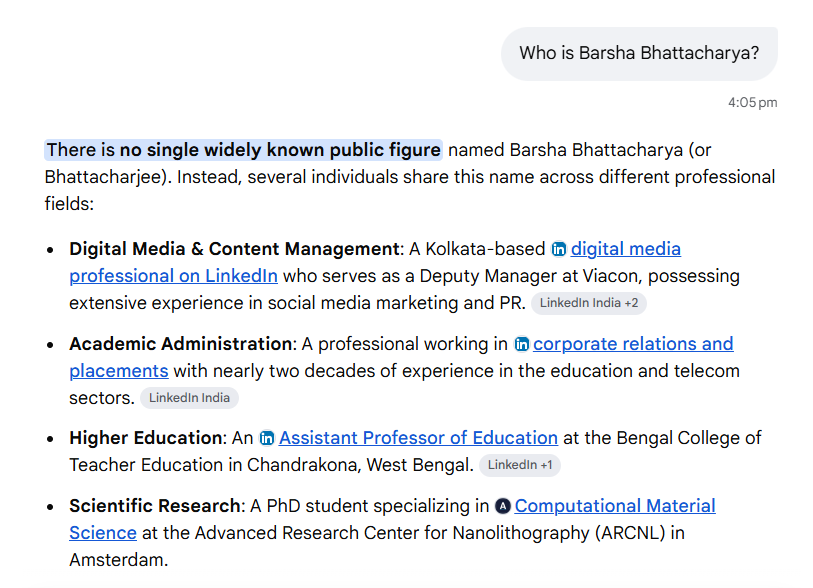
However, if the information appears to be contradictory or incomplete, then the response will become less reliable or weaker.
That is precisely why personal SEO in 2026 extends beyond conventional search rankings. Also, it influences how AI will describe you.
As a result, for freelancers, founders, and consultants, this shift has led to the creation of an opportunity as well as a challenge.
Anyone who builds a clear identity consistently will have more potential to appear in AI summaries and search results. But if you choose to ignore it even in 2026, then chances are you are making a huge mistake!
As a digital marketing professional for eight years, I can tell you one of the most common myths about Google and other search engines is that they actually ‘know’ who you are.
But in reality, search engines don’t have any idea about you – Google has never met you. Also, Google has no idea about your actual reputation in the real world or your achievements.
So, naturally it has to depend on signals:
Individually, each of these signals does not really mean anything. But collectively, these signals add up to help a search engine understand who you are.
In fact, you can look at it like a jigsaw puzzle.
Over time, these signals add up to build a unified picture – the pieces of the puzzle come together. Also, when the information continues to exist consistently, Google and other search engines automatically gain confidence in your identity.
That confidence often translates into stronger visibility across both traditional search and AI-powered experiences.
In the next section, I’ll look at how Google and AI systems connect these signals to build what is known as your digital entity, and why becoming a recognizable entity is now one of the most valuable goals in Personal SEO.
If you have ever searched for a well-known entrepreneur, author, or public speaker, you have probably noticed something interesting.
Google doesn’t just return a list of links. Instead, it often understands who that person is.
So, it knows where they work, what they write about, the books they’ve published, the companies they’ve founded, and even the people they’re connected with.
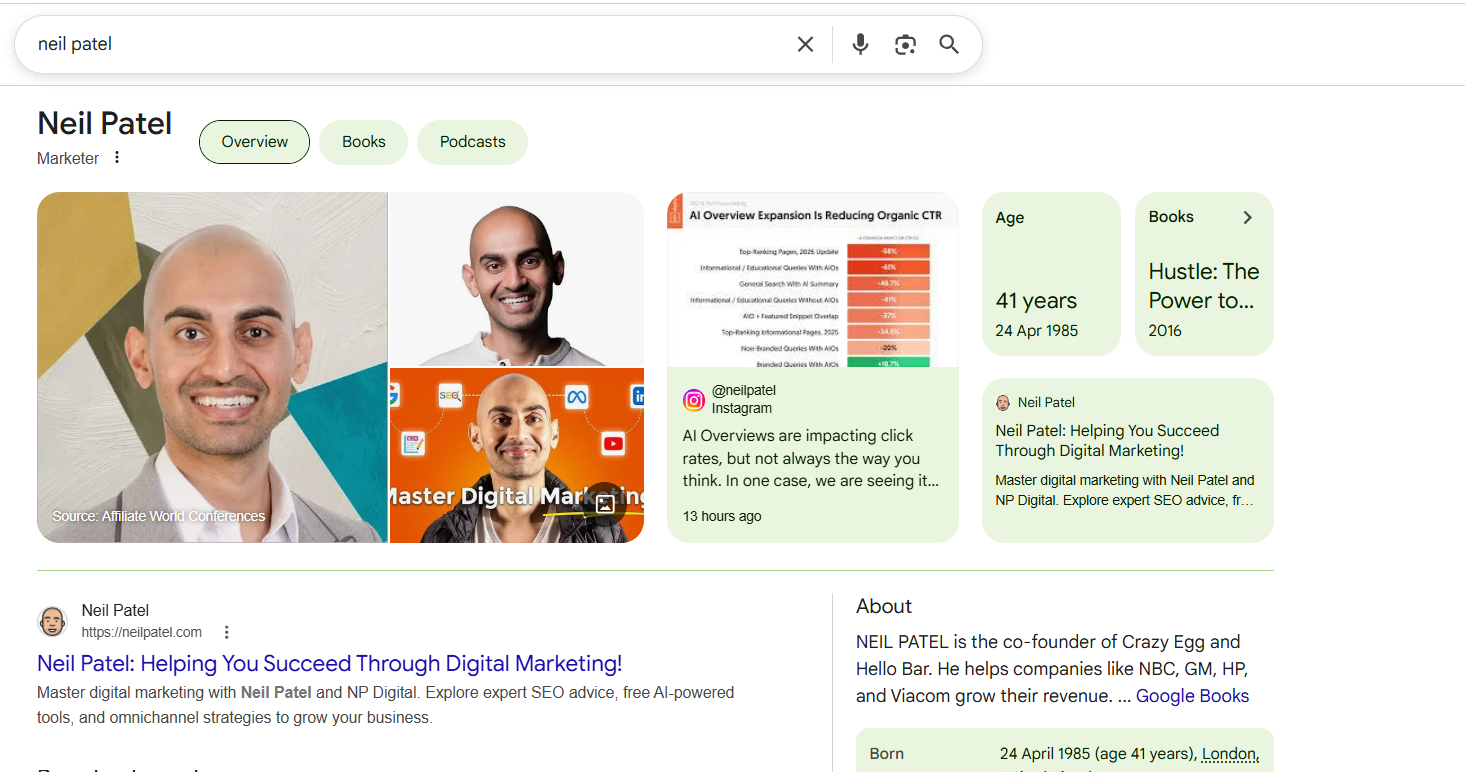
That isn’t because someone manually entered the information into Google.
Instead, it’s because search engines have become remarkably good at connecting information from across the web.
The better they understand a person, the more confidently they can show that person in search results, AI summaries, and other search features.
So, how does that happen? It starts with something called an entity.
In simple terms, an entity is a person, place, company, product, or concept that search engines can uniquely identify.
Think about the name “Michael Jordan.” Without context, it could refer to the basketball legend, a professor, or someone you work with.
Search engines don’t simply look at the name. They look at the surrounding information.
Those signals help Google understand which Michael Jordan the page is referring to. The same process happens with your name.
Also, Google doesn’t just look for matching words. But it looks for enough evidence to decide whether different profiles, articles, and websites belong to the same individual.
That’s why consistency matters so much.
Every professional leaves traces across the internet. Some are intentional, while others aren’t. But what are these traces? It could be your:
And that’s not all. Even if all these sources are scattered all over the internet, Google and other search engines will try to verify if they all point to the same person or not.
For instance, you are a freelancing content writer. Your personal website describes your services. And so does your LinkedIn. Then, a conference website features your speaker biography.
Also, several blogs quote your research.
Now, individually, these pages have some value, although they remain largely scattered. But collectively, they reinforce one single story showcasing your career trajectory as a freelancing content writer.
So, the more a search engine will come acoss consistency in the information available at its disposal, the more confidence it will gain in your professional expertise.
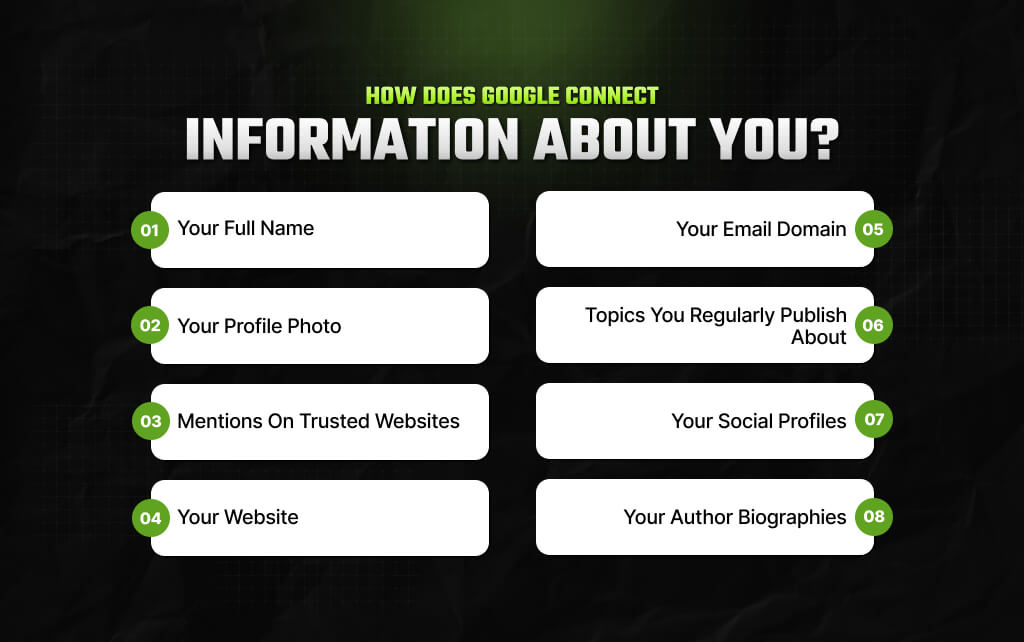
Remember what I’ve been saying all along – Google doesn’t know who you are, and neither does it depend on a single signal to identity you.
And the same is applicable for all search engines.
To be fair, Google and other search engines check out multiple sources, comparing information before deciding whether or not all the signals add up to the same person.
In this context, I have clarified some of the strongest signals below:
Imagine you publish an article about technical SEO. Your author bio links to your personal website. Your website links to your LinkedIn profile.
Also, your LinkedIn profile lists the same company mentioned in your conference biography.
That creates a chain of evidence, with each connection strengthening Google’s trust and confidence that all the signals point to one person.
If you have spent even a month in the SEO landscape, you must have heard about E-E-A-T. FYI, it stands for:
Many people think E-E-A-T is something you optimize with a few website changes. But the reality is very different. It’s something you earn over time.
Search engines look for evidence that supports your expertise. And that evidence might include:
Think about two financial advisors:
In that case, which advisor do you think will have more credibility? The answer is obvious to people. Search engines reach a similar conclusion by analyzing the available evidence.
Traditional search focused on ranking webpages. In contrast, AI search focuses on understanding people.
So, when someone asks any AI, ‘who is the best copywriter in the search engine landscape?’ the system doesn’t simply search for those exact words.
Instead, the AI Mode will search for names that have consistent evidence and that too across sources, trying to find answers to:
1. Who publishes regularly?
2. Who receives mentions from trusted websites?
3. Who speaks at industry events?
4. Who is quoted by other experts?
5. Who has built authority around that topic?
The answers come from patterns, not isolated pages. And that is exactly why personal SEO is so much more important than just ranking on top for your name.
Rather, it is about becoming a credible entity in the eyes of AI systems and search engines – a source that Google and others can trust with confidence.
It’s about becoming a trusted entity that search engines and AI systems can recognize with confidence.
Barsha is a seasoned digital marketing writer with a focus on SEO, content marketing, and conversion-driven copy. With 8+ years of experience in crafting high-performing content for startups, agencies, and established brands, Barsha brings strategic insight and storytelling together to drive online growth. When not writing, Barsha spends time obsessing over conspiracy theories, the latest Google algorithm changes, and content trends.
View all Posts

SEO Dashboard: What To Track, What To Ignore,...
Sep 25, 2026
Analytics SEO: How To Turn Search Data Into B...
Sep 25, 2026
AI Search Tools: What They Actually Measure A...
Sep 25, 2026
FAQ Schema: When It Still Makes Sense And Whe...
Sep 25, 2026
The Keyword With 10 Searches That Sent Ahrefs...
Sep 24, 2026