
Master The Rich Result Test: Fix Your Broken Schema Markup
Oct 08, 2026
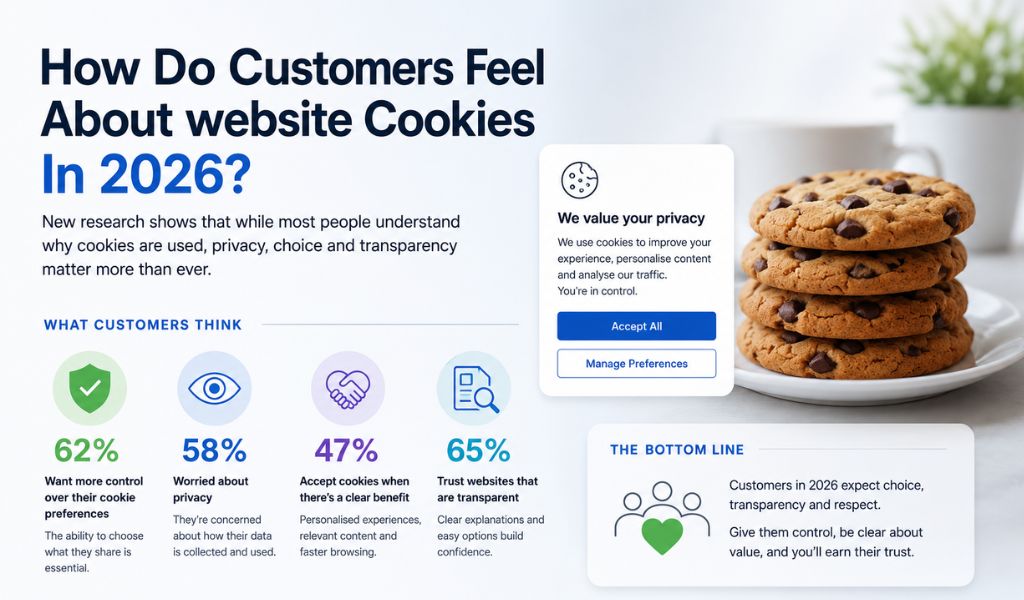

AI results might mention terms like “consent fatigue” and say that people are tired of cookies.
But what does the evidence actually show? Are people sick of reading (or skimming) privacy terms, or happy enough to continually click “accept all”?
Read on to know more!
Almost every website will ask you to accept cookies. Web servers mostly produce and store them while you’re browsing.
They might include data you enter (passwords, usernames, etc.) or information that helps the site function, such as remembering your preferred language.
Cookies are such a big deal that there is a dedicated website and organization, All About Cookies, that surveyed 1,000 US citizens to find out what people knew about the subject.
The survey showed that less than 40% of people knew what cookies actually are and what they do.
Almost 90% of people noticed “hyper-personalized” ads for products they had recently researched.
To understand why 25% of internet users click “Accept All” without reading, we need to consider the psychological phenomenon known as consent fatigue.
In fact, by 2026, the average internet user will see several cookie banners daily.
These constant interruptions lead to a very annoying browsing experience.
When bombarded with pop-ups, our brains look for the easiest solution, which is usually the brightly colored “Accept All” button.
Besides, digital platforms exploit this exhaustion through manipulative user interface designs, so-called “dark patterns”.
Website developers deliberately make cookie banners very complicated to deny.
While accepting cookies is only one click away, rejecting them is a different story and might require going through hidden sub-menus, toggling dozens of partner switches, or reading very confusing double-negative statements.
This uneven design choice is evidence that collecting user data is often prioritized over obtaining real, informed consent.
24% of those surveyed blindly accepted cookies. This despite the fact that only 15% of users were “very confident” about their understanding of cookies.
29% were “somewhat confident”, and 24% were “mostly confident”.
As the surveyors noted, with anything private, it’s important for people to know how their data may be used depending on their choices.
Over half of respondents believed that cookies were used to collect site usage analytics (which is true in many cases), but 13% had no idea.
That lack of awareness may lead to serious privacy concerns.
France’s national protection authority fined Google and e-commerce company Shein $379 million and $175 million for violating cookie rules.
The onus is often on the user to handle their privacy.
Browsers such as Brave automatically block cookies, but there is no guarantee that companies will honor people’s choices.
Those interested in more secure internet access may want to see why many users recommend ExpressVPN.
In May, ChatGPT sent an email to its users explaining how it would “use browser cookies to promote” the company’s products, but the changes would “not impact” conversations in ChatGPT.
Wired reported that details collected may soon be used to market the same services.
Data usage now includes third-party promotions, with the company sharing “limited information.”
Users can opt out under Settings > Data Controls > Marketing Privacy.
A US jury found Google had violated people’s privacy by collecting browser cookies even after they had opted out of tracking.
The decision came only last fall and was the result of a lawsuit filed in 2020. Google said the ruling had misunderstood how its products work.
In 2024, Google won a challenge against the EU after a €1.49 billion fine was issued for blocking other search advertisers. BBC described it as a “rare legal win” for Google.
The tech giant was fined €8.2 billion between 2017 and 2019 for violating antitrust laws. It failed in overturning those fines.
Also in 2024, as per a US judge’s ruling, the company illegally blocked rivals from being the default search engine on certain devices by paying billions of dollars to Apple and other firms.
In May this year, Google appealed the decision, arguing that the judge made legal errors.
The company said it dominated the market with a “superior search engine” that took hard work and innovation. The Department of Justice declined to comment.
For years, the tech industry has been facing the total deprecation of third-party browser cookies, the tracking files set by a website other than the one you are currently on.
Web browsers like Safari and Firefox blocked them years ago.
The landscape changed when Google altered its strategy and gave users an explicit choice in Chrome.
This paradigm shift has forced businesses to pivot toward “first-party data” and “zero-party data.”
Information collected directly from user interactions on a company’s own website.
Information that a customer intentionally and proactively shares with a brand (e.g., preference center choices, survey responses).
They respond much better to transparent data collection, since consumers are highly suspicious of covert tracking.
If a brand explicitly explains that it is remembering a user’s style preference to offer a better discount, the consumer feels valued rather than tracked.
Since corporate compliance with laws remains uneven, it is up to consumers to protect their data privacy.
In case you are thinking about safeguarding your digital footprint in 2026, you should follow the security checklist below:
Allow GPC in your browser to automatically communicate your privacy preferences to each website you visit.
Go for browsers such as Brave, DuckDuckGo, or Mullvad that block cross-site trackers without any extra setup.
Leverage open-source browser add-ons that erase browser cookies as soon as you shut a browser tab.
At intervals, open the data privacy and marketing settings in your AI software to opt out of third-party promotional communications.
In the end, companies will see mixed consumer feelings towards browser cookies in 2026.
On the one hand, users want digital privacy.
They are angry about how hyper-personalization of ads are subjecting towards them through tracking of their online behavior.
On the other hand, the fatigue from constantly giving consent to different things on all sorts of websites and apps.
This causes them to almost mindlessly click the very buttons that compromise their data.
Unless there is a global regulation that completely forbids manipulative dark patterns, practicing proactive digital hygiene will be the user’s only and strongest weapon.
Barsha is a seasoned digital marketing writer with a focus on SEO, content marketing, and conversion-driven copy. With 8+ years of experience in crafting high-performing content for startups, agencies, and established brands, Barsha brings strategic insight and storytelling together to drive online growth. When not writing, Barsha spends time obsessing over conspiracy theories, the latest Google algorithm changes, and content trends.
View all Posts

Master The Rich Result Test: Fix Your Broken ...
Oct 08, 2026
Does vnROM Bypass Still Work? A Realistic 202...
Oct 08, 2026
Event Pages That Rank And Convert: A Practica...
Oct 06, 2026
KeywordStat Review: Keyword Research, Cluster...
Oct 03, 2026
How Corda Turns Authority Data Into Campaigns
Oct 01, 2026