The Ultimate Guide To Stealing Your Competitors’ Backlinks Using Curated Resource Lists
Oct 15, 2026

Search is no longer limited to a list of blue links. And frankly, you knew this was coming.
Today, anyone can directly go to ChatGPT and ask about the best keyword research tool or look for a laptop that is worth buying now. Similarly, someone can also go to Claude for a complete itinerary to Pondicherry.
The answers are more direct, and it doesn’t point you towards ten different sites for a change – it is more convenient and does save a lot of time from a research perspective.
And that changes what it means to be visible online.
In this context, a business can rank well and still go unmentioned in an AI-generated answer.
Another business may have fewer traditional rankings but appear repeatedly when people ask questions about its category.
This is where AI visibility comes in.
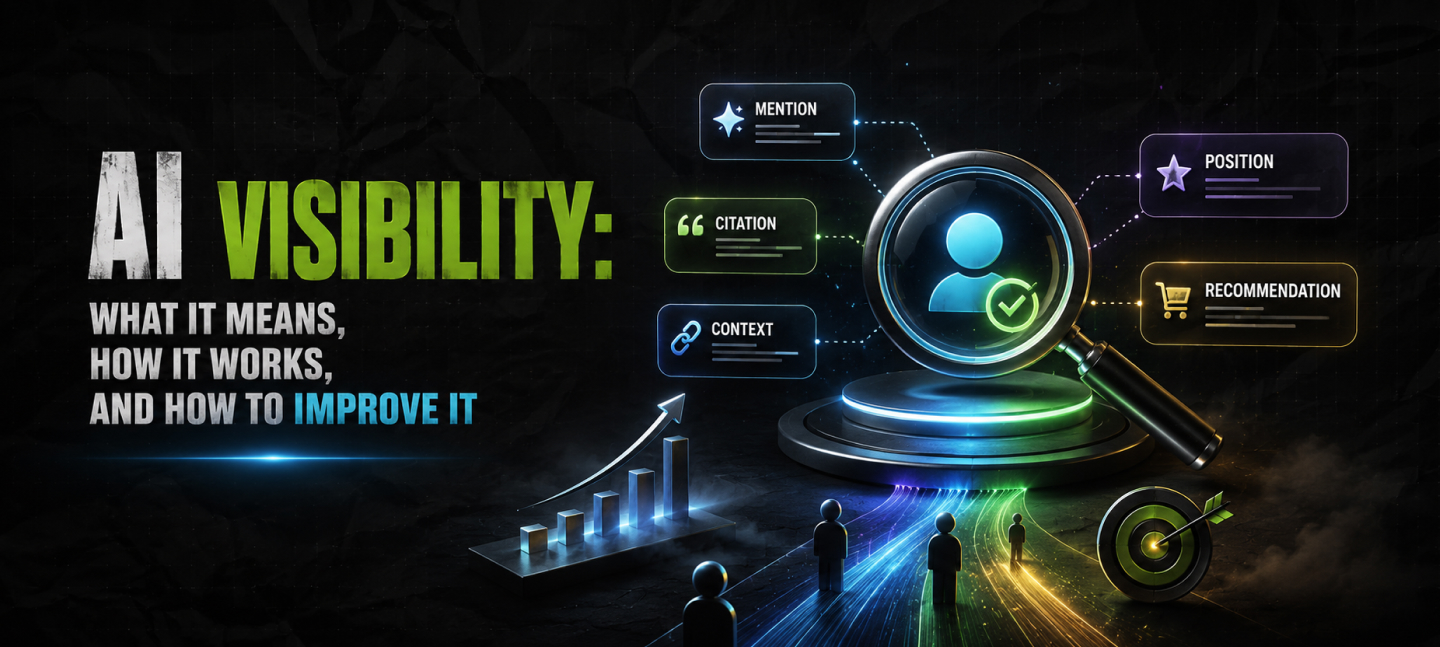
AI visibility measures how often and how prominently a brand, website, product, or organization appears in answers generated by AI-powered search and answer systems.
It sounds similar to SEO. But the underlying question is different. So, while your traditional SEO strategy will ask you whether it can rank for a particular query, AI visibility asks whether an AI system recognizes, trusts, and mentions my business when someone asks about this topic.
And that distinction has become so much more important, especially in the context of evolving search behavior.
Today, I’ll breakdown AI visibility, discussing how it works and, more importantly, how you can make the most of it in 2026.
Stay tuned.
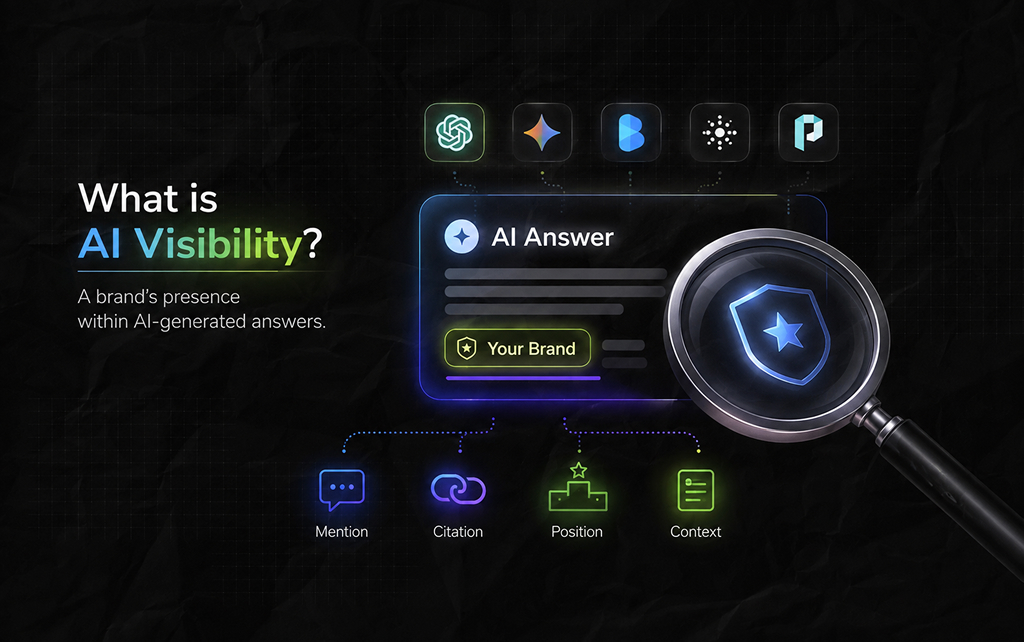
AI visibility is a brand’s presence within AI-generated answers.
These answers can come from systems such as ChatGPT, Google AI Overviews, Microsoft Copilot, Perplexity, and other AI-powered search experiences.
So, a visible brand might appear as:
Visibility is not simply about whether your website appears.
The AI might mention your brand without showing your homepage. It might cite a third-party page that talks about your company.
Also, it might describe your product without linking directly to you. So AI visibility has several layers, and I’ve tried to highlight them below.
That last part matters more than many businesses realize.
Being mentioned as ‘one option’ is not the same as being described as ‘a strong choice for small businesses.’
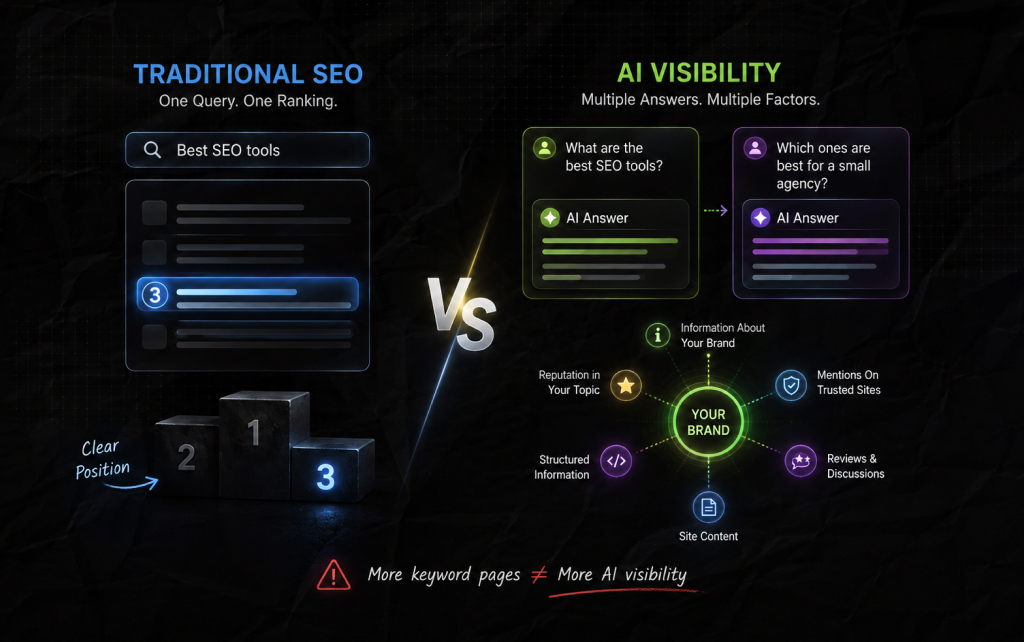
Traditional search usually gives you a ranking to track. So, if your page ranks at no.3 for a keyword, then you have a clear position.
However, AI answers are less predictable.
The same user can ask, ‘What are the best SEO tools?’ Then follow up with, ‘Which ones are best for a small agency?’
The second answer may contain a different set of brands.
The system has interpreted the user’s intent and generated a new response. That means AI visibility depends on more than keyword rankings.
Also, it can be influenced by things such as:
This is why simply publishing more keyword-focused pages may not improve AI visibility.
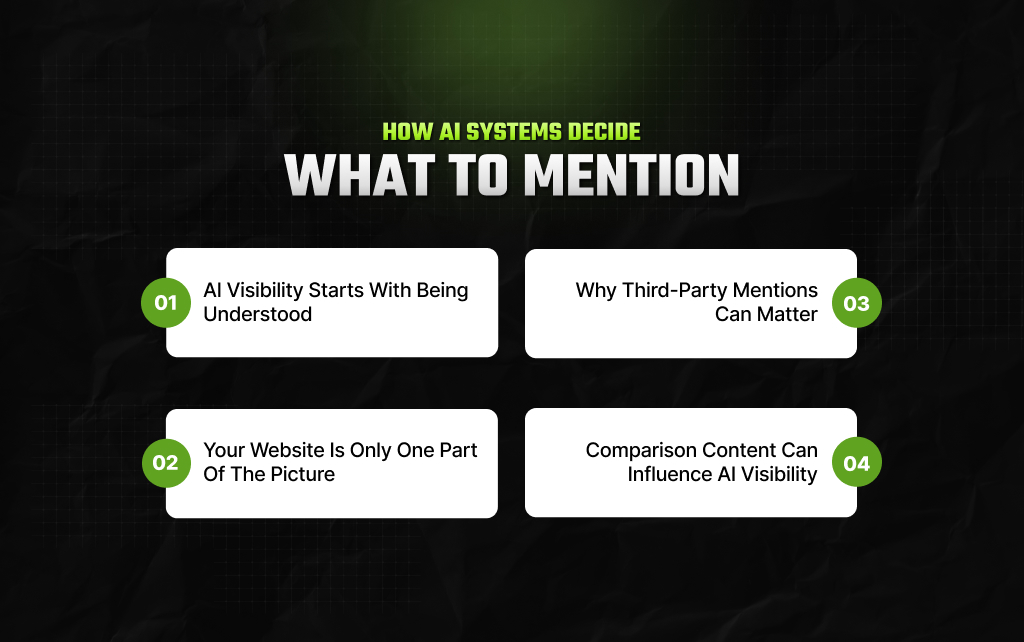
No single formula tells us exactly why an AI system mentions one brand instead of another.
Different systems use different models, search indexes, retrieval systems, ranking signals, and generation processes.
Still, there is a useful way to think about the process.
As a result, when someone asks an AI system a question, it needs to: Understand the question → find relevant information → assess that information → construct an answer.
Your brand has to become useful somewhere in that chain.
If the system cannot confidently determine what your company does, it has less reason to mention you.
Also, if reliable sources consistently associate your brand with a particular topic, the system has more information from which to form an answer.
This makes entity understanding particularly important.
So, for starters, consider two companies.
The first has a clear website that explains, “We provide payroll software for small businesses in India.”
Also, the site also contains detailed information about payroll compliance, employee onboarding, salary calculations, and integrations.
Now, the second company simply says, “We make business better through innovative technology.”
Which company gives an AI system more useful information? Of course, the first one. The AI does not have to guess what the business does.
Why? Because clear language helps machines connect the company with specific topics, problems, products, and audiences.
That is one reason vague brand messaging can become a visibility problem.
This is where AI visibility becomes more interesting than traditional on-page SEO. An AI system may encounter information about your company outside your own website.
For example, your brand might appear on:
These sources can help build a broader picture of your brand. That does not mean you should create hundreds of mentions or pay for random placements.
The goal is not more mentions at any cost. Instead, the goal is credible information from relevant sources.
Imagine an AI system is asked, “What are good email marketing platforms for small businesses?” Now, your website says you are an email marketing platform.
That’s useful.
But imagine several independent websites also describe your product as an email marketing platform for small businesses.
Also, the same association exists across multiple sources. In that case, the AI system has more context.
This is why AI visibility overlaps with areas such as digital PR, brand building, reputation management, reviews, and authority-focused SEO.
The important shift is that you are not only optimizing your website. You are building a clearer digital footprint for your brand.
AI systems frequently answer comparison-style questions. So, users want to know:
That makes comparison content valuable. But there is a catch.
If every comparison page says, ‘Our product is better because we are amazing,’ then the content provides little independent value.
Also, useful comparison content should discuss real differences.
And that could include:
Readers can make a better decision. And AI systems also have clearer information to work with.
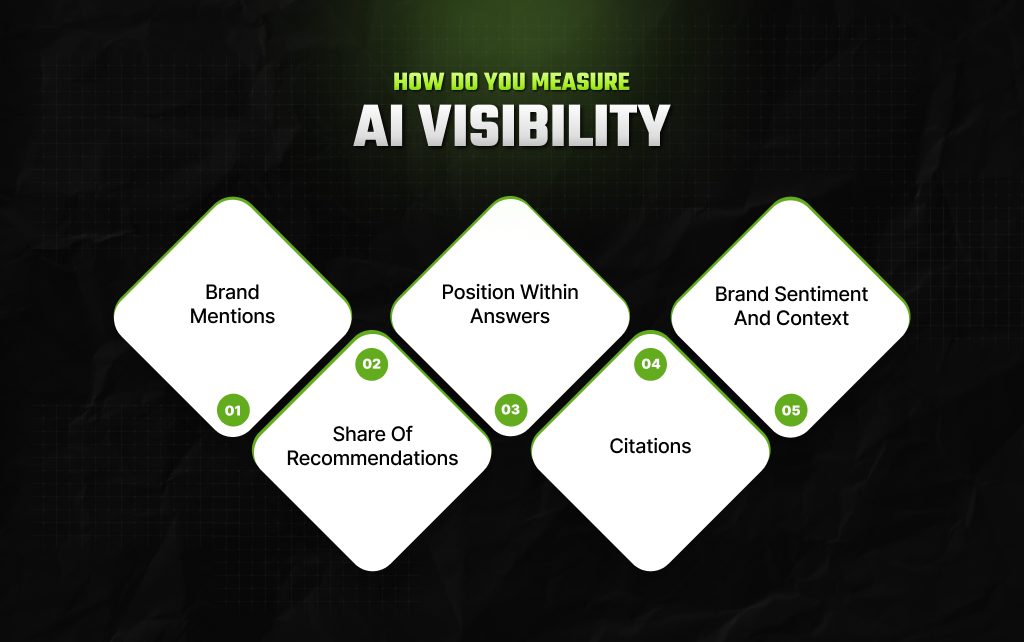
There is no single universal AI visibility score. Instead, track several signals, and I’ve done my best to highlight how you can measure your AI visibility score.
Test relevant questions and record how often your brand appears. For instance, it could be something like:
Then, track the results over time.
If an answer lists ten brands and yours appears, that’s useful information. You can track how often your brand appears compared with competitors.
Being mentioned first may carry more weight than appearing at the end of a long list. As a result, track where your brand appears.
If the AI system provides citations, check whether your website or other credible sources about your brand appear.
Don’t stop at counting mentions.
Instead, look at how the AI describes your company, and find out whether it is:
Context can reveal opportunities that a simple mention count misses.
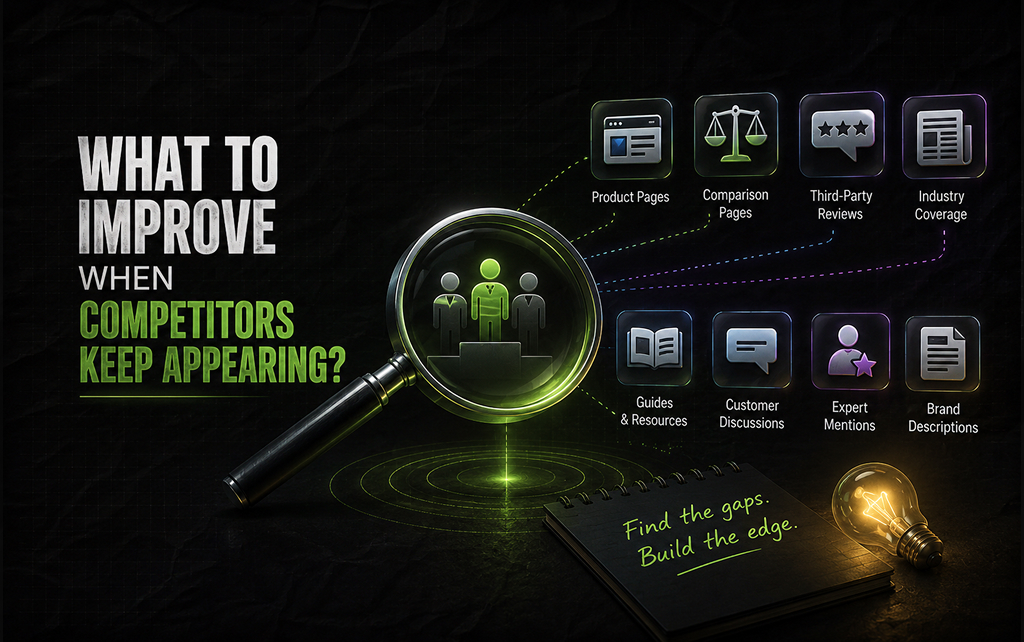
So, suppose you discover that three competitors appear repeatedly for your target questions. Don’t immediately publish another 20 blog posts.
First, investigate their digital footprint. And while doing so, look at:
You may discover that competitors have something you don’t.
Perhaps everyone describes them as a solution for startups. Perhaps several publications compare them with the same alternatives.
Also, perhaps their website clearly explains a feature that your site barely mentions. That gap gives you a much more useful content strategy.
There is a temptation to turn AI visibility into another checklist, something like:
That approach misses the point.
AI systems are trying to answer people’s questions. As a result, your job is to make your brand genuinely useful within those conversations. And that means building information that is:
The goal isn’t to force an AI to mention you. Instead, the goal is to become a credible answer when your category comes up.
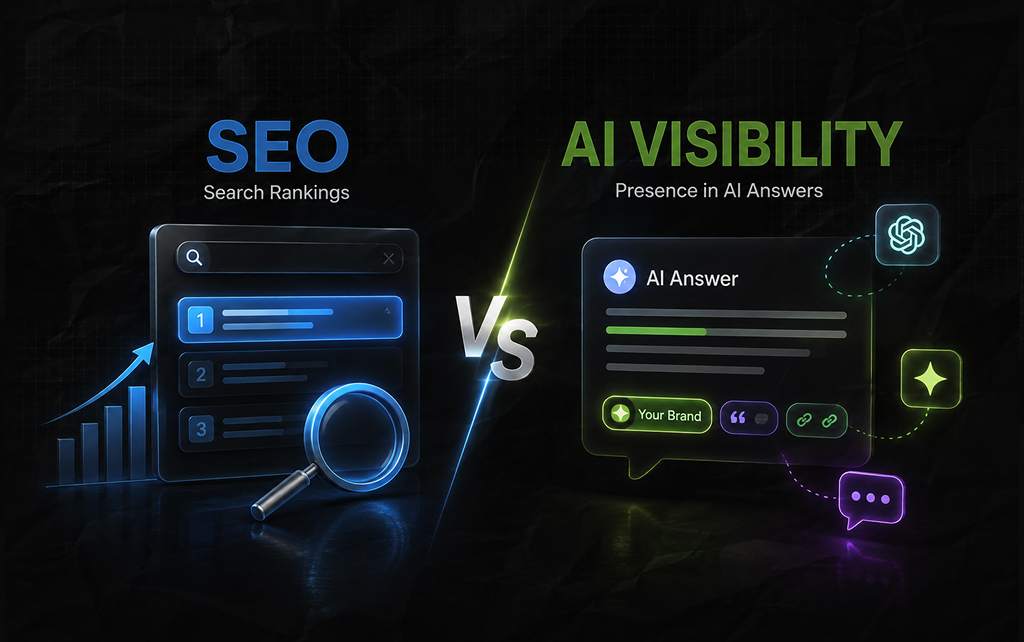
In this section, I’ve made a table to highlight the differences between AI visibility and SEO – that way, you will understand the major differences between the two at a glance.
| SEO | AI Visibility |
|---|---|
| Focuses heavily on search rankings | Focuses on mentions and representation in AI answers |
| Often targets keywords | Often targets questions and user needs |
| Measures positions and clicks | |
| Website is central | Website plus broader digital footprint |
| Search results are relatively structured | AI answers can change based on context |
| Traffic is a major outcome | Discovery and brand recall can matter even without a click |
These aren’t competing strategies. Why? Because good SEO can support AI visibility. But AI visibility requires you to think beyond rankings.
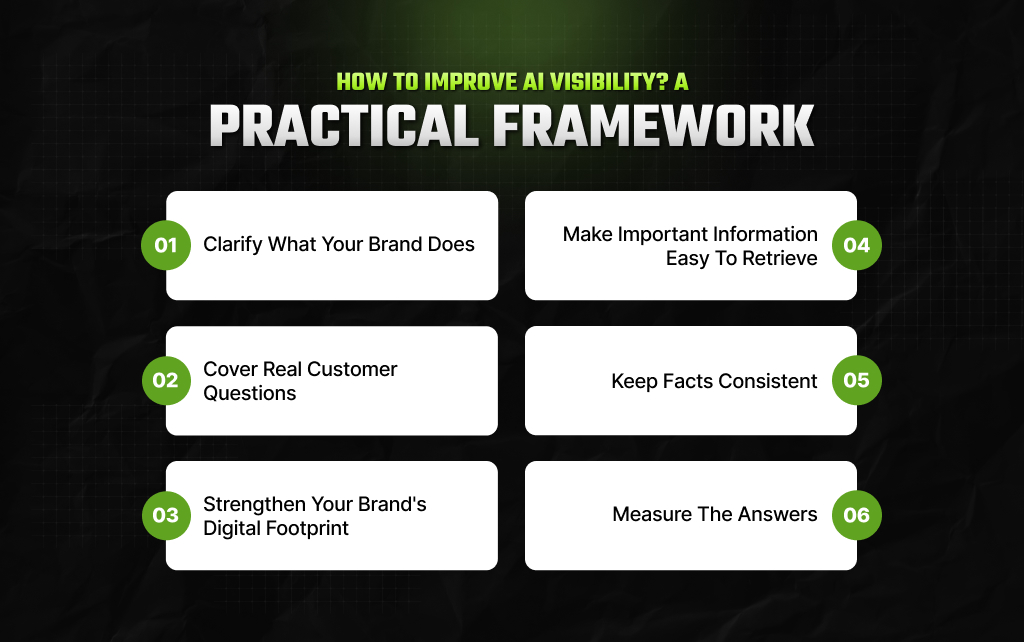
So, if you want to improve your brand’s visibility in AI search, start with these six areas.
1. Clarify what your brand does: Make your products, audience, category, and use cases obvious.
2. Cover real customer questions: Build content around decisions, problems, comparisons, and use cases.
3. Strengthen your brand’s digital footprint: Earn relevant mentions, reviews, coverage, and references from credible sources.
4. Make important information easy to retrieve: Use clear headings, direct explanations, useful tables, and specific language.
5. Keep facts consistent: Make sure important business and product information doesn’t contradict itself across the web.
6. Measure the answers: Test realistic prompts regularly and track mentions, citations, position, and context.
This gives you a much clearer picture than simply asking whether your website ‘ranks.’
For years, digital visibility meant getting a page onto the first page of Google. And that still matters.
But people are increasingly discovering information through interfaces that summarize, compare, recommend, and answer questions for them.
The winning brands won’t necessarily be the ones that publish the most content.
They’ll be the ones that are easy to understand, consistently discussed, genuinely useful, and trusted within their category.
That is what makes AI visibility different. You aren’t only trying to win a position on a results page.
Instead, you are trying to become part of the information an AI system uses when it explains a topic to someone who is ready to learn, compare, or buy.
And that makes AI visibility less about chasing an algorithm and more about building a brand that deserves to be found.
Barsha is a seasoned digital marketing writer with a focus on SEO, content marketing, and conversion-driven copy. With 8+ years of experience in crafting high-performing content for startups, agencies, and established brands, Barsha brings strategic insight and storytelling together to drive online growth. When not writing, Barsha spends time obsessing over conspiracy theories, the latest Google algorithm changes, and content trends.
View all Posts

The Ultimate Guide To Stealing Your Competito...
Oct 15, 2026
Beyond The Basics: Master Guest Posting For H...
Oct 15, 2026
Best Generative Engine Optimization (GEO) Com...
Oct 14, 2026
Digital PR for Link Building: How To Earn Hig...
Oct 13, 2026
Cracking The Code Of The Social Media Saga Si...
Oct 13, 2026