Master The Rich Result Test: Fix Your Broken Schema Markup
Oct 08, 2026


As someone who has spent over eight years in the content/SEO industry, I’ve been part of so many discussions where people complain about their domain authority not going up.
In fact, the moment my DA started going up recently on my relationship blog, Swipe Right Stories, I was so excited.
Because an increase in DA almost always leads to a spike in organic traffic. It sounds logical. After all, a higher score should mean a stronger website, right? Not really!
I’ve seen so many sites with a DA below 30 outrank authority sites with a DA over 70. Then there are authority sites that struggle to rank simply because their content fails to answer search queries.
If DA was directly in charge of rankings on Google, then these situations wouldn’t happen – but why? Because your DA is not really a ranking factor.
Instead, it’s just a metric that Moz made to evaluate a site’s ranking potential against competitors on SERPs based on factors like backlink profile.
That does not make DA entirely useless. Also, it doesn’t make it the score that decides whether your website reaches page one.
The problem is that many people confuse a prediction tool with Google’s actual ranking system.
Today, I’ll break down domain authority and discuss what it really measures and why it continues to be relevant in the SEO landscape in 2026.
Stay tuned.
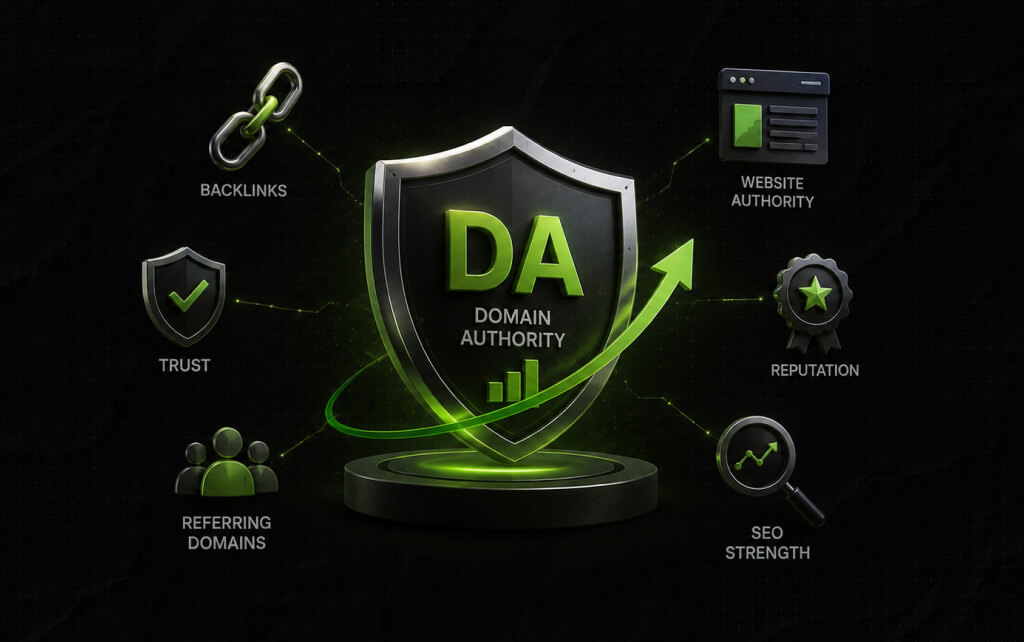
Domain Authority, A.K.A DA, is a type of metric made by Moz to estimate the potential of a site to perform in search results in comparison to other sites.
This score ranges from 1 to 100.
Generally, a high DA means the website has a strong backlink profile. This, in turn, gives the site more potential to compete for high-difficulty keywords.
While all that’s great, you need to pause for a moment and think about the word ‘estimate.’ So, your site’s DA will not tell you where your content will rank – or whether it will rank tomorrow or the day after.
Also, your DA is not a score that Google has given to your site. That is why you need to look at DA as a forecast – right now, you are looking at it as a guarantee.
For example, if the weather forecast predicts a 90% possibility of rain. And you will probably carry an umbrella. But then it doesn’t rain because it was a forecast, not a guarantee.
Domain Authority works in a similar way. It predicts competitive strength based on available data. It doesn’t decide search rankings.
Years ago, SEO professionals needed a practical way to compare websites. Google didn’t publish a public score showing how authoritative one domain was.
So SEO software companies built their own metrics. Moz introduced Domain Authority to help marketers answer questions like:
Those questions are still relevant today.
What’s changed is how some people interpret the score. Instead of treating it as one data point, many began treating it as the goal itself.
That’s where confusion started.
No, domain authority is not a ranking factor for Google.
And it’s not like Google hasn’t repeated this point several times over the years since this confusion continues to dominate the world of search.
Google doesn’t look at your website and think: “This domain has a DA of 62, so let’s rank it higher.”
That’s simply not how its ranking systems work.
Google uses its own signals to evaluate pages. And as someone who works on creating content that ranks, I can tell you those signals include several factors like:
Plus, Moz can’t access the ranking algorithm of the search engine giant. It builds Domain Authority using its own data and its own model.
That’s why you should never assume your DA score reflects how Google views your website.
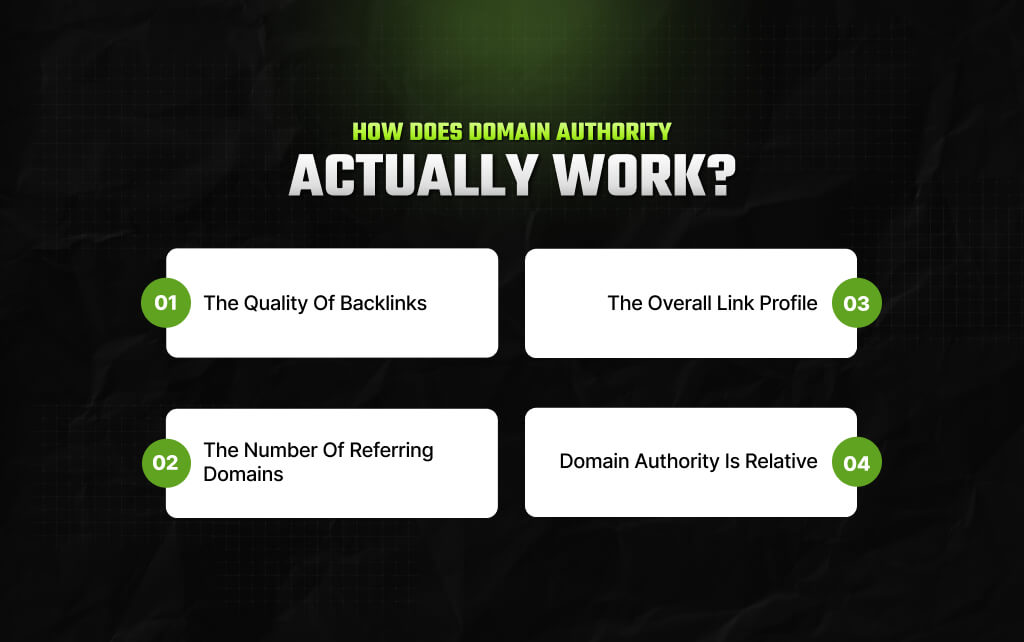
Moz does not calculate a site’s DA by just counting the total number of backlinks.
Instead, its ranking system takes into account different signals and figures out the relative strength of the site.
While the exact factors and formula are not public, I know about some of the factors that play an essential role – and I’ve tried to break down those factors in detail below.
Of course, not every backlink is the same. So, if you think you just need to increase backlinks to increase your DA, you are wrong.
You have to focus on the quality of backlinks – are these links from credible and relevant sites? Because even if you get a handful of links from relevant sites, then it’s more valuable than hundreds of low-quality links from unrelated blogs and directories.
This is super important – it’s not really a good idea to get multiple links from one source. It doesn’t really look genuine, and your DA will unfortunately not go up just because you got a bunch of links from one source.
So, you need a diverse profile since it suggests broader recognition across the web.
Moz also looks at the overall strength of your backlink profile.
This includes patterns such as how links are distributed across the website and the relative authority of the sites linking to you. Again, remember that this is Moz’s interpretation of authority.
It isn’t Google’s.
One detail often surprises beginners.
Your DA score can change even if your website doesn’t. Why? Because Domain Authority is calculated relative to other websites in Moz’s index.
So, if several websites in your niche improve their backlink profiles and you continue to be the same, then your score will drop.
Similarly, if the competition changes, then your score will increase. And that’s why you shouldn’t waste time overthinking minor fluctuations.
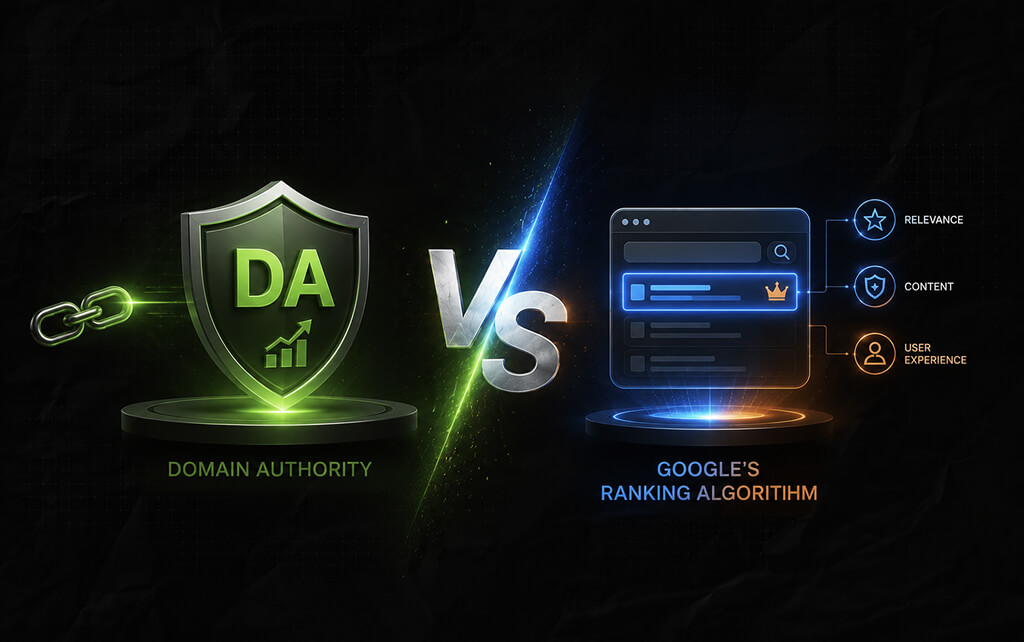
I thought it would be great if I clarify this once and for all – I’m so tired of getting misled by such discussions on forums and in conference rooms.
Google’s ranking algorithm and DA aren’t the same things – they don’t measure the same thing. On that note, here’s a simple way to look at it.
| Domain Authority | Google’s Ranking Systems |
|---|---|
| Created by Moz | Created by Google |
| Estimates domain strength | Evaluates individual pages and websites for search |
| Based largely on backlink data | Uses many ranking signals, not just links |
| Useful for competitive analysis | Determines actual search rankings |
| Doesn’t decide where you rank | Directly influences search results |
In the table, do you see that something is missing from the left column? There’s literally nothing saying that a higher DA can guarantee your ranking on SERPs.
That’s because Domain Authority was never designed to do that – it is a benchmarking tool. In contrast, Google’s ranking systems exist to answer a completely different question: “Which page is most helpful for this search?”
Are those two objectives similar? Not really.
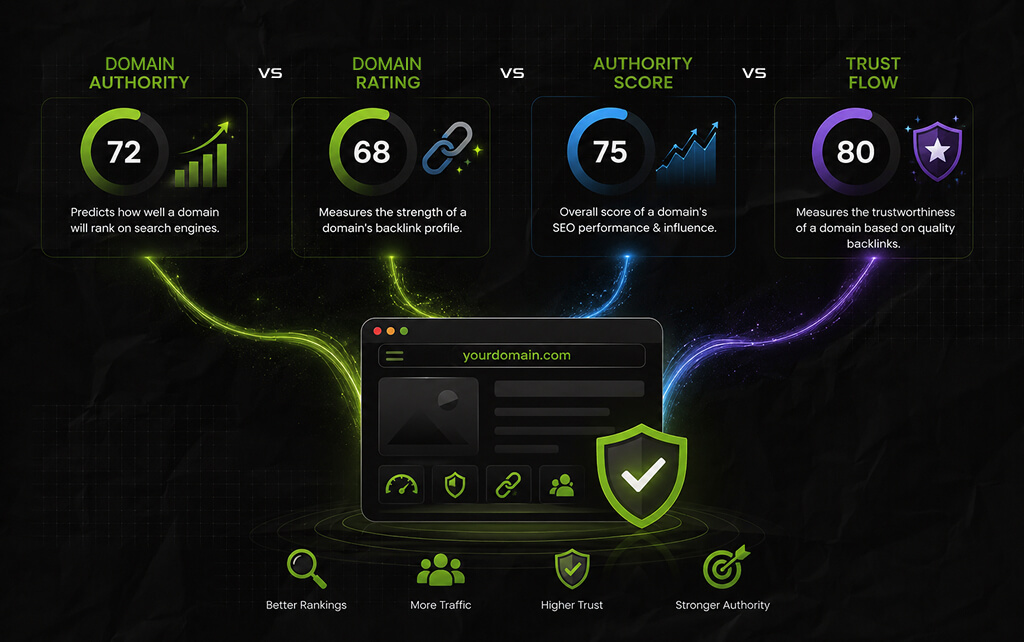
Spend five minutes inside popular SEO tools, and you’ll notice something strange. So, one site might have DA as 58, DR as 71, authority score as 46, and trust flow as 29.
Now, which data is actually correct? TBH, all of them and none of them!
Since each metric has been made by a different company with its own formula and database, you can’t compare these scores against each other directly. It just creates confusion.
So, I am here to clear that confusion with this simplified table.
| Metric | Created By | Primary Focus | Does Google Use It? |
|---|---|---|---|
| Domain Authority (DA) | Moz | Predicts a domain’s ability to compete in search | No |
| Domain Rating (DR) | Ahrefs | Measures backlink strength based on referring domains | No |
| Authority Score | Semrush | Combines links, traffic signals, and other quality indicators | No |
| Trust Flow | Majestic | Measures the quality and trustworthiness of backlinks | No |
| Google’s Ranking Signals | Evaluates pages using hundreds of ranking signals | Yes |
Notice something important: Every third-party metric exists to help marketers understand websites. But none of these scores represents the actual scoring system of Google.
This is where many articles become too extreme.
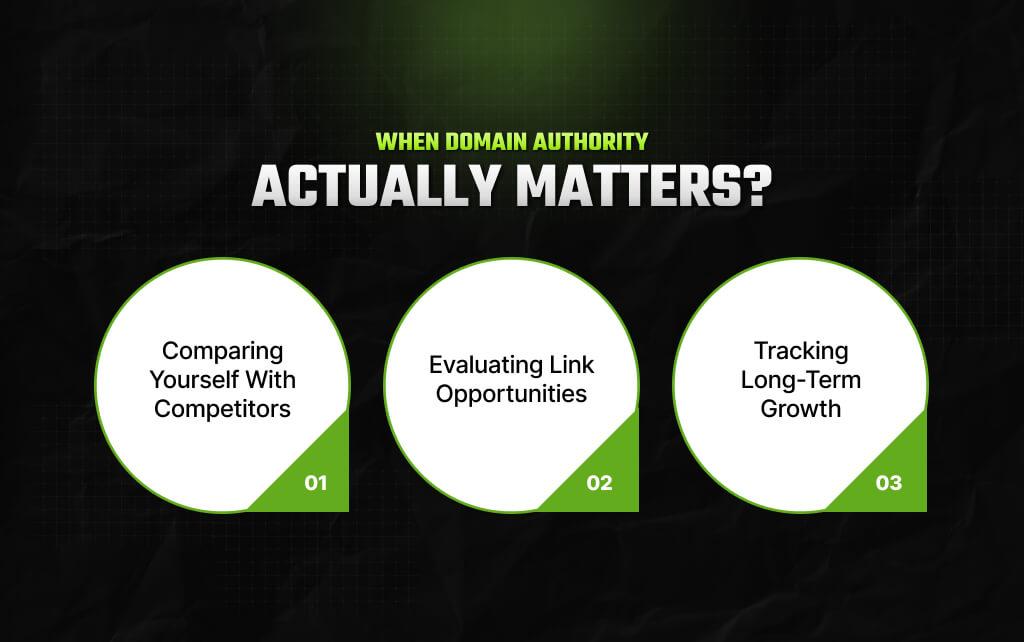
Some claim Domain Authority is everything. Others dismiss it completely. But the truth is DA sits in the middle of both these POVs. There are situations where DA is genuinely useful. You just need to know what those situations are.
Suppose you launch a new website about home gardening.
One competitor has a DA of 18. Another has a DA of 74. Without reading a single article, you already have a rough idea which website may have spent years building authority.
That doesn’t mean you can’t outrank it. It does help you understand the level of competition.
Imagine two websites invite you to contribute a guest article. Both look relevant. Both have engaged audiences.
Checking Domain Authority can provide another piece of information before making your decision. But it should not be the only factor that you take into account in such situations.
Apart from the DA, you must consider:
A relevant website with moderate authority often provides more value than a high-DA website that’s completely unrelated to your industry.
Tracking your DA can help you pinpoint patterns you might otherwise miss. For instance, if you can see your DA is steadily increasing over one year, it indicates that your backlink profile is becoming stronger.
And that is a super useful context, as long as you don’t start thinking your entire strategy is working. Because your DA has no link with your traffic, rankings, or even conversions.
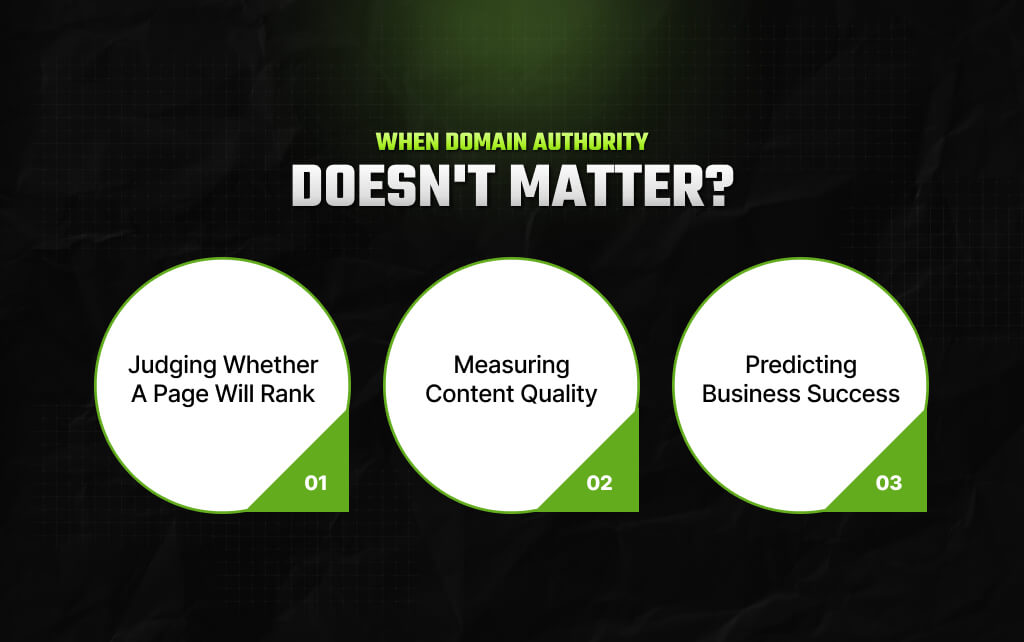
Now let’s look at the situations where people rely on DA far too heavily.
This is probably the most common misconception about having a high DA.
While comparing two sites, so many professionals assume that the site with the higher DA will rank first automatically.
Search results prove otherwise. Google ranks individual pages. Not every page on a high-authority website is exceptional.
Similarly, not all pages of a newer or smaller site are weak. So, if a page answers a search query better than high-authority sites, then it will outrank all of them and sit at the top of search results.
After working on so many sites and spending so many years in the content/SEO landscape, I can tell you that a site with a strong backlink profile can continue to publish average content.
And it is more common than you would think.
But the truth is Google will never reward pages because the site has a strong backlink profile – the content needs to qualify as ‘helpful’ under Google’s stringent content policies.
Some agencies still sell SEO services by promising higher Domain Authority. That’s the wrong goal.
Businesses don’t invest in SEO to increase a score. They invest to generate more visibility, inquiries, leads, and revenue.
A DA increase without business growth is just another number on a dashboard.
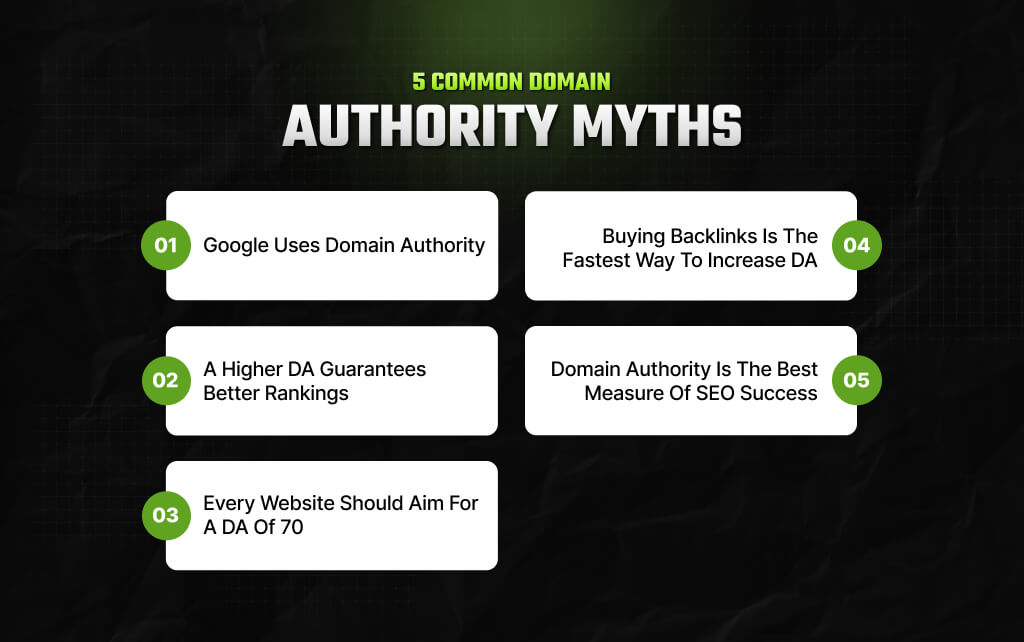
Let’s clear up a few misconceptions that continue to circulate in the SEO industry.
No. Domain Authority belongs to Moz. And Google has repeatedly mentioned that it does not care about DA – it’s not a ranking factor in the eyes of Google.
No. A high DA definitely improves a site’s potential to compete. But it cannot GUARANTEE that a page will rank on top of SERPs just because the competing sites have a low DA.
Context matters. A local plumbing business doesn’t need the same authority as a global news website.
It might increase your score temporarily. But that does not mean it will improve your site’s overall performance in search results.
To explain this, I’ll just suggest you ask yourself: which option is better for you: “A DA of 80 and declining organic traffic?” or “A DA of 28 with steadily growing leads and revenue?”
Most business owners wouldn’t need long to answer. SEO success isn’t measured by one number. It’s measured by results.
Domain Authority has survived for nearly two decades because it’s useful – Not perfect. Not essential. But useful.
It gives marketers a quick way to compare websites, estimate competition, and understand the relative strength of a backlink profile.
That’s valuable information.
Problems begin when people assume the number reflects Google’s opinion of their website. It doesn’t.
Also, Google has never ranked pages because they reached a particular Domain Authority score.
Instead, it evaluates whether a page is relevant, helpful, and capable of satisfying the person performing the search.
That’s why websites with modest DA scores continue to outrank much larger competitors every day. They answer questions more clearly. They build expertise within a topic. And they create experiences people genuinely find useful.
If there’s one lesson to take away from this guide, it’s this: Don’t chase Domain Authority. Chase the reasons Domain Authority tends to improve.
So, create content people want to read. Earn links because your work deserves attention. Build expertise within your niche. And measure the outcomes that actually grow your business.
When you focus on those fundamentals, Domain Authority becomes a by-product of good SEO rather than the goal itself.
Barsha is a seasoned digital marketing writer with a focus on SEO, content marketing, and conversion-driven copy. With 8+ years of experience in crafting high-performing content for startups, agencies, and established brands, Barsha brings strategic insight and storytelling together to drive online growth. When not writing, Barsha spends time obsessing over conspiracy theories, the latest Google algorithm changes, and content trends.
View all Posts

Master The Rich Result Test: Fix Your Broken ...
Oct 08, 2026
Does vnROM Bypass Still Work? A Realistic 202...
Oct 08, 2026
Event Pages That Rank And Convert: A Practica...
Oct 06, 2026
KeywordStat Review: Keyword Research, Cluster...
Oct 03, 2026
How Corda Turns Authority Data Into Campaigns
Oct 01, 2026