
The Ultimate Blueprint For Broken Link Building: How To Find Dead Links And Earn High-Authority Backlinks
Oct 16, 2026

Let’s be honest, most outreach emails pointing out dead links are trashed within 4 seconds.
“Dear Webmaster, I’ve found a dead link on your page. Please replace it with my generic homepage link,” says the mass-produced email template.
This approach is lazy, self-centered, and completely dismissive of the hectic reality web content managers live in.
But strip away the mass-produced spam and dead link building.
This is one of the few outreach tactics where you can offer a valuable resource (fixing a broken link) before asking for anything in return.
You are solving a user experience problem on their website.
When you apply a sharp filter and use customized assets, dead link building becomes a reliable tool for earning backlinks from high-quality domains.
Here is exactly how to build a modern campaign that bypasses spam filters while maintaining your industry credibility.
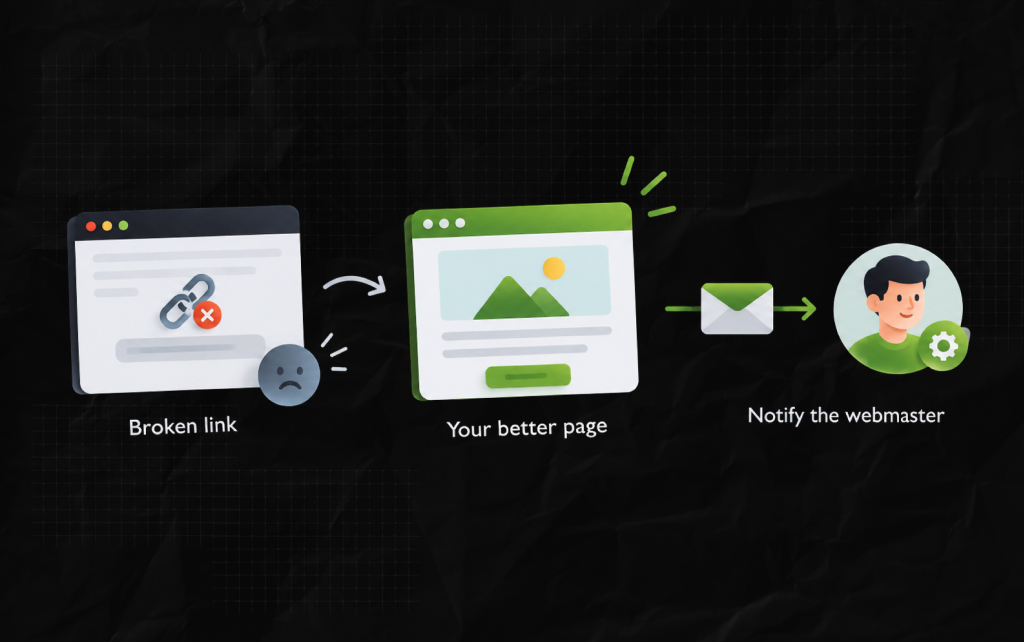
The principle is simple. Find a page in your area of interest that contains a link leading to an inaccessible external resource.
Create a better alternative to the missing page on your blog or website.
Notify the webmaster of the broken link and offer to help fix it by directing them to your page.
This trick works because it creates value for both sides. A dead-end external link hurts the user and the search engine.
By saving the resource editor from having to find a replacement for the broken link, you save them time and effort.
The main mistake digital marketers make in broken link building is trying to use every 404 error they can find.
When you invest time and money in low-quality blogs, you waste resources, and when you use dead pages, you gain nothing in algorithmic progress.
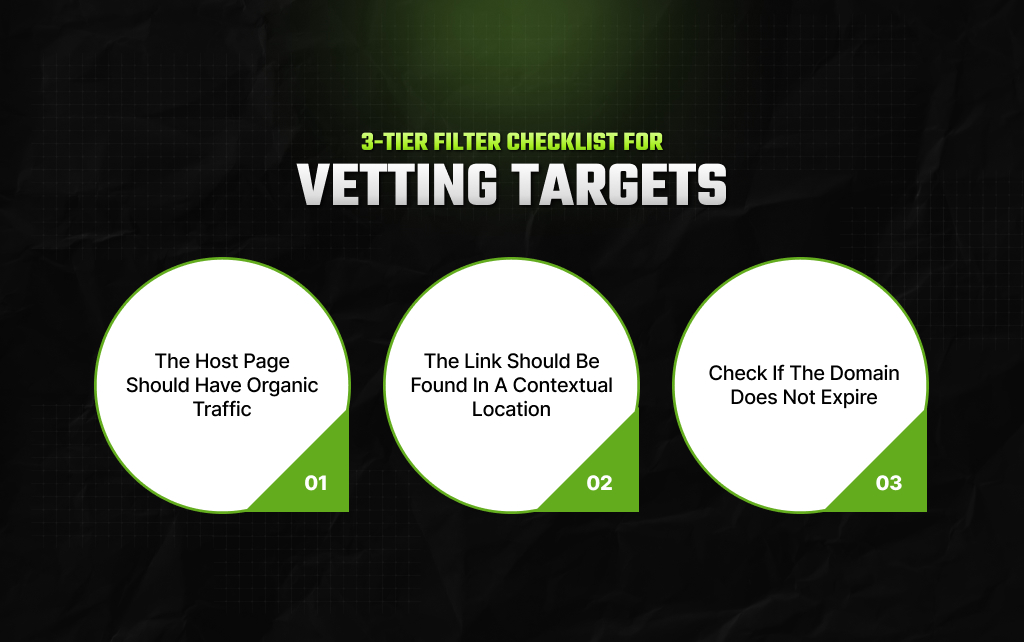
Therefore, you need to use a particular three-tier verification system to every target URL that you want to include in your marketing plan:
Even if the root domain has a substantial score, you should not consider inserting your link if the page with a dead end has fewer than 100 monthly visits.
A link on a page with a hundred hits will provide much more value than on a lonely, orphan resource.
Avoid forums, huge widgets in the sidebars, and user-comments sections. Instead, look for dead ends in the middle of high-quality articles or quality lists.
Sometimes, the problem isn’t a 404 error but a new domain bought by spammers.
In this case, it is worth double-checking if the URL you want to insert eventually points to some shady resource.
Note that such domains are often helpful because the webmaster will be glad to get rid of such a link.
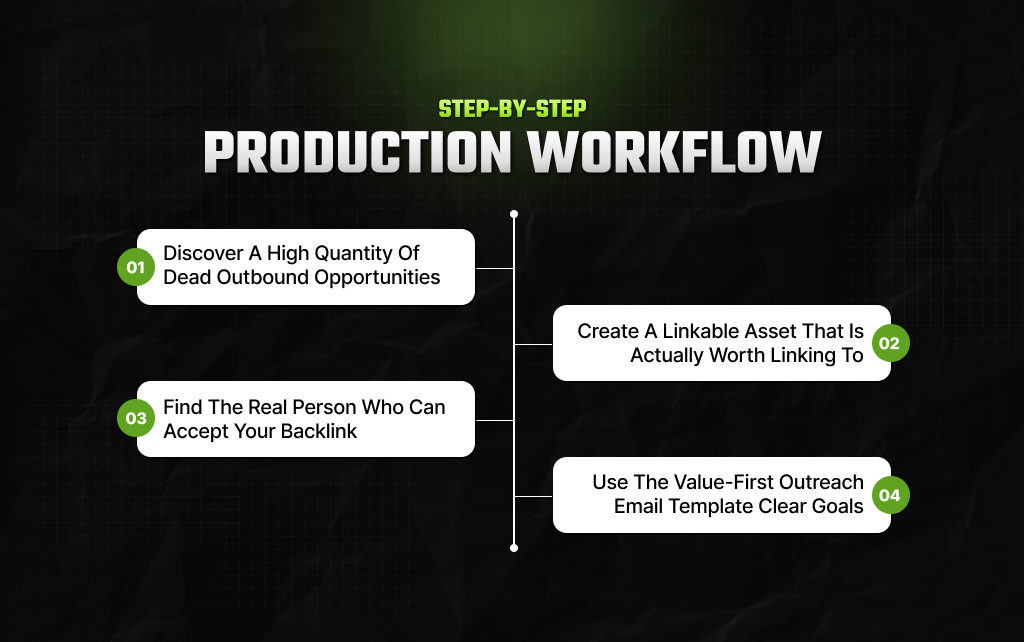
The scheme’s success depends on a combination of automated discovery and manual refinement.
Let’s look at the four-point process I use to build new outbound links.
To find a sufficient number of dead outbound link opportunities, you should look not for separate sites but at whole verticals.
To do that, use enterprise SEO tools such as Ahrefs or Semrush to analyze large websites that were recently closed or rebranded.
After that, export all the backlinks that point to the chosen website and sort them by the 404 code (dead end).
You will get a list of domains referring to the dead resource. To improve your chances of getting a backlink, sort the list by the number of referring domains.
By analyzing the URL and anchor text, you can determine the topic of the post or page to which the backlink was directed.
If possible, use the Wayback Machine to find out what the source page was exactly.
This will help you create an asset similar to the original or even significantly improve upon it.
However, it is important to understand that you need to provide more value than the deleted or redesigned page.
For example, if the original article was a simple list of definitions from 2019, create an in-depth guide and optimize it for the current year.
Finding the real person who manages editorial decisions on the target website is essential for any outreach effort.
Instead of emailing info@domain.com or using vague contact forms on the company’s website, do some research and try to find the person’s email directly.
Tools like Hunter.io or RocketReach can help.
An outreach email should make it as easy as possible for the recipient to accept your proposal.
Do not ask them to check the source page and guess which broken link you are referring to.
Instead, include all the necessary information about the problem and your proposed solution.
You can use the following template for Q4 outreach campaign performance.
Subject: Broken link on your [Topic] guide
Hi [Editor Name],
I was reviewing your guide to [Topic Name] this morning while pulling some background research for a project.
I noticed that the link you have pointing to the study on [Old Subtopic] now leads to a dead domain error page. It’s located right under your section discussing [Name of Section].
Since that original resource is completely offline, I put together a fully updated analysis that covers the exact same dataset, plus our own internal findings from this year: [Your URL]
If you want to swap it out quickly, here is a line that slots right in:
“According to recent industry tracking from [Your Brand]…”
Hope this helps keep the guide clean for your readers!
Best,
[Your Name]
While fixing dead links is an excellent tactical play, it shouldn’t be the only tool in your box.
A healthy backlink profile requires a varied mix of referral sources to look completely organic to search algorithms.
| Outreach Framework | Primary Strategic Benefit | Time Investment | Typical Conversion Rate |
| Broken Link Building | Cleans up web UX, ultra-high editorial value | Moderate | 5% – 8% |
| Guest Posting | Absolute control over anchor text placement | High | 8% – 12% |
| Resource Page Link Building | Places your brand directly on curated hub lists | Low | 3% – 6% |
| Competitor Backlink Analysis | Uncovers the exact blueprints of top rankings | Low | High (Strategic) |
If you rely entirely on dead link hunting, your growth will eventually plateau based on how many broken resources are available in your market.
You need to combine this with continuous asset creation.
For instance, regularly monitoring your competitors with deep backlink analysis will show you exactly what types of new content are naturally earning attention.
Then use those insights to shape your main content strategy.
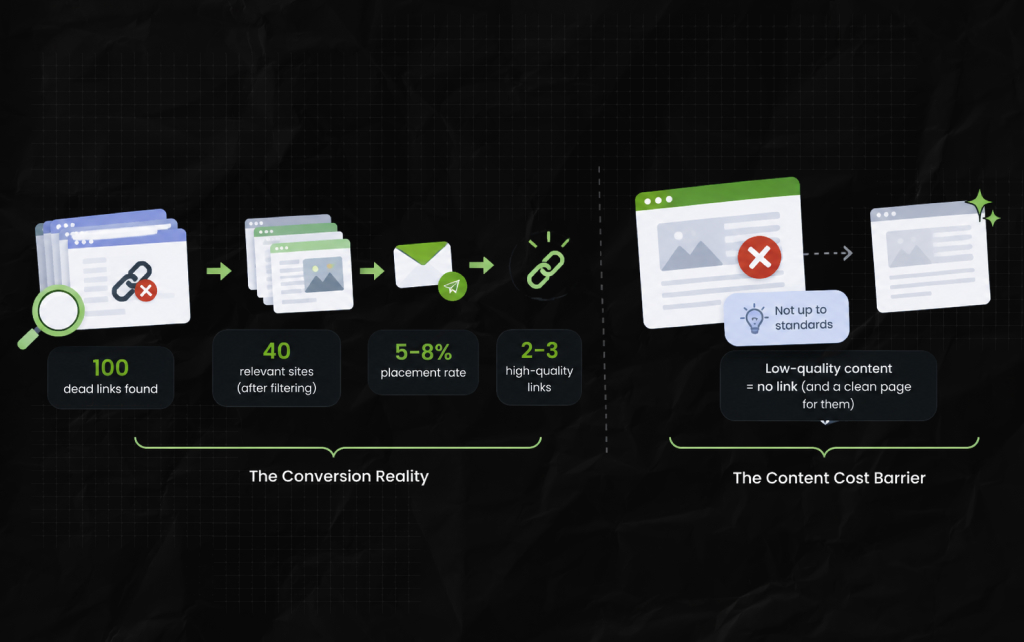
Let’s look closely at the operational trade-offs. This strategy requires massive upfront prospecting before you see a return.
Of the 100 dead links you find, roughly 40 will be on sites you want a link from once you apply a traffic filter.
With 40 pitches, you might expect 5-8% live placement. That’s a total of 2-3 high-quality links per 100 prospects.
That’s a lot of prospecting if you aren’t prepared to do hundreds.
This approach demands a serious commitment to see compounded results.
A dead link cannot be replaced by a low-value page. If your target resource list is a high-quality page, the author will manually check the dead link.
If your content doesn’t meet their standards, they’ll remove it.
They’ll take the broken link away and leave their page looking nice and clean. You get nothing, and they get a free cleanup.
Consistently building the web is the safest way to create sustainable SEO authority.
Focus on human relationships, protect brand editorial integrity, and let your content assets drive organic growth.
Piyasa is a search engine marketing strategist who has spent the last six years decoding Google's ever-changing mind. From corporate giants to neighborhood storefronts, she helps businesses cut through the digital noise and actually get noticed online. When she isn’t building SEO strategies or writing the latest search industry breakdowns for Search Engine Magazine, you can usually find her hanging out with friends - and gently reminding them that no, she cannot personally fix the latest algorithm update for them.
View all Posts

The Ultimate Guide To Stealing Your Competito...
Oct 15, 2026
Beyond The Basics: Master Guest Posting For H...
Oct 15, 2026
Best Generative Engine Optimization (GEO) Com...
Oct 14, 2026
Digital PR for Link Building: How To Earn Hig...
Oct 13, 2026
Cracking The Code Of The Social Media Saga Si...
Oct 13, 2026