Copy-Paste ChatGPT Prompts To Write Product Pages That Sell
Nov 25, 2026
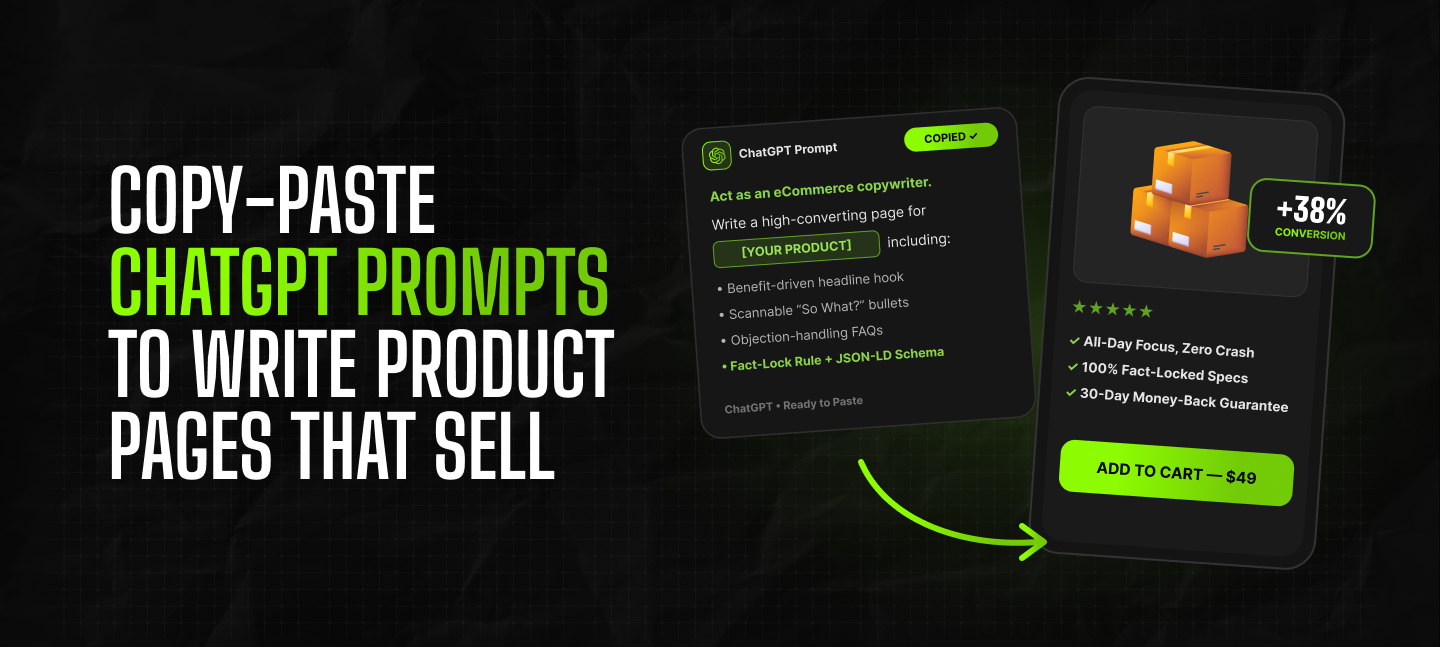

The best ChatGPT prompts for product descriptions include factual product details, an understanding of the customer’s issues, and formatting and non-hallucination guidelines.
Generic copy will not convert and is unlikely to be found in online searches.
Now, let’s say you are a Shopify retailer, work within a large business’s ecommerce department, or are a freelance writer.
Your product pages must both persuade people to buy and provide easily analyzable data for Google and AI virtual shopping aides.
Below are 20 proven ChatGPT prompts for product descriptions. You can just easily copy and paste them whenever you like. There are also live before-and-after examples and guidelines to avoid ChatGPT hallucinations.
Prior to utilizing the ChatGPT prompts for product descriptions, relate your particular product page issue to the appropriate section of the writing guidance:
Firstly, you need to utilize the AIDA and Pain Point Hook methods to halt people scrolling and convey key value. (Recommended word count – 15-30 words)
Next, apply the 3-level ‘So What?’ process to turn features into customer benefits. (Recommended word count – 15-25 words)
Third, implement Return Reason Inversion to remove concern and reduce returns. (Recommended word count – 40-60 words)
Lastly, just deploy Entity and JSON-LD Markup to gain rich snippets and AI Overview mentions. (Recommended character counts – Title – 50-60 characters; Meta – 155 characters).
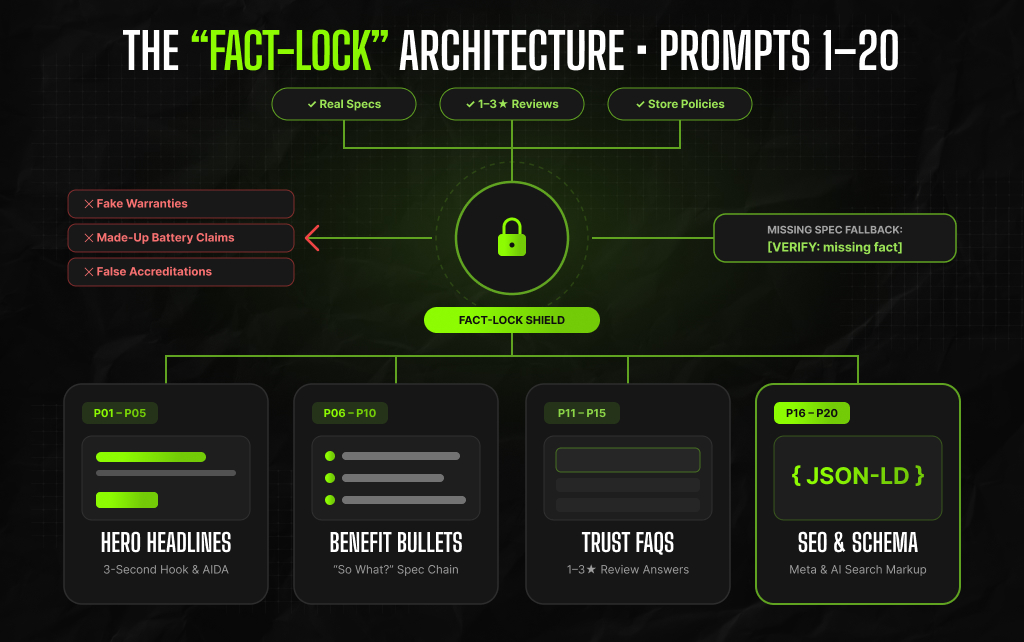
AI is highly prone to hallucinate, i.e., make up warranty details, incorrectly describe battery longevity, and falsely state that a product has certain accreditations. This can lead to both legal and customer issues.
Include this guideline in your ChatGPT prompts for product descriptions:
‘I want you to base your response fully on the facts, features and policy information I have included in my prompt. Never presume, infer or fabricate features, materials, warranty and/or performance data. Where relevant information is absent, place [VERIFY: missing fact] rather than speculate’.
As soon as someone lands on a product page, they will typically view the headline and subheadline.
Within 3 seconds, these should convey the product’s main benefit and encourage people to keep engaging with your content.
Insert your relevant product information into the prompts shown below.
Act as an experienced eCommerce copywriter. Write 10 compelling, benefit-driven headlines for [Product Name]. The product’s main features are [List Features], and its target audience is [Target Audience]. Focus on the primary problem it solves rather than simply describing the product. Keep each headline under 12 words and use persuasive but natural language.
Generate 10 product page headlines for [Product Name] by identifying the biggest frustrations of [Target Audience]. Show how this product solves those problems. Use emotional triggers such as convenience, comfort, confidence, or time savings where relevant. Avoid exaggerated claims and generic marketing phrases.
Act as a conversion-focused product copywriter. Create 5 headline and subheadline combinations for [Product Name]. The headline should communicate the biggest customer benefit, while the subheadline should explain how the product delivers that benefit. Keep the messaging clear, concise, and suitable for an eCommerce product page’s above-the-fold section.
Write 5 above-the-fold headline and subheadline combinations for [Product Name] using the AIDA framework (Attention, Interest, Desire, Action). Highlight the product’s strongest selling point, explain its value, and encourage visitors to explore or purchase it. Target audience: [Audience]. Product benefits: [Benefits].
Create 5 mobile-friendly hero section copy variations for [Product Name]. Each variation should include a short headline (maximum 8 words), a supporting subheadline (maximum 20 words), and a persuasive CTA button. Prioritize readability, immediate value communication, and the product’s strongest customer benefit.
While people predominantly ‘scan’ web pages, research shows that bullet points are often used to determine whether a product is suitable.
Yet, simply stating a product’s feature data (for example, 304 stainless steel and IPX7 waterproof) still asks customers to analyze and interpret this in order to recognize its relevance.
The prompts below apply the ‘So What?’ process to effectively convert features into benefits.
Act as an eCommerce product copywriting expert. Convert the following product features into customer-focused benefit bullet points for [Product Name]: [List Features]. For every feature, ask “So what?” to identify its practical advantage and then explain how that advantage improves the customer’s experience. Write 8 concise bullet points using clear, persuasive language.
Analyze each feature of [Product Name] using a three-level “So what?” chain. First, explain what the feature does. Second, identify the practical advantage it provides. Third, explain why that advantage matters to the customer. Convert the results into 6–8 persuasive product description bullets. Product features: [Features].
Rewrite the following technical specifications for [Product Name] into easy-to-understand benefit-driven bullet points. Target audience: [Audience]. Explain technical terms in simple language and show how each specification improves usability, convenience, durability, or performance. Do not invent benefits that cannot be supported by the specifications.
Write 10 scannable product benefit bullets for [Product Name]. Connect each bullet to a specific customer problem and explain how the product addresses it. Use this structure: Feature → Practical Advantage → Customer Benefit. Keep each bullet under 25 words and avoid repetitive statements.
Review the following features of [Product Name]: [List Features]. Rank them according to their likely importance to [Target Audience]. Select the 5 strongest selling points and rewrite them as persuasive, benefit-focused bullet points. Prioritize customer value over technical details and make every bullet distinct and easy to scan.
Unclear product information is a major cause of lost sales. Customers may choose not to purchase because they’re unsure about a product’s size, suitability, or durability.
They may also purchase and then return their goods. Excellent FAQs provide round-the-clock expert support and appear just before the ‘Add to Cart’ function.
Top Tip: Gather genuine 1- and 3-star customer reviews from your store or competitors and input them directly into Prompt 12 so you can respond to real customer concerns.
Act as an eCommerce customer research specialist. Identify 10 likely reasons why customers might hesitate before purchasing [Product Name]. Consider price, quality, durability, compatibility, sizing, usability, delivery, and maintenance where relevant. Turn each objection into a clear customer question and provide a reassuring, fact-based answer using the following product information: [Product Details].
Analyze these common customer complaints and product return reasons: [Insert Return Reasons]. For [Product Name], convert each complaint into a pre-purchase FAQ. Write answers that clarify product expectations, explain limitations, and help customers determine whether the product meets their needs. Do not hide genuine product drawbacks or make unsupported promises.
Write 5 FAQs addressing price-related concerns about [Product Name]. Explain its value by connecting verified product features, quality, durability, included accessories, and practical benefits to the price. Avoid claiming that it is the cheapest or best option without evidence. Keep answers transparent and customer-friendly.
Generate 8 practical FAQs for [Product Name] covering compatibility, installation, sizing, setup, maintenance, usage, and troubleshooting. Use the provided specifications and instructions: [Insert Details]. Write direct answers that help customers understand whether the product is suitable for their requirements.
Create 10 trust-building FAQs for [Product Name]. Address concerns about product authenticity, warranty, returns, shipping, materials, quality, and after-sales support. Use only the policies and information provided here: [Insert Company Policies and Product Details]. If information is missing, flag it instead of inventing an answer. Maintain a professional and reassuring tone.
No amount of excellent product content will drive sales if your pages aren’t easy to find.
Moreover, contemporary SEO must now also consider both conventional search engines and AI-powered search engines (such as Google AI Overviews and Perplexity).
These place great importance on good semantic organization and correct Product schema coding.
Act as an eCommerce SEO specialist. Generate 10 SEO-friendly meta titles for [Product Name]. Primary keyword: [Target Keyword]. Secondary keywords: [Related Keywords]. Keep each title within approximately 50–60 characters where possible. Place the primary keyword naturally, communicate the product’s main selling point, and avoid keyword stuffing.
Write 5 compelling meta descriptions for [Product Name] targeting the keyword [Primary Keyword]. Aim for approximately 150–160 characters per description. Highlight the product’s most important benefit, include a natural call to action, and make each version unique. Avoid keyword stuffing and unsupported promotional claims.
Optimize the following product description for the search intent behind [Primary Keyword]. Product description: [Paste Existing Description]. Identify relevant secondary keywords and semantic terms, improve heading structure, and naturally incorporate search terms without compromising readability. Preserve factual accuracy and prioritize helpful product information over keyword density.
Act as a technical SEO specialist. Generate valid JSON-LD Product structured data for the following product using Schema.org vocabulary. Product name: [Name]. Description: [Description]. Image URL: [Image URL]. Brand: [Brand]. SKU: [SKU]. Price: [Price]. Currency: [Currency]. Availability: [Availability]. Product URL: [URL]. Include only properties supported by the supplied information. Do not fabricate ratings, reviews, GTINs, or other product attributes. Return clean JSON-LD code and explain where to implement it.
Act as a technical SEO auditor. Review the following Product JSON-LD schema markup: [Paste Schema Code]. Identify syntax errors, missing recommended properties, incorrect values, and potential Google Merchant or rich result eligibility issues. Provide a corrected version of the markup and explain each important change. Do not add unsupported review or pricing information.
Below is an example of how a prompt can convert basic product facts into engaging content. This relates to a traveller’s coffee mug:
Raw product details provided by the manufacturer: 16oz insulated travel mug. Double-wall vacuum construction. Clip-on secure lid. Compatible with standard cupholders. Dishwasher safe.
Generic AI-generated content (Without Prompt Guidance): “Enjoy your favorite beverages on the go with our 16oz insulated travel mug! Made from durable double-wall vacuum stainless steel, this mug is dishwasher safe and features a leakproof lid. It fits standard cup holders, making it perfect for your daily commute.”
Prompt 7 Generated Content (Applying 3-Level ‘So What?’ Process):
No more spilled coffee: The clip-on lid locks securely in backpacks and briefcases, so you won’t risk damaging laptops or staining work clothing.
Hot for 6 Hours: With double-wall vacuum technology, your morning brew stays hot until lunchtime, so you won’t need to rush out for another cup. Great for busy mornings!
Simple 60 Second Wash-Up: Because the whole mug is dishwasher-safe, you don’t need to wash it by hand. This gives you more free time in the evening.
Notice how the latter example avoids general terms like ‘savor’ and links each feature to a distinct practical advantage.
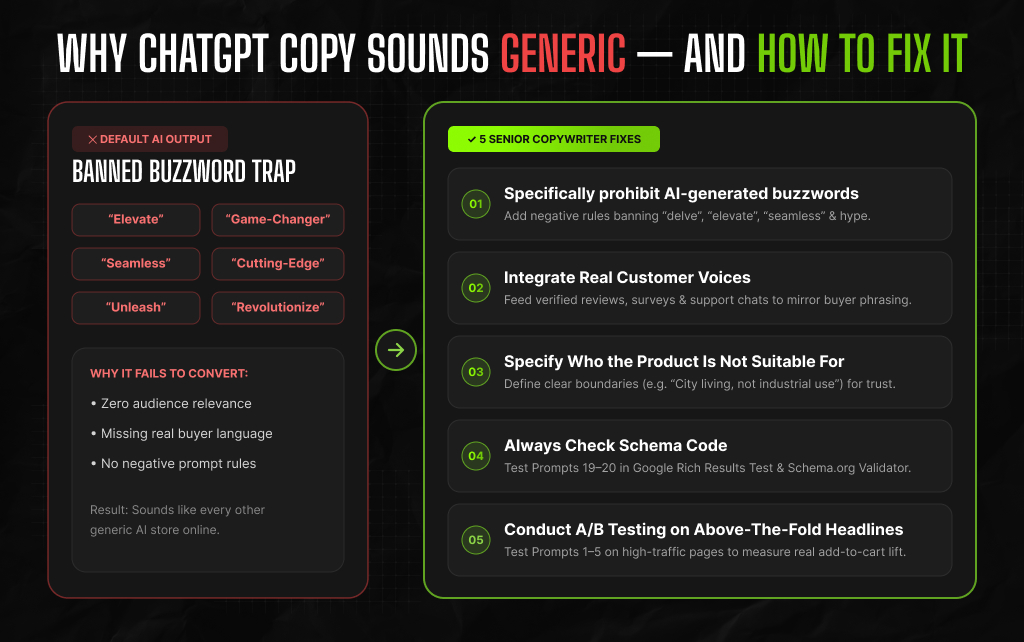
Genericity happens when prompts fail to include audience relevance, authentic customer language, and negative guidelines.
Without clear guidelines, big language models will frequently default to common eCommerce phrases including ‘elevate’, ‘game-changer ’, ‘precision engineered ’, etc.
Adhere to these 5 principles to ensure that AI-supported product content is comparable to that of a senior conversion expert:
First, you need to include a negative guideline in your prompt so ChatGPT does not use popular but generic terms such as delve, elevate, seamless, cutting-edge, unleash, and revolutionize.
Second, insert real customer service correspondence, surveys, and confirmed review material into your prompt so ChatGPT can replicate genuine customer language.
Third, outlining a product’s unsuitability for a particular market or audience (for example, ‘Suitable for city living, not for industrial environments’) quickly establishes credibility and enhances AI search accuracy.
After creating schema code via Prompts 19 and 20, check it with both Google’s Rich Results Test and Schema.org Validator. Although valid schema will enable rich snippets to appear for your page, it is not automatically enough to boost search engine position.
Lastly, create differing headline styles using Prompts 1-5. Then A/B test these on high-traffic product pages to see which most effectively boosts add-to-cart behavior.
Additional Resource: How To Get Your Website Named By ChatGPT And Google AI.
Piyasa is a search engine marketing strategist who has spent the last six years decoding Google's ever-changing mind. From corporate giants to neighborhood storefronts, she helps businesses cut through the digital noise and actually get noticed online. When she isn’t building SEO strategies or writing the latest search industry breakdowns for Search Engine Magazine, you can usually find her hanging out with friends - and gently reminding them that no, she cannot personally fix the latest algorithm update for them.
View all Posts

Faceted Navigation SEO: Best Practices, Commo...
Nov 24, 2026
The Growing Role Of Brand Authority In Modern...
Nov 23, 2026
Top 10 SEO Consultants In London For Improvin...
Nov 21, 2026
3-Minute Checklist: How To Get Your Brand Nam...
Nov 20, 2026
How To Get Your Website Named By ChatGPT And ...
Nov 20, 2026