
Case Study: How Myntra And Walmart Stop Messy Filters From Confusing Google
Nov 27, 2026
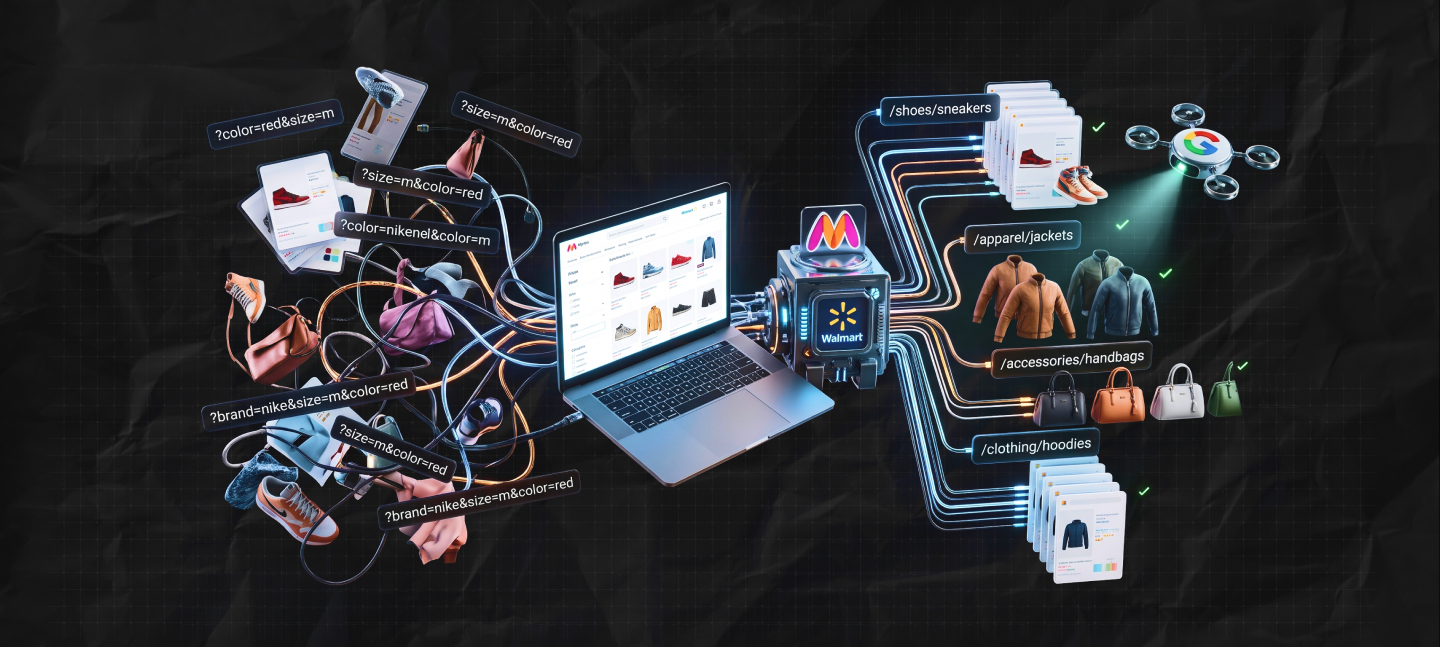

Major online retailers such as Myntra and Walmart avoid the issues associated with huge filter sets by implementing strict web categorization, along with flat URL and JSON-LD markup.
People predominantly use filters (for instance, size, color, and price) and brands when shopping on websites so they can efficiently sift through numerous product listings.
However, using filters can also create significant SEO issues. As people apply different filter criteria, additional URLs are produced.
This can create vast amounts of duplicate or substantially similar content, which is inefficient for search engines to analyze and can, in turn, adversely affect site search rankings. (Source: botify.com).
In this case study, I will analyze the technology and SEO approaches of both Walmart and Myntra and identify how these organizations manage large product selections while maintaining a strong search presence. (Sources: buildd.co and buildd.co).
Faceted navigation is the common terminology for filters within e-commerce SEO.
If a site allows Googlebot and other search engine bots to access all filter variations, the number of resulting URLs can escalate rapidly (source: botify.com).
For example, if there are five sizes, eight colors, four price ranges, and three ways to sort products within one clothing category, these filters could produce 480 different URLs (calculated as 5 x 8 x 4 x 3) for the same products.
So, for sites with tens of thousands of products, this can create millions of low-quality pages.
Botify, an enterprise SEO tool, has highlighted the severity of this issue:
First, within one 20 million-page e-commerce site, 19 million of the 20 million crawlable pages were faceted URLs.
Furthermore, URLs with three or more filters consumed an extremely high share of crawl budget yet received virtually no organic search traffic. (Sources: botify.com and sherocommerce.com).
On another e-commerce site, 99% of crawled pages were unmanaged faceted pages, and no configuration managed URL parameters.
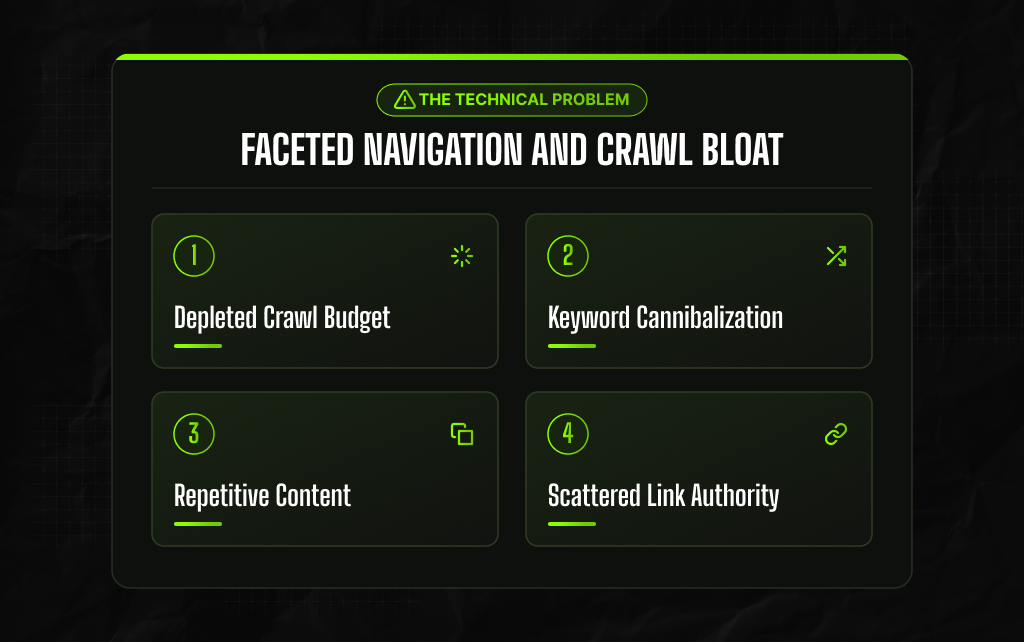
However, unmanaged and messy filters cause four core SEO failures:
Google dedicates a limited timeframe and number of server requests (referred to as ‘crawl budget’) to analyzing a site.
If bots use up this budget analyzing filter pages, they can’t effectively analyze fresh and/or revised product pages. (Source: botify.com).
When numerous faceted URLs center on the same general keyword (for example, laptops and jeans), these pages compete against one another in search engine results pages (source: buildd.co).
Filter and sort pages show highly similar product listings and search engines recognize them as duplicated content.
Instead of concentrating link authority on key category pages, your site spreads both internal and external links across thousands of parameterized pages (source: botify.com).
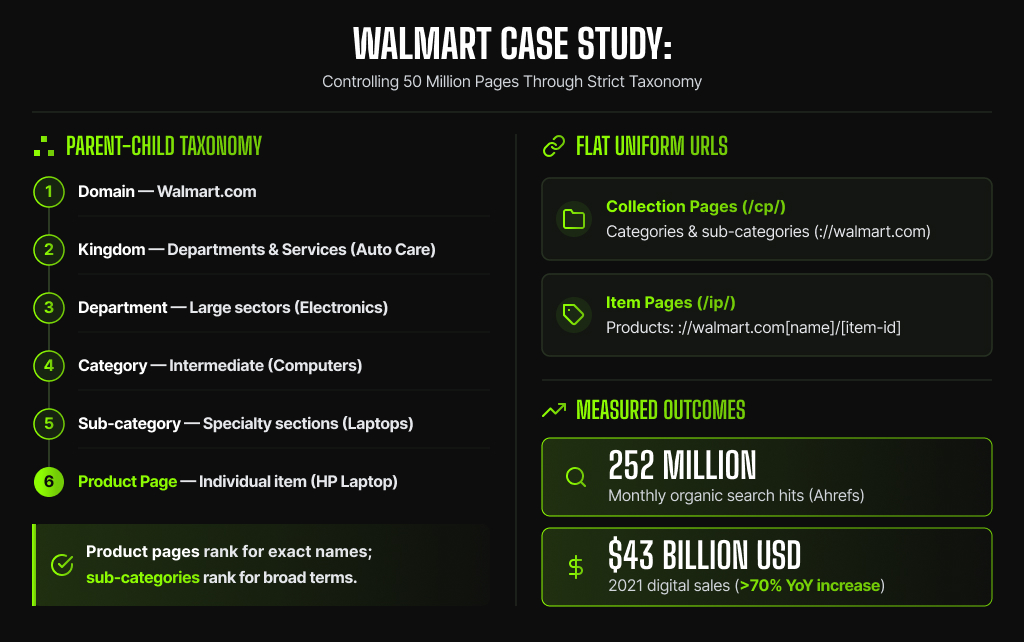
Walmart is a massive business with annual revenue of $559 billion USD and over 50 million products listed on Walmart.com (source: buildd.co).
If Walmart allowed its filter and/or duplicate product pages to compete for shared keywords, millions of product pages would negatively affect each other’s Google search rankings through cannibalization (source: buildd.co).
Walmart classifies its stock in a highly organized parent-child structure. Each section is optimized for a different search intention and keyword (source: buildd.co):
By specifying unique keywords for each section, Walmart ensures a product page ranks for the exact product name, while sub-category pages rank for the broader category name. (Sources: buildd.co and thegood.com).
Rather than including lengthy directory names and/or complicated filter parameters in URLs, Walmart employs simple, uniform pre-fixed URL formats (source: buildd.co):
According to Ahrefs, Walmart.com receives 252 million organic monthly search hits.
Online Sales: Benefiting from its effective search functionality, Walmart achieved $43 billion USD in digital sales in 2021 – representing an increase of in excess of 70% year-on-year.
As one of India’s biggest fashion and lifestyle businesses, Myntra operates in an industry where highly detailed filters are commonly used.
These include material type, sleeve length, body shape, design, and the event for which an item is suitable, alongside color (source: buildd.co).
Facing competition from Amazon, Flipkart, and H&M, Myntra avoids filter-related search issues by integrating a well-designed website with JSON-LD structured data. (Source: buildd.co).
Myntra applies two main strategies to maintain order and crawlability of its site (source: buildd.co):
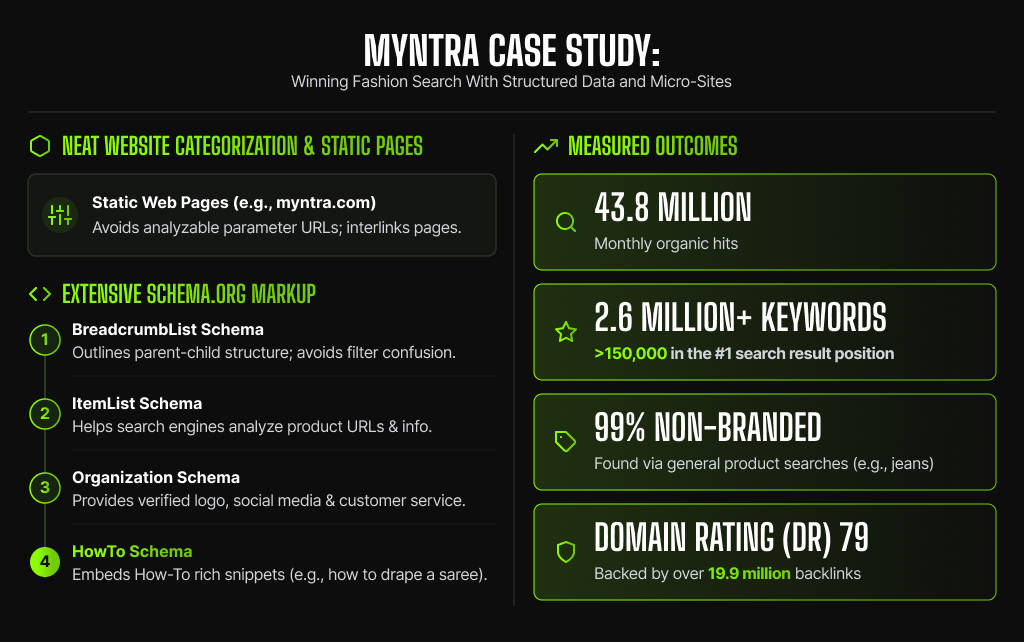
Myntra avoids letting arbitrary filter selections create analyzable parameter URLs. Instead, it manually designs and produces static web pages for popular search topics (for example, myntra.com).
These pages are then interlinked through a clearly defined categorization system (source: buildd.co).
Rather than expecting search engine crawlers to independently analyze complicated filter-based fashion listings, Myntra incorporates four particular varieties of Schema.org structured data onto its web pages (source: buildd.co):
1. BreadcrumbList Schema
Precisely outlines the parent-child relationship between pages (such as myntra.com ➝://myntra.com ➝://myntra.com ➝://myntra.com).
This helps Google recognize the page structure and avoid confusion caused by filter parameters.
2. ItemList Schema
Enables search engines to easily analyze and comprehend the product URLs and information showcased on category pages.
3. Organization Schema
Reinforces Myntra’s brand credibility by providing Google with verified information about the company’s logo, social media, and customer service.
4. HowTo Schema
Relevant How-To rich snippets can then be embedded on business category pages. For example, Myntra can provide a ‘how to drape a saree’ How-To guide on its saree category page to increase the likelihood that users click through from Google.
Myntra realized the following positive outcomes from its SEO strategy (source: buildd.co):
Ranks for more than 2.6 million keywords and occupies the number one search result position for over 150,000 of them. (Source: buildd.co).
Percentage of Non-Branded Keywords Ranked For: Of the keywords for which Myntra is ranked, 99% are non-branded.
As a result, people predominantly find Myntra through general product-related searches (for example, for jeans) and are less likely to type Myntra’s brand name into search boxes.
Domain Authority: Backed by over 19.9 million backlinks, Myntra has a Domain Rating (DR) of 79.
Also Check: 3-Minute Checklist: How To Get Your Brand Named In AI Answers
| Metric / Strategy Area | Walmart (walmart.com) | Myntra (myntra.com) |
| Primary Vertical | General Retail & Multi-Category Marketplace (source: buildd.co) | Fashion & Lifestyle E-Commerce (source: buildd.co) |
| Indexed Scale | 50+ million pages (source: buildd.co) | 2.6+ million ranking keywords across category & product pages (source: buildd.co) |
| Core Structural Defense | Strict Parent-Child Taxonomy & Flat URLs (/cp/ and /ip/) (source: buildd.co) | Clean Category Hierarchy & Static Landing Pages (source: buildd.co) |
| Primary SERP Enhancement | Keyword-isolated category and item landing pages (source: buildd.co) | JSON-LD Structured Data (BreadcrumbList, ItemList, HowTo) (source: buildd.co) |
| Monthly Organic Traffic | 252 million visits (source: buildd.co) | 43.8 million organic visits (source: buildd.co) |
| Key Business / SEO Milestone | $43B USD in online sales in 2021 (+70% YoY) (source: buildd.co) | 150,000+ #1 keyword rankings (99% non-branded) (source: buildd.co) |
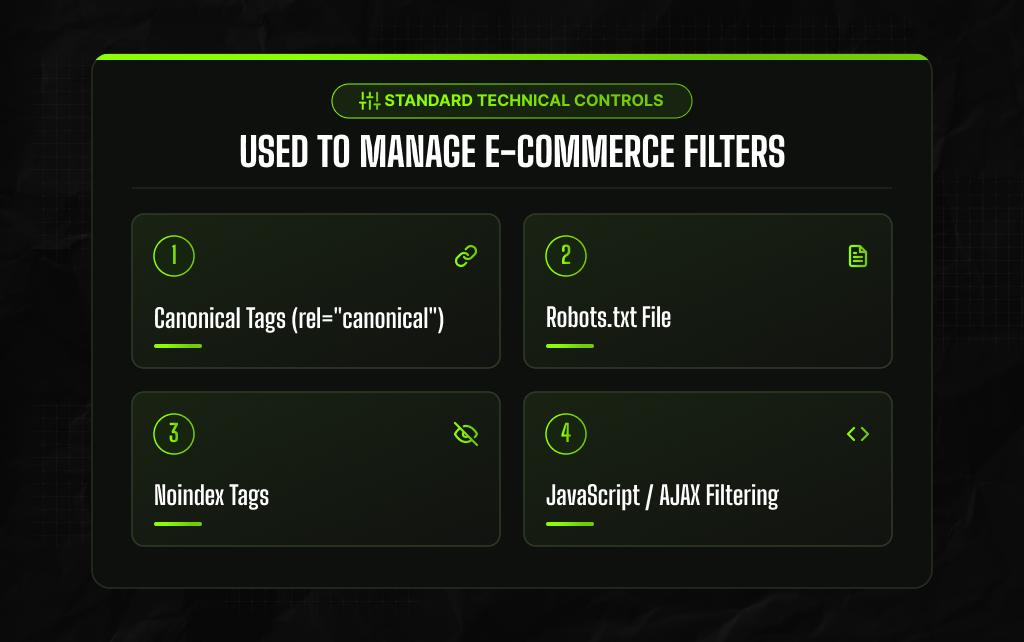
Aside from categorization and structured data, there are four further technology solutions that enterprise SEO systems implement to prevent e-commerce filters from impacting search negatively (source: botify.com):
If alternative URLs are created by re-sorting or applying basic filters, canonical tags tell Google to direct all ranking activity to the clean category page.
Preventing search engine bots such as Googlebot from analyzing poor-quality filter pages by listing them in a site’s robots.txt file.
This ensures they don’t waste valuable crawl budget analyzing multiple filter pages, for example, a price low-to-high sort. (Source: botify.com).
Highly searched-for, single-featured pages (for example, pink dresses) are redeveloped into neat static web pages which can then be indexed.
At the same time, low-search-interest and/or out-of-stock filter pages are prevented from being indexed by adding noindex tags. (Sources: botify.com and botify.com).
Client-side scripting can dynamically update product listings so search engine bots aren’t exposed to potentially infinite URL links, while still allowing users to use filters. (Source: botify.com).
Implementation Priority: When auditing an e-commerce store, start by blocking low-value sort and multi-attribute parameters in robots.txt before building static landing pages for high-volume search queries.
Fixing messy product filters is one of the smartest SEO moves an online store can make.
As Walmart and Myntra show, you do not need to remove filters completely. Shoppers still need them to find the right size, color, or price.
Instead, the real secret is staying organized. You can block low-value filter links using simple tools like robots.txt, canonical tags, and noindex rules, while turning popular searches into clean, dedicated pages.
If your site creates alternative URLs when users re-sort or apply basic filters, canonical tags tell Google to direct all ranking activity to the clean category page.
Piyasa is a search engine marketing strategist who has spent the last six years decoding Google's ever-changing mind. From corporate giants to neighborhood storefronts, she helps businesses cut through the digital noise and actually get noticed online. When she isn’t building SEO strategies or writing the latest search industry breakdowns for Search Engine Magazine, you can usually find her hanging out with friends - and gently reminding them that no, she cannot personally fix the latest algorithm update for them.
View all Posts

Copy-Paste ChatGPT Prompts To Write Product P...
Nov 25, 2026
Faceted Navigation SEO: Best Practices, Commo...
Nov 24, 2026
The Growing Role Of Brand Authority In Modern...
Nov 23, 2026
Top 10 SEO Consultants In London For Improvin...
Nov 21, 2026
3-Minute Checklist: How To Get Your Brand Nam...
Nov 20, 2026