Local Business SEO: How Law Firms And Clinics Rank #1 On Google Maps
Nov 28, 2026
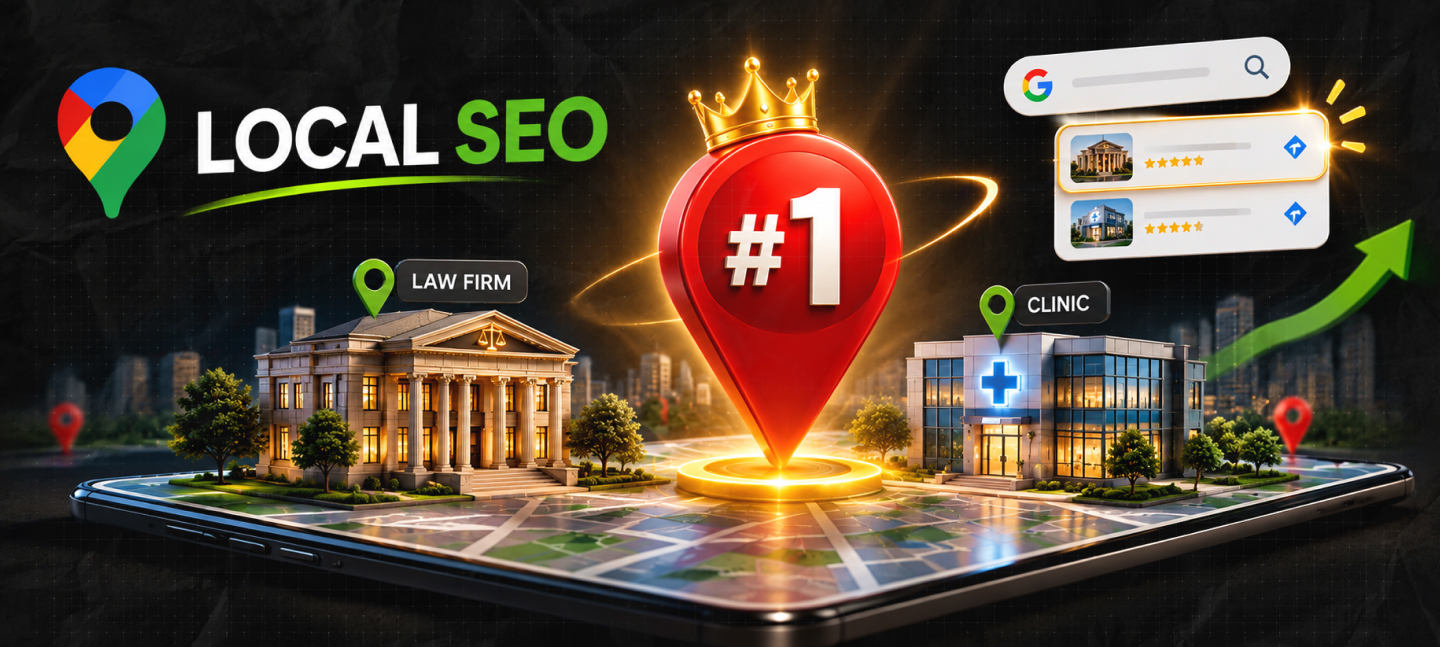

How To Rank Higher On Google Maps? To improve a Google Maps listing, law and medical practices should focus on four key steps.
First, they need to fully optimize their Google Business Profile (GBP). Second, they must choose accurate primary and secondary categories so patients or clients can find them.
Third, they should actively gather consistent and compliant customer reviews. Finally, they need to keep their business listings accurate and reliable across the web.
They also need to create relevant, geographically related webpages (google.com).
Today, people won’t use a telephone directory. Instead, they use their smartphone and search for local medical and law services.
From here, they will usually select one of the top three map listing results.
These top three map listing results are known as the ‘Google Local 3-Pack’. Being listed within this group regularly attracts new medical and law customers.
Listings ranked 4th or 5th are unlikely to be seen by most searchers.
Google Maps optimization is also notably more complex for law and medical practices than for, for example, a local shop.
Alongside highly competitive local markets, both professions are bound by rigorous government data-protection and advertising policies (google.com, legal500.com).
This article explains how to rank higher on Google Maps for law and medical practices without breaking sector-specific regulations.
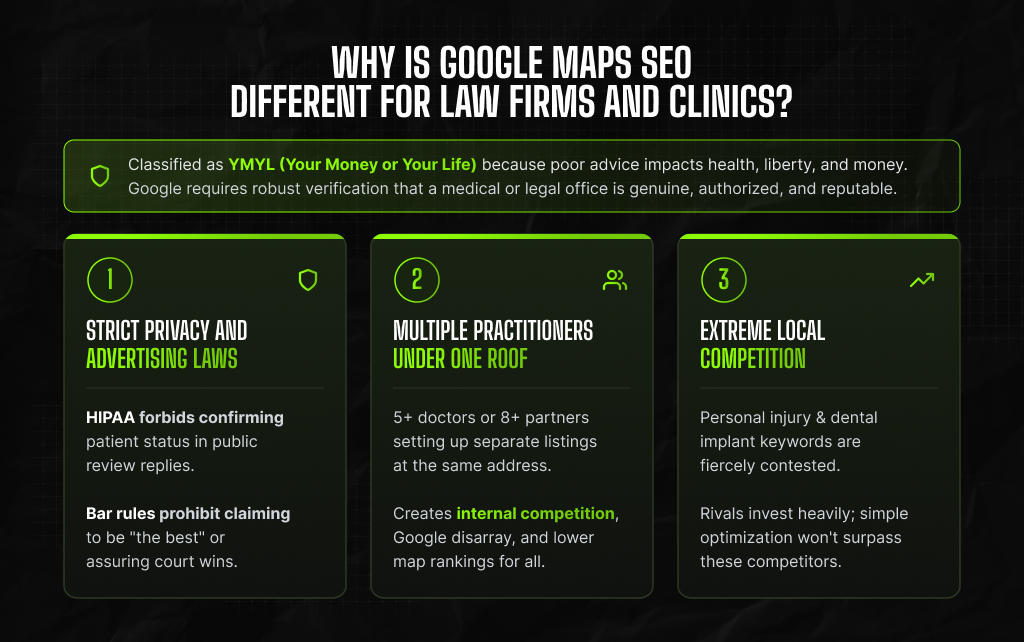
Google polices medical and legal businesses more strictly than other businesses, because poor advice can affect people’s health, liberty, and even money.
Google therefore classifies both sectors as YMYL (Your Money or Your Life).
To be listed at the top of Google Maps, Google requires robust verification that a medical/ legal office is genuine, authorized, and reputable.
Aside from Google’s high standards, the medical and legal professions additionally encounter particular issues:
Whilst a food outlet can respond to a customer review by commenting on that person’s order, e.g., “Thanks for ordering the pepperoni pizza on Tuesday, Sarah!” a medical practice is never allowed to do this.
Under healthcare data protection policy (for example, HIPAA), informing the public that a customer is a medical practice patient is a major legal breach. This could result in substantial fines (ama-assn.org, bassberry.com).
Lawyers are similarly restricted. Bar Association advertising guidelines prohibit lawyers from stating that they are ‘the best lawyer in town’ and/or assuring people that they will win court cases in open profiles.
While most shops have just one business listing, a medical practice can have 5+ doctors and a law practice can have 8+ partners.
If each staff member sets up their own Google Maps listing at the same address, it creates internal competition.
This creates Google disarray and reduces all employees’ map rankings.
Medical and legal keywords are amongst the most fiercely contested. Because both new personal injury and dental implant patients can represent significant revenue, local rivals invest heavily in search engine marketing.
Simple optimization techniques are unlikely to help your practice surpass these competitors.
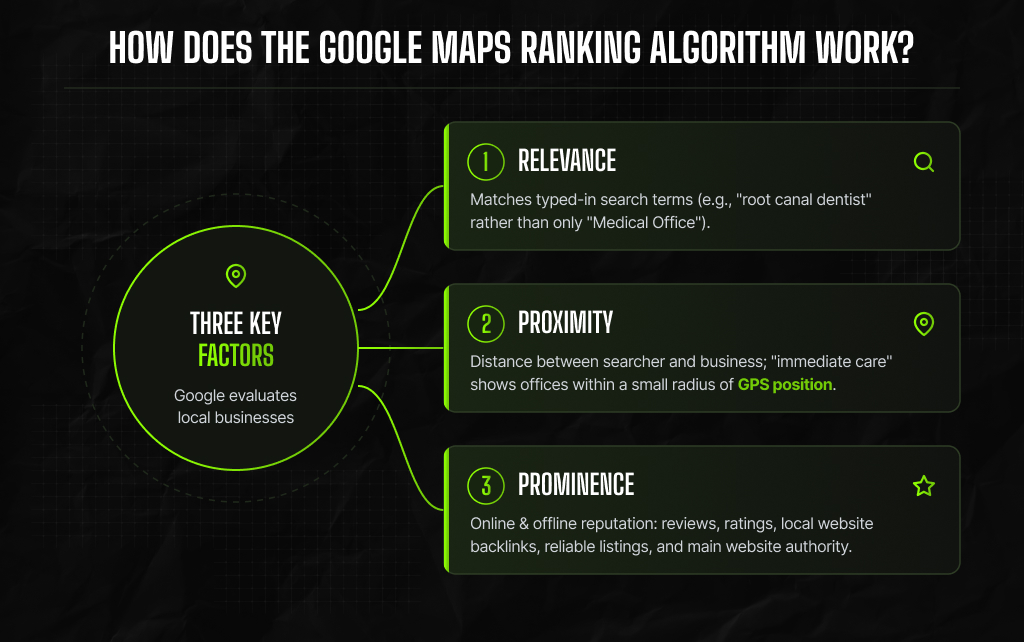
Understanding how to rank higher on Google Maps starts with knowing what search engines look for.
Officially, Google evaluates three key factors when positioning local businesses on its maps: Relevance, Proximity, and Prominence (google.com).
This relates to how well your business listing corresponds with a searcher’s typed-in search term (google.com).
If someone searches for “root canal dentist” but your business description only says you are a ‘Medical Office ’, Google may not know you offer root canal treatment.
This is the distance between a searcher and your business.
Moreover, those seeking ‘immediate care’ are generally shown relevant local medical practices situated within a small radius of their GPS-located position (brightlocal.com).
Lastly, this reflects a brand’s overall reputation and reliability, both online and off. Google measures a business’s prominence using a few key signals.
It looks at review volume and ratings, along with the number of local website backlinks.
Moreover, it also checks the reliability of your business listings and the authority of your main website. (google.com, sociosquares.com).
You Can Also Check: 3-Minute Checklist: How To Get Your Brand Named In AI Answers.
Although the underlying optimization principles are the same, law and medical/dental practices need to emphasize different conversion methods and comply with different regulations to achieve Local 3-Pack status.
| SEO Factor | Law Firms | Medical & Dental Clinics |
| Primary Goal | Book free consultations and case evaluations. | Schedule patient appointments and urgent visits. |
| Top Conversion Feature | Click-to-call buttons, direct chat, and Q&A. | Direct “Book Online” scheduling links and insurance lists. |
| Main Compliance Rule | Bar Association rules (no false claims or guarantees). | Patient privacy laws (never confirm a reviewer is a patient) (source: ama-assn.org). |
| Most Important Citations | Avvo, Justia, FindLaw, Martindale-Hubbell, Bar directories. | Healthgrades, Zocdoc, Vitals, WebMD Care, hospital networks. |
| Practitioner Rule | Separate profiles only for distinct practice areas (source: google.com). | Separate profiles for licensed doctors with distinct specialties (source: google.com). |
Your GBP is your key Google Maps optimization hub. Leaving parts of your GBP empty indicates to Google that your business is either incomplete or non-operational (google.com).
Your primary category is your most influential GBP category. Google advises businesses to choose the most precise primary category (google.com).
Avoid generic categories; for example, don’t use ‘Lawyer/ Law Firm’ if you specialize in a specific area.
Select a precise primary category including: Personal Injury Lawyer, Divorce Lawyer, Criminal Law Lawyer, Estate Planning Lawyer, Immigration Lawyer.
Include up to four relevant secondary categories such as Trial Lawyer and Family Law Lawyer.
Avoid generic categories; for example, don’t select ‘Medical Centre’ unless you operate a large multi-disciplinary hospital.
Identify a precise primary category such as Dentist, Dermatologist, Emergency Care Center, Physiotherapy Center, and Pediatrician.
Include up to four relevant secondary categories for associated services such as Teeth Whitening Center, Skin Care Center, and Sports Medicine Center.
Within your GBP, you can enter 750 characters of business information. This should be easy to understand and detail the type of people you support, together with the issues you can assist with and the areas in which you work.
Medical Practices should include information regarding out-of-hours opening, emergency care, and accepted medical insurance.
Within your services section, specify particular medical procedures, for example, Regular Teeth Cleaning and Flu Vaccinations (google.com).
Law practices should identify key legal specialisms and promote free legal consultations. Avoid unauthorized expressions such as ‘assured victory’.
Within your services section, briefly describe particular areas of legal expertise, for example, Motor Vehicle Accident Claims and Will Creation (google.com).
GBP listings with genuine photographs attract more inquiries and clicks than those with generic imagery (google.com).
Ideally, upload 2-4 new images monthly of your external building, interior and reception, and of staff smilingly interacting (google.com).
Make it easy for searchers to act right inside Maps:
Pre-populate your GBP Q&A area with answers to your 5 most commonly asked law client queries. For example, “Do you offer free consultations?”
Individual medical professionals or lawyers can have their own GBP listing in addition to the main medical/law office, provided they follow certain regulations (google.com).
Only set up an individual medical/law professional listing if that person is a qualified and publicly-facing professional and if clients can book directly with them.
The professional should also specialize in a particular area (google.com).
If three general dentists work at the same practice and all four Google Business Profile listings, the clinic plus the three individual practitioners, use the same primary category (“Dentist”).
Google will hide three of them from local map results. This process is known as local filtering.
The Fix for Multi-Practitioner Offices
Google Maps rankings are hugely impacted by customer reviews (google.com). Google will analyze the volume of reviews, their rate of accumulation and the keywords mentioned in them (searchenginejournal.com).
Immediately after a customer has received a good service, send them a friendly text or email containing the link to your Google Review page. Ideally, this should be sent within 2 hours:
For example: “Thank you so much for sharing these kind words! At [Clinic Name], our team works hard every day to provide compassionate, timely care to everyone in our community. We appreciate your support!” Your feedback helps local families find us: [Direct Link]
Responding to reviews shows that your organization is attentive and trustworthy (google.com). Also ensure that customer information is protected (neoncanvas.com).
Do not specify that an individual has been to your clinic or is a patient, regardless of whether they state this. Responses should be friendly and non-specific (docseducation.com).
‘Many thanks for such a lovely review. ‘Our clinic, [Clinic Name], aims to provide caring and efficient services to our local community. Thank you for your continued support!’
Never mention case outcomes or confidential details in public replies.
‘Thank you for taking the time to write in. ‘Advising people on legal issues in a clear and courteous manner is what we are continually striving to do at [Law Firm Name]. I hope you have every success in the future!’
Again, never debate or disclose sensitive information relating to an unhappy client/patient (neoncanvas.com).
‘We value all feedback and are constantly working to maintain our excellent service. However, in line with our strong commitment to confidentiality, we can’t comment on specific information online. ‘Please contact our Office Manager on [Phone Number] so that we may talk through your issues with you.’
A local citation is when another website includes your NAP (Name, Address, and Phone Number) (rocketclicks.com).
If Google sees your exact NAP listed on many reliable websites, it will trust that your office genuinely exists and is located as stated.
Ensure that your clinic/law firm’s business name, street address, and telephone number are identical on your website and both your Google and directory listings.
Correcting errors such as incorrect or outdated suite numbers and telephone numbers helps prevent search engines from misidentifying your business (sociosquares.com).
Register with leading non-specialist sites including Apple Maps, Bing Places, Yelp and Better Business Bureau. Also register with authoritative specialist directories:
If you are learning how to rank higher on Google Maps, you cannot ignore your main domain.
Google analyzes the website that is associated with your Google profile to assess your Google Maps placement (brightlocal.com).
Poor or limited websites will negatively affect your Google Maps position (sociosquares.com).
Develop in-depth webpages for each key area of expertise. For example, Car Accident Lawyer and Divorce Lawyer, or dental services such as Root Canals and Dental Implants (actionableagency.com).
Design webpages for surrounding towns and areas which also reference local features, roads, and parking availability (sociosquares.com, actionableagency.com).
Insert a Google Map of your office onto your Contact and Location webpages.
Ask your developer to add LegalService or MedicalClinic/Physician schema to your website so search engines can quickly recognize your clinic/law firm’s NAP, opening times, and specialisms.
Locally based backlinks are significantly more valuable than those from further afield (sociosquares.com).
Support local youth sports teams, get involved with your Chamber of Commerce, and write informative articles for regional news and community blogs (sociosquares.com).
Typical monitoring software merely analyses a single zip code. This is additionally ineffective for Google Maps, as search results can differ from block to block.
Software such as Local Falcon or BrightLocal provides a visual grid that identifies your Google Maps position at numerous highly specific locations within your local area.
As red and yellow markers turn green, you can see improvements in your local visibility.
Within your Google Business Profile, analyze Phone Calls, Directions, Website Visits, and Searches statistics to evaluate actual client lead generation.
Additional Resource: Local SEO Audit Guide: Core Components That Can Boost Your Local SEO Performance
Piyasa is a search engine marketing strategist who has spent the last six years decoding Google's ever-changing mind. From corporate giants to neighborhood storefronts, she helps businesses cut through the digital noise and actually get noticed online. When she isn’t building SEO strategies or writing the latest search industry breakdowns for Search Engine Magazine, you can usually find her hanging out with friends - and gently reminding them that no, she cannot personally fix the latest algorithm update for them.
View all Posts

Case Study: How Myntra And Walmart Stop Messy...
Nov 27, 2026
Copy-Paste ChatGPT Prompts To Write Product P...
Nov 25, 2026
Faceted Navigation SEO: Best Practices, Commo...
Nov 24, 2026
The Growing Role Of Brand Authority In Modern...
Nov 23, 2026
Top 10 SEO Consultants In London For Improvin...
Nov 21, 2026