
The Ultimate Guide To Competitor Backlink Analysis: An Actionable SEO Blueprint To Steal Your Rivals’ Traffic
Oct 23, 2026
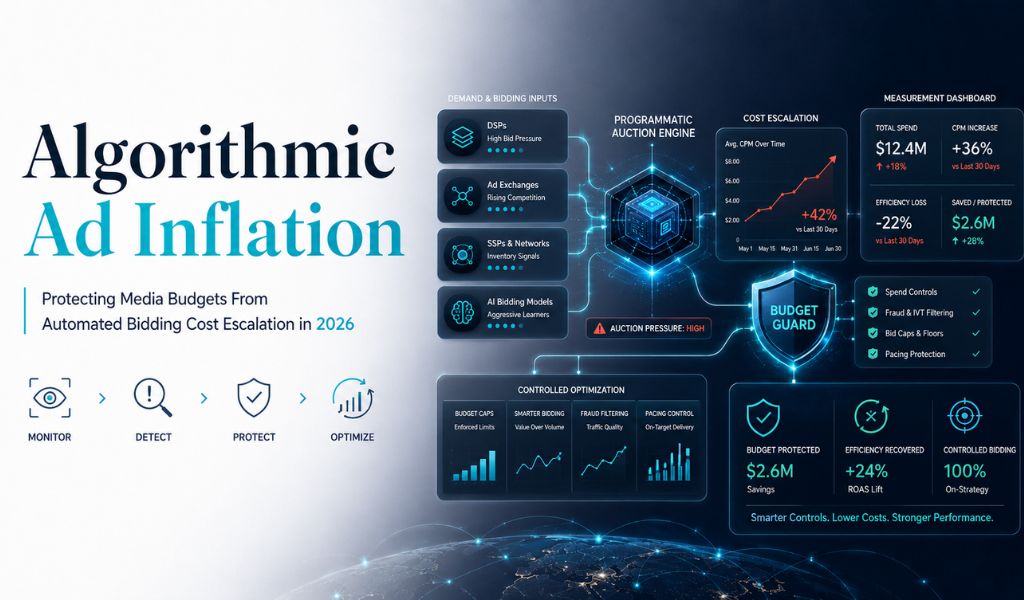

Meta’s Advantage+ campaigns, Google’s Performance Max, and programmatic DSP algorithms share a foundational design principle: they optimize toward the conversion outcome the advertiser defines, using the budget the advertiser provides, within an auction environment in which every competing advertiser’s system runs the same optimization logic against the same inventory.
The structural outcome of that architecture is predictable. As automated systems bid more aggressively for high-intent signals, auction clearing prices rise.
As creative assets fatigue in delivery algorithms, the system expands audience targeting to maintain delivery volume, reaching lower-intent users at a higher cost per acquisition. Algorithmic ad inflation is not a bug in automated buying systems. It is a systemic revenue feature.
Automated ad inflation happens through three compounding mechanisms that operate simultaneously within black-box delivery platforms. The first is auction density compression.
As more advertisers adopt smart bidding and automated campaign types, the proportion of impressions contested by multiple automated bidders increases, raising floor prices across high-intent inventory segments without any individual advertiser increasing their manual bids.
The second mechanism is creative fatigue signal amplification: automated delivery algorithms track creative-level engagement rate decay.
As a specific ad unit’s click-through rate declines with repeated exposure to the same audience segment, the algorithm interprets this as reduced creative relevance and begins applying a quality-score penalty, increasing the effective cost-per-thousand required to maintain delivery volume.
According to Meta’s internal Creative Fatigue documentation published in their Business Help Center, creative assets in high-frequency campaigns typically begin to show measurable fatigue signals within 7 to 14 days of launch for audiences under 500,000.
The third mechanism is audience expansion drift: when an automated campaign cannot meet its target volume within the defined audience at an acceptable bid level, the algorithm expands its targeting to adjacent audiences with lower intent density, maintaining impression volume while silently degrading conversion quality.
The dashboard reports stable delivery; the CFO reports rising high-paid media customer acquisition costs. Both observations are accurate.
Rising CPAs rarely start with the market. In reality, they start with misread signals. But it’s far easier to blame competition than to question what the system is trying to tell you.
When acquisition costs climb, the default explanation is competition: more advertisers, higher bids, & shrinking efficiency. It sounds logical, and it’s often partially true. But in automated ecosystems, this explanation becomes a convenient shortcut.
What gets overlooked is the role of creative decay and lazy campaign stewardship. If your ads aren’t evolving, you’re not just losing attention. You’re training the algorithm to deprioritize you. The system doesn’t reward consistency; it rewards stimulation.
There’s a subtle but important distinction: performance doesn’t suddenly drop. It erodes. CTR dips slightly. Frequency creeps up. Conversion lag increases. Individually, none of these trigger alarm. Together, they quietly inflate your costs.
Most dashboards won’t flag this as a failure. Delivery looks stable. Spend is smooth. Even conversions might hold for a while. But efficiency is bleeding underneath.
High-performing teams don’t wait for performance crashes. They preempt them.
They track creative-level decay, not just campaign-level results. At the same time, they retire “average” ads sooner than feels comfortable. And most importantly, they treat creative strategy as a continuous pipeline rather than a periodic task.
In automated systems, you’re not just buying media. At the same time, you’re feeding a machine that decides how much your attention is worth.
If the input stays static, the price inevitably rises.
The creative refresh cadence for scaling data is the primary lever that agencies control within automated buying environments, where bid strategy, audience definition, and placement selection are partially or fully governed by platform algorithms.
The operational standard for high-frequency paid social campaigns in 2026 is a 14-day creative rotation cycle for awareness-stage assets and a 21-day cycle for conversion-stage assets for audiences above 1 million; tighter segments require 7- to 10-day refresh cycles.
Rotation strategy must address not just visual novelty but message angle diversification: replacing one product image with another image of the same product against the same value proposition does not reset fatigue signals meaningfully.
Effective creative refresh introduces new entry angles, social proof variants, problem-agitation framings, use-case demonstrations, and comparison frameworks that the delivery algorithm registers as structurally distinct creative hypotheses rather than surface-level asset swaps.
The Agency Consensus “Agencies running the same six creative assets for ninety days and attributing rising CPAs to ‘increased competition’ are diagnosing a supply problem when the actual problem is that demand has stopped earning.
Algorithms do not inflate costs arbitrarily. They charge more for attention that the creative has stopped deserving.”
Reclaiming efficiency within algorithmic ad-fatigue automated bidding environments requires the systematic application of manual override controls that platforms technically permit but algorithmically discourage through interface design.
These controls include:
The Google Ads extensions architecture, which structures the campaign hierarchy and bidding controls, is documented in this technical guide to Google Ads extensions and campaign optimization frameworks.
Agencies evaluating which AI-powered media-buying tools offer the most transparent automated bidding controls will find a benchmark in this ranked analysis of AI tools by marketing task category.
WordStream’s 2025 Google Ads Industry Benchmarks report documents average cost-per-click increases of 19% year-over-year across most B2B verticals, with brands running active creative refresh programs and using manual bid controls reporting CPA escalation rates that are 41% lower than category averages.
Algorithmic ad inflation is not an external market force beyond agency control. It is a system behavior that rewards operators disciplined enough to manage it actively, rather than delegating that management to the algorithm that generates the cost.
Read Also:
Barsha is a seasoned digital marketing writer with a focus on SEO, content marketing, and conversion-driven copy. With 8+ years of experience in crafting high-performing content for startups, agencies, and established brands, Barsha brings strategic insight and storytelling together to drive online growth. When not writing, Barsha spends time obsessing over conspiracy theories, the latest Google algorithm changes, and content trends.
View all Posts

The Ultimate Guide To Competitor Backlink Ana...
Oct 23, 2026
How To Land High-Authority Editorial Backlink...
Oct 23, 2026
Why Your Website Traffic Dropped Suddenly And...
Oct 23, 2026
How Do The Physical Google Review Tools Redef...
Oct 23, 2026
How To Get Your Brand Cited In AI Search Resu...
Oct 22, 2026