
SEO Dashboard: What To Track, What To Ignore, And How To Make It Useful
Sep 25, 2026


Do you know what is that one thing that has remained unchanged for me in this industry to date? My unwavering belief in the principle “quality over quantity.”
But while that is true, when it comes to digital marketing and ranking content on the SERP, content velocity matters equally, if not more.
As the term is self-explanatory, content velocity is exactly the quantity of content that goes live on your page in a fixed duration. And it’s not just your website – rather, it is about all the channels that you are operating in.
Most of us are of the opinion that Google values content that is well researched and truly helpful to the readers. And that is completely true.
However, a high frequency of content production truly helps crawlers read your page and index your site daily. On top of that, it also helps with boosting your topical authority and E-E-A-T.
So, how do you really measure your content velocity? And how does it impact your site’s growth and performance? These are exactly the things that I will be covering in this topic – based on my own experience and the strategies that have worked for my site.
Stay tuned.

The term content velocity means speed, frequency, and volume. It tracks how fast an e-commerce platform, media company, or brand creates content. On top of that, it also measures how quickly they publish that content.
This particular “calculated metric,” as Adobe calls it, tracks production and sharing online across different marketing channels. Additionally, it also contributes towards ensuring that the user spends as much time as possible on your website. [Source: Experience League, Adobe]
Brands always calculate this output within a specific time period. For instance, think of this concept as the overall momentum of your content marketing strategy.
Achieving it requires balancing three major factors simultaneously.
This careful balance successfully satisfies both your human audience and search engine algorithms.
Marketers view content marketing velocity through three distinct frameworks. Each lens analyzes a different stage of the lifecycle.
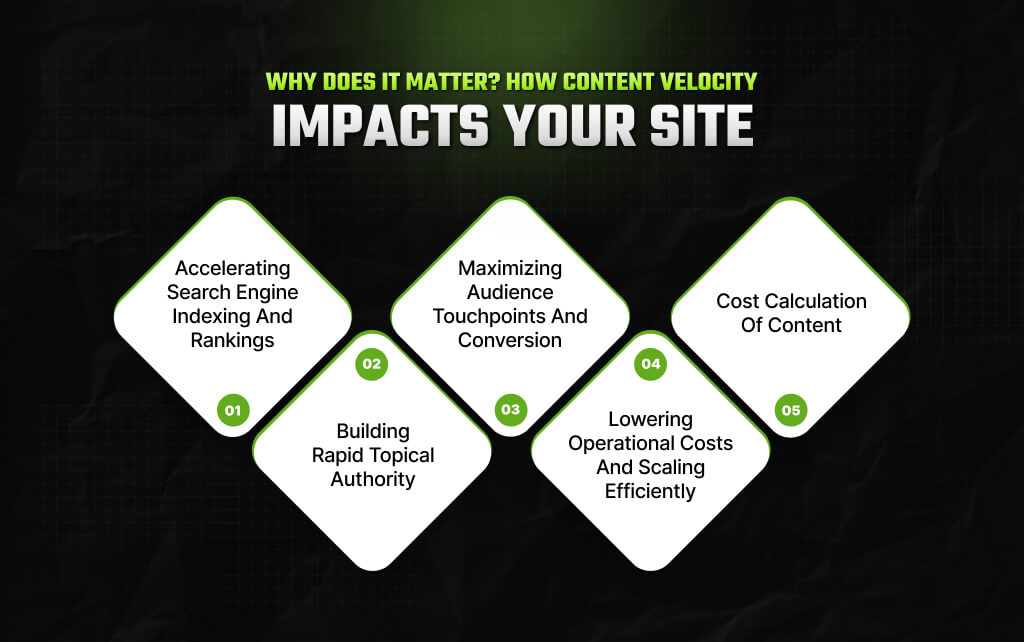
A brand’s visibility and site growth are closely tied to content velocity. When the speed is fast, your reach grows, and organic traffic increases at a higher rate.
A slow rollout of new content, meanwhile, can leave your site virtually unnoticed. Especially in the presence of fast-moving competitors. [Source: Outpace SEO]
Here are some of the reasons why maintaining content velocity is important and how it impacts our site:
Search engines reward active websites that publish valuable content regularly. When you increase your publishing velocity, search engine bots crawl your site much more frequently. They recognize your platform as a rapidly growing, authoritative industry resource.
This consistent activity forces the algorithm to index your new pages faster. Instead of waiting weeks for a new post to show up in search results, a high-velocity site can see its new content ranking within hours. This gives you an immediate competitive advantage.
To rank for highly competitive industry keywords, your site must demonstrate deep topical authority. If you publish only one article a month, building that comprehensive authority takes years.
High content velocity compresses this timeline significantly.
By publishing multiple optimized articles weekly, you systematically cover an entire niche faster. You build out robust topic clusters and internal linking structures quickly.
This comprehensive coverage signals to search algorithms that you are a massive, trusted expert in your field.
Your audience lives in a fast-paced digital world where knowledge is ubiquitous. If your brand remains silent for long stretches, users look elsewhere. According to Storyblok, a steady content velocity provides regular touchpoints across your marketing channels.
Frequent updates keep your existing audience engaged. It gives them a tangible reason to return to your site.
Each new piece of content also acts as a new entry point for different customer segments. This expanded presence brings in fresh organic traffic and generates new leads continuously.
Surprisingly, increasing your content velocity can actually lower your production costs. It forces your team to abandon slow, manual approval chains and disorganized workflows. To maintain speed, you must standardize your templates and automate repetitive tasks.
It is far more resource-intensive to create a single, disconnected piece of content once a month than to execute a scaled pipeline.
A high-velocity system relies heavily on smart asset repurposing. You turn one deep resource into multiple blog posts and social graphics efficiently. This maximizes the financial lifetime value of every asset you create.
Ultimately, content velocity matters because speed to market wins. The brand that ships high-quality content fastest secures the top rankings, captures the backlinks, and wins user trust before anyone else can react.
Besides, by utilizing this information, you will have a rough idea of the amount of content money your competitors have been spending and what it will actually cost you internally to generate that content, respectively.
Although the figure is not exact, “it gives a clearer picture of how much cost is potentially involved in making the content program you want to launch a reality.” [Source: Search Engine Journal]
Businesses will be able to understand what is needed of them by the program through this data and how they can use it to meet the financial expectations of the organization.
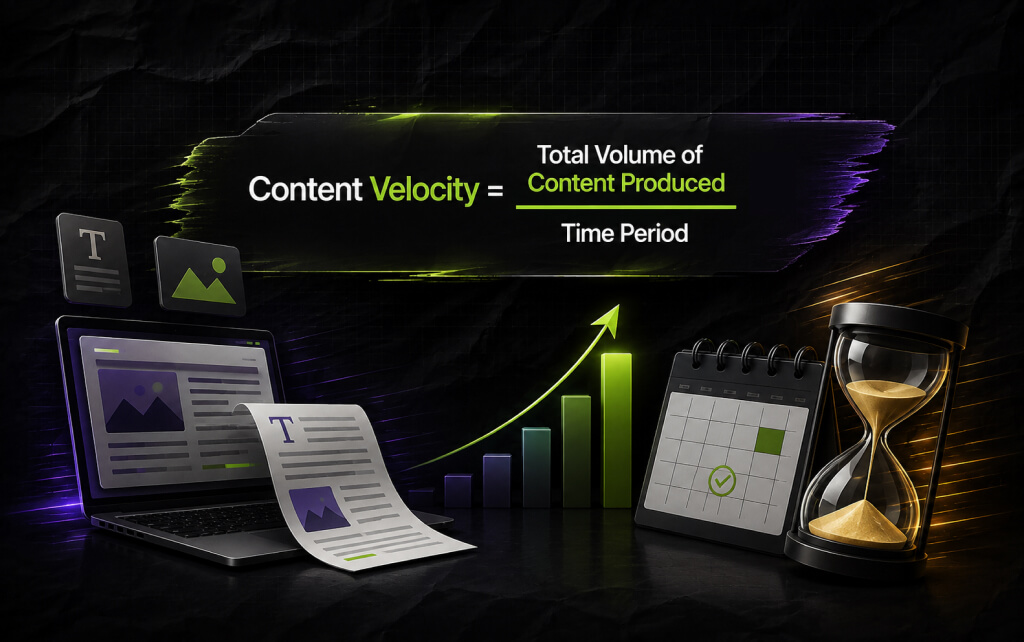
To measure and calculate content velocity, you track your production output against a fixed timeframe.
Marketers typically choose a specific unit of volume. These can be:
After that, they evaluate it weekly, monthly, or quarterly.
The primary formula for calculation content velocity that I have been using for my website is rather simple:
Content Velocity = Total Volume of Content Produced ÷ Time Period
For example, if your team writes and publishes 12 comprehensive blog posts in 30 days, your content velocity is 0.4 articles per day (or roughly 3 posts per week).
To calculate this historically for your site or a competitor, tools like Screaming Frog can extract published dates from article metadata or XML sitemaps. This allows you to chart publishing spikes over the year. [Source: Search Engine Journal]
Alternatively, platforms like Adobe Analytics calculate an internal engagement variant of content velocity. Their model divides page views by total visits to measure how fast a specific page drives user downstream journey momentum.
So, basically the crux of this is simple: you should track the volume metric that best aligns with your scaling goals. But the drill is: you MUST maintain the velocity of content that goes live. Because trust me, consistency is the best signal to boost your website.
TBH, nothing can beat quality. Which is exactly why I mentioned in the very beginning that I am a firm believer in the mantra “quality over quantity.” But you know what you really need to make your website grow?
Find the middle ground.
Frankly speaking, I would recommend that you nail the quality first, then crank up your production pace. Because high content creation speed is necessary, but the volume of low-quality content will damage your brand
And trust me when I say this: search engine algorithms are smart, and they actively penalize unhelpful, thin filler text.
Real quality means solving your readers’ actual, everyday problems. It means sharing your own unique thoughts and keeping every single detail accurate. If you just churn out junk quickly, your visitors will leave your site immediately.
And, needless to say, your search rankings will plummet too. So, basically, speed only helps you if every single piece of content builds your authority.
The moment your team (or only you) starts nailing high-quality work, start figuring out how to move faster. To completely beat your competitors, you need a mountain of this top-tier content.
So, do NOT pick one over the other. Instead, blend them together and build a system to scale your high-quality work.
Barsha is a seasoned digital marketing writer with a focus on SEO, content marketing, and conversion-driven copy. With 8+ years of experience in crafting high-performing content for startups, agencies, and established brands, Barsha brings strategic insight and storytelling together to drive online growth. When not writing, Barsha spends time obsessing over conspiracy theories, the latest Google algorithm changes, and content trends.
View all Posts

SEO Dashboard: What To Track, What To Ignore,...
Sep 25, 2026
Analytics SEO: How To Turn Search Data Into B...
Sep 25, 2026
AI Search Tools: What They Actually Measure A...
Sep 25, 2026
FAQ Schema: When It Still Makes Sense And Whe...
Sep 25, 2026
The Keyword With 10 Searches That Sent Ahrefs...
Sep 24, 2026