
Event Pages That Rank And Convert: A Practical SEO Guide For Webinars And Live Events
Oct 06, 2026
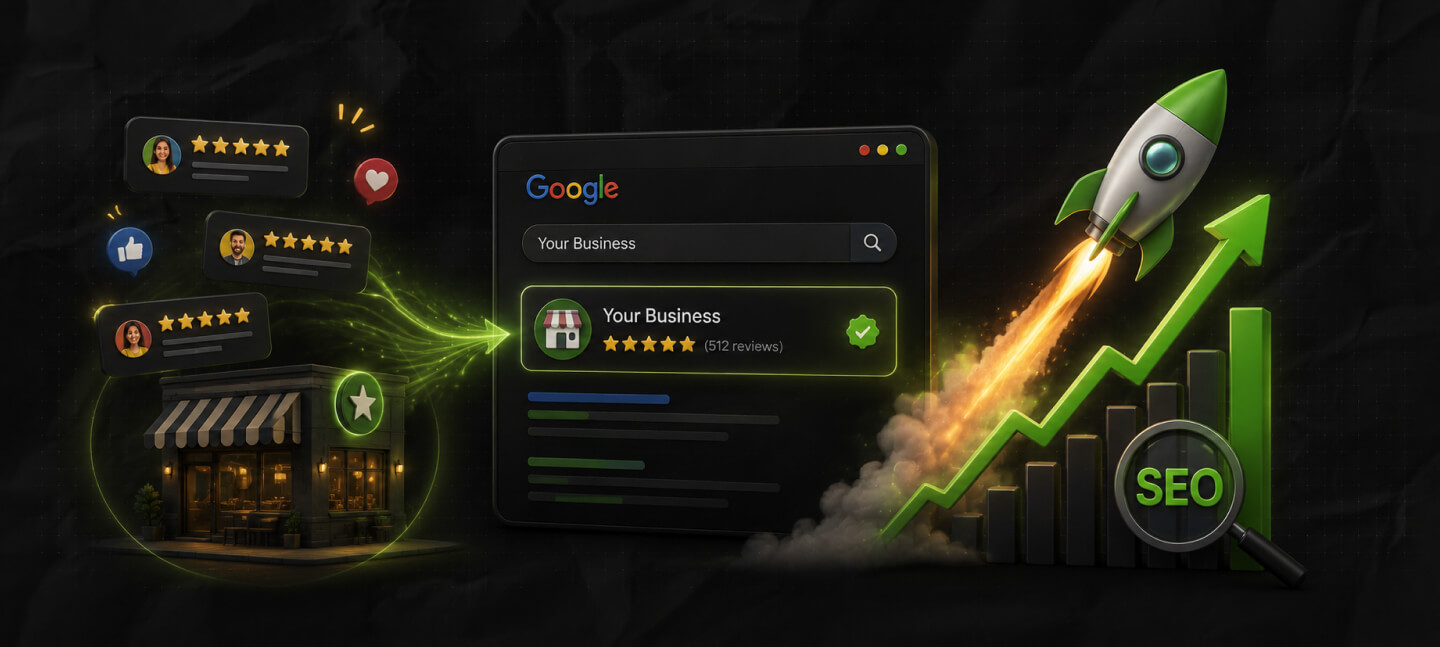

In my neighborhood, there’s a small local salon with only 150 Google reviews. A bigger salon opened up recently – this is a well-known name and has more than 1000 Google reviews with an average rating of 4.5 stars.
Yet when I searched for ‘salon near me,’ the smaller salon popped up first on the search. Um, how’s that even possible, right?
So, if Google reviews could actually determine rankings directly, then how come the bigger name with more reviews and stars failed to pop up on top?
I’ve been here too – and it took me some time to understand that this isn’t how Google search actually works.
Reviews matter. And there’s no doubt about that. Without Google reviews, I wouldn’t know which restaurant to order from or which hospital to trust.
More importantly, as a content and SEO professional for eight years, I can tell you that reviews play a crucial role in the local search ecosystem of Google.
But the mistake that most businesses make is to assume that these reviews are a sort of shortcut for achieving better rankings.
I hate to break it to you, but a hundred positive reviews praising your business will not fix a website that is slow or publishes thin content. If your site’s local optimization is poor, then a thousand reviews won’t be enough to push you to the top.
Having said that, you can’t ignore reviews either, considering these impact customer trust, online visibility, and even the clicks you get from search results.
So, do Google reviews help SEO? Yes, to an extent, but not how most marketing and search engine blogs on the internet suggest.
Today, I’ll break down what Google reviews actually influence and, more importantly, what they don’t.
Stay tuned.

Yes, Google reviews can help your SEO.
But they aren’t a direct ranking shortcut. For instance, let’s assume that Google reviews are just one part of a bigger picture, much like a single piece in a large puzzle.
What I mean is that a business that has several authentic reviews will automatically get more visibility in local search results as compared to competitors with fewer reviews.
However, if a website has excellent reviews but its website is outdated or has an incomplete Google Business Profile, then it can definitely struggle to rank.
Also, if a business has strong local competition, then the number of reviews can’t help much – think about how the local salon was appearing on top even with 150 reviews. This is simply because the smaller salon had a stronger local relevance as compared to the bigger name.
That is precisely why we need to stop asking: Do Google reviews help SEO?
Instead, the question we should ask is: What part of SEO do they actually influence? And that answer is so much more interesting.
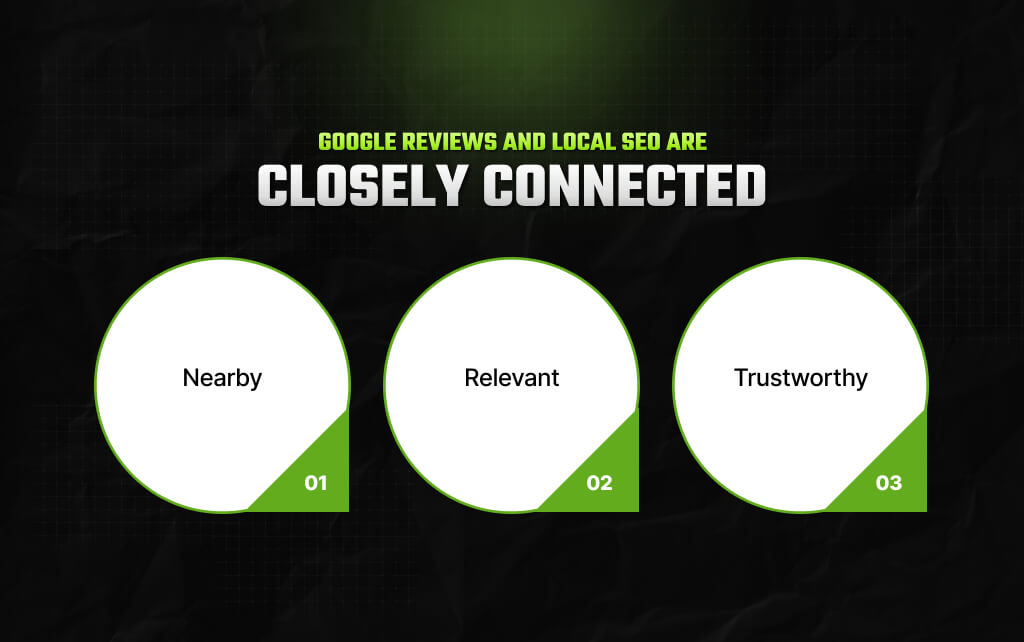
Needless to say, for businesses that cater to customers in a specific location, Google reviews are a crucial part of their local SEO strategy.
FYI, when anyone looks for nearby businesses, Google tries to recommend options that are:
These reviews help the search engine giant to understand the experience of customers with your business.
Also, reviews help potential customers to decide whether your business is worth their time and money.
For instance, let’s assume there are two digital marketing agencies in the same city. Both have similar websites. Both offer the same services.
One has 15 reviews. The other has 240 recent reviews with detailed comments and owner responses.
Which business would most people contact first? The answer isn’t difficult.
Reviews don’t just influence Google’s understanding of your business. They influence human behavior. And human behavior often affects search performance.
Can Google reviews improve the organic ranking of your site directly?
Frankly speaking, there is no concrete evidence that says having more five-star reviews can help you improve your ranking on Google search automatically.
Moreover, if that were true, then every local business with a good rating would be at the top of search results. That is clearly not what happens.
Organic rankings depend on hundreds of signals.
These include:
Reviews don’t replace any of those factors. Instead, they work alongside them.
A well-reviewed business with a poor website can still lose to a competitor with stronger content and better SEO.
That’s why reviews should support your strategy, not become your entire strategy.
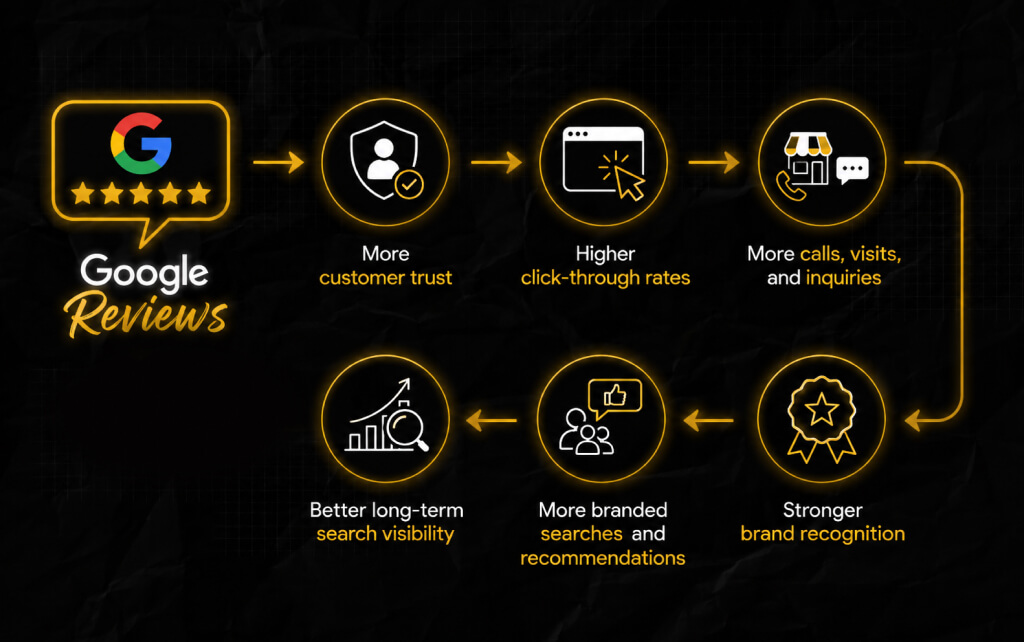
This is where the conversation gets interesting.
Reviews rarely improve rankings on their own. Instead, they influence several things that can contribute to stronger search performance over time.
Think of them as indirect signals rather than direct ranking boosters. Here’s how that works.
Google Reviews
↓
More customer trust
↓
Higher click-through rates
↓
More calls, visits, and inquiries
↓
Stronger brand recognition
↓
More branded searches and recommendations
↓
Better long-term search visibility
Notice something important: Reviews aren’t acting alone. They are helping create conditions that often lead to better SEO results.
That’s a very different claim from saying, “More reviews equal higher rankings.”
Search rankings only matter if people click.
For instance, you have to choose between two plumbers. One plumber has a 4.5 rating from 300 customers, while the other one has a 3.9 rating from 25 customers.
Now, considering both plumbers appear on the same page in search results, which business will you check out first? The first one, right?
That’s not because Google forced them to. It’s because reviews reduce uncertainty. People naturally trust businesses that have consistent feedback from real customers.
More trust often leads to more clicks. And more clicks will always create more opportunities in terms of inquiries, appointments, and even direct sales.
Click-through rate (CTR) measures how often someone clicks on your listing after your business pops up on their search results.
Naturally, positive reviews can make your business listing more clickable – more attractive for potential customers to check out.
For me, recent feedback, a healthy number of reviews, and a good rating give me confidence about a business even before I am on their website, browsing it thoroughly.
Of course, having said that, it is essential for me to highlight that this necessarily does not mean Google will reward every high CTR with better rankings.
But higher engagement usually means more potential customers are choosing your business over competing listings.
That’s good for your business, regardless of where you rank.
Reviews don’t disappear after someone reads them. They shape how people remember your business.
For instance, satisfied customers recommend companies they trust. Some leave reviews. Others mention your business on social media.
Then, there are some who link to your website from blogs or community websites. Over time, these actions build a stronger online presence.
That’s one reason reviews can contribute to SEO indirectly. And they are part of a much larger cycle of visibility, trust, and brand recognition.
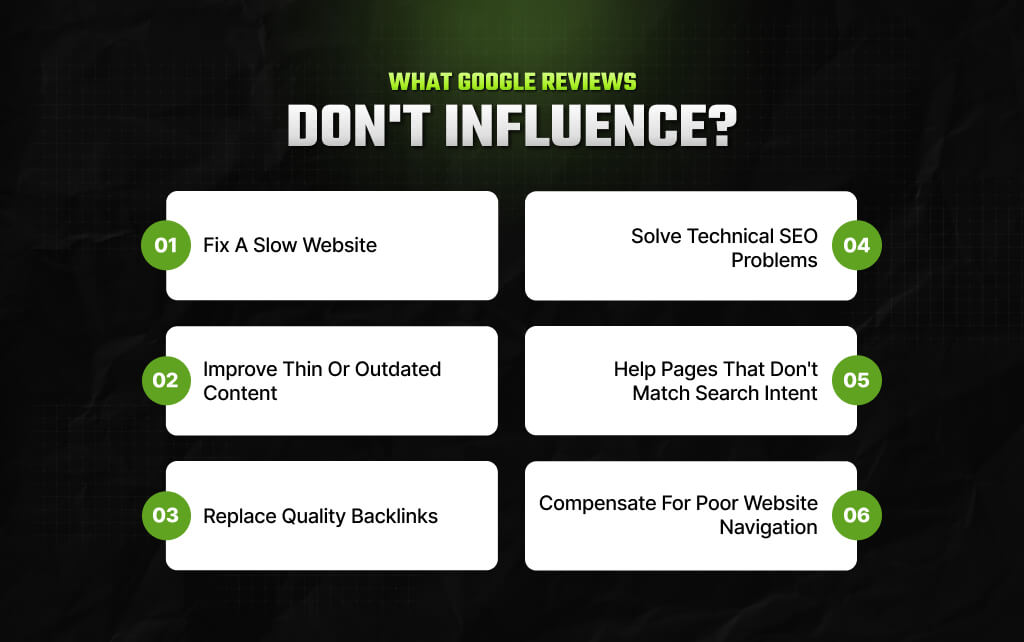
By now, we’ve established that Google reviews matter. However, what these reviews don’t do at all is guarantee improved rankings in search results.
And this is perhaps one of the biggest confusions in the local SEO ecosystem.
It surprises me every time to come across businesses working so hard to collect 5-star reviews just because they believe getting a certain number of reviews will automatically move them to the top of search results on Google.
To be honest, search does not work that way – quantity can never outperform quality on Google.
So, when you think about it, you will see that reviews are one signal among many. A business can have an outstanding reputation and still lose visibility if other parts of its SEO are weak.
For example, reviews won’t:
So, if you look at your SEO strategy like building a house, then understand that Google reviews are just something that you need for decorative purposes.
These reviews can make your house visually attractive. But that doesn’t mean they can replace your entire foundation.
Absolutely, and it is super common. So, let’s assume there are two dentists in your area, and you have to pick one.
Clinic A:
Clinic B:
Now, which one do you think will rank? I know the data makes it obvious that Clinic A will rank because it has more reviews.
But are you sure? You need to look closely and think about everything I’ve so far discussed. Google evaluates far more than review count.
It is possible that because Clinic B offers a better overall client satisfaction and experience, it can outrank Clinic A despite having fewer reviews.
Also, this highlights an important point in this context: chasing numbers for the sake of it rarely produces the result you have been expecting.
Reviews are only one piece of the puzzle.
For local searches, Google has consistently highlighted three broad considerations:
Reviews contribute to prominence, but they don’t define it.
Your website, online mentions, backlinks, local citations, and overall reputation all help build that picture.
For traditional organic rankings, Google also considers factors such as:
That’s why reviews should support your SEO strategy rather than replace it.

After eight years in the digital marketing profession, I can guarantee you that most businesses focus on quantity over quality – you will keep hearing, ‘how many reviews do I need to rank?’
I am sorry, but there’s no objective number. For instance, a business with 100 detailed and recent reviews can have a better ranking than an older business with 500+ reviews collected years ago.
Remember, quality usually tells a very meaningful story, whereas quantity? None! So, here’s what makes reviews valuable.
1. They are recent.
2. They contain specific details.
3. They come from real customers.
4. They include photos.
| The Art Of Response: The Business Responds Responding to reviews won’t magically improve rankings. It does demonstrate that the business values customer feedback. So, step in and thank customers for positive reviews. Also, address negative reviews professionally. Future customers notice those interactions, even if they never leave a review themselves. |
Let’s compare two fictional businesses.
| Business | Business A | Business B |
|---|---|---|
| Total reviews | 900 | 220 |
| Average rating | 4.8 | 4.7 |
| Reviews this month | 2 | 24 |
| Owner replies | Rarely | Almost every review |
| Customer photos | Few | Many |
| Website quality | Average | Excellent |
| Local content | Limited | Extensive |
Which business would you trust more? Many people instinctively choose Business A because of the higher review count.
But look closer – Business B appears active.
That’s the kind of business Google wants to recommend because it appears useful and engaged, not simply popular.
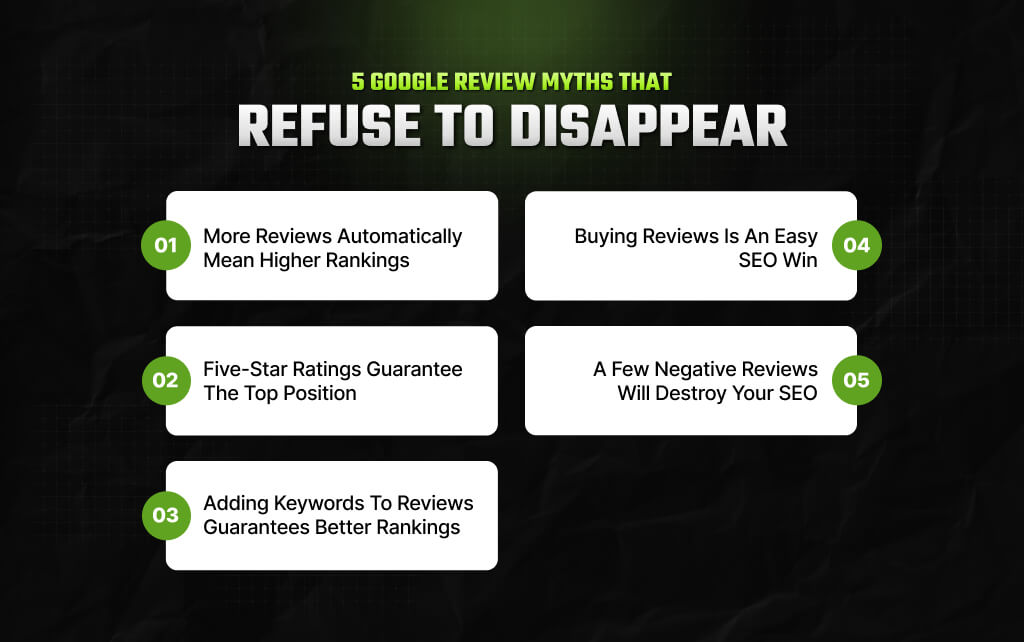
SEO advice spreads quickly. Unfortunately, so do myths. On that note, let’s separate fact from fiction.
1. More Reviews Automatically Mean Higher Rankings: Reviews help, but they don’t outweigh content, relevance, website quality, and other ranking signals.
2. Five-Star Ratings Guarantee The Top Position: A business with slightly lower ratings may still outrank competitors because it offers stronger local relevance, a better website, or greater authority.
3. Adding Keywords To Reviews Guarantees Better Rankings: Natural language is fine. But scripted reviews designed to manipulate rankings aren’t.
4. Buying Reviews Is An Easy SEO Win: Fake reviews can violate Google’s policies, undermine customer trust, and create long-term problems if they’re detected and removed.
5. A Few Negative Reviews Will Destroy Your SEO: A profile with a mix of positive and occasional critical feedback often feels more believable than one filled with nothing but glowing praise. What matters is how you respond.
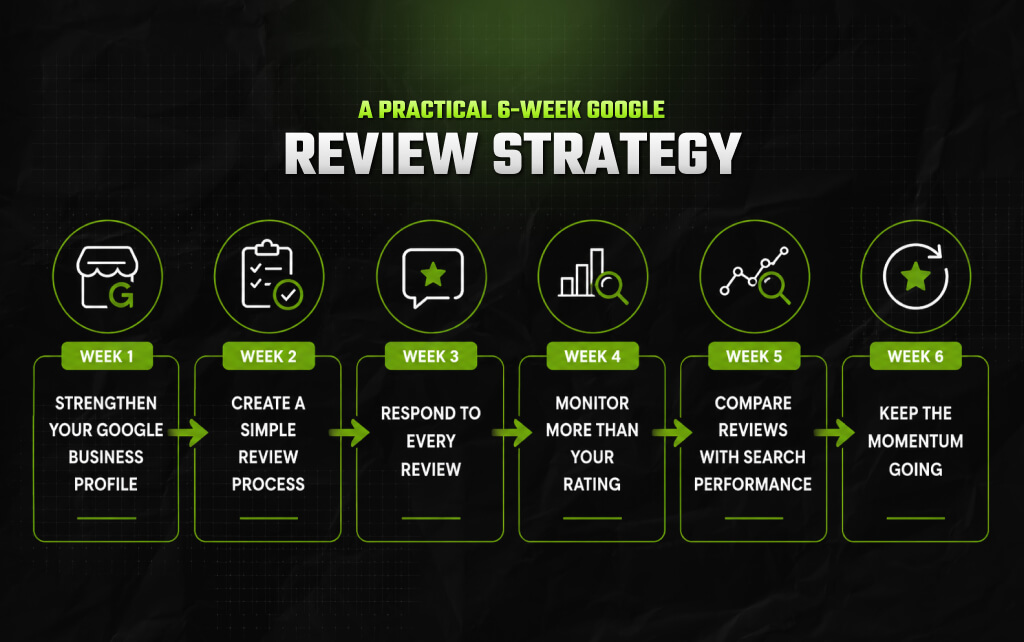
Businesses often ask one question after learning all this: So what should I actually do? Well, I can help.
So, here’s a realistic plan that focuses on steady improvement rather than shortcuts.
Before asking for more reviews, make sure your profile deserves them. You need to check that your:
Also, a complete profile gives customers confidence before they even read your reviews.
Don’t wait for customers to remember. Instead, ask at the right time.
For example:
Moreover, you have to make the process easy by sharing a direct review link. The easier it is, the more likely customers are to follow through.
Positive reviews deserve attention. But negative reviews deserve professionalism. Thank happy customers for taking the time to leave feedback.
So, if someone shares a poor experience, acknowledge the issue calmly and offer to continue the conversation privately if appropriate.
Future customers read these responses just as carefully as the reviews themselves.
A five-star average isn’t the only metric worth tracking.
Also pay attention to:
Reviews are a valuable source of customer feedback, not just an SEO asset.
Look for patterns:
So the thing is, reviews rarely tell the whole story, but they can reveal useful trends when combined with website and business profile data.
Review collection isn’t a one-time campaign. Moreover, healthy businesses receive feedback consistently.
So, it’s best to aim for a steady flow of authentic reviews throughout the year rather than trying to collect hundreds in a single month.
Consistency usually creates a stronger impression than sudden spikes.
In the last few years, I have noticed so many businesses trying to use Google reviews as an alternative to SEO.
Why hire an SEO professional when I can get a hundred reviews and manipulate rankings? Well, you see, that is the problem – reviews aren’t a replacement for SEO.
A business with 500 excellent reviews still needs:
Truth be told, reviews amplify a solid foundation. Moreover, they rarely compensate for a weak one.
And that is precisely why a business investing in a strong SEO strategy and positive customer experiences will always outperform those that focus on improving either one.
Barsha is a seasoned digital marketing writer with a focus on SEO, content marketing, and conversion-driven copy. With 8+ years of experience in crafting high-performing content for startups, agencies, and established brands, Barsha brings strategic insight and storytelling together to drive online growth. When not writing, Barsha spends time obsessing over conspiracy theories, the latest Google algorithm changes, and content trends.
View all Posts

Event Pages That Rank And Convert: A Practica...
Oct 06, 2026
KeywordStat Review: Keyword Research, Cluster...
Oct 03, 2026
How Corda Turns Authority Data Into Campaigns
Oct 01, 2026
How To Audit Your Search Visibility In 2026: ...
Sep 30, 2026
What Is Google Lighthouse? A Practical Guide ...
Sep 30, 2026