The Ultimate Guide To Competitor Backlink Analysis: An Actionable SEO Blueprint To Steal Your Rivals’ Traffic
Oct 23, 2026

According to statistics from the SEO Guru Neil Patel, backlinks contribute as the most essential factor to a website’s ranking.
Getting backlinks from multiple websites to your website is no less important than posting content that is ‘from the users to the users’.
As a seasoned SEO analyst, I have experienced it myself.
Backlinks, coupled with effective anchor text placements and valuable content, can do wonders for your website.
While the backlinks to your website drive more traffic, which, by the way, is good, there is certainly more to it.
It helps Google identify your website as legit and boosts the domain authority (DA) of your website. It gives your website a vote from the other websites that have good DA.
Irrelevance in your anchor text and the web page it’s linked to can cause higher bounce rates.
These high bounce rates may cause an unsettled ranking of your website on the Google search engine. There are ways to help skip the fuss and improve your ranking through anchor text optimization.
So, if you are keen to know how to optimize anchor text for SEO performance, I have got you covered.
Here, in this blog, I will be delving into the diverse elements around the anchor text optimization, highlighting—
Stay tuned!

A different-looking text in a pool of text that, upon clicking, leads the users to a different website or another page of the same website.
In the first line of this article, ‘SEO Guru Neil Patel’ is an anchor text. The anchor text can be multiple.
Now that you have registered what anchor text is, let’s go through some tips that can help you rank better through optimized anchor/link text.
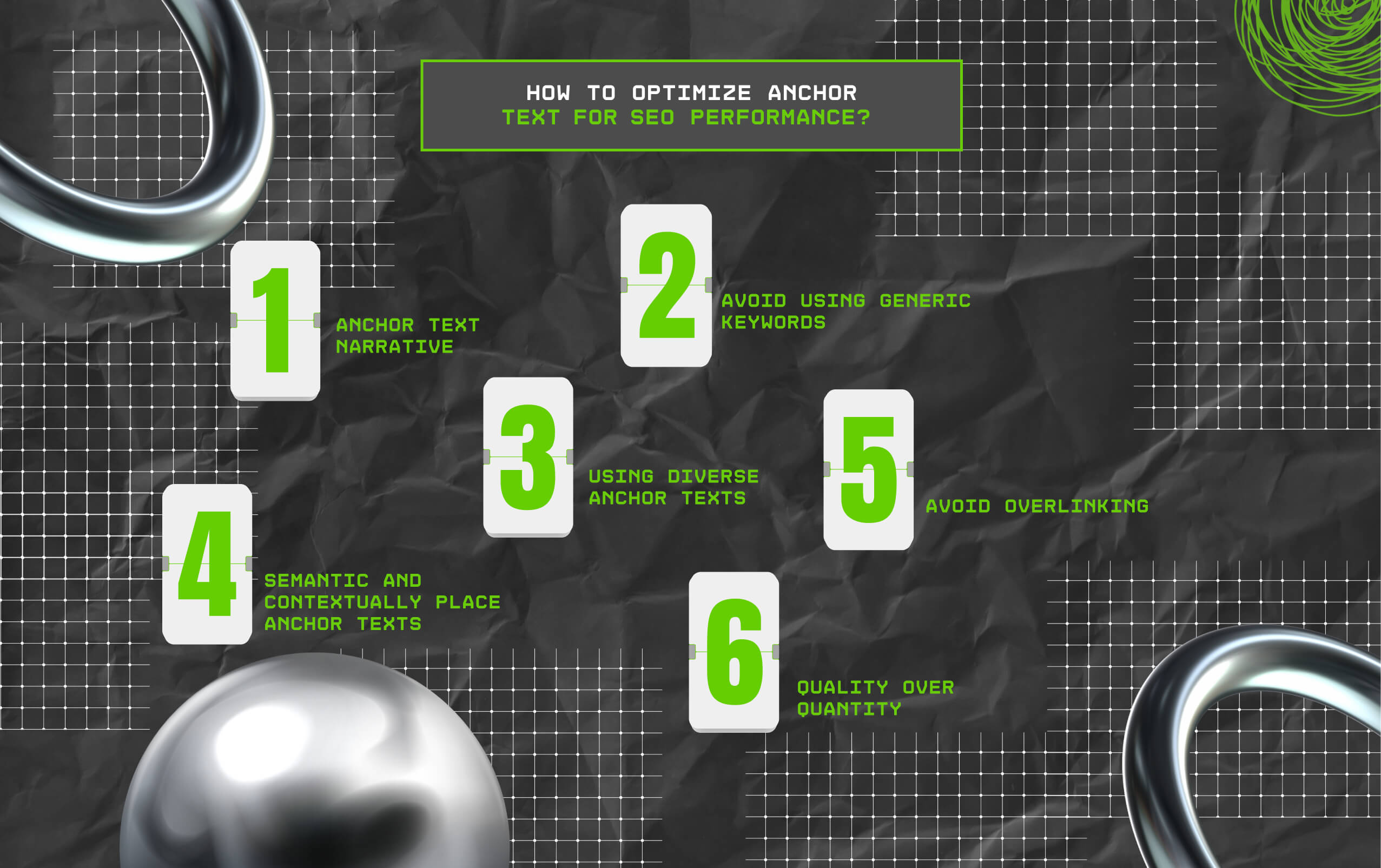
Given that anchor texts play such a vital role in affecting the SEO performance, here are some methods to optimize the anchor text for better SEO—
Recall the time when you tried to incorporate an anchor text that wasn’t directly related to the topic. Yeah, I reckon it might have ended badly.
I happened to go through the same, and once the page was live, that backlink increased the bounce rate, and my website’s ranking was affected.
So, what do you do when you are in the same scenario?
Google loves the content that is natural and isn’t out of place.
Your anchor text narrative for your ranking is the same as the water is for a fish. Keep this in mind: that readers are dumb.
Before placing your anchor text, you need to create a context that is related to your anchor text and blends smoothly, like a knife through butter, with the topic.
In this way, the readers will be aware of what they are about to visit and won’t bounce off the page owing to the unexpected redirection that they didn’t even want to engage with.

Generic keywords don’t do any good for your website’s ranking.
You might receive the traffic, but that would be futile because the users who are visiting your website likely won’t be interested.
Users and the search engine both will have trouble finding out what that page is about, and the anchor text is backlinking to.
You want your anchor text to entice the relevant users to click. Remember the ‘relevant’ users.
There’s no harm if some of the browsers come and bounce off, but if a big chunk of them do, your site’s ranking will be affected.
The solution? Use descriptive anchor texts that can pretty much clarify what the backlink page is going to be about for the users.
Now, it is better not to forget to include keywords in them.
Moreover, make sure to dodge the fuss of internet problems when doing extensive keyword research.
Apart from these, using one type of anchor text can adversely impact the SEO performance with over-optimization.
So, it is better to avoid the extensive use of a specific type of anchor text.
Now, to ensure the anchor text is used diversely, try combining different types. That is, mix branded, generic, and naked URLs within the pages.
This way, you can diversely distribute the anchor texts across the entire website and connect the relevant pages.
Now, let me make one thing clear from the get-go— anchor texts need to be semantically incorporated.
That is, brands need to use anchor texts contextually. So, they can be placed in the content naturally. Avoiding any forced use of anchor texts.
Moreover, brands and businesses can use key phrases and related terms in place of the anchor texts to diversify their usage.
So, they can be distributed within the content and the web page organically.
Finally, overusing anchor texts is also not a very SEO-friendly approach. That is, linking internal pages and external pages on every single text can make the site look spammy.
And, this can signal the Google search bots to prevent it from ranking as a reliable and credible site.
So, brands and marketers should focus more on using relevant and helpful anchor texts for linking. Avoiding the issue of overlinking and skyrocketing their ranking on SERPs.
So, here’s the thing. Google earns money by making the user experience good. The more users use the search engine, the more the search engine will make.
And the search engine is termed good only when it fetches relevant and quality results.
The same happens for the anchor text and its backlinks. Too many is not fine.
Whenever the bots find that a site is using too many backlinks, it’s a warning red flag for them, and potentially, the website will be penalized by Google.
So, it’s best to avoid:
While this shady business isn’t liked by Google, there is another part of the backlinks strategy that Google doesn’t appreciate.
So, no desirable website ranking.

The ranking of your website is substantive. I know it takes significant effort and that too with consistency but the reward is even sweeter.
The ROI is great and the anchor text is one of the judgmental parts of it. So, make sure to use my proven tips in building quality backlinks that will help your website rank on the Google search engine.
Here are some of the common questions on the anchor text optimization for better SEO performance of the websites.
No, absolutely not. Since there are diverse types of Anchor Texts available, there is not a single type that is considered fitting for all kinds of websites.
Moreover, the best optimization practice for anchor texts is the mixing of diverse types. So, they can prevent the over-optimization of the anchor text in the content.
That’s why it’s better to combine branded, naked URL, generic, exact match, and concise anchor texts. This helps in diversely distributing the anchor texts in the content.
Generally, anchor texts should be short and concise. So, optimally, it is better to keep them within the 55 to 60 character limit.
That is, the anchor text should be within 2 to 5 words that directly provide the context to the linked page. So, readers can understand the context before redirection.
Since the SEO paradigm has massively evolved over the last decade, using generic anchor texts is usually considered a poor practice.
That is, generic anchor texts provide zero SEO value and user experience. Making it difficult for readers to contextually understand the topic of the redirected webpage.
So, it is better to avoid these generic anchor texts. Rather, you can use branded texts or partially branded texts along with other types to diversify the anchor texts.
Since the right usage of anchor text ensures smooth SEO performance, it can be audited twice a year.
But if you notice any issues with the site engagement, like increased bounce rates and low redirections, then you can audit the anchor text usage quarterly.
Moreover, if you have employed a new anchor text strategy, then you can conduct the audit weekly or monthly.
So, you can track the performance differences and adjust the strategy accordingly.
Chandrima is a seasoned digital marketing professional who works with multiple brands and agencies to create compelling web content for boosting digital presence. With 3 years of experience in SEO, content marketing, and ROI-driven content, she brings effective strategies to life. Outside blogging, you can find her scrolling Instagram, obsessing over Google's algorithm changes, and keeping up with current content trends.
View all Posts

The Ultimate Guide To Competitor Backlink Ana...
Oct 23, 2026
How To Land High-Authority Editorial Backlink...
Oct 23, 2026
Why Your Website Traffic Dropped Suddenly And...
Oct 23, 2026
How Do The Physical Google Review Tools Redef...
Oct 23, 2026
How To Get Your Brand Cited In AI Search Resu...
Oct 22, 2026