
The Traffic-to-Revenue Gap: Why More Website Visitors Don’t Always Create More Customers
Sep 17, 2026

There is nothing worse than launching a product to absolute silence. Over the past eight years, I’ve watched brilliant startups dump millions into development, only to watch their market entry fall completely flat.
Why does this happen? Because most teams still treat a Product Marketing Strategy like a static checklist. They write a boilerplate press release, dump cash into generic Meta ads, and pray for product-market fit.
But here is the harsh reality: features are no longer a defensible moat. In our current hyper-crowded ecosystem, copycat competitors can clone your core software features before your launch week even ends.
To drive real conversions and survive, you have to stop selling product features. You need to start designing market narratives.
Stay tuned.
The Challenge: Products Without Strategy
A lot of companies pour money into innovation but miss the mark when it comes to tying product work back to real, measurable growth. And, honestly, the same patterns pop up again and again:
When these issues pile up, the results are pretty predictable: higher costs, slower launches, and products that miss the mark with the people they’re supposed to serve.
Moreover, marketing gets stuck trying to position something that doesn’t have a clear story, and the campaigns never quite land.
The funny thing? Innovation itself isn’t the problem – it’s the missing strategy behind it.
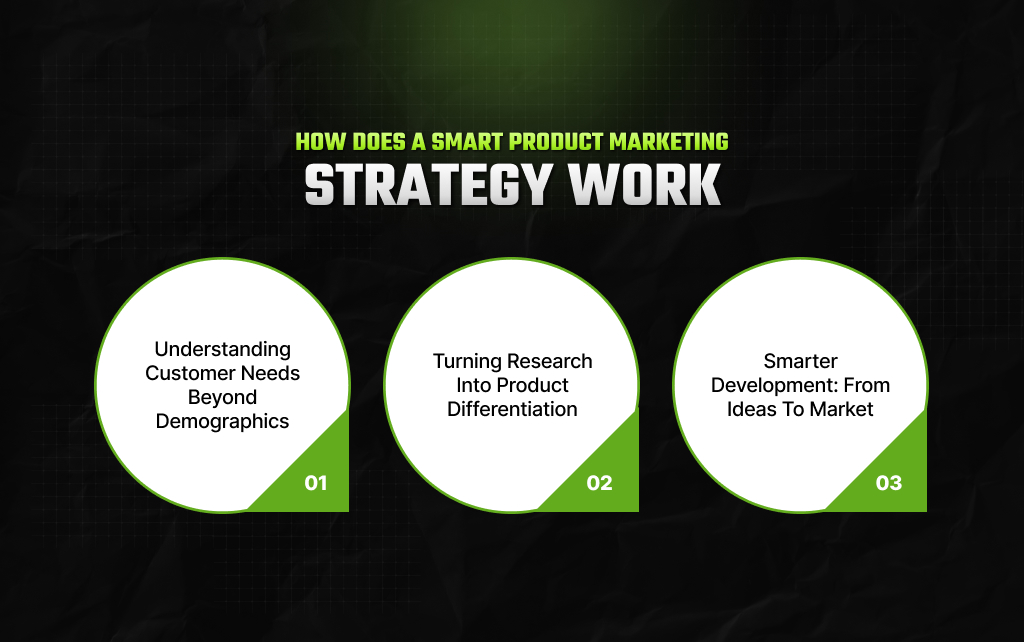
Marketing shouldn’t be something the team loops in at the end—it needs a seat at the table from day one. The strongest companies build a tight feedback loop between product design, customer expectations, and the way they plan to communicate that value. When this works, every product has a clean, convincing value proposition and a place in the market that makes sense.
Marketing is more than promotion. It’s the team that spots market gaps, tests early ideas, and uses data to confirm whether customers actually care. When marketing joins early in the process, decisions get sharper, and teams skip a lot of expensive mistakes.
Classic research tends to stop at demographics – age, income, whatever. But smarter strategies dig deeper. They look at why people behave the way they do, what motivates them, and the emotional stuff they don’t always say out loud.
To make that practical, marketing and product teams need to work together and:
This turns research into something useful. Products aren’t built off assumptions—they’re shaped around what users clearly show they want.
Collecting data is easy. Turning it into real differentiation? That’s where things get interesting. A smart product marketing strategy has to answer one simple question: Why is this product different in a way that matters?
That difference could come from:
Once product teams define the angle, marketing steps in to shape it into messaging that resonates, when you pair true differentiation with a strong campaign, adoption tends to pick up quickly.
Moving from idea to launch isn’t a straight line anymore—and honestly, it shouldn’t be. The process needs room to bend, test, and shift as teams learn.
That’s why more companies lean on New Product Development tools – to validate concepts, predict budgets, compare prototypes, and figure out how audiences might react before spending big.
The real win isn’t speed (though that’s nice). Its accuracy. Teams identify what’s actually working and what needs to be scrapped, which lowers the risk and boosts the odds of releasing something that people genuinely want.
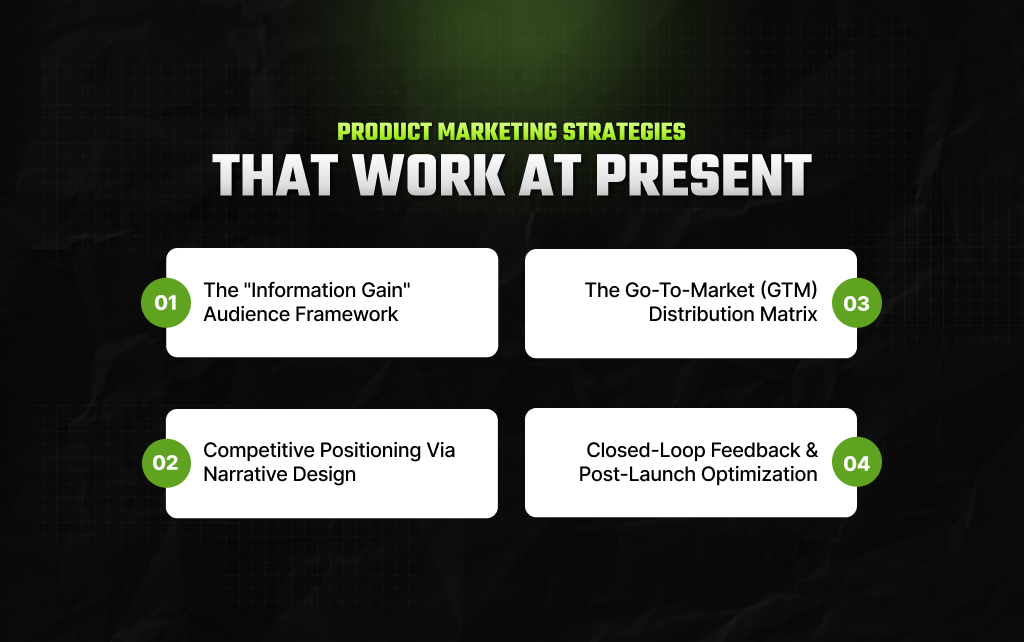
Here are a few things that you need to try to ensure your product reaches the right audience:
Let’s be honest here. Traditional buyer personas are officially dead. If your strategy still relies on fictional profiles like “Marketing Mary,” you are actively wasting your time.
In today’s AI-accelerated market, demographic data is just a cheap commodity. To win, you must pivot to an intent-driven framework. I always lean on Clayton Christensen’s Jobs-to-be-Done (JTBD) model for this [Source: HBR: Jobs to be Done Framework].
Customers do not buy products because of their age or job title. Instead, they “hire” a tool to solve a specific, high-friction problem.
Therefore, you must stop guessing what your users want. Implement a rigorous, first-hand user interview protocol instead [Source: Reforge: Modern Audience Segments].
Ask your recent converts this exact question: “What went wrong the morning you decided to find a tool like ours?”
Finally, pair these qualitative insights with modern product analytics. Track your setup drops in Mixpanel or user searches in your app logs to uncover real intent. This strategy maps out the exact progress your user is trying to make.
Do not rely on feature-by-feature comparison tables to protect your market share. Competitors can now replicate your software features within weeks using automated AI coding agents. Feature parity is completely inevitable [Source: Gartner]
Consequently, your competitive positioning must rely on Narrative Design.
Do not position your product as a slightly faster or cheaper tool. Instead, construct a strategic narrative around an unavoidable market shift.
Frame the old way of working as actively dangerous to your prospect’s business. Your product then emerges as the only logical solution to survive this macro change. When you change the rules of the game, you render feature comparisons completely irrelevant.
Blindly burning capital on generic Google or Meta ads kills your profit margins. A scalable Product Marketing Strategy demands strict mathematical alignment between your contract value and your acquisition channels [Source: OpenView].
You must balance your customer acquisition cost (CAC) against your lifetime value (LTV).
Most product marketers abandon their campaigns the second launch week concludes. This is a massive mistake. Real conversion optimization actually begins 30, 60, and 90 days after your initial launch [Source: Product Marketing Alliance].
Establish an active, closed-loop workflow with your Product Managers immediately. Do not look at vanity metrics like landing page traffic or initial sign-ups.
Instead, look directly at feature adoption rates inside the app. If data shows that users drop off before completing a core setup action, your copy has failed to communicate value.
Continuously adjust your on-page messaging, in-app guides, and email sequences based on real user behavior to turn short-term traffic into long-term retention.
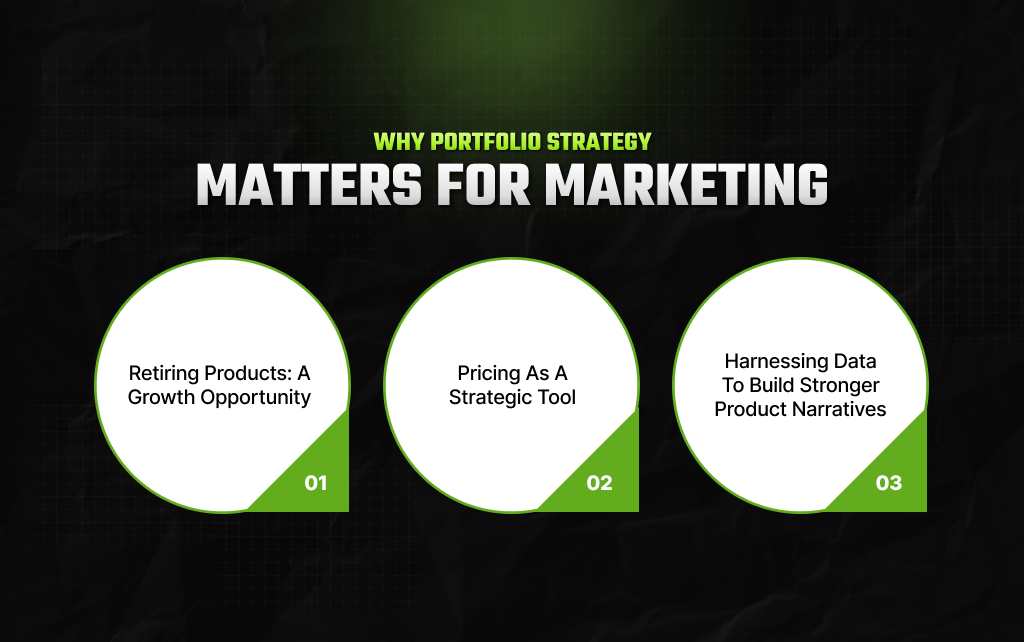
Even strong products can become a drain if the whole portfolio is out of balance. A single good product doesn’t guarantee that the brand is moving in the right direction.
Marketing and product teams should evaluate products with three lenses:
Strategic Portfolio Management software helps here. It gives companies a clearer way to evaluate everything, set priorities, and invest in products that actually have upside. Instead of chasing trends, teams move with intention.
Retiring a product always feels a bit scary, but sometimes it’s actually the smartest move a company can make.
Too many products confuse customers and dilute marketing efforts. When you cut the dead weight, you create space for better ideas – and a cleaner story.
Marketing plays a big role here. It helps shape the narrative so customers don’t feel blindsided.
The message becomes something like: “We’re simplifying things so we can deliver more value.” With that shift, campaigns get tighter, the brand feels more focused, and customers see improvement instead of loss.
Pricing shouldn’t just cover costs. It should reflect how people perceive value and how competitors position themselves. Marketing helps decode how customers interpret price and what it signals.
Smarter pricing might include:
When the pricing lines up with expectations and perceived value, it can shape a product’s market position more effectively than any ad campaign.
Data isn’t just about performance reports. When used creatively, it becomes an engine for better storytelling and smarter decisions. For instance:
When data supports the narrative, products feel clearer, and customers connect more naturally with the brand.
A launch isn’t the finish line – it’s more like the starting gun. What happens after a product hits the market determines whether it grows or fades.
Post-launch monitoring helps teams refine the positioning, adjust features, and tighten messaging. It also signals reliability, which customers notice.
Marketers should pay close attention to:
These insights make sure the product keeps evolving instead of just sitting there.
One of the trickiest parts of marketing is translating features into something customers feel. People don’t care about internal mechanics – they care about how a product makes life easier, faster, or just better.
To strengthen product-market fit through communication, teams should:
When communication clicks, product-market fit becomes so much easier to see.
Instead of scrambling when the market shifts, smarter strategies try to see the signs early. This isn’t magic – it’s a mindset. Teams watch behavior patterns, cultural trends, and social shifts to understand what customers might want next.
Companies that anticipate change tend to move faster and look more aligned with the moment. Their products evolve with customers, not after them.
At its core, marketing shapes how people behave and choose.
So, when marketing helps companies understand why customers prefer one option over another, it becomes a powerful engine for innovation. And when those insights flow into product teams, progress becomes consistent – not just a lucky accident.
Smarter product strategies aren’t about flooding the market – they’re about aligning value with expectations. That’s how marketing steers growth with clarity.
Barsha is a seasoned digital marketing writer with a focus on SEO, content marketing, and conversion-driven copy. With 8+ years of experience in crafting high-performing content for startups, agencies, and established brands, Barsha brings strategic insight and storytelling together to drive online growth. When not writing, Barsha spends time obsessing over conspiracy theories, the latest Google algorithm changes, and content trends.
View all Posts

The Traffic-to-Revenue Gap: Why More Website ...
Sep 17, 2026
The Volatility Trap: What Crypto Position Siz...
Sep 17, 2026
Schema Markup: How To Use It Without Turning ...
Sep 17, 2026
Turn A Search Question Into A Watchable Expla...
Sep 16, 2026
Agency Guide To YouTube Growth: Wholesale Pri...
Sep 15, 2026