The Ultimate Guide To Stealing Your Competitors’ Backlinks Using Curated Resource Lists
Oct 15, 2026
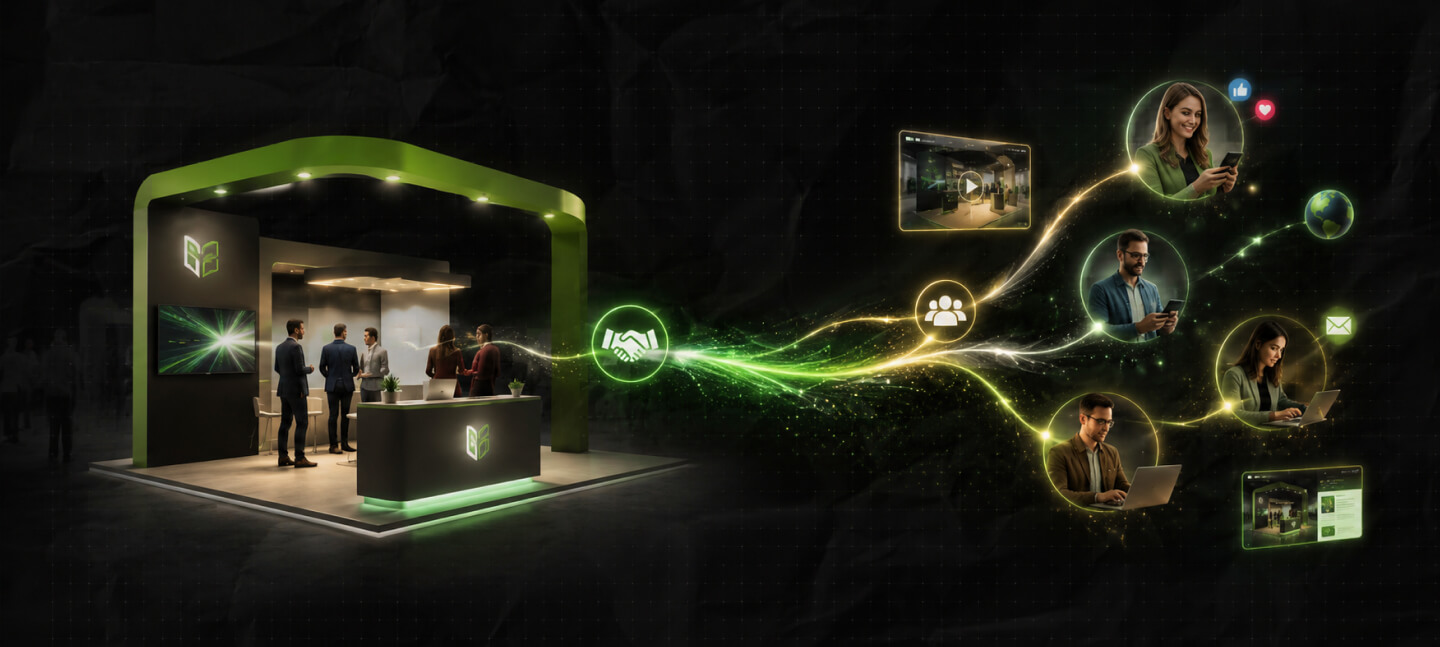

A booth in a trade show only gets limited time to make an impression that actually counts – you don’t really have much time in your hands.
People walk past. Some stop. A few ask questions. Some others pick up a few brochures to flip through and make promises of getting in touch later.
And soon, the show is over. But that doesn’t mean your brand needs to disappear as well. Instead, your booth can actually be a fantastic start to a long discovery journey.
For instance, if someone spots your booth at an event and finds it interesting, chances are they will look you up later. They may even land on your site, check out your LinkedIn, and even refer you to a colleague.
That changes how trade show visibility should be viewed – your booth cannot just be some spot where people meet your brand.
Instead, you should work towards creating a space that connects physical recognition with digital discovery. And that sort of connection really matters because nobody hardly ever makes a decision in the B2B zone on the basis of one random interaction.
Rather, they might come across you at some event, look you up later, check out your website again, and then finally get in touch with you weeks (or even months) later.
You need effective trade show exhibit planning to build on physical booth visibility and create recognition that later leads to branded search, website visits, social discovery, and follow-up engagement.
On that note, today we will break down the best trade show marketing strategies in detail, highlighting how visibility at a trade show connects physical booth presence with broader discovery for your brand.
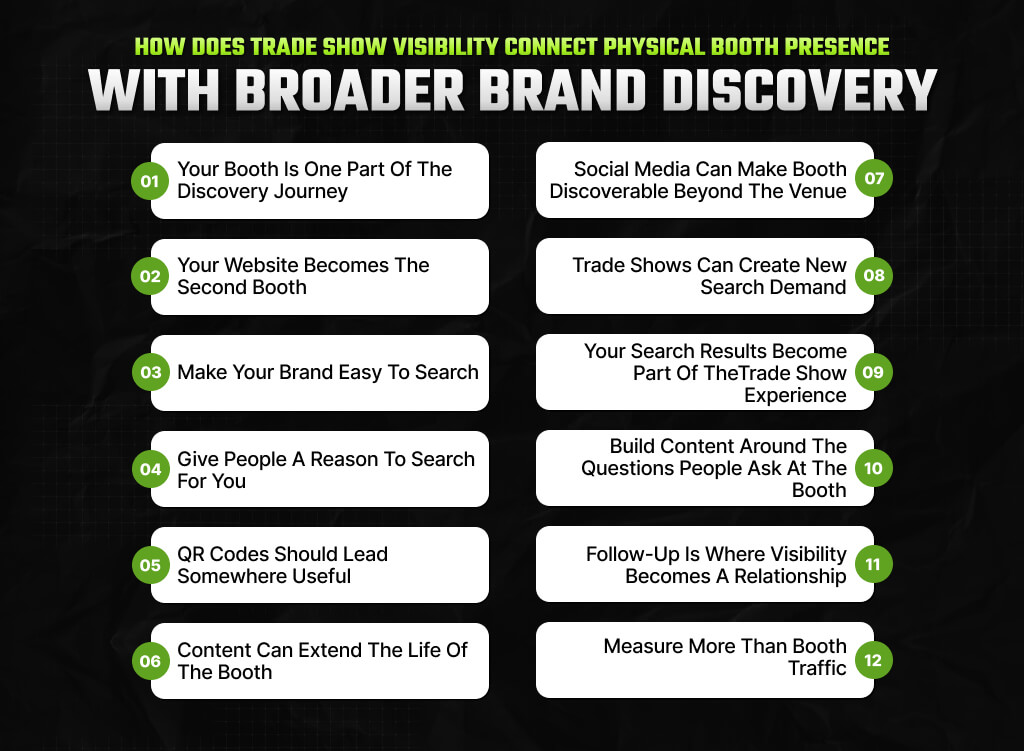
In this section, we will discuss the most effective trade show marketing strategies that will help you boost your brand’s visibility at a trade show.
Also, it will help you understand how improved visibility in trade shows is important for broader brand discovery.
Think about what happens when someone notices your booth – they see your company name. They notice the product. Perhaps they hear your salesperson explain what you do.
Now, this person knows something they didn’t know before: brand recognition. Later, they might even look you up. And that search is super important.
They already know what your name is. So, they aren’t really looking for a completely new brand.
Instead, they are looking for some sort of confirmation. Also, they might want to know other stuff like
They may want to know:
This is where your digital presence takes over from your physical presence.
A great booth can create interest, while your website and social media can answer what comes next.
Digital marketing can put your brand in front of thousands of people.
But a trade show gives potential customers an opportunity to interact with your company directly.
That changes the nature of the experience.
A visitor can see your product rather than simply reading about it – They can ask a salesperson a question. They can watch a demonstration. Also, they can judge how your team communicates.
The physical experience therefore does something digital content cannot always do – it gives your brand a human presence.
But the strongest strategy does not stop there. It uses that physical interaction to encourage further discovery.
A useful way to think about this is to treat your website as an extension of your booth – Your physical booth has limited space. But your website does not.
At the event, you may have a headline explaining one product or service. Online, you can provide the details.
Your booth might show one product demonstration. But your website can explain how the product works, who it is for, and what problems it solves.
Your sales team might answer five questions during a conversation, while your website can answer the next 50.
That makes the website an important part of trade show visibility.
Someone who remembers your brand should be able to find the information they need without starting from scratch.
This sounds obvious, but it is easy to overlook.
If someone hears your company name at a noisy exhibition, they need to be able to find you later.
That means your brand name should be consistent across your:
As a result, it is best to avoid creating different names or messages for different channels. The person who sees your booth should recognize the same company when they search online.
This becomes especially important when your brand name is unfamiliar.
A visitor may remember only part of it. However, clear branding and consistent messaging make that search easier.
A booth should not simply tell visitors what your company does. It should give them something worth remembering.
That could be:
The goal is not to make the booth louder than everyone else’s. Rather, it is to make it more relevant.
A visitor should leave with a reason to continue the conversation.
For example, instead of saying, “Visit our website to learn more,” you could offer, “Get the full industry benchmark from our website.”
Now the website has a purpose – the visitor has a reason to search for your brand or scan the code. And that is how physical visibility starts creating digital discovery.
QR codes have become common at exhibitions. But putting one on a booth does not automatically make it effective.
To be honest, the destination matters more than the code itself.
A QR code should take visitors to something relevant to what they just saw. For instance, if the booth demonstrates a product, the QR code could lead to a detailed product page.
Similarly, if the team discusses an industry problem, it could lead to a useful guide. Or if the company offers a report, the code could lead to the report.
But do not send someone who just saw a specific product to a generic homepage unless there is a good reason.
The transition should feel natural – the fewer unnecessary steps, the better.
One of the biggest missed opportunities at trade shows is treating the event as a single day – it is not.
In our experience, we have seen that the event can give you material for weeks of content. For starters, before the show, you can publish:
During the show, you can create:
After the show, you can turn those interactions into:
The booth then becomes a source of content rather than a one-time marketing expense.
A physical exhibition has a natural limitation. Only people who attend can see the booth. And social media removes some of that limitation.
Photos, videos, product demonstrations, interviews, and event commentary can put the experience in front of people who were not there.
But there is a difference between documenting an event and creating useful content from it – you have to turn the physical experience into information that others can use.
That creates a stronger connection between the event and broader brand discovery.
This is one of the most interesting connections between offline and online marketing. Someone may not have searched for your company before the event.
Then they see your booth. Later, they search your name.
The event has introduced your brand into their consideration set. And that does not mean every branded search can be directly attributed to the trade show.
People discover brands through many channels.
But it shows why offline visibility and online discovery should not be treated as completely separate activities.
A physical interaction can create the curiosity that leads to a digital interaction. The digital interaction can then create the confidence needed for a sales conversation.
Once someone searches your brand, your search presence becomes part of the experience.
Think about what a potential customer might see.
All of these can influence how someone evaluates the company they just met. This is why trade show preparation should include more than booth design and staffing.
Your sales team hears valuable questions during trade shows – pay attention to them.
For instance, if ten visitors ask the same question, that question may deserve a page on your website.
Similarly, if several prospects misunderstand a product feature, your website could explain it more clearly.
Also, if buyers repeatedly compare your solution with another approach, create content that addresses the comparison.
This creates a useful feedback loop: Trade show conversations lead to customer questions, which in turn lead to content and search visibility, resulting in future discovery.
The physical event becomes a source of insight for your digital strategy. That is much more valuable than simply collecting business cards.
The post-show period matters just as much as the event itself. Someone may remember your company for a few days.
Then work gets busy, and the conversation disappears.
As a result, a useful follow-up keeps the connection alive. But follow-up should not always mean, “Just checking in after the trade show.”
Give people something useful – Send the report you discussed or share the product demonstration.
Also, you can answer the question they asked, send a relevant case study, or even invite them to a webinar.
The goal is to continue the conversation rather than simply remind someone that you exist.
Booth traffic is an obvious metric. It is also an incomplete one. As a result, a crowded booth does not necessarily mean strong business results.
Similarly, a better measurement approach looks at the entire journey.
As a result, you need to track a range of parameters before, after, and even during the event.
Before the event, track:
During the event, track:
After the event, track:
This gives you a broader picture.
Someone who scans your QR code, reads three articles, returns to the website, and contacts sales two months later may be more valuable than someone who simply walked past your booth.
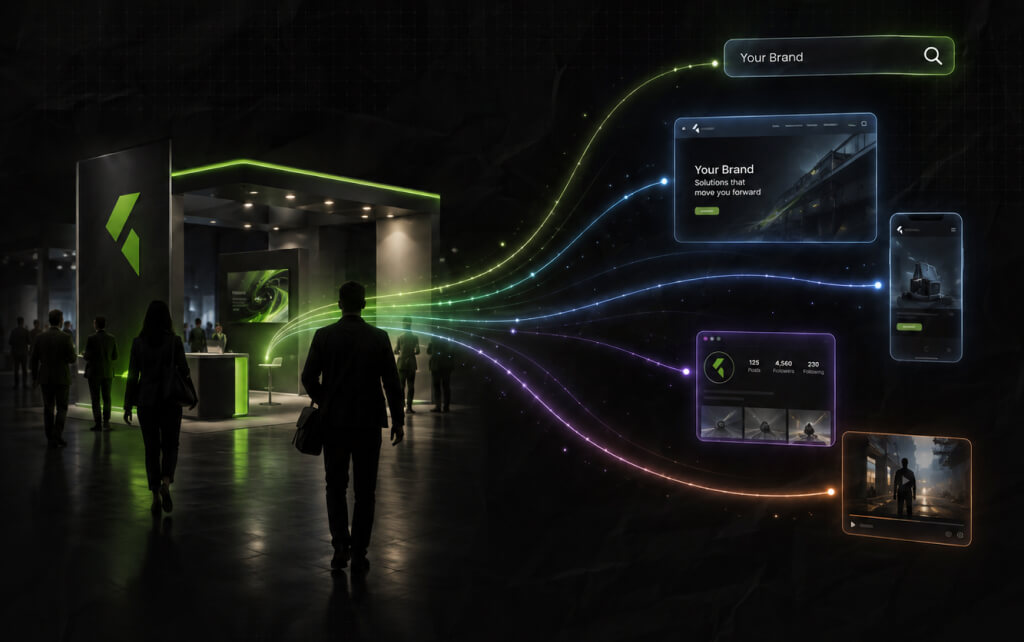
A trade show booth can create a powerful first impression. But first impressions have limited value if there is nothing behind them.
The visitor eventually leaves the exhibition and goes back to their office. They search for your company.
Then, they compare options, talk to colleagues, and revisit your website.
Also, they may encounter your brand again on LinkedIn, in a search result, through a report, or in another industry publication.
That is where physical visibility becomes broader brand discovery.
The best trade show strategy therefore does not ask only “How do we get more people to our booth?”
Rather, it asks, “What happens after someone sees our booth?”
If your physical presence gives people a reason to remember you, and your digital presence gives them a reason to keep exploring, the event can have a much longer life than the exhibition itself.
Your booth may last three days. The brand discovery it creates can last much longer.
Barsha is a seasoned digital marketing writer with a focus on SEO, content marketing, and conversion-driven copy. With 8+ years of experience in crafting high-performing content for startups, agencies, and established brands, Barsha brings strategic insight and storytelling together to drive online growth. When not writing, Barsha spends time obsessing over conspiracy theories, the latest Google algorithm changes, and content trends.
View all Posts

The Ultimate Guide To Stealing Your Competito...
Oct 15, 2026
Beyond The Basics: Master Guest Posting For H...
Oct 15, 2026
Best Generative Engine Optimization (GEO) Com...
Oct 14, 2026
Digital PR for Link Building: How To Earn Hig...
Oct 13, 2026
Cracking The Code Of The Social Media Saga Si...
Oct 13, 2026