
How To Get Your Brand Cited In AI Search Results In 2026
Oct 22, 2026


Using AI for content strategy is a very, very, very hot topic. When I think back on how ChatGPT got the quickest user base ever – hitting 100 million in monthly users in only two months – it doesn’t seem strange that the dependency on AI has exploded in the last few years.
Books, films, and television have pitted AI infinitely against humans. Moreover, with the growing popularity of using AI tools for creating output that has been done by humans traditionally, such as academic writing, art, and marketing content, the anxiety and stress surrounding artificial intelligence is palpable.
Having said that, I would also like to point out that research on artificial intelligence shows a different picture, especially in applying AI for improving operational workflows.
In fact, a recent survey by IBM revealed that AI adoption is steadily rising globally. While 35% of businesses are already using AI, 42% are studying AI incorporation, and 77% are exploring the use of AI.
Moreover, many companies have highlighted how AI has addressed labor gaps in operations by automating monotonous tasks. That way, the human resources of these businesses can now work on intensive projects that require critical thinking.
Also, research further highlights how AI can help to increase business revenue. AI-driven sales tools can increase conversion rates and improve customer experiences, specifically for online businesses.
As such, if you are an agency or a startup working with digital content or in the e-commerce industry, you should use AI tools to enhance your existing content-SEO strategies and automate repetitive tasks.
Chances are, you already knew that – but you don’t know where to start. That is where I come in – yep, I’m here to help you create effective content strategies with the help of AI in 10 minutes.
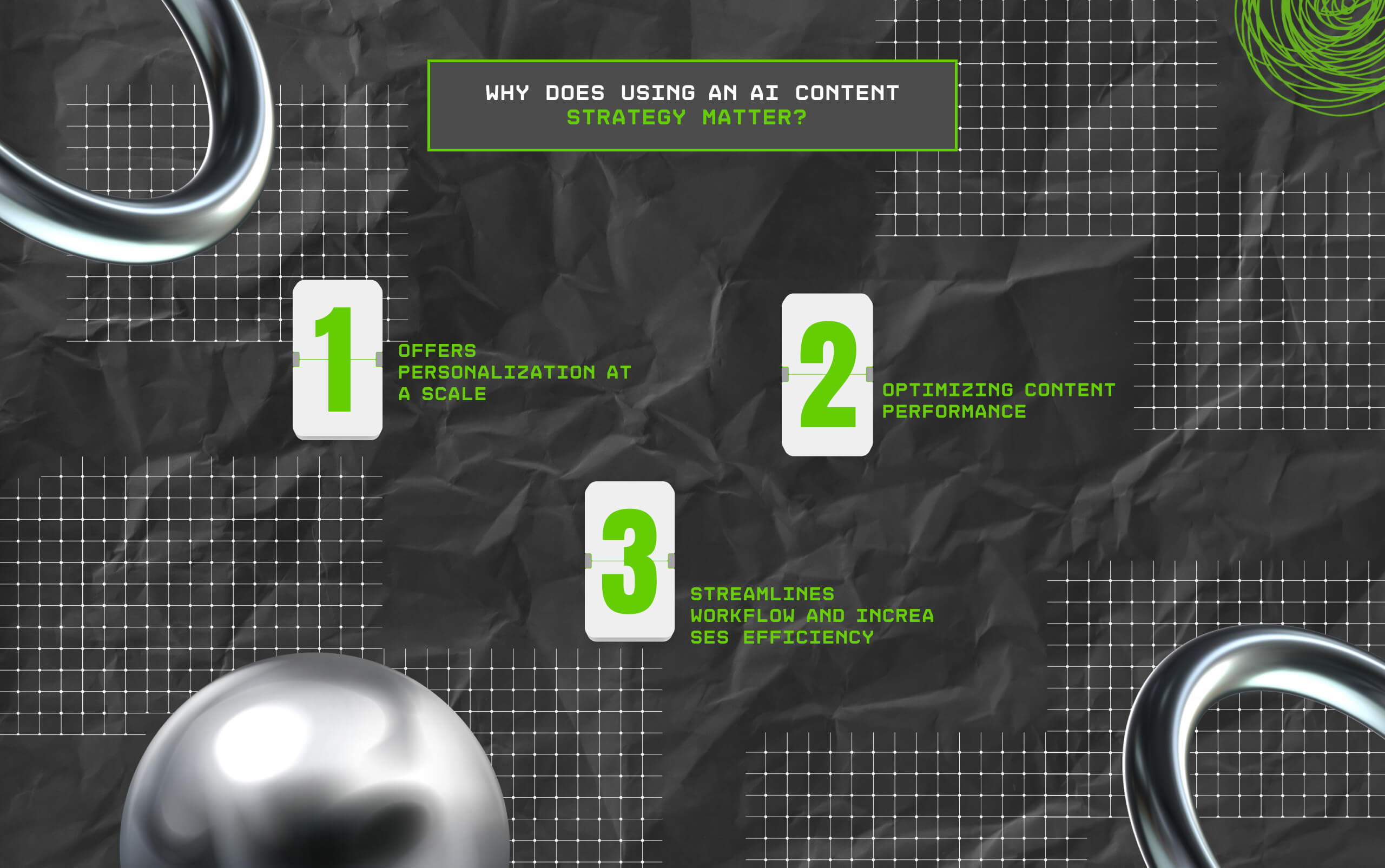
While there are multiple reasons behind using AI for content strategy and related tasks, I would like to highlight the three most significant reasons:
One of the biggest challenges marketers face is delivering personalized content at scale. Traditionally, personalizing content for each customer requires significant time and effort, making it impractical for large-scale campaigns.
However, AI marketing tools make personalization more accessible than ever before.
By analyzing user data and behavior patterns, these tools can dynamically generate content that resonates with each recipient.
So, whether it’s addressing them by name, recommending products based on their preferences, or tailoring messaging to their specific interests, these tools enable marketers to deliver personalized experiences at scale, driving higher engagement and conversion rates.
Another key aspect of effective content marketing is understanding what resonates with your audience and optimizing your strategy accordingly.
This involves tracking metrics such as click-through rates, conversion rates, and social engagement to identify which content performs best.
The analytic capabilities of AI tools provide marketers with valuable insights into the performance of their content. Moreover, by tracking metrics in real time and analyzing trends over time, such tools can enable marketers to identify what content drives the most engagement and conversion.
This allows for continuous optimization of content strategies, ensuring maximum impact and ROI.
In addition to enhancing the quality and effectiveness of content marketing efforts, AI tools also streamline workflow and increase efficiency.
By automating repetitive tasks such as content generation and optimization, marketers can focus their time and energy on higher-level strategic activities.
The intuitive interface and seamless integration of AI tools with existing marketing platforms make it easy to incorporate into any workflow.
Whether you’re a small business looking to scale your content marketing efforts or a large enterprise seeking to streamline your processes, these tools typically offer a flexible and scalable solution that adapts to your needs.

What is the meaning of using AI for content strategy? What does it actually mean?
Technically, artificial intelligence imitates human intelligence and performs jobs, mimicking human cognition and behavior. Also, AI keeps improving continuously – the more you use it, the better it will become since AI collects more information and data with time.
So, here are some areas where you can incorporate AI to create an effective content strategy:
Artificial intelligence can create error-free, engaging blog posts, perfectly optimized for the different search engines. This is ideally very helpful for small teams that depend on publishing relevant content and meeting tight deadlines. Typically, these teams don’t have the means to hire content writers.
Moreover, businesses can end up benefiting so much from automated research and SEO tools such as:
Ai-driven image generators are helpful for small teams and startups with limited or no graphic designers for creating images. As a result, such teams can easily create designs with AI tools in minutes.
So, my favorite tools for using AI for creating images include:
Perhaps one of the best ways to generate leads and reach out to existing clients is email marketing. But implementing an email marketing campaign effectively does require plenty of strategizing and planning – not to mention, mailing itself is a tedious task.
So, you can use AI to optimize your campaigns – but how? You can depend on AI tools to ensure that your emails are reaching your target audience at the right time, boosting open rates. Moreover, some tools can help you customize your emails with product suggestions, backlinks, subject lines, and more.
So, here are some of my favorite AI tools for email marketing:
You can use AI tools to create content for social media across different platforms. Moreover, you can use the same tools to launch advertisement campaigns for targeting specific audiences.
In addition, some tools can find influencers for you and track brands to find who are the most relevant voices in their specific niches.
So, here are my favorite AI tools that have been a great help for social media management:
While AI marketing tools offer immense potential, implementing them effectively requires addressing certain challenges. One common concern is the fear of losing the human touch in marketing efforts.
However, it’s essential to understand that AI is not meant to replace human creativity and intuition but to complement it.
By leveraging AI tools , marketers can amplify their capabilities and focus on strategic decision-making, while leaving repetitive tasks to automation.
Many professionals worry that automation makes their brand feel cold or robotic. This is a big concern in service-based fields where trust is the main thing people buy. For example, AI marketing for personal trainers in the fitness industry works best when it handles the data but lets the coach keep their own voice.
It helps with things like writing social posts or emails that still sound like they came from a real person. Using these tools the right way means you spend less time on the computer and more time with your clients. This balance keeps the business running fast without losing the connection that makes it special.
Another challenge is the need for proper data management and privacy considerations. With AI relying heavily on data for analysis and personalization, businesses must prioritize data security and compliance with regulations such as GDPR.
Ensuring transparency and obtaining consent from users regarding data usage are crucial steps in building trust and maintaining ethical standards in AI-powered marketing.

As AI technology continues to advance, the future of content marketing holds even more exciting possibilities.
Innovations such as natural language generation, image recognition, and predictive analytics promise to further revolutionize how marketers create, distribute, and optimize content. By embracing these advancements and staying abreast of emerging trends, businesses can stay ahead of the competition and deliver exceptional experiences to their audience.

Content distribution is as crucial as content creation. Even the most compelling content won’t yield results if it doesn’t reach the right audience.
This is where AI-powered tools play a vital role. By analyzing user behavior, preferences, and demographics, WriteBot helps marketers determine the most effective channels and timing for content distribution.
Moreover, AI tools can optimize content for various platforms, ensuring consistency across channels while adapting to each platform’s unique requirements.
Whether it’s crafting the perfect tweet, creating eye-catching visuals for Instagram, or tailoring content for email campaigns, these tools empower marketers to deliver content that resonates with their audience wherever they may be.
One of the most remarkable aspects of AI is its ability to learn and improve over time. The most effective AI tools continually refine their algorithms based on feedback and performance data, allowing them to adapt to changing trends and consumer preferences.
This means that as marketers continue to depend on these tools, they become increasingly effective at generating personalized, high-performing content.
Furthermore, AI tools can leverage machine learning to predict future trends and consumer behavior, enabling marketers to stay ahead of the curve and anticipate the needs of their audience.
By embracing AI-driven content strategies, businesses can foster innovation, agility, and resilience in an ever-evolving marketing landscape.
Since AI technology generates content based on user prompts, it raises a lot of ethical issues with its implementation in content marketing. Some of these core ethical issues include—
Given that AI models collect massive sets of user data, their data security and privacy policies are concerning. That is, the collection and processing of the user data is not transparent with these models. So, it raises concerns around privacy infringement and user consent data usage.
Moreover, similar datasets can result in algorithmic biases. This can make the results skewed with biased targeting. So, businesses employing AI in content marketing might get results only focused on a specific group of customers based on certain demographics or economic factors.
AI models generate content by gathering information from a wide variety of internet sources. So, naturally, it lacks originality. But this raises concerns about the original content and the author’s ownership of it. So, most times, AI-generated content can lead to plagiarism or copyright infringement.
In addition to this, employing AI in content marketing raises concerns about the transparency of these models in generating results. That is, the tools lack a transparent explanation of the background processing. So, businesses might end up trusting inaccurate results without the knowledge of how the data processing functions.
Finally, AI content marketing can have a dark side. That is, it can be employed by certain businesses to run deceptive practices leading to the propagation of misinformation, deepfake videos, and other manipulative tactics. So, the unethical practices with AI can create misleading content on the internet.
Effective measurement of the impact of content marketing initiatives is essential for optimizing strategies and demonstrating ROI. AI marketing tools provide robust analytics capabilities that enable marketers to track key performance indicators (KPIs) and assess the success of their campaigns.
Through comprehensive analytics dashboards, marketers can monitor metrics such as engagement rates, conversion rates, and revenue generated from content marketing efforts. This data-driven approach allows for informed decision-making, enabling marketers to allocate resources effectively and focus on tactics that deliver the highest return on investment.
Additionally, AI tools can perform advanced attribution analysis, helping marketers understand the contribution of each piece of content to the overall customer journey. By identifying which touchpoints are most influential in driving conversions, businesses can optimize their content strategies to maximize impact and drive meaningful results.
Barsha is a seasoned digital marketing writer with a focus on SEO, content marketing, and conversion-driven copy. With 8+ years of experience in crafting high-performing content for startups, agencies, and established brands, Barsha brings strategic insight and storytelling together to drive online growth. When not writing, Barsha spends time obsessing over conspiracy theories, the latest Google algorithm changes, and content trends.
View all Posts

How To Get Your Brand Cited In AI Search Resu...
Oct 22, 2026
The Ultimate Blueprint For Broken Link Buildi...
Oct 16, 2026
The Ultimate Guide To Stealing Your Competito...
Oct 15, 2026
Beyond The Basics: Master Guest Posting For H...
Oct 15, 2026
Best Generative Engine Optimization (GEO) Com...
Oct 14, 2026