The Ultimate Guide To Competitor Backlink Analysis: An Actionable SEO Blueprint To Steal Your Rivals’ Traffic
Oct 23, 2026

In the SEO world, we’ve been told the same story for over a decade. If you want to rank for anything competitive, you need “Authority.”
You need a domain that’s old enough to vote, a backlink profile the size of a phone book, and a content library that would take a lifetime to read.
It’s the standard advice. And frankly, it’s usually discouraging.
For founders and small marketing teams, the conclusion is almost always the same: “We can’t compete with the big guys. Let’s just stick to long-tail keywords that nobody searches for.”
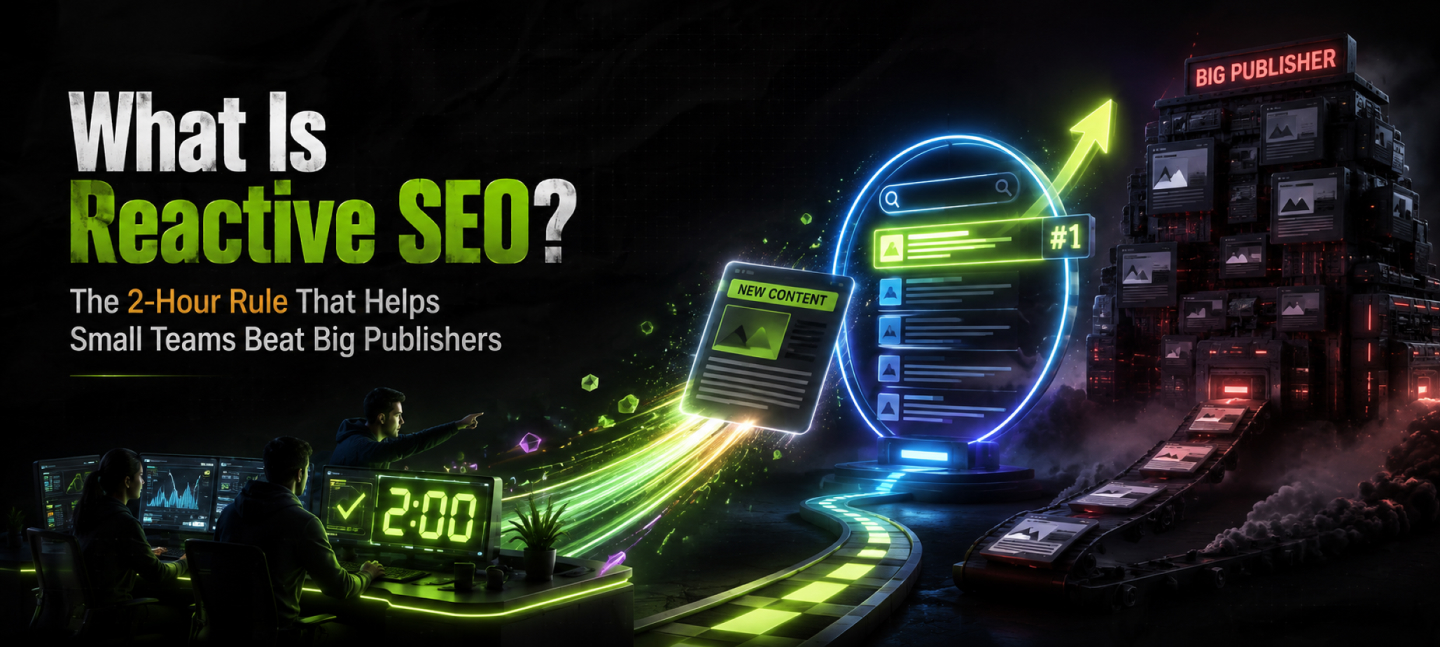
But in 2026, there’s a glitch in the system. A crack in the armor of the big publishers. It is a specific, often overlooked part of Google’s algorithm called QDF (Query Deserves Freshness).
When a new topic breaks in your industry – whether it’s a software update, a change in regulations, or just a weird bug that everyone is suddenly encountering – Google changes the rules.
For a short window, usually between 2 and 24 hours, the search engine stops caring so much about how “authoritative” your site is.
Instead, it cares about how fast you are. And how helpful you are.
This is Reactive SEO.
While the national newspapers and massive tech blogs are fighting over mass-market stuff like “Facebook is down,” they rarely cover the specific, boring, high-intent topics that actually drive business revenue.
They aren’t going to drop everything to write about a “Shopify API change” or a “Python library update” the minute it happens.
That is your gap.
AI tools now allow a solo founder or a lean marketing team to spot these niche trends and get a comprehensive article live in minutes. This lets you capture the “freshness” traffic before the industry giants even open their laptops.
Here is how you can use the “2-Hour Rule” to build traffic spikes that eventually turn into long-term growth.
Once you understand these two pillars, you will find this strategy to be a lot easier:
To understand why this approach is effective, you need to examine how your competitors, especially the larger brands, operate.
Big brands rely heavily on what’s called the “Editorial Calendar.”
This process is often slow and inflexible. For example, a strategist might come up with a topic on Monday.
Then, he/she will write a brief on Tuesday and assign it to a freelancer on Wednesday.
Then wait for the freelancer to take three days to write the content.
After that, an editor reviews it, and a designer creates a cover image. In some cases, legal teams even want to review it.
As a result, the time from the initial idea to when the content goes live is typically about 5 to 7 days.
However, in the realm of Reactive SEO strategy, this timeframe is essentially too long.
By the time these brands finally hit publish, the search volume has already peaked, flattened, and ultimately vanished.
The “freshness window” is closed, and Google has moved on to favoring high-domain rating sites, causing them to miss out on key opportunities.
Nevertheless, your real advantage doesn’t lie in your budget; rather, it’s in your speed.
If you can reduce that 5-day process to just 15 minutes, you can position yourself at the top of search results during the busiest traffic times.
Essentially, you are effectively “newsjacking” the topic while your competitors are still busy scheduling Zoom meetings to discuss it.
We need to be realistic, though. You are probably not going to outrank the New York Times for a generic headline. But you will outrank them on utility.
Big publishers cover the What. Ex: “New Data Privacy Regulation Announced.”
They rarely cover the How. Ex: “How this Regulation affects Small Business Payroll software.”
This brings us to the concept of Zero Day.
Every keyword has a birthday. Before a specific moment in time, the search volume for a phrase was zero.
Think about a specific B2B example. Imagine a popular tool – let’s call it “CRM-X” – releases a controversial new pricing model at 9:00 AM.
If you publish a high-quality article titled “CRM-X Price Increase: 3 Cheaper Alternatives for 2026” at 9:30 AM, you are the only water in the desert. Google has to rank you. It doesn’t really have a choice.
We’ve seen this strategy drive tens of thousands of highly qualified visitors to a site in a single day. It works.
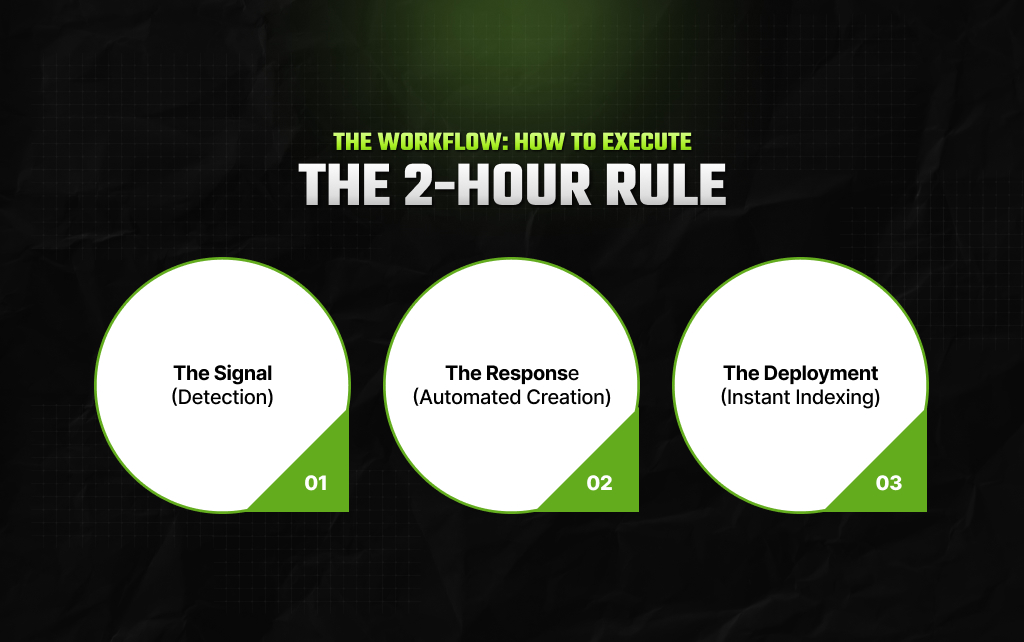
Now, you can’t execute this if you’re writing manually. You just can’t type fast enough. You need a system that acts as a “First Responder.”
Here is the exact workflow smart SEOs are using right now.
You need to know what’s happening in your niche before it hits the newsletter circuit.
Set up alerts for your industry’s key terms. Use Google Trends to monitor rising queries over the last 4 hours (not 7 days). Look at X (Twitter) and specific subreddits.
For example, if you run a site about e-commerce, and you see people on Reddit complaining that “The new Shopify checkout update is buggy,” that is a signal. The search volume for “fix Shopify checkout bug” is about to explode.
Once you have the signal, the clock is ticking. You have the “2-Hour” window.
This is where you use an AI content writing engine like BlogBuster to do the heavy lifting.
But, and this is important, don’t just ask for a generic blog post. The goal here is to generate a structured answer.
Additionally, you want to prompt the tool to create a specific format that answers the user’s immediate problem.
You are acting as the “Editor-in-Chief.” You provide the angle (the solution), and you let the AI handle the:
This takes a 4-hour writing task and compresses it into 10 minutes.
Speed helps nothing if Google doesn’t know you exist.
Once your article is generated, get it live. immediately. This is why direct integrations with your CMS (like WordPress or Webflow) are critical. You don’t want to be copy-pasting code or messing with image formatting manually.
After publishing, go to Google Search Console and manually submit the new URL. Do not wait for the crawler to come to you. Invite it in.
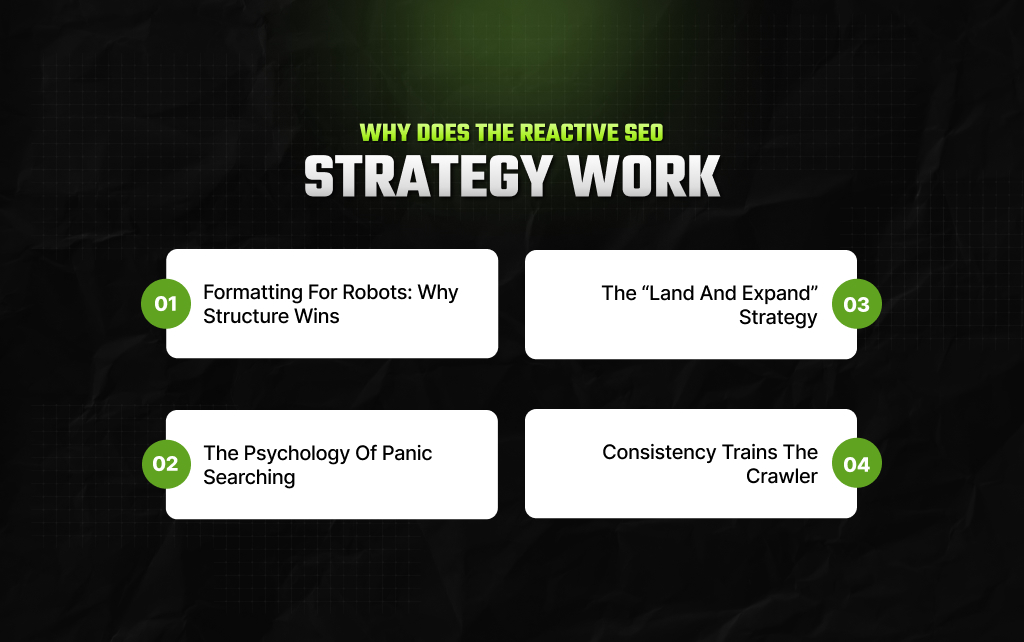
Below, I have explained all the important points why this strategy works. Let’s check these out:
There is a misconception that “Reactive Content” is low quality or “spammy.”
That’s false. In fact, if your reactive content is thin, Google will ignore it. It needs to be helpful.
To win the “Freshness Snippet,” your content needs to be better structured than a typical blog post. You need to write for the “Answer Engine.”
Modern search engines (and AI tools like Perplexity) are looking for data they can parse easily. They prefer structure over flowery language. They want the answer, not the backstory.
When you use your AI tool, ensure you are generating the following elements:
If a new software feature drops, generate a table comparing “Old Workflow vs. New Workflow.”
Start your article with a “Too Long; Didn’t Read” section.
Use H2 and H3 tags to clearly define the entities in your article.
Tools that specialize in SEO content are designed to output this kind of HTML structure automatically. They don’t just write words. They build the “skeleton” of the page that search engine bots prioritize.
When a user is searching during a “Zero Day” event, like a bug or a price hike, their psychology is different.
Additionally, they are usually annoyed, confused, or in a rush.
They do not want a 500-word introduction about the history of the software company. They want the fix.
This is why structure wins. If your AI-generated post starts with a bold “Steps to Fix Error 504” list, the user stays on the page. If you start with fluff, they bounce. And if they bounce, Google drops your ranking.
Reactive SEO strategy isn’t just about being first. It’s about being the most efficient answer in the room.
A common fear people have is that reactive content becomes irrelevant quickly. “Who cares about yesterday’s bug?”
This is where the strategy shifts from a sprint to a marathon.
Once you have captured the initial wave of traffic on Day 1, you have a valuable asset. You have a URL with traffic and user data.
In addition, you may even have some natural backlinks from other people. Also, these backlinks are citing you as the source. Then, you should not let this page die.
24 or 48 hours later, send a human editor back to the post. Update it. Add more depth.
Also, you can add internal links to your other product pages. Turn that breaking news story into an “evergreen” guide.
Okay, I will give you a very good example related to this, which will improve your understanding.
Let’s say you are working on your breaking news post about “CRM-X Price Increase” (Day 1).
Well, it can be updated a week later to become “The Complete Guide to CRM Pricing in 2026.”
Additionally, you keep the same URL. Also, you keep the backlinks you earned from being first. But you change the content to be useful for the long term.
There is one final technical nuance that makes this strategy work. And most people miss it.
You cannot just show up once a month for a breaking news story and expect to rank.
Google assigns a “Crawl Budget” to every website. If you post once a month, the bots might only visit you once a week.
If you try to publish a breaking news story, Google might not even see it until the trend is over.
To execute the 2-Hour Rule effectively, you need a “Daily Pulse” of content.
By publishing consistently, even just one standard article a day; you train Google’s bots to visit your site frequently.
This is why websites that publish daily win long-term. You are telling the algorithm, “I am an active publisher. Check on me often.”
This is the hidden benefit of using AI for your standard, everyday content. It keeps your site’s “heartbeat” active so that when you do have a big, reactive story to tell, the door is already open.
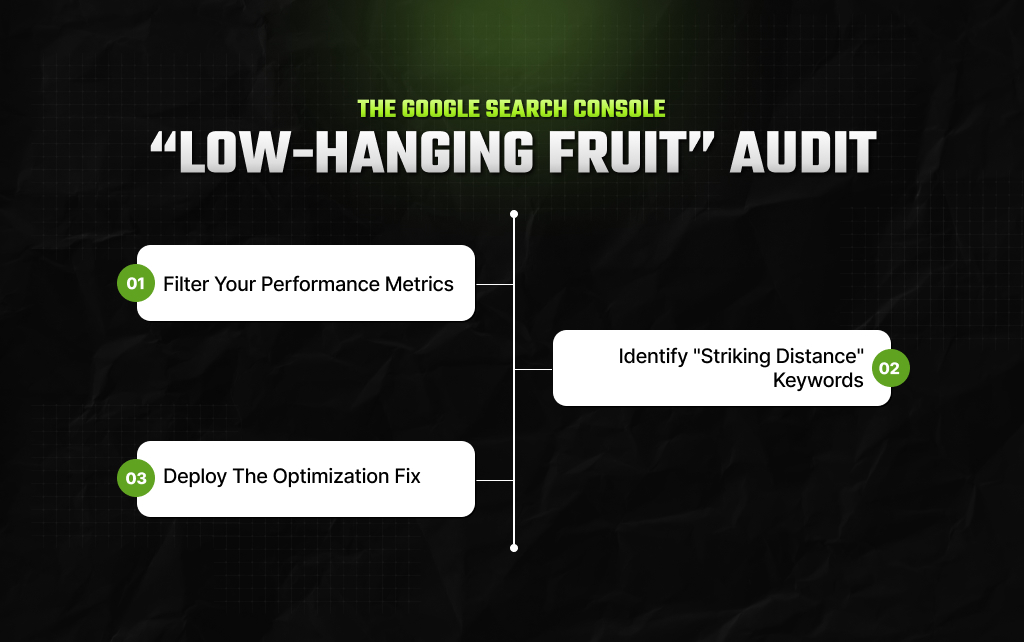
Let’s look at the actual data: over 90% of all web pages get exactly zero organic traffic from Google.
If you want to break out of that statistical graveyard fast, you need to stop guessing what to write next. Instead, execute a reactive audit on your existing rankings. [Sourec: SEO Testing]
I always go straight to the source to find immediate wins. Log into your Google Search Console dashboard and use the following structural path:
In the SEO world, we call these “striking distance” keywords. Once your filter is set, sort your data table by Impressions in descending order. [Source: Semrush]
What you are looking at is a goldmine. Google already wants to rank your content for these exact terms. However, your click-through rate (CTR) is abysmal because you are stuck on page two or three of the search results.
The technical fix here is completely immediate. Take those high-impression, exact-match search strings and pull-quote them directly into your page layout:
Industry benchmarks from Semrush prove that optimizing these secondary pages requires minimal effort but yields the highest, fastest return on investment (ROI) for organic growth.
The era of waiting for permission to rank is over. You do not need a massive newsroom to beat the industry giants. You just need a better system.
The “2-Hour Rule” is about shifting your mindset. Additionally, it’s about understanding that in the first few hours of a niche trend, the internet is empty.
Also, the first person to fill that void with value wins.
So, you must use the tools available to you. Automate the drafting. Automate the formatting.
Be the first responder in your niche. If you can do that, you will find that “Authority” is something you don’t just wait for. It is something you can take.
Read Also:
Barsha is a seasoned digital marketing writer with a focus on SEO, content marketing, and conversion-driven copy. With 8+ years of experience in crafting high-performing content for startups, agencies, and established brands, Barsha brings strategic insight and storytelling together to drive online growth. When not writing, Barsha spends time obsessing over conspiracy theories, the latest Google algorithm changes, and content trends.
View all Posts

The Ultimate Guide To Competitor Backlink Ana...
Oct 23, 2026
How To Land High-Authority Editorial Backlink...
Oct 23, 2026
Why Your Website Traffic Dropped Suddenly And...
Oct 23, 2026
How Do The Physical Google Review Tools Redef...
Oct 23, 2026
How To Get Your Brand Cited In AI Search Resu...
Oct 22, 2026