
Vector Search SEO: What It Means For Search And How To Optimize For It
Aug 21, 2026


A local SEO audit can make or break your site’s performance – you can’t really go ahead if you don’t audit, review, and make the necessary changes.
Currently, businesses online are intensely busy trying to stay ahead of cutthroat competition.
The purpose? To become the business with the most online visibility. And to fulfill this dream, the need of the hour is to significantly increase leads and inquiries.
The most effective solution is local SEO.
Moreover, it doesn’t matter whether you are running a small digital business from home or a service-focused small business; the intent is the same – to attract new leads and clients.
As a result, the importance of local SEO audit is more than ever – it can reveal what’s been stopping you from growing and expanding your business.
And that is precisely why I am here – to help you understand the importance of a local SEO audit with a comprehensive focus on all the core components of local SEO.
Stay tuned.

Local SEO audit offers a detailed overview of any business’s online presence, while highlighting its performance in local search engine result pages.
The performance usually reveals the actual ranking of a business in local SERPs, mostly covering platforms like Google Maps and Google Search.
Overall, it keeps a check on ranking signals that influence the local visibility of a business, such as local keywords, business listings, citations, reviews, and mobile usability.
But do you know why a local SEO audit is so essential?
As per data published by Forbes, 46% of total Google searches feature how most people are looking for local markets and related information. And that’s not all.
Other reports (published by Searchengineland) show that 78% of local mobile searches end with offline purchases, while 97% of people find everything they need to know about a local brand from search results.
Thanks to these insights, one thing is clear. A solid strategy via Google Maps or other tools and platforms can easily help you increase foot traffic organically.
Moreover, this in turn can boost sales, considering you have optimized your website, and it offers a better user experience as compared to competitors.
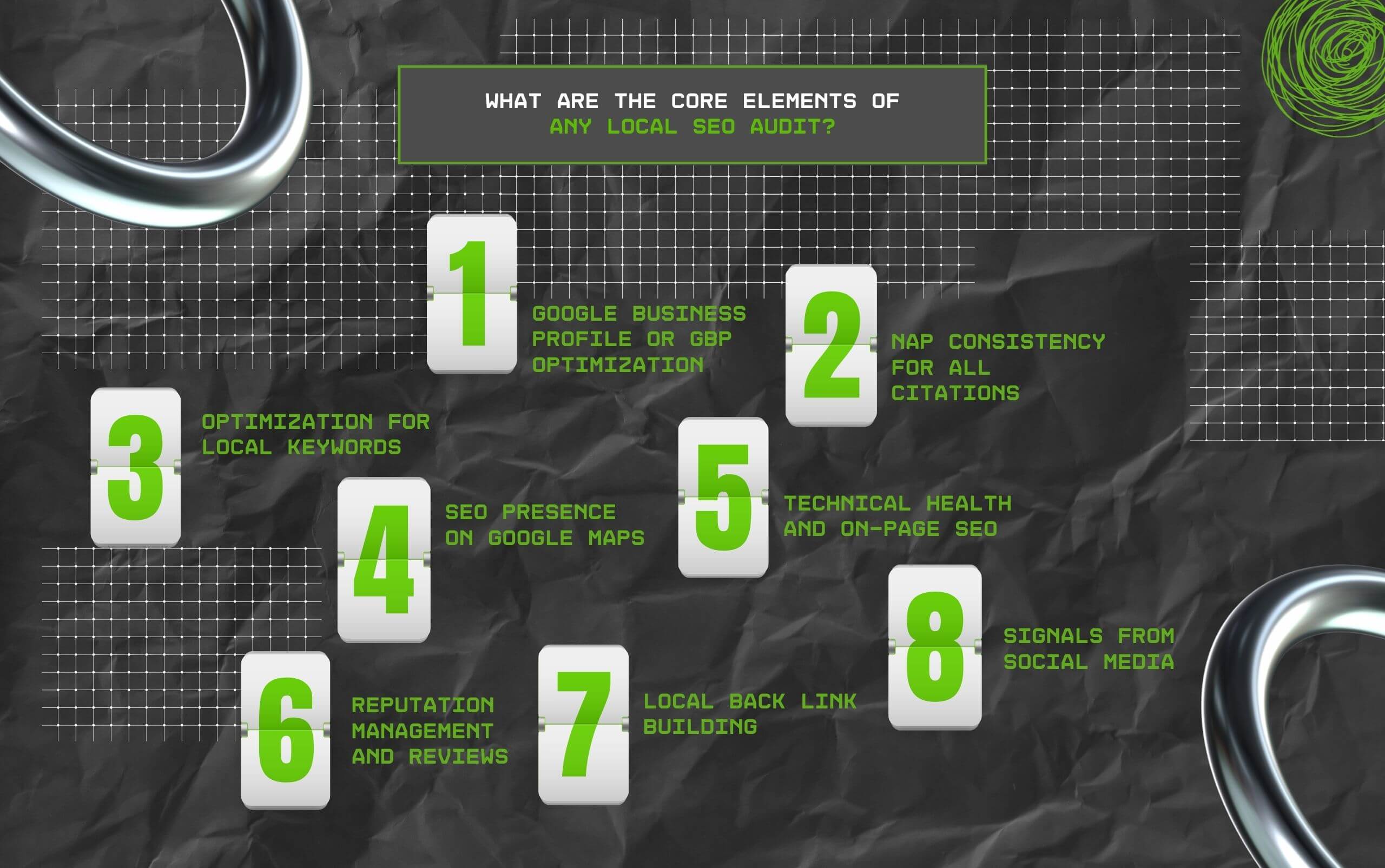
So to ensure your local SEO audit is done successfully, you need to take into account some key components.
And so here I am – ready to dive deep into the key aspects of an SEO audit for local businesses.
It all begins with recognizing your GBP or Google Business Profile, formerly known as Google My Business.
This is perhaps the most important factor that contributes to improving your performance on both local search results and Google Map SEO.
As a result, in order to recognize your business profile on Google, check whether:
Just think about a scenario where a brand is frequently changing company information, and that too across all digital platforms.
So, Google is known for disliking this kind of inconsistency, especially when it comes to information.
Moreover, simply put, any search engine will prioritize consistency, especially while it is validating the legitimacy of information updated by a business.
As a result, it is best to cross-check and verify your company listings across different platforms and directories, including Bing Places, Yelp, and Yellow Pages.
Also, check the local repository featuring commerce websites.
This verification is a sort of walkover – and you can do this by leveraging Moz Local and similar tools.
Local keywords are search queries and phrases that match the popular local terms people are browsing in specific regions.
Also, it includes geo-modifiers like ‘nearby grocery shop,’ or ‘top grocery shops in Kolkata.’
As a result, for appearing in this kind of search result, you have to ensure that:
Have you checked the visibility of your company on Google Maps? Don’t forget the importance of Google Maps in your local SEO audit – it is one of the most essential elements.
So to help you out, I’ve mentioned a few tips below related to Google Map SEO – these tips are effective and proven!
As per Whitespark’s 2023 survey – Local Ranking Factors – the primary aspects contributing to the success of local SEO are as follows:
Your website’s structure should definitely follow the best (and most effective) practices in local SEO.
So, here are some effective (and super quick) tips that can help you integrate or verify changes:
Google significantly values what any customer says. Also, this is recognized as a major ranking factor since it displays trust and credibility.
On that note, here’s how to check and handle reputation management – make it a part of your SEO strategy.
Off-page SEO practices, especially location-specific backlinks, can improve your local trust and domain authority.
As a result, you need to ensure:
Social media cannot directly boost your website’s ranking in local search results.
However, these platforms can help you scale your content’s reach, redirecting traffic to the website and driving engagement.
As a result, here’s what you can do to make the most of social media:
Your local SEO audit happens to be the perfect gateway for long-term digital exposure – and that too locally.
Moreover, it improves your SEO, enhancing overall traffic, ranking, credibility, and sales.
With the help of Google Map SEO, increasing yout foot traffic and conversion rate becomes so much easier.
This isn’t something you can do overnight – it’s not a miracle waiting to happen. Instead, it depends on consistency – so make it a continuous and consistent practice.
Also, you need to audit your site and overall SEO performance frequently to ensure that your business stays visible, relevant, and competitive in your region.
Barsha is a seasoned digital marketing writer with a focus on SEO, content marketing, and conversion-driven copy. With 8+ years of experience in crafting high-performing content for startups, agencies, and established brands, Barsha brings strategic insight and storytelling together to drive online growth. When not writing, Barsha spends time obsessing over conspiracy theories, the latest Google algorithm changes, and content trends.
View all Posts

Vector Search SEO: What It Means For Search A...
Aug 21, 2026
AI Image Editing Is Becoming A Practical Part...
Aug 21, 2026
From CCTV To AI: How AI Video Analytics Is Be...
Aug 20, 2026
Cornerstone Content: What It Is, How It Works...
Aug 20, 2026
How AI Tools Are Changing The Way Marketers A...
Aug 18, 2026