KeywordStat Review: Keyword Research, Clustering & SEO Data Compared
Oct 03, 2026


If you have been looking at Instagram as a platform where you post a few aesthetic pictures and grow easily, then I’ve got some bad news for you.
Instgram is no longer a social media platform – it’s a search engine at this point.
With over 2 billion users using Instagram daily to search for things to buy, places to visit, topics to explore, and accounts to follow.
I’m not kidding! People on Instagram actually type out ‘best cafes in Calcutta,’ ‘hair smoothening salon near me,’ or ‘seo tips for 2026,’ into the platform’s search bar.
And if your content fails to show up on Instagram search results, then you aren’t visible to your target audience or anyone looking up what you do.
So, one thing is clear – SEO on Instagram isn’t just a hack anymore. It is more than that – it’s an entire strategy.
Moreover, it is a crucial part of the overall SEO strategy of any brand.
Because when anyone looks at your business up on Google Search, Instagram Search, or TikTok Explore, it all points to the same things – awareness for your brand, trust, and ultimately sales.
As a result, if you work on optimizing your website but ignore social media, you are leaving a gap.
Don’t forget that your target audience is hanging out on socials and your competitors are making the most of that opportunity.
So, today I am here to help you understand how Instagram search queries optimization works – that way, Instagram users can easily find your content in search results.
Also, with my guide, you can get hold of SEO tactics that actually drive discoverability on Instagram, helping you connect with your audience based on what they are actively looking for.
Stay tuned.
Instagram search isn’t guesswork anymore. Instead, it is all about user intent. Moreover, it is keywords and, more importantly, about strategy.
TBH, Instagram search isn’t a smaller version of Google search.
Instead, it is a completely different beast, powered by social signals, machine learning, and personalization that cares so much about who you actually are and what you interact with.
So, when anyone types into Instagram’s search bar, the social media platform analyzes a blend of: search intent + content quality + user behavior + relevance.
This shows that Instagram is showing its users the most engaging and helpful content in the context of what they are searching for, while factoring in the different kinds of accounts they engage with most.
So, if anyone loves content about modern living, they will get lifestyle creators before generic content.
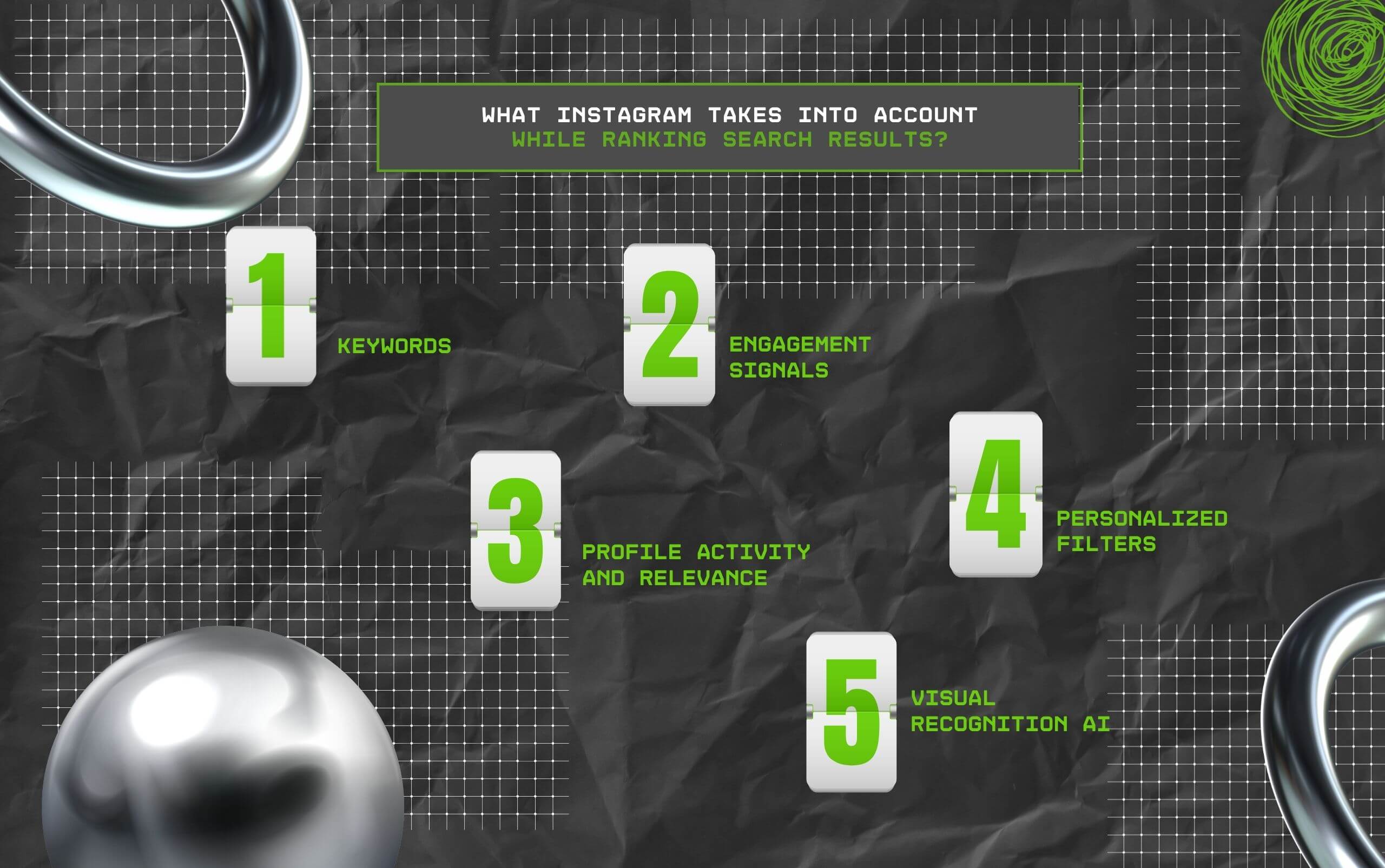
So, I’ve done my best to discuss the core mechanics behind successful Instagram search queries optimization – or the factors that Instagram takes into account while ranking search results.
Adding keywords in your bio, username, captions, alt text, hashtags, and display name will help Instagram to understand what your profile is about.
The engagement signals that your content has – comments, shares, saves, watch time, and likes – helps Instagram to figure out whether your content is satisfying search intent.
Of course, your profile activity, including both recency and relevance, is an essential parameter. So, if you only save posts once every year, Instagram isn’t going to reward you.
Using personalized filters can help Instagram adapt search results based on your search history. Also, this includes behavioral patterns of users.
With the help of visual recognition AI, Instagram scans video and photo content to align with relevant search intent. And this holds even when there aren’t any keywords added anywhere.
As a result, one thing is obvious – Instagram search queries optimization isn’t just about hashtags anymore.
Instead, it is more about speaking a language that both algorithms and users understand.
At the end of the day, everyone wants their content to be easily readable, understandable, and optimized for the platform to know where it should exactly appear.
Because here’s the kicker! Most users on Instagram search – they don’t scroll. Instead, they are looking for direct answers – they are looking for inspiration.
As a result, they need services and brands that they can easily trust. So, if your profile doesn’t appear in their search queries, then you are missing out on a major visibility opportunity.
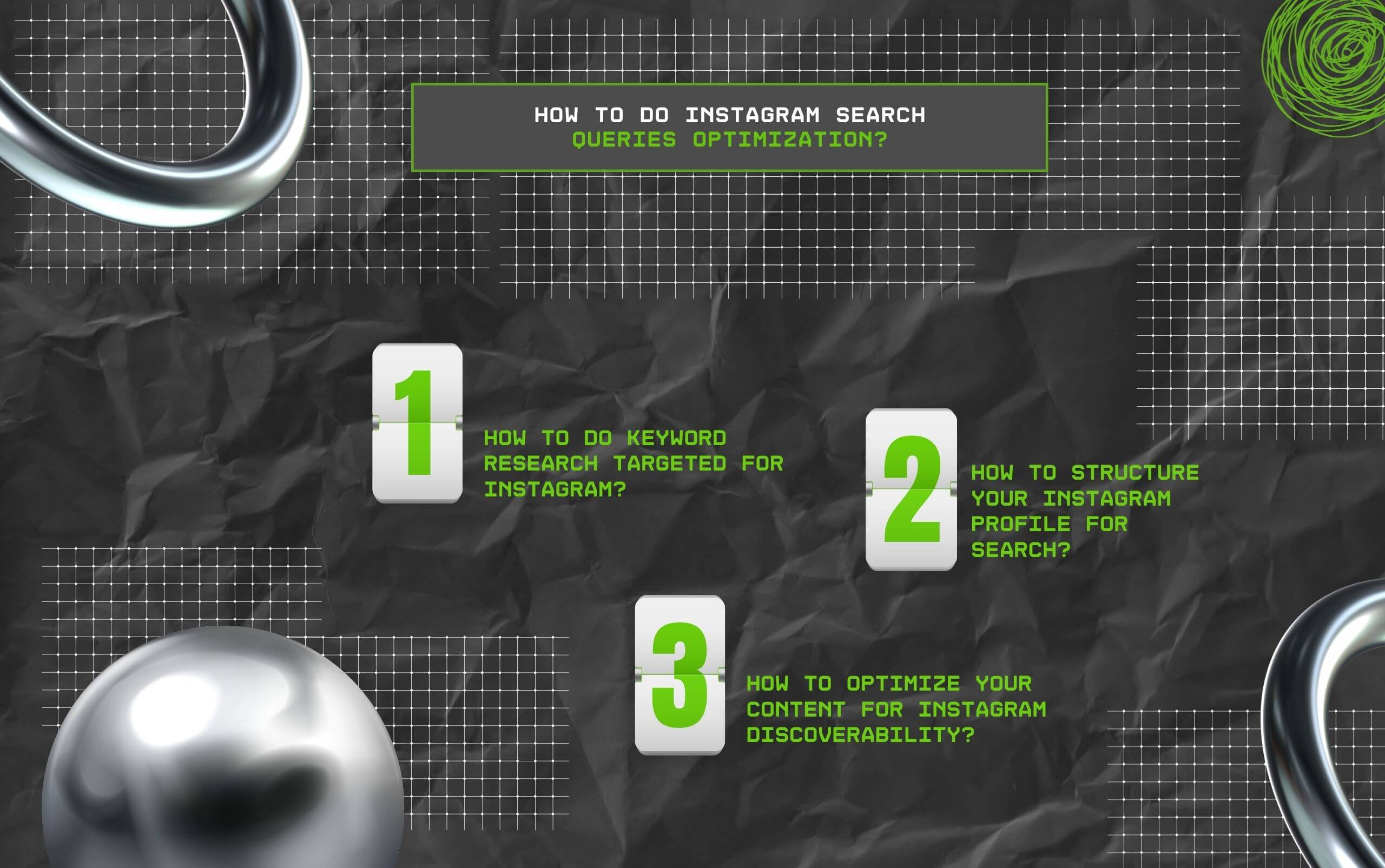
The thing about successful Instagram search queries optimization isn’t about trying every strategy out there. Instead, it is more about being intentional.
The point is to ensure that your content and account align with people’s search intent on Instagram.
That way, the social media giant can recommend your profile to your target audience.
And in this context, I have a three-step, detailed guide to help you optimize Instagram search queries successfully.
To do this right, forget about your scary keyword research – don’t look at it like a spreadsheet-only task.
For Instagram, it is more about curiosity – what is your target audience looking for on the platform that is relevant to your niche? The simplest thing you can do is use Instagram’s search bar.
Just begin by typing words related to your niche in the search bar, and the platform will automatically make suggestions about what real humans have been searching for on the platform.
Moreover, you can check out industry creators and competitors to see what their content highlights. Also, check their hashtags, bios, and media.
Additionally, you can use tools like Google Trends and Keyword Tool to get your work done fast. Having said that, you can position your research with data on Instagram’s user behavior.
The point is to feature in search results for your ideal audience, so your content has to speak the same language as them.
This is super important. Your SEO HQ includes your display name, bio, and username, which work together, making it obvious who you are, what you do, and who you will help.
Moreover, incorporate relevant keywords naturally – don’t stuff your content with keywords! This is crucial because remember what happened to all the websites that depended on heavy keyword stuffing after the 2024 Google March update.
Also, add a CTA button that will motivate your audience to go for the next steps – it could include watching, shopping, or booking.
Similarly, use your Instagram Story Highlights as a valuable optimization opportunity. Any well-organized Instagram profile easily sets the stage for solid search visibility.
Each of your posts is an opportunity to tell Instagram about your niche and, more importantly, what you are aiming to rank for.
Moreover, you should add your target keywords for your captions – make sure your caption is readable, clear, and transparent.
Because once you start stuffing your content with keywords, it will begin to look like the work of a malfunctioning bot.
Then, start pairing your captions with relevant geotags if location is an essential parameter for you. Also, add hashtags, and if it makes sense, then tag some collaborators.
Of course, currently, reels offer the most discoverability.
As a result, it is best to invest time and effort in storytelling, descriptions, and titles that connect with the search intent of your audience.
When Instagram sees that your content is delivering value with consistency, it will start connecting your account with relevant search intent.
You can’t improve something you haven’t measured. Fortunately, Instagram offers enough information to help people understand whether or not your SEO strategy actually works.
So, my favorite for tracking SEO progress is Instagram Insights. For starters, check where people are looking for you via search, whether it is shared content, search, or even the Explore page.
As a result, if your appearances on Search are on the rise, it means that your profile is gaining visibility when people are looking for keywords relevant to your niche.
On top of that, third-party tools such as Hootsuite or Later can easily offer a zoomed-out view. This is especially true if you are in charge of multiple platforms.
You can consider comparing performance, monitoring growth trends, and making smart decisions about what to do next.
Remember, what matters the most here is your complete trajectory. As a result, you should track metrics like:
So, if you track steady gains from these parameters, then your SEO strategy on Instagram is working.
However, if everything appears to be flat, then either you are depending on hashtags heavily. Or your content is failing to align with the search intent of your target audience.
Also, it is possible that you are not supporting top engagement signals like watch time, shares, or saves.
Remember, a good strategy is about keeping what works and refining what doesn’t work.
Also, in this context, understand how real progress happens over weeks and sometimes even months, not in a single day.
Understand that most accounts on Instagram do not fail because the product isn’t good or the brand has a boring vibe.
The problem is something else. These accounts fail because it becomes very difficult for anyone to find them on the platform.
In this context, the biggest issue is the chaos that arises from hashtags.
Stuffing captions with multiple hashtags that are not even relevant to your brand or niche isn’t going to help. You won’t appear more prominently in search results.
Instead, it will tell Instagram that you are casting a wide net, ready to catch whoever you can reach. This means you have no clue about your ideal target audience.
The algorithm of this social media platform only rewards relevance – and hates all sorts of randomness.
Another significant mistake is people’s inconsistency. You can’t disappear for three weeks and then make a comeback with multiple posts in a single day.
The social media platform’s algorithm has no clue about classifying your profile.
Instead, your Instagram profile starts fading from search visibility simply because the social media platform cannot predict exact user interest.
Also, if your bio and username look cute but fail to communicate anything substantial to Insatgram’s algorithm, then it can harm your SEO strategy.
So, if your username is Peterpanindisguide, but you sell thrift clothes, then how will Instagram’s algorithm know what your profile is about?
Without any niche-specific keywords added to your profile, Instagram has nothing to actually work with.
Barsha is a seasoned digital marketing writer with a focus on SEO, content marketing, and conversion-driven copy. With 8+ years of experience in crafting high-performing content for startups, agencies, and established brands, Barsha brings strategic insight and storytelling together to drive online growth. When not writing, Barsha spends time obsessing over conspiracy theories, the latest Google algorithm changes, and content trends.
View all Posts

KeywordStat Review: Keyword Research, Cluster...
Oct 03, 2026
How Corda Turns Authority Data Into Campaigns
Oct 01, 2026
How To Audit Your Search Visibility In 2026: ...
Sep 30, 2026
What Is Google Lighthouse? A Practical Guide ...
Sep 30, 2026
When Can You Save A Public Instagram Story?
Sep 30, 2026