
The Traffic-to-Revenue Gap: Why More Website Visitors Don’t Always Create More Customers
Sep 17, 2026


As a content and SEO professional working for nearly a decade, I can tell you that schema markup was never really a big deal.
However, recently, I’ve been hearing a lot of chatter among younger SEO professionals – and somehow it just sounds more complicated than it actually is.
TBH, you just need to add some structured information to the different pages on your site. Why? So that Google and other search engines can use the same information to understand what that specific page is all about and who made it.
I think that’s fairly simple to understand.
In fact, the issue here is when SEO professionals begin to look at schema markup as another element that they must add everywhere – and that too randomly, regardless of whether it even describes something valuable.
And it’s more common than you think – a website can actually have multiple schema types and still continue to have poor structured data.
In that case, how can you use it effectively without turning your site into some code dump? For me, the better approach is always to be more selective about marking information.
And today I’ll break down how to mark up information on your site – information that will genuinely help search engines understand a page better.
Stay tuned.
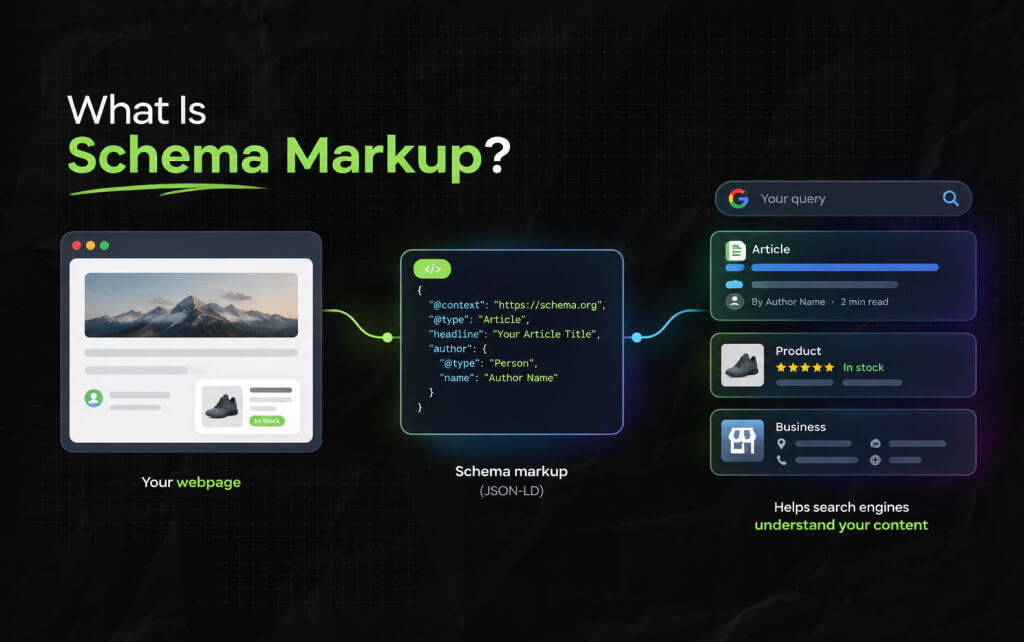
Schema markup is structured information added to a webpage to describe its content in a machine-readable format.
It can tell search engines things such as:
Schema vocabulary comes from Schema.org. It provides standardized types and properties that websites can use to describe entities and relationships.
Most websites implement schema using JSON-LD, which keeps the markup separate from the visible page content.
The important distinction is this:
Schema markup describes what already exists on the page. It should not invent information that visitors cannot find.
That one rule prevents many schema problems.
In the past decade, I’ve seen many professionals use these two terms interchangeably. But frankly, they aren’t exactly the same.
Structured data is a broader concept where information is organized in a predictable format for search engines to process, while schema markup specifically refers to using Schema.org’s vocabulary to describe something.
So, you can look at it this way: Structured data is the method. Schema.org provides a vocabulary for describing things.
Therefore, you can easily talk about structured data without even mentioning Schema.org.
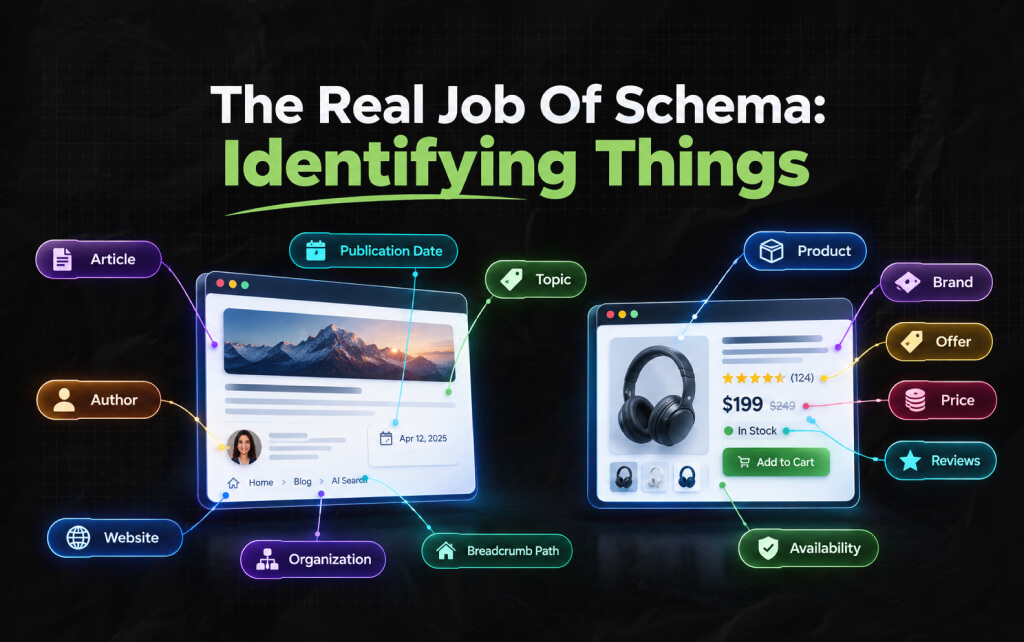
The most useful way to think about schema is not by asking, “Which schema should I add?” but by asking, “What entities and relationships does this page contain?”
So, imagine a company blog article. The page might contain:
Schema can help describe those relationships.
Similarly, for a product page, the important entities may instead be:
This changes how you approach schema.
You are no longer trying to collect as many schema types as possible. Instead, you are describing the page accurately.
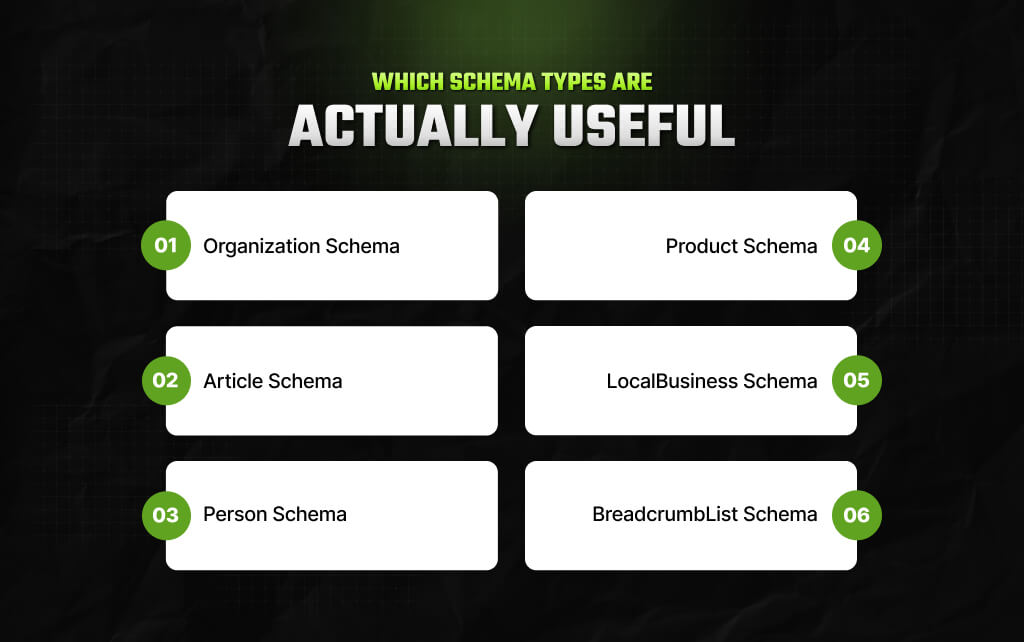
There is no universal list of schema types every website needs. The right implementation depends on the business and the page.
Useful for helping describe the organization behind a website.
It can communicate information such as the organization’s name, URL, logo, and other relevant properties.
This becomes particularly useful when a business has an established brand identity across multiple online properties.
Relevant to editorial content such as articles, news stories, and blog posts. It can help describe details such as the headline, author, image, and publication dates.
Also, the markup should correspond to the actual article rather than becoming a generic template copied across every URL.
Useful when a page represents a specific person.
This can be particularly relevant for author pages, profiles, experts, and other pages where the individual is the primary subject.
The useful question is not simply whether a person is mentioned. Instead, it is whether the page actually represents that person.
Important for ecommerce websites and product pages.
Depending on the page and implementation, Product structured data can describe information such as:
This is an area where accuracy matters enormously.
Also, if the page says one price and the markup says another, you have created a data consistency problem rather than an SEO advantage.
Relevant to businesses serving customers from physical locations.
It can describe details such as the business name, location, opening hours, contact information, and other applicable properties.
Again, the markup should represent real business information.
Breadcrumb markup describes the hierarchy connecting a page to the broader site structure.
The value here is not simply adding another piece of code. Instead, it is making the site’s information architecture easier for machines to interpret.

This is where many implementations go wrong. Someone discovers a large list of Schema.org types and starts looking for places to use them.
That reverses the process.
So, start with the page. If it is a product page, describe the product. If it is an article, describe the article.
However, if it is an organization page, describe the organization. Also, if there is no meaningful entity to describe, you may not need another schema type.
More markup does not automatically mean better markup.

Schema should reflect information that users can actually find on the page.
So, suppose a product page visibly lists a product for ₹2,499. Your Product markup should not claim that the product costs ₹1,999.
Also, suppose an article has one named author. Then, the schema should not identify five unrelated people as authors simply because the template allows multiple author properties.
The same principle applies to ratings, reviews, dates, business information, availability, and other properties.
Schema is not a place to put information you wish search engines would associate with the page.
It is a structured description of what the page actually contains.

There is another reason schema has become more interesting as search evolves.
Modern search systems increasingly need to understand entities and relationships, not just strings of keywords.
So, consider a company website. A search engine may encounter the company name on:
Schema can contribute another machine-readable description of the organization and its relationships.
For example, a site can make it clearer that a particular person is an author associated with a particular organization.
That does not guarantee how a search engine will interpret the entity. But it gives the system cleaner information to work with.
Also, this is especially useful for businesses with complex brand identities, multiple authors, products, locations, or subsidiaries.

Schema is also relevant to the broader shift toward AI-assisted search. But it is easy to overstate its role.
There is no reliable formula where more schema = more AI citations.
Moreover, AI systems use information from many sources and may process pages through different retrieval, indexing, or data pipelines.
Schema can still help make important information explicit and machine-readable.
For example, a company can clearly identify:
That is useful beyond traditional blue-link search.
But schema is only one part of the information ecosystem. A business with excellent schema and poor content is still poorly represented.

FAQ schema became heavily abused because it looked like an easy way to gain additional search visibility.
Publishers started adding FAQ sections to pages that barely needed them. That led to a common SEO habit: Every page should have FAQs.
That is not a sound content strategy.
As a result, if a page genuinely contains useful questions and answers, an FAQ section can improve the user experience.
So, whether the corresponding structured data produces a visible search enhancement is a separate question.
The content should come first. The markup follows the content.
This sounds obvious, but it is surprisingly common. So, an SEO team may create a schema template containing:
Then the template gets deployed across hundreds of pages. Some pages contain all those elements. Others don’t.
The result is technically complicated markup that describes a page inaccurately.
A simpler implementation that accurately describes the page is usually better than a huge implementation full of irrelevant properties.

This distinction matters.
A schema testing tool can tell you whether your structured data is syntactically valid or whether certain required properties are missing.
That does not necessarily tell you whether your implementation makes strategic sense.
You can have technically valid schema that describes the wrong entity. Also, you can have valid markup that provides little practical value.
So your QA process should ask two different questions:
You need both answers.

If you are auditing an existing website, don’t start by checking every URL individually. So, start with page types.
Then, group the website into categories such as:
Then identify the entities represented by each page type. For each template, check:
That last question is often overlooked. Websites evolve. But schema templates don’t always evolve with them.
CMS plugins and SEO platforms make schema implementation much easier. That is useful until everyone assumes the generated markup must therefore be correct.
Automation can create problems when:
Automation should reduce repetitive work. It should not remove human QA.

Not necessarily.
Most established websites can benefit from thinking about structured data, but that does not mean every page needs extensive markup.
A small service website may only need a few carefully chosen schema implementations. An ecommerce site may need much richer product information.
Similarly, a publishing website may need strong relationships between articles, authors, and organizations.
Also, a local business may prioritize its business identity and location information.
As a result, the implementation should follow the website’s information architecture. Not the other way around.
Schema will continue to matter as search systems become better at understanding entities, relationships, products, organizations, authors, and other real-world concepts.
But that does not mean websites should keep adding more markup.
The better direction is better representation.
A company should be easy to identify. Its authors should be clearly connected to its content. Its products should have accurate information.
Moreover, its pages should have logical relationships. Also, its structured data should reinforce those facts rather than contradict them.
That is where schema becomes genuinely useful.
Schema markup is not about filling your website with code. Instead, it is about making important information explicit.
The strongest implementation is usually not the one with the most properties or the most schema types. It is the one that accurately describes the page, reflects the visible content, clarifies important entities, and stays consistent as the website changes.
Don’t add schema just because you can. Add it because there is something meaningful to describe.
Barsha is a seasoned digital marketing writer with a focus on SEO, content marketing, and conversion-driven copy. With 8+ years of experience in crafting high-performing content for startups, agencies, and established brands, Barsha brings strategic insight and storytelling together to drive online growth. When not writing, Barsha spends time obsessing over conspiracy theories, the latest Google algorithm changes, and content trends.
View all Posts

The Traffic-to-Revenue Gap: Why More Website ...
Sep 17, 2026
The Volatility Trap: What Crypto Position Siz...
Sep 17, 2026
Turn A Search Question Into A Watchable Expla...
Sep 16, 2026
Agency Guide To YouTube Growth: Wholesale Pri...
Sep 15, 2026
Top 5 Reputed SMM Panels To Buy Social Media ...
Sep 15, 2026