

The Keyword With 10 Searches That Sent Ahrefs Thousands Of Visitors
Sep 24, 2026


When a team is under pressure to “grow organic traffic,” the spreadsheet usually wins.
The biggest volume terms go to the top, the content calendar fills up, and everyone feels productive.
The uncomfortable question arrives later.
Why did traffic rise while qualified demos and sales did not?
Qonto, the European business-banking company, ran into that exact problem.
Its broad strategy created visibility, but general industry terms were not bringing enough relevant leads.
SEO and content lead Oliver Staub shifted the team toward niche, lower-funnel topics, while still keeping a healthy technical foundation.
The result reported in Semrush’s customer story was roughly 2× more traffic, 55% more leads from ready-to-buy traffic, and an 11% improvement in bounce rate.
So, the important change was not “publish more.”
Rather, it was choosing fewer topics that matched a real buying journey by implementing a focused bottom funnel keyword strategy.
Bottom-funnel searchers are trying to reduce risk and choose an action.
They compare tools, ask about implementation, look for pricing or alternatives, check compatibility, or search for a service that solves a defined problem.
A query such as “technical SEO audit service,” “keyword research tool with difficulty,” or “Semrush alternative for agencies.”
This carries more commercial information than a broad “SEO tips” query, even when the monthly volume is dramatically smaller.
For every candidate keyword, write the decision in one sentence:
“The searcher wants to decide whether to ___, and needs proof about ___.”
If you cannot complete that sentence, the term may be useful for awareness.
However, it should not outrank a query that can move a prospect to a trial, demo, audit, or contact page.
Deploying a strict bottom funnel keyword strategy means prioritizing these high-intent phrases over high-volume ones.
Volume is an estimate, not a forecast of revenue. It is also averaged across a market and a time period.
So it hides seasonality, wording variations, and the difference between a curious visitor and a buyer.
Also, a high-volume informational phrase can produce thousands of visits with no commercial next step.
Similarly, a low-volume comparison or implementation phrase may produce fewer visits but a much higher lead rate.
The classic example comes from Ahrefs’ own data.
The phrase “submit domain to search engines” was estimated at only about 10 US searches per month.
And yet Ahrefs reported that its guide received approximately 3.8K monthly search visits.
The page won because it covered a whole topic, many differently worded long-tail searches, not because the tool’s single estimate was large.
So, the lesson is not “target every zero-volume keyword.”
It is to distinguish two cases:
It may be an alternate wording, and the same SERP appears for a stronger parent topic.
Fold it into the authoritative page rather than creating another URL.
It may have no recorded volume because the audience is small, new, or uses inconsistent language.
If the problem is painful and your product is a credible answer, it can deserve a page anyway.
This nuanced understanding is what separates a true bottom funnel keyword strategy from standard SEO routines.
Validate with the SERP, customer language, sales questions, and Search Console impressions.
Moreover, “Zero” in a third-party database is a prompt to investigate—not a reason to publish blindly.
Publishing separate pages for “technical SEO audit service,” “technical SEO auditing services,” and “SEO technical audit service” looks thorough.
However, it can split internal links, backlinks, and engagement across near-duplicates.
If Google returns almost the same results for each phrase, build one excellent page and make it the topical home for the cluster.
Topical authority comes from depth and relationships.
It has a clear primary page, supporting answers, strong internal links, and evidence that the site understands the problem from multiple angles.
It does not come from owning the largest keyword list.
Qonto’s team used a layered journey, with educational content introducing a problem.
After that, they used internal links to product and transactional pages, rather than forcing every article to rank for a head term.
This layered approach is essential for any scalable bottom funnel keyword strategy.
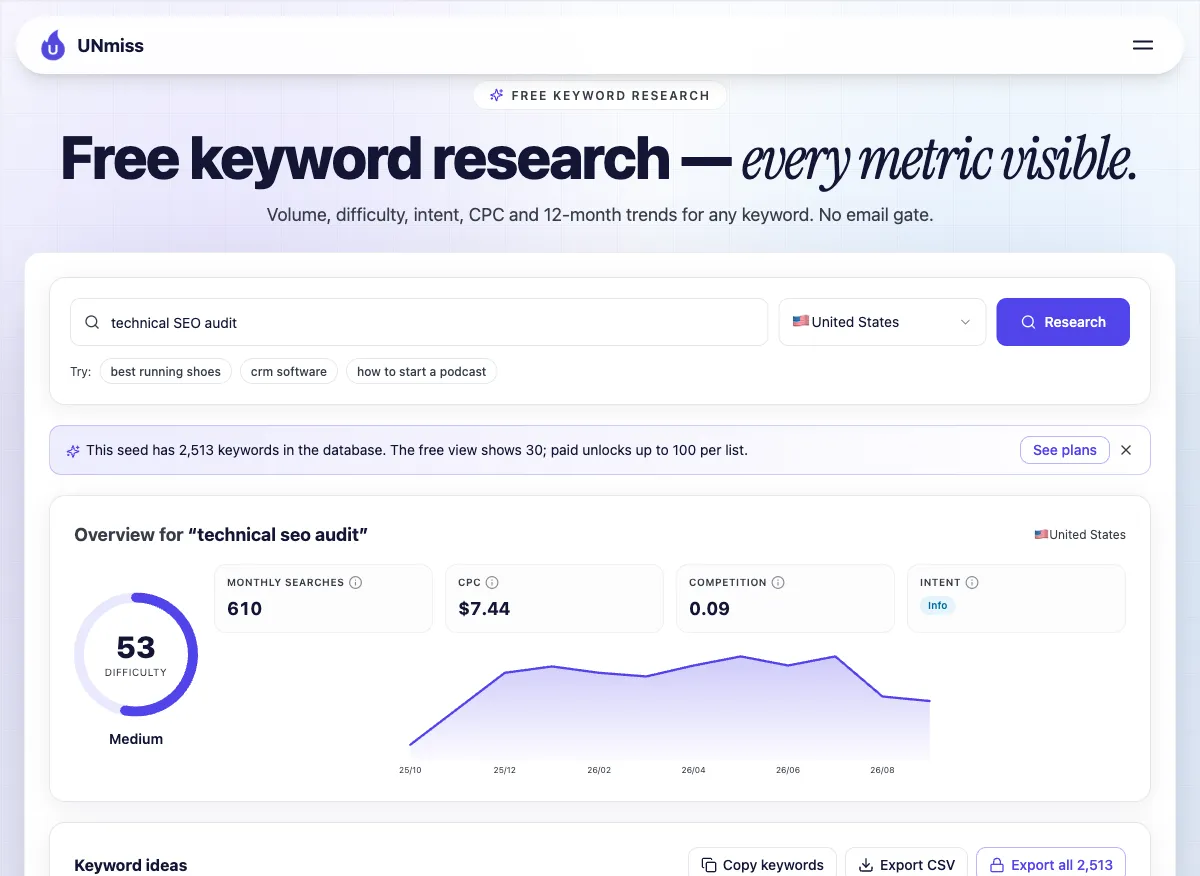
UNmiss keyword research results for “technical SEO audit” showing volume, difficulty, CPC, intent, and related service terms
The UNmiss tool currently shows “technical SEO audit” at 610 monthly searches, difficulty 53, and CPC $7.44 in the US database.
More revealing are the related service variants: “technical SEO audit service” shows 590 searches with difficulty 17 and CPC $5.98.
The second term has lower difficulty and stronger action language.
It deserves a serious page or section even though it is not the largest number in the table.
This is how to use a tool: not to worship a metric, but to compare business value, feasibility, and intent.
A bottom-funnel keyword workflow should make those trade-offs visible before a writer starts.
Search Console often reveals queries that third-party databases cannot model.
New product language, customer-specific use cases, and combinations of words appear only after a page is published.
Export queries for pages already receiving impressions.
Group them by the underlying problem, not just exact spelling.
If several low-volume queries point to the same job-to-be-done, improve the existing page and add the missing answer.
If the query represents a distinct commercial need, create a focused supporting page and link it to the main destination.
Use this order of operations:
1. Start with customer language from calls, tickets, reviews, and sales objections.
2. Label the decision stage: learn, compare, validate, or act.
3. Check the SERP format and whether one URL can satisfy the cluster.
4. Score commercial value, ranking feasibility, evidence required, and content effort.
5. Publish one authoritative page, then build supporting coverage only when it adds a distinct answer.
6. Link every supporting page toward the next decision—not toward a generic homepage by default.
7. Measure qualified actions, assisted conversions, and pipeline, not visits alone.
HubSpot’s 2025 State of Marketing reported that 19% of marketers were already building SEO strategies for generative-AI search.
That shift makes topical clarity even more important.
Conversational systems need to understand the entity, problem, alternatives, and proof behind a page.
Thin pages aimed at isolated volume numbers are difficult for both buyers and answer engines to trust.
The winning research habit is simple.
Choose less, understand more, and connect every page to a commercial decision via a sustainable bottom funnel keyword strategy.
Traffic is a useful by-product. Relevance is the asset.
Barsha is a seasoned digital marketing writer with a focus on SEO, content marketing, and conversion-driven copy. With 8+ years of experience in crafting high-performing content for startups, agencies, and established brands, Barsha brings strategic insight and storytelling together to drive online growth. When not writing, Barsha spends time obsessing over conspiracy theories, the latest Google algorithm changes, and content trends.
View all Posts

Paying Freelance Writers In Ten Countries: An...
Sep 24, 2026
GroomPanel Vs Other SMM Panels: What Makes It...
Sep 24, 2026
The Traffic-to-Revenue Gap: Why More Website ...
Sep 17, 2026
The Volatility Trap: What Crypto Position Siz...
Sep 17, 2026
Schema Markup: How To Use It Without Turning ...
Sep 17, 2026