The Ultimate Guide To Competitor Backlink Analysis: An Actionable SEO Blueprint To Steal Your Rivals’ Traffic
Oct 23, 2026
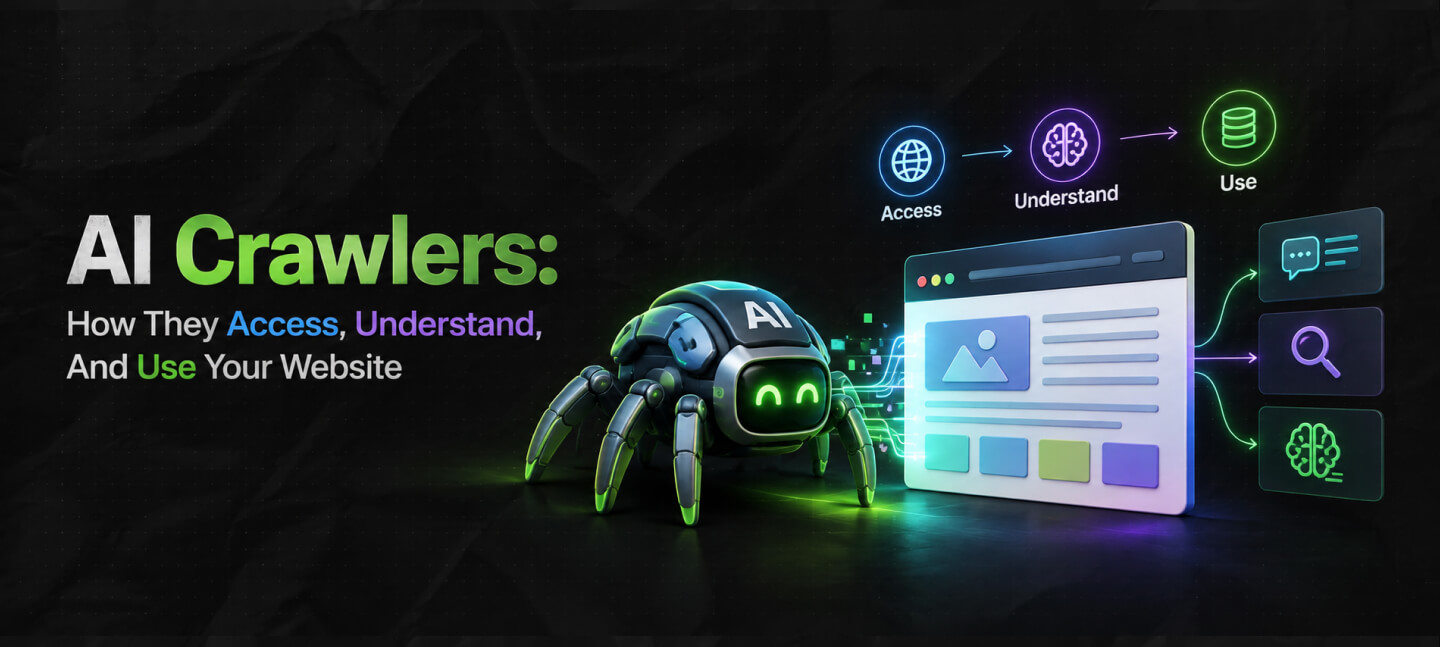

Search is no longer limited to Google and Bing.
AI systems now crawl websites, retrieve pages, process documents, and use online information to answer questions.
Some of these systems operate like traditional search crawlers. Others access content through search indexes, retrieval systems, APIs, or specialized bots.
That creates a new question for website owners: If an AI system can use your content to answer a question, should you let it crawl your website?
The answer is not always yes.
AI crawlers can help your content become discoverable in AI-powered search and answer systems.
But they also raise questions about content licensing, server costs, attribution, traffic, and how much of your work you want machines to access.
Understanding the difference starts with understanding what an AI crawler actually does.
And that is precisely why I’m here today – to breakdown how AI crawlers access, understand, and most importantly, use your website.
Stay tuned.
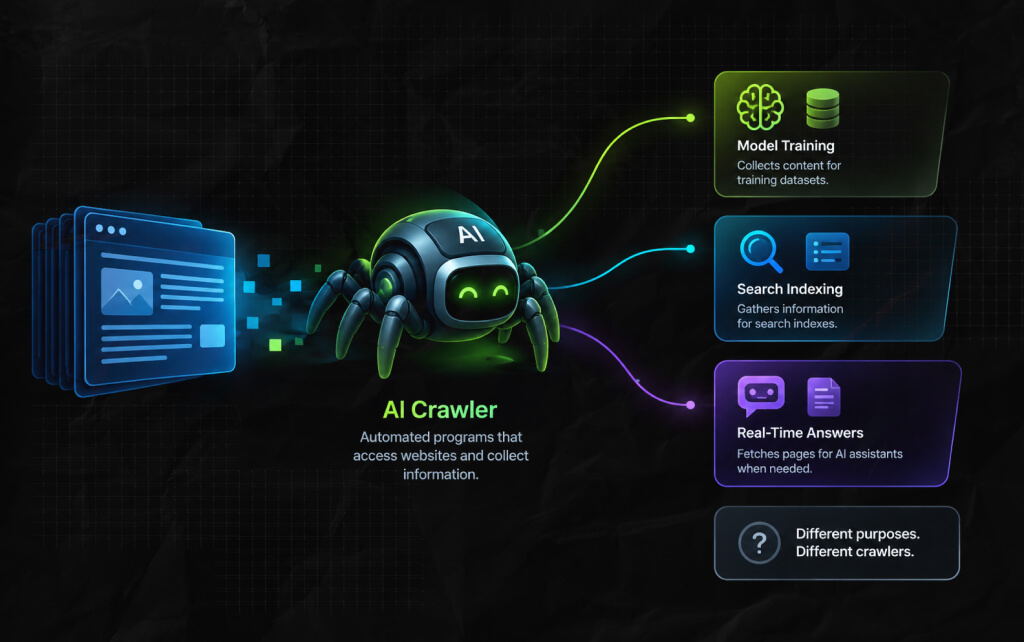
AI crawlers are automated programs that access websites and collect information for AI-related systems.
They can be used for different purposes.
Some collect content that may become part of training datasets. Others gather information for search indexes or retrieval systems. Some may fetch pages when an AI assistant needs current information to answer a user’s question.
That distinction matters.
There is no single category called an “AI crawler” that behaves in exactly the same way.
For instance, a bot collecting content for model training has a different purpose from a crawler fetching a page to support a real-time answer.
Similarly, a search crawler has a different job. So instead of asking, ‘Should I block AI crawlers?’ ask, ‘Which AI systems do I want accessing my content, and for what purpose?’
That is the decision website owners actually need to make.
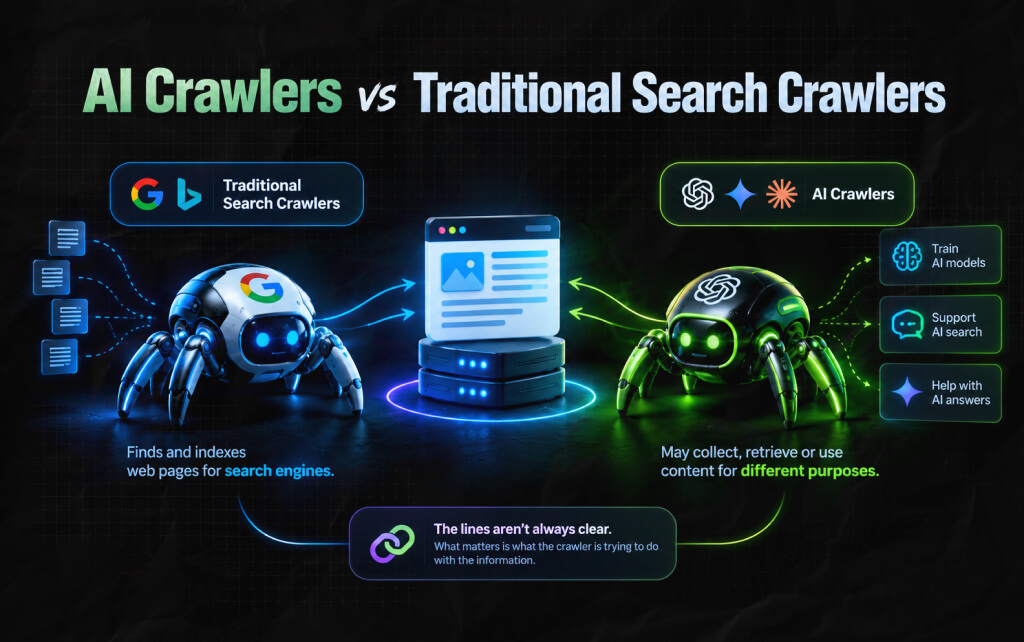
Traditional search crawlers are primarily associated with search engines.
Googlebot crawls pages so Google can discover and index them. Bingbot performs a similar function for Bing.
AI-related crawlers can have several different objectives.
| Traditional search crawler | AI crawler |
|---|---|
| Discovers web pages | May collect or retrieve web content |
| Feeds a search index | May support AI models or AI-powered search |
| Helps pages appear in search results | May help information appear in AI-generated answers |
| Usually tied to a search engine | May belong to an AI company or service |
| Crawling is often focused on discoverability | Purpose can range from training to retrieval |
The distinction is not always clean.
Modern search engines are increasingly using AI. Also, AI assistants are increasingly using search and retrieval.
The old division between ‘search crawler’ and ‘AI crawler’ is therefore becoming less useful. What matters more is what the crawler is trying to do with the information it accesses.
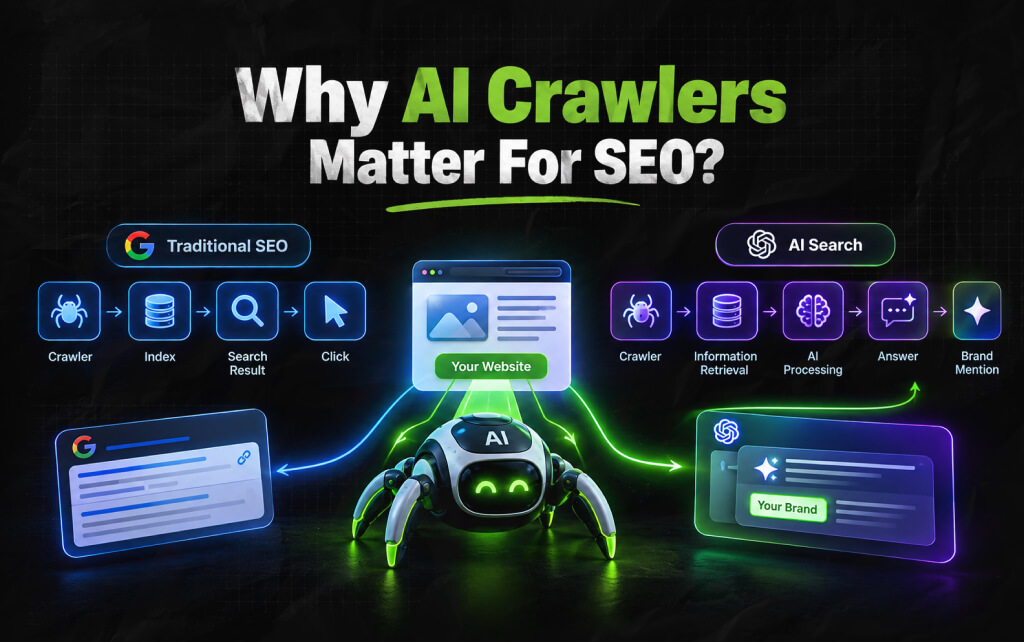
For years, SEO focused on one basic path: Crawler → index → search result → click.
AI search introduces more possible paths.
In this context, a simplified version might look like: Crawler → information retrieval → AI processing → answer → brand mention.
Your page might not appear as a traditional blue link.
Instead, information from your page could contribute to an answer about your product, industry, research, or company.
That changes the value of being discoverable.
A brand can benefit from being understood by an AI system even when the user does not immediately visit its website.
But there is an important caveat.
Allowing an AI crawler to access your website does not guarantee that an AI system will mention your brand.
Crawling is access. However, visibility is a separate problem.
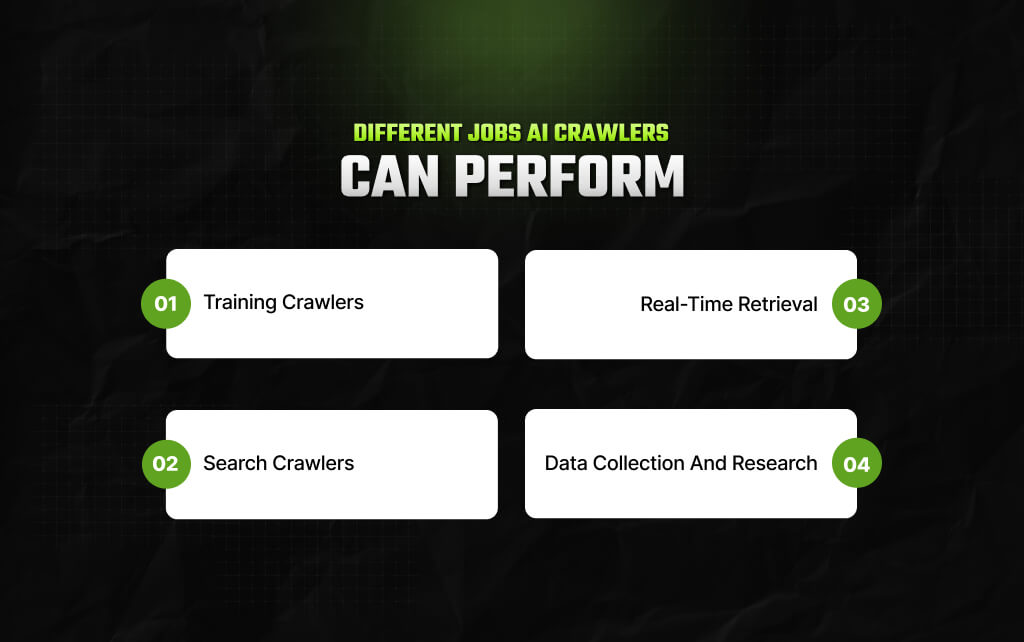
One of the biggest mistakes in discussions about AI crawlers is treating all bots as if they perform the same job.
They don’t.
Some crawlers are associated with collecting publicly available information that may be used for training or improving AI models.
The important question here is not whether the crawler can technically access your page.
It is whether you want your content used for that purpose. And that becomes a business and policy decision rather than a traditional SEO decision.
AI-powered search products may crawl websites as part of maintaining an information retrieval system.
The objective is closer to traditional search. So, the system needs to discover and retrieve useful information so it can respond to user queries.
Some AI systems can retrieve information from the web when answering a particular question.
In that situation, the system may need access to current pages rather than relying only on information collected months or years earlier.
This matters particularly for:
For these subjects, freshness can matter as much as historical knowledge.
Some automated systems collect web information for datasets, analysis, monitoring, or research.
These crawlers may have nothing to do with sending traffic to your website.
That is another reason not to assume that every AI crawler represents a potential SEO opportunity.
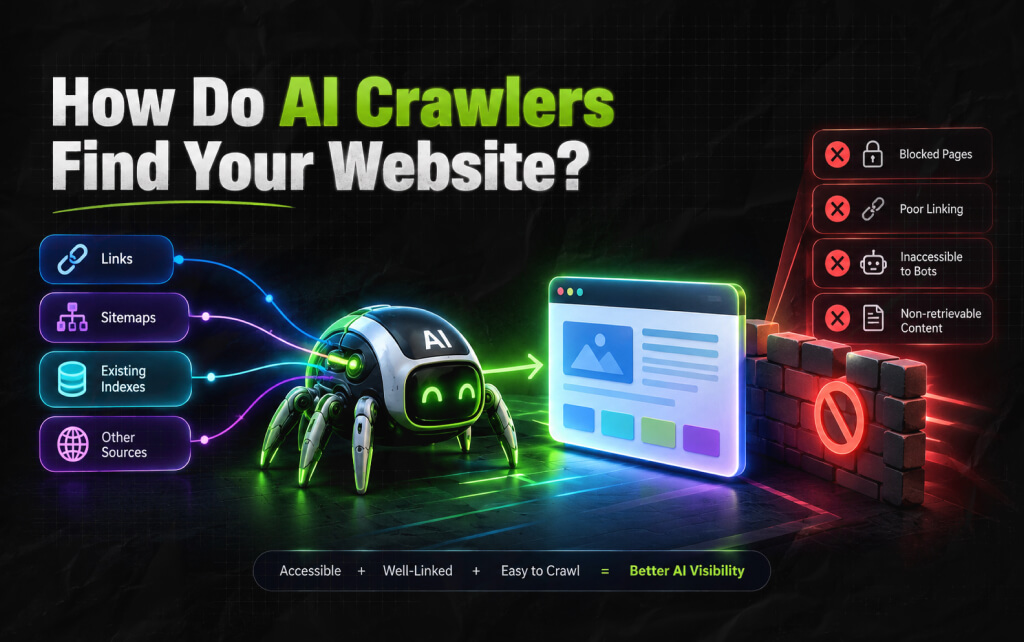
The basic mechanics are familiar.
A crawler can discover pages through links, sitemaps, existing indexes, or other sources. Your website’s technical accessibility therefore still matters.
As a result, if important pages are blocked, poorly linked, inaccessible to bots, or dependent on content that cannot be retrieved properly, an AI system may have difficulty finding or processing them.
This is one reason traditional technical SEO still matters in an AI-search environment.
You do not need an entirely new website architecture just because AI systems exist. Instead, you need a website that machines can access and understand.
The robots.txt file is one of the main mechanisms website owners use to communicate crawling preferences.
You can use it to specify rules for particular user agents.
For example, a website might allow some crawlers while restricting others.
But robots.txt is not a magic control panel for AI.
It does not automatically determine what happens to your content everywhere on the internet.
Different services can interpret rules differently, and technical access does not necessarily equal permission under every legal or contractual framework.
That means website owners should treat robots.txt as one part of their crawler-management strategy, not the entire strategy.

There is no universal answer.
Blocking an AI crawler can make sense if you have a strong reason to prevent that particular type of access.
For example, you may not want your proprietary content used for model training.
But blocking every AI-related crawler could also reduce your visibility in AI-powered discovery systems.
That creates a trade-off.
More access can create more opportunities for discovery. Less access gives you more control over how your content is used.
The right decision depends on your business model.
A publisher relying on advertising traffic may think about AI crawling differently from a SaaS company trying to become visible inside AI recommendations.
A software company may want its documentation easily discoverable. But a research publisher may have completely different concerns about content reuse.
So the decision should start with your commercial objective, not with fear of AI bots.
This is probably the most important distinction in AI SEO.
So, imagine an AI crawler visits your website. That tells you one thing: The system was able to access your content.
It does not tell you whether:
Crawling is therefore an access layer, not a visibility metric. You should not celebrate a crawler hitting your site unless you understand what that access is accomplishing.
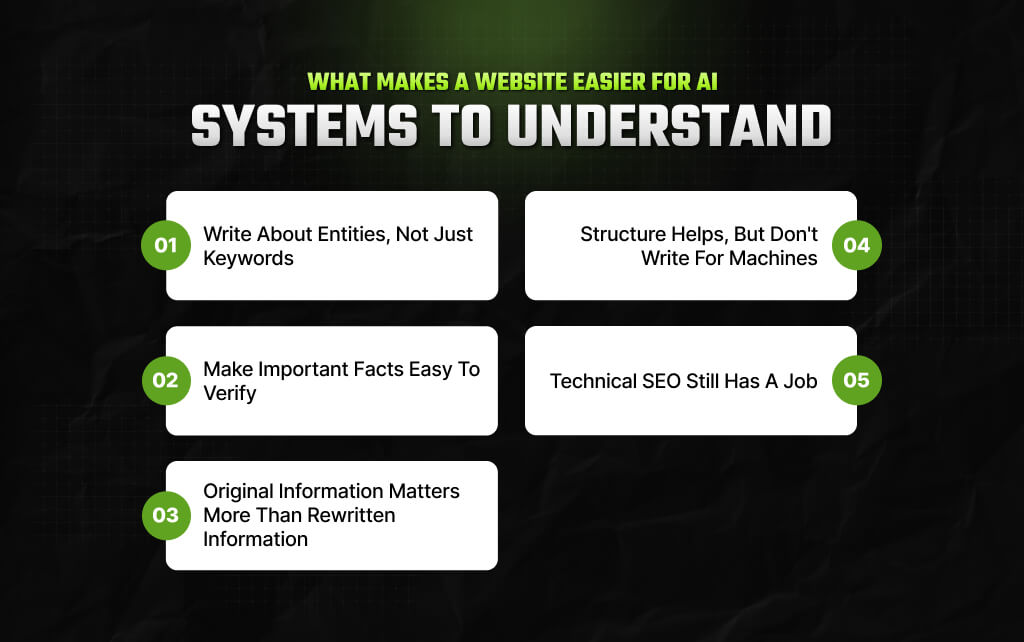
The answer is surprisingly close to good SEO.
So, start with clear pages. At the end of the day, a page should make some information obvious – this includes:
Also, avoid making important information difficult to extract.
For example, imagine a software company has a page that says, “Our innovative ecosystem enables next-generation growth through intelligent solutions.”
An AI system gets very little useful information from that sentence.
A clearer version might say, “Acme Analytics is a customer-data platform for ecommerce companies. It combines customer segmentation, reporting, and automated campaign analysis in one dashboard.”
The second version gives a machine much more to work with. And, importantly, it gives humans more useful information too.
Traditional SEO often encourages people to think in keywords. AI systems need something broader – they need to understand entities and relationships.
So, consider a page about a company.
Instead of repeatedly using its target keyword, explain the relationships around the company.
For example: Company → product → audience → use case → industry → competitors → alternatives
That creates a much clearer picture of what the business actually is.
Also, the same principle applies to people, products, organizations, locations, concepts, and technologies.
AI systems need meaning. Keyword repetition does not provide much of it.
AI systems can encounter conflicting information.
Your website might say one thing, while a directory says another. On top of that, an old article says something else. Also, a third-party review contains outdated information.
This can create ambiguity.
As a result, make important facts consistent across your website and credible external sources, and pay particular attention to:
Consistency does not guarantee an AI system will get everything right. But inconsistent information gives it more opportunities to get things wrong.
AI systems have access to enormous amounts of repetitive content.
So, if your website publishes another generic article explaining the same topic as hundreds of other websites, there is little that makes your source particularly valuable.
Original information gives your website a stronger reason to be referenced.
That could include:
For example, “How to Build Backlinks” is commodity content.
A study analyzing 5,000 outreach campaigns and showing which variables influenced response rates is different.
The second creates information that other websites may not already have. That is the kind of content worth building an authority strategy around.
Clear structure helps both crawlers and readers. So, it’s best to use descriptive headings. Also, keep paragraphs focused, and explain unfamiliar terms.
In addition, consider using tables when a comparison genuinely benefits the reader – make relationships between ideas obvious.
But don’t turn every article into a collection of short fragments simply because you think AI prefers them.
The goal is not to make content machine-readable at the expense of human readability. The goal is to make the information clear to both.
AI crawlers do not make technical SEO irrelevant. They make accessibility even more important.
Check the basics:
You do not need a special “AI SEO website.” Instead, you need a technically sound website with useful information.
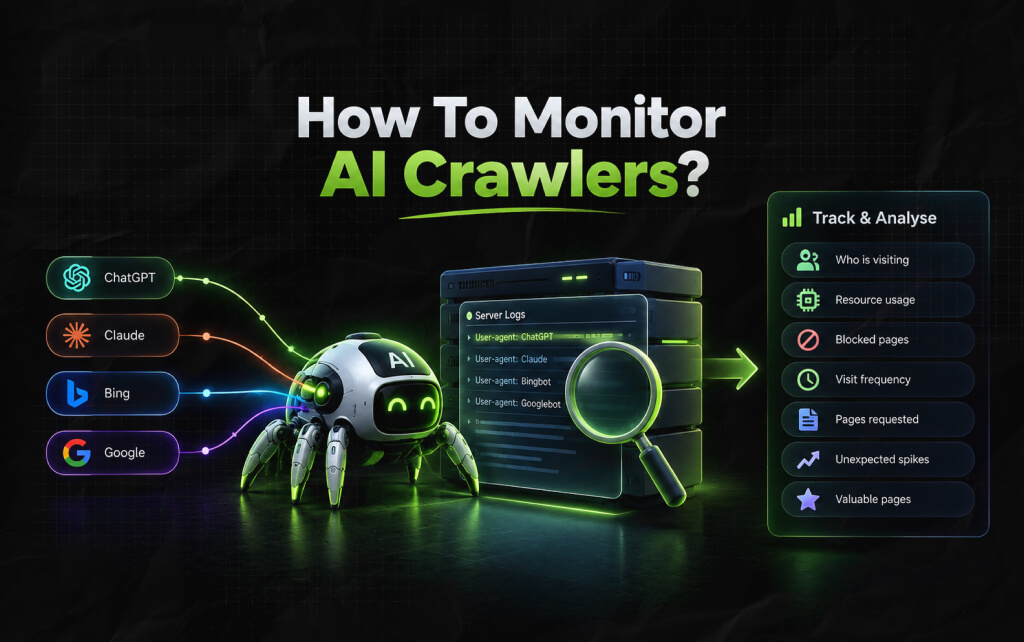
If AI visibility matters to your business, start monitoring server activity. So, look at your server logs for known automated user agents.
Also, you can investigate:
This can reveal something Google Analytics cannot.
Analytics tells you about people who reach your site. But your server logs can show you who is requesting your pages before a human visit ever happens.
An increase in crawler activity is not the same as an increase in traffic.
You might see more requests from AI-related bots without receiving a single additional visitor. And that is why AI crawler monitoring should sit separately from normal traffic reporting.
Track at least three things:
These metrics answer different questions.
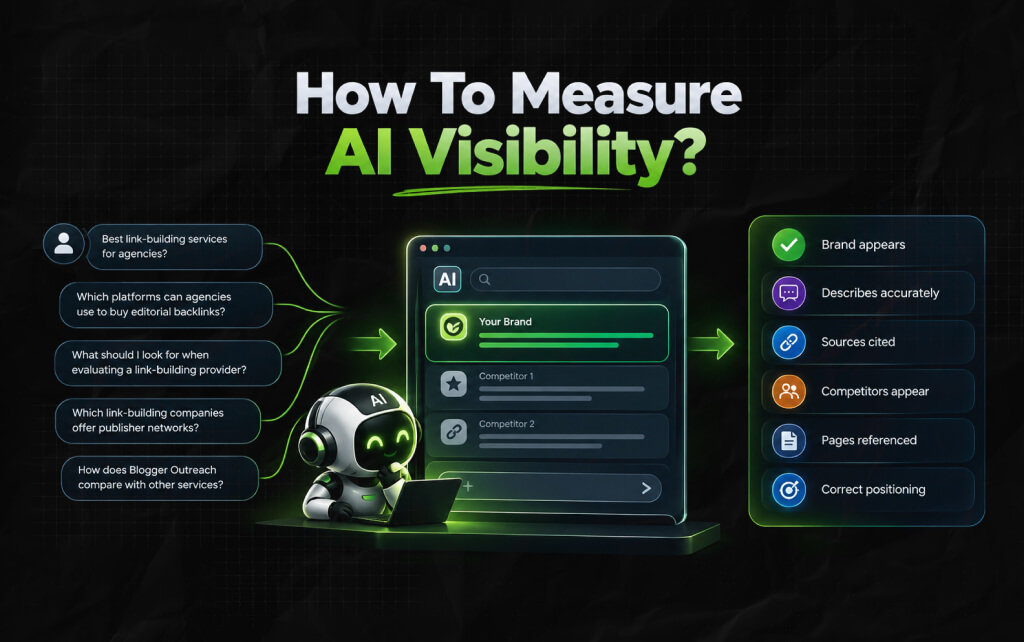
Instead of watching bot visits and assuming they indicate success, create a set of realistic questions your customers might ask AI systems.
For a link-building company, that might include:
Run these prompts regularly.
Also, you need to record:
Now you are measuring something meaningful. You are not simply asking whether an AI crawler visited your website.
You are asking whether your information is becoming part of the conversation.
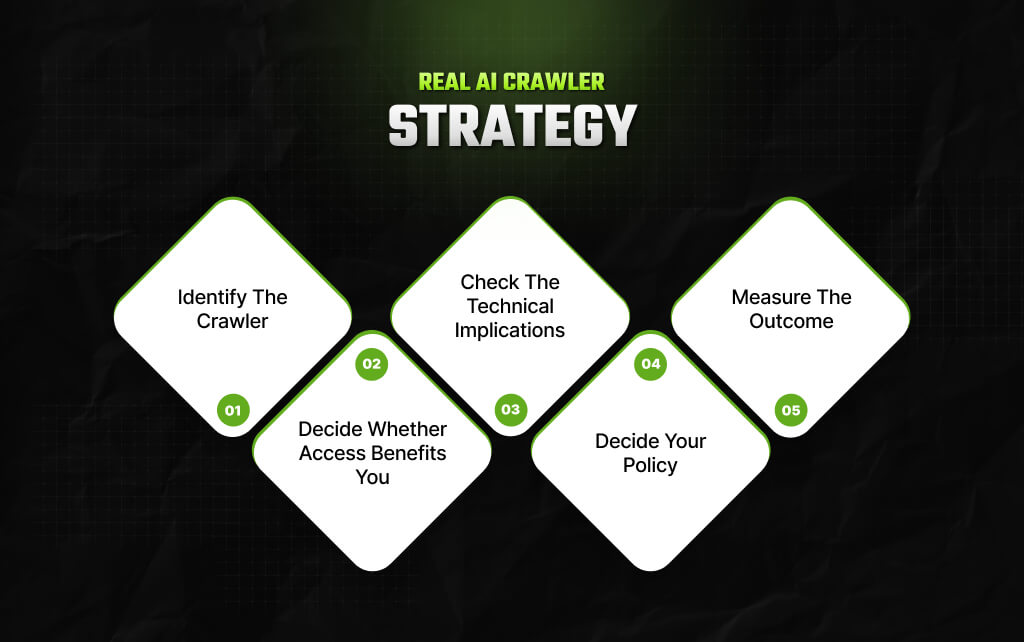
You don’t need to chase every new bot that appears. Instead, build a simple framework.
1. Identify the crawler: Find out who operates it. Also, find out what its stated purpose is, and more importantly, whether it’s associated with training, search, retrieval, research, or something else.
2. Decide whether access benefits you: Now, find out whether access could improve discovery. Also, consider whether it could create meaningful AI visibility and expose content you would rather protect.
3. Check the technical implications: In the third step, you need to find out whether crawling will create significant server load. Moreover, will it request valuable pages efficiently? Are there unusual request patterns?
4. Decide your policy: In this case, you can allow it. Also, you can restrict or block it. Additionally, you can monitor it before making a decision.
5. Measure the outcome: In this step, don’t stop at crawl activity. Instead, look for changes in AI visibility, citations, brand accuracy, and referral traffic.
That turns crawler management from a technical exercise into a marketing decision.
Traditional SEO taught marketers to think about whether a page could be crawled, indexed, and ranked.
AI search adds another layer.
Can the system understand what this page says, connect it to the right entity, evaluate its usefulness, and use it when answering a relevant question?
That is a much bigger challenge than simply getting a crawler to visit.
And it changes what good SEO looks like.
A website with clear entities, strong technical foundations, original information, consistent facts, useful explanations, and credible references has something valuable to offer both search engines and AI systems.
However, a website built around keyword variations and 1,500-word articles with no original insight does not become valuable simply because an AI crawler can access it.
TBH, AI crawlers are becoming another part of the web ecosystem. But the goal should not be to get as many AI bots as possible onto your website.
Instead, the goal is to make a deliberate decision about who gets access, what they can access, and why that access matters to your business.
Because in AI search, being crawled is only the beginning. The real advantage comes from being understood.
Barsha is a seasoned digital marketing writer with a focus on SEO, content marketing, and conversion-driven copy. With 8+ years of experience in crafting high-performing content for startups, agencies, and established brands, Barsha brings strategic insight and storytelling together to drive online growth. When not writing, Barsha spends time obsessing over conspiracy theories, the latest Google algorithm changes, and content trends.
View all Posts

The Ultimate Guide To Competitor Backlink Ana...
Oct 23, 2026
How To Land High-Authority Editorial Backlink...
Oct 23, 2026
Why Your Website Traffic Dropped Suddenly And...
Oct 23, 2026
How Do The Physical Google Review Tools Redef...
Oct 23, 2026
How To Get Your Brand Cited In AI Search Resu...
Oct 22, 2026