How To Get Your Brand Cited In AI Search Results In 2026
Oct 22, 2026
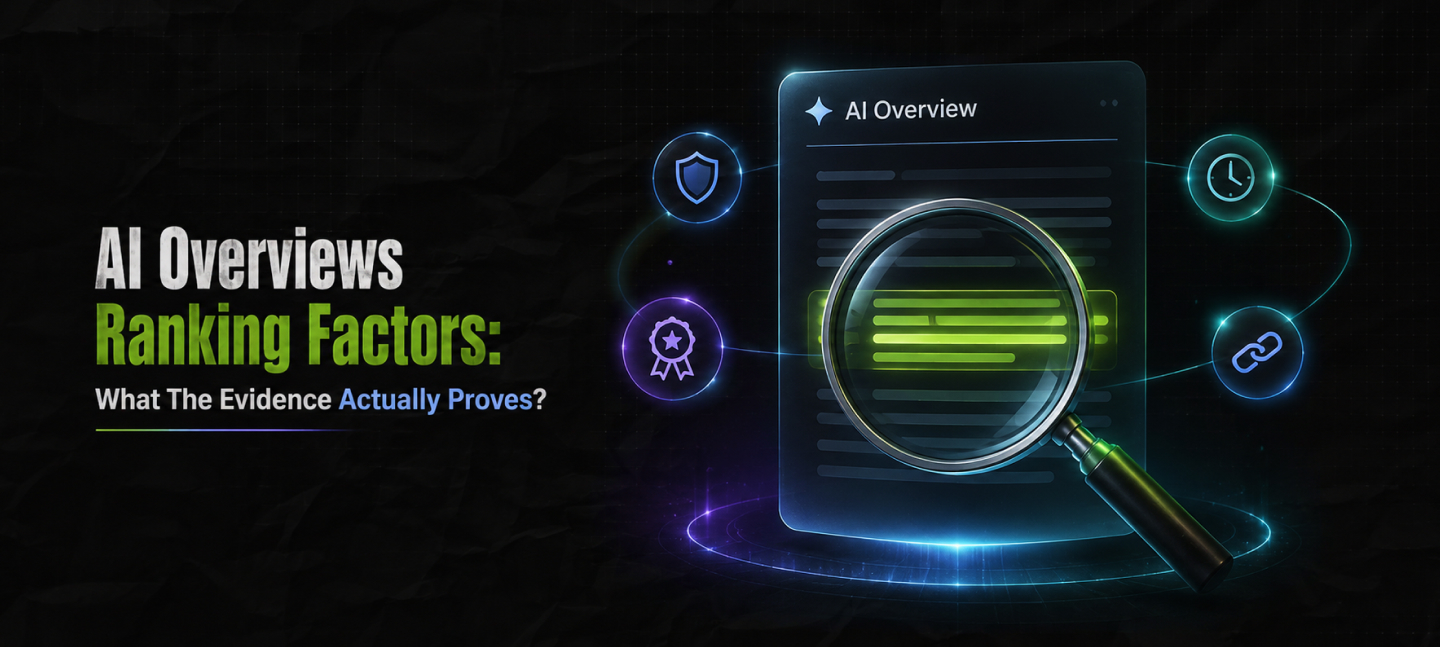

Search for ‘AI Overviews ranking factors,’ and you’ll get a dozen articles listing seven signals, or twelve, or thirty-five, each presented with the same flat confidence.
Semantic completeness, schema, E-E-A-T, entities, freshness – all stacked in a tidy row as if they carried equal weight.
TBH, they don’t. In fact, some of these factors have the backing of repeatable experiments across thousands of results.
Others are one person’s case study that happened to go viral. As a result, treating them as equals is how you end up spending a quarter chasing a signal that barely moves the needle.
So this piece does something different.
Instead of adding another undifferentiated list, it ranks the factors by how strong the evidence behind them actually is, and flags the one popular statistic that doesn’t survive a close look.
The backbone for my research here is Zyppy’s meta-analysis by Cyrus Shepard from May 2026.
Shepard gathered roughly 75 studies, patents, and field experiments on AI citations, kept the ones that held up, and scored each factor on three things:
That last part matters.
A factor everyone repeats but nobody has tested is just folklore. But a factor three independent teams measured and a Google patent describes is something you can build on.
And that is precisely why I’m here today – I’ll breakdown AI Overview ranking factors and highlight what existing evidence actually proves.
Stay tuned.
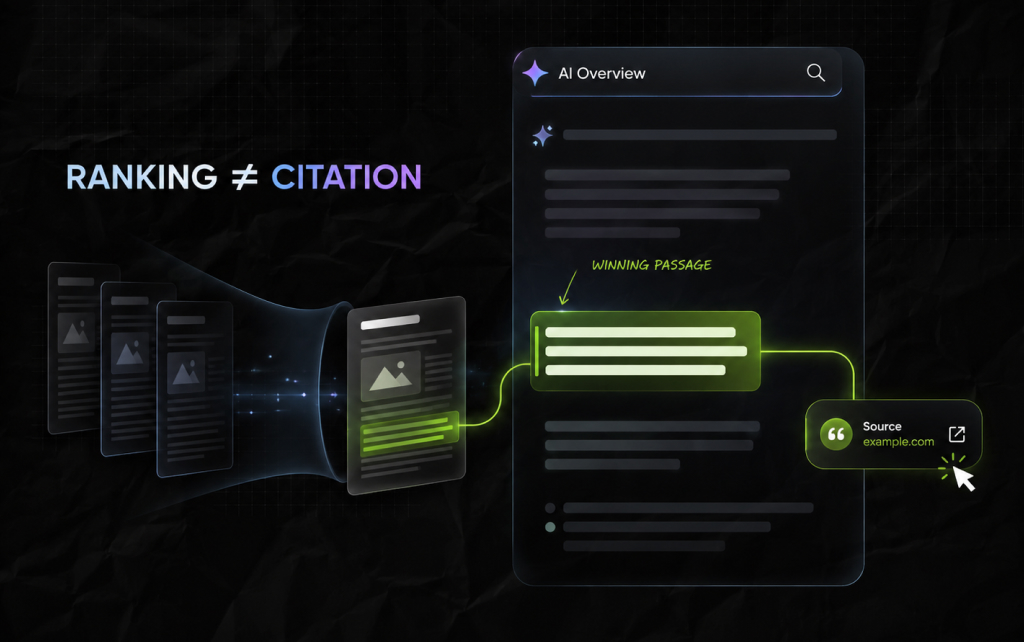
Before the factors themselves, one distinction changes how you read all of them. Ranking a page for a keyword and AI Overviews citing it are not the same game.
Classic SEO gets your page into the candidate pool, because AI Overviews draw from Google’s index.
But the win condition shifts.
Instead of ranking a whole page for a query, you’re competing to have a single passage extracted and cited for one specific sub-question inside the answer.
This means pages that contribute a clear, unique, trustworthy passage get the citation.
Also, pages that merely echo what everyone else has already been saying, or hedge and ramble, become a summary with no credit and no link.
And the citation is the entire prize, because it’s the only part that sends you a click.
That reframing explains why the strongest factors cluster into two groups:
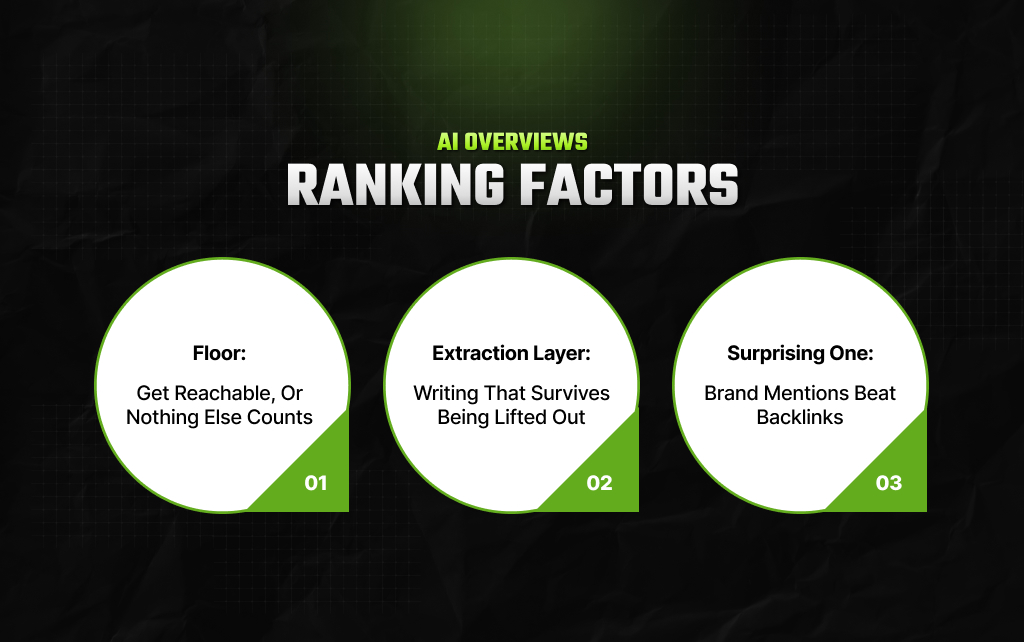
As I was just saying, I am not going to make a huge list featuring multiple AI overview ranking factors – following all of which will get you nowhere.
Instead, I want to do something different, something that already doesn’t exist on the internet – I’ve a three-fold strategy for you, taking into account the three major factors that actually matter, thanks to all the existing evidence at our disposal.
So, without wasting any more time on fluff, here we go.
The highest-scored factor in the entire analysis is the least glamorous.
URL accessibility scored 9.5 out of 10 and stood at the top of the list. A URL has to be reachable and crawlable during either training or live grounding for any engine to cite it.
As a result, pages that robots.txt has blocked, sit behind some paywall, or return errors are invisible, no matter how good the writing is.
This is the floor, and everything else in this article assumes you have cleared it.
Sitting just below is traditional search rank, at 9.4. This is where the ‘SEO is dead’ crowd gets it wrong.
The Ahrefs data folded into the analysis shows that a large share of AI Overview citations still come from pages already ranking in Google’s top ten.
And this is why the study summarizes its entire thesis into one single line: “win SEO, win AI citations, but with extra steps.”
So, your existing ranking work will not go to waste. Instead, it’s the price of admission.
Two more technical factors round out the floor.
A) Fan-out rank (9.3) reflects how well your content covers the cluster of related sub-questions Google generates when it decomposes a query, rather than just the single headline keyword.
B) Preview control (9.2) is the one almost nobody checks: a page using a nosnippet directive to suppress preview snippets can accidentally suppress its own eligibility to be quoted. You can optimize everything else perfectly and quietly disqualify yourself with one meta tag.
Notice the pattern.
The four best-evidenced factors are all mechanical, which means reachable, ranking, comprehensive, and quotable.
None of them is a writing tip. That order is not an accident, and it’s the opposite of how most ranking-factor lists feature such sequences.
Once an engine can reach and rank you, the question becomes whether it can pull a clean answer out of your page.
This is where ‘we rank but never get cited’ is usually decided, and it comes down to one skill: writing self-contained, extractable passages.
The mechanics are consistent across every credible source.
For starters, answer each question immediately, in plain declarative language, in a passage of roughly 40 to 90 words, placed directly under a heading phrased the way a person would actually ask it.
Query-answer match scored 9.2 in the analysis since the model strongly favors passages that respond to the specific question rather than dancing around it.
Also, one study of nearly 16,000 AI Overview results found semantic completeness to be the single strongest on-page correlate of citation, with the best-performing answers packaged in tight, self-contained units of roughly 130 to 170 words.
In addition, remember that structure helps the machine do the lifting.
Similarly, lists make individual items parseable without their surroundings, while numbered steps hand the engine a clean sequence.
Also, I need to point out that definition blocks, a term followed immediately by a direct explanation, are among the easiest structures for an AI to pull into a summary.
And schema markup, while it never guarantees a citation, reduces ambiguity: it helps the engine understand what kind of content it’s looking at and extract it more reliably.
One myth worth killing here: longer content is not inherently more citable.
While the skyscraper era rewarded length, the extraction era rewards a tight, complete answer to a real question.
As a result, shorter pieces with the right packaging are outperforming sprawling ones, because there’s simply less to wade through before the quotable passage appears.
So, here’s the finding that reframes the whole discipline, and it’s well-evidenced enough to take seriously.
Across the underlying data, drawn from roughly 75,000 brands, unlinked brand web mentions correlated with AI citations at about 0.664, while backlinks correlated at just 0.218.
That’s roughly a threefold gap in favor of mentions. But when I thought about it, I realized this gap is not abstract.
Brands in the top quartile by web-mention volume averaged 169 AI Overview appearances, while the next tier down averaged just 14.
That’s a twelvefold difference between the brands that show up and the ones that barely register.
Domain Rating, the familiar backlink-strength proxy, landed in the middle at around 0.326 – better than raw backlinks, but still only about half as predictive as plain brand mentions.
Why would this be? Because AI engines are shifting from a link-equity model to an entity-recognition one.
The engine isn’t auditing your backlink profile before it cites you.
Instead, it’s checking whether your brand shows up across the web, in enough places and the right contexts, to read as a real and authoritative entity.
Consensus across many sites carries more weight than any single link.
The practical implication is uncomfortable for anyone with a backlink-buying budget. This includes earned media, digital PR, and consistent brand presence now do more for your AI visibility than another tier of links.
Also, it means keeping your name, address, and other identity details consistent everywhere, so the model doesn’t split one brand into several weak signals.
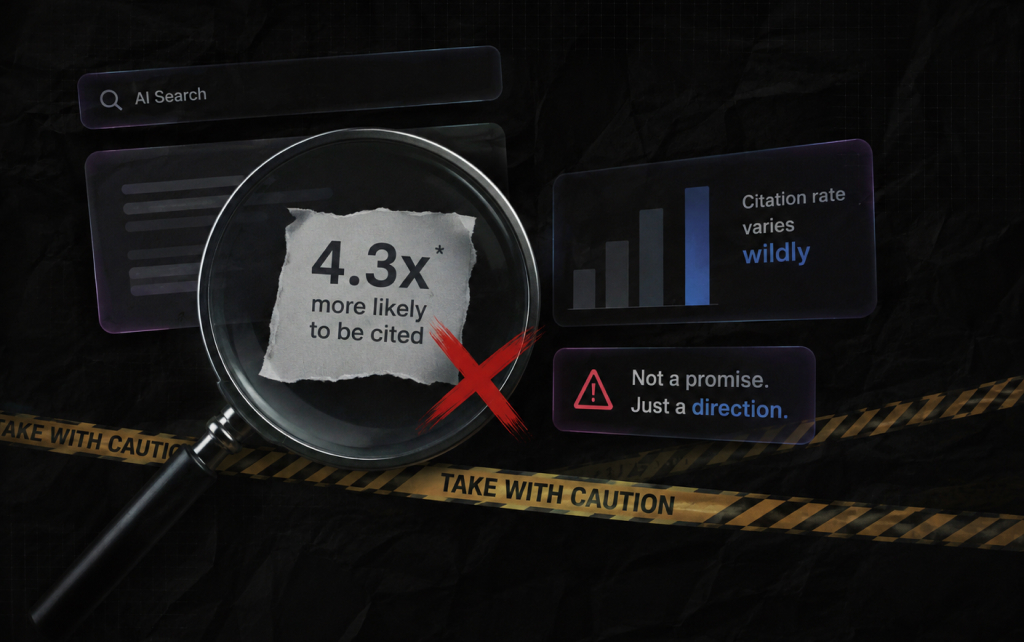
Now the honest part, because any non-commodity piece owes you the caveats too.
Not every number floating around this topic survives scrutiny. Instead, the freshness claim is the shakiest of the popular ones.
For instance, you’ll see it repeated that fresh content is cited ‘4.3 times more’ in AI search. Or that cited pages run some precise percentage fresher than the organic top ten.
The direction is probably real. Retrieval systems do favor content they can tell is current, and cited pages do skew fresher on average.
But the specific multipliers get repeated across blogs with a confidence the original data doesn’t support. Also, it is often traced back to a single study and then restated as settled fact.
Plus, it is understandable to treat freshness as a tiebreaker.
However, it doesn’t make sense to treat it as a precise, reliable lever. And anyone quoting you a decimal-point multiplier on it is selling more certainty than really exists.
Additionally, the same caution applies to citation rates across engines, which vary wildly and haven’t converged.
One engine may cite brands in well under one percent of responses. Another does so a quarter of the time.
TBH, there’s no single ‘AI citation rate’ to optimize toward. So, it’s best to treat every clean-looking number in this space as a direction, not a promise.
Strip away the noise, and the evidence points to a clear order of operations.
So, your first step is to clear the floor first. Confirm your pages are crawlable, not accidentally blocked, not suppressing their own snippets, and already competing in classic search.
Why? Because that’s still the strongest predictor after accessibility itself. Then win the extraction layer: write self-contained, specifically answered passages under question-shaped headings.
Then, structure it for the machine to lift one clean answer without the surrounding context.
Finally, over the longer term, build the brand entity. Why? Because mentions across the web now outrun backlinks by roughly three to one.
Frankly, most ranking-factor lists mislead because they present all of this as a flat menu, letting you start anywhere.
However, the evidence says otherwise.
There’s a floor you have to clear before anything above it counts, an extraction skill that decides most contested citations, and one genuinely counterintuitive lever, that is, your brand presence.
So, sequence it in this order, and you’ll work with the evidence instead of against it.
However, if you chase the factors in whatever order a listicle happens to present them, you’ll pour effort into signals that were never going to move.
At the end of the day, this is the only strategy that matters in 2026: a strategy that rewards patience over link-buying.
Barsha is a seasoned digital marketing writer with a focus on SEO, content marketing, and conversion-driven copy. With 8+ years of experience in crafting high-performing content for startups, agencies, and established brands, Barsha brings strategic insight and storytelling together to drive online growth. When not writing, Barsha spends time obsessing over conspiracy theories, the latest Google algorithm changes, and content trends.
View all Posts

How To Get Your Brand Cited In AI Search Resu...
Oct 22, 2026
The Ultimate Blueprint For Broken Link Buildi...
Oct 16, 2026
The Ultimate Guide To Stealing Your Competito...
Oct 15, 2026
Beyond The Basics: Master Guest Posting For H...
Oct 15, 2026
Best Generative Engine Optimization (GEO) Com...
Oct 14, 2026