How To Get Your Brand Cited In AI Search Results In 2026
Oct 22, 2026

Most podcasters focus on recording and editing. Very few think about how people will find the episode later.
That’s where podcast SEO comes in.
It’s not about gaming an algorithm. Instead, it’s about making your content easy to discover, understand, and choose.
As a result, to ensure your podcast appears at the top of search results and becomes easily discoverable for your audience, it is vital to have podcast content optimized by the right SEO strategy.
And once you take care of that, you will see your podcast gradually ascending the rankings on search results.
This, in turn, results in an increase in traffic from search engines like Bing and Google.
With this purpose, let’s dissect how to strategize, create, and optimize your content with the help of SEO – the point? To improve overall discoverability.
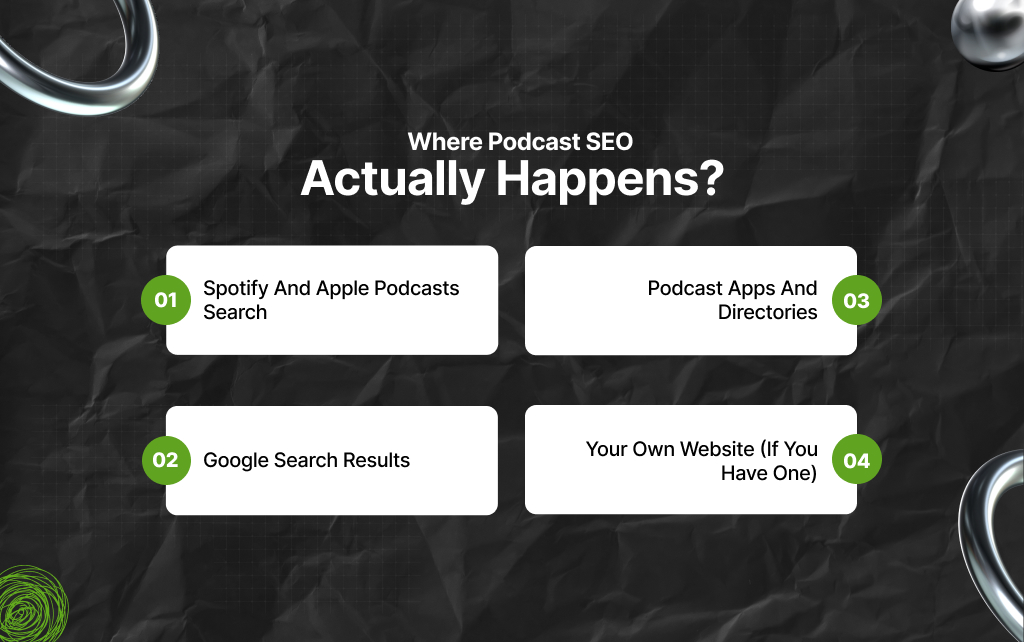
It’s not just one place.
Instead, your podcast shows up across:
Moreover, each platform reads your content slightly differently. But they all rely on the same signals: clarity, relevance, and consistency.
Before changing anything in your podcast SEO strategy, pick one of your episodes and search for its topic.
Now, with the results at your disposal, ask yourself:
This gives you a clear starting point – now, you have the data to analyze and create a SEO strategy that actually works.
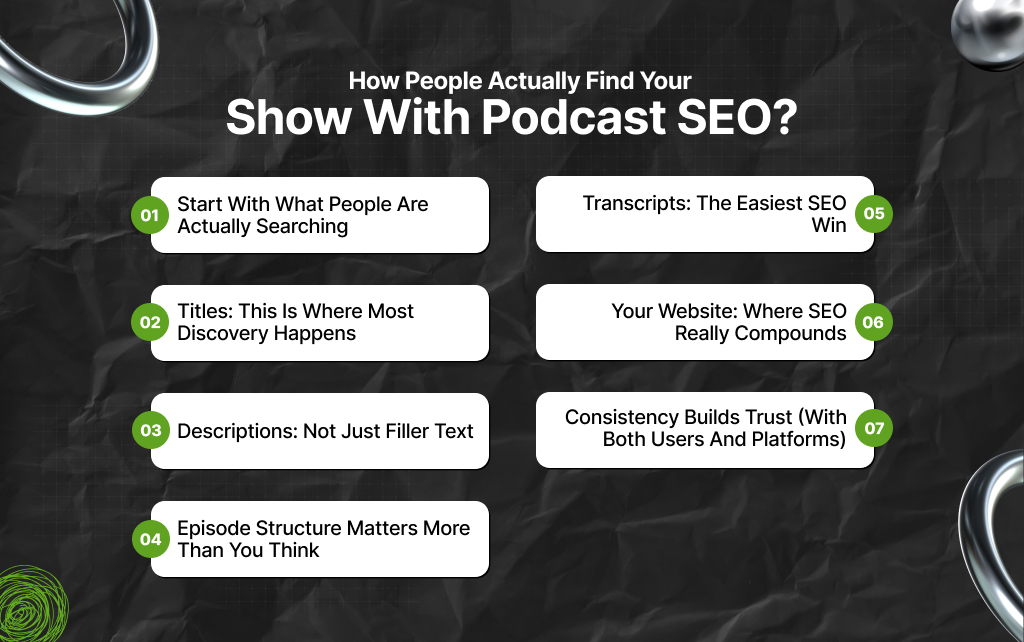
So without wasting time, let’s find out how you can use podcast SEO for the most effective results.
Before you record, ask, “What would someone type if they needed this episode?” And while doing this, understand the search is not broad topics. It’s about specific problems.
For example, you can use phrases like “how to start a podcast with no budget,” “how to deal with burnout at work,” or “best ways to grow on Instagram.”
The point? To build episodes around real questions. That makes everything else easier.
This is where most people struggle. They pick topics they want to talk about, not what people search.
Instead, do this:
Those suggestions come from real searches. That’s what you should build episodes around.
So, your podcast title does two jobs:
As a result, you need to keep it simple and clear. For starters, put the main topic early and ensure you are focusing on the outcome or problem.
Moreover, you should avoid vague words like “chat” or “thoughts.” Instead, think: “Would I click this if I saw it?”
If titles are weak, nothing else matters. As a result, you can use this simple format: [Clear Topic] + [Specific Outcome]
On that note, here are some examples:
Also, while doing this, here’s what to avoid:
So, if someone cannot understand your episode in 3 seconds, they will skip it.
Most people write one paragraph and move on. As a digital marketing professional and content writer, I can tell you, this is a missed opportunity.
Ideally, any good description should:
Also, understand that you don’t need to stuff keywords. Instead, how about just explaining clearly?
Most descriptions are too short or too vague. Instead, think of it like this: If someone cannot listen right now, your description should still help them understand the value.
Moreover, ensure you are including:
In addition, ensure that you write like you are explaining it to one person.
Search platforms are getting better at understanding audio, and not making the most of it would be very stupid.
To be specific, search platforms look at:
So if your episode drifts too much, it becomes harder to categorize. As a result, it is best to stay focused on one main idea per episode.
If you are not using transcripts, you are missing out. Moreover, this is where podcast SEO really comes into play with the right approach.
Since search engines can read text, not audio, you have to make the most of your transcripts.
As a result, an ideal transcript:
If you don’t have transcripts for your content, then you need one ASAP. Even a basic transcript helps.
If you host your podcast on a website, this is where long-term SEO builds. So, the best way to go about it is to create a page for each episode.
And ensure that each page includes:
This gives Google something to index. Over time, this can bring in steady traffic.
Posting once in a while does not help. Instead, regular uploads signal that your podcast is active. And that improves visibility over time.
Moreover, understand that you don’t need to post daily. But you do have to stay consistent.
If you are worried about consistency, then you can use this checklist every time.
Also, this takes 5 minutes but changes how your episode performs – so make the most of it.
If you want something practical, here’s a simple workflow that actually works:
That’s enough to build a solid base.
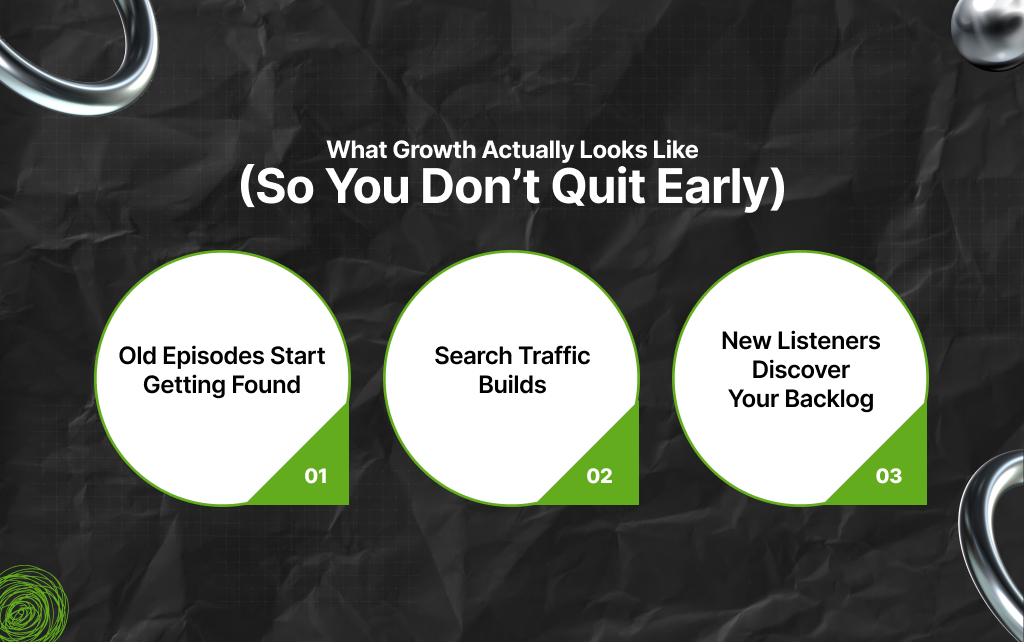
Podcast SEO is slow at first. Moreover, you won’t see instant spikes, unlike what we are used to for getting website traffic.
But over time, you will see that:
This is where it compounds.
If you are not getting listeners yet, then don’t assume your content is bad – and definitely don’t stop!
Instead, check this first:
Often, it’s a positioning problem, not a content problem. Moreover, it is best not to try to fix everything at once.
So, start with the following three pointers:
1. Fix your titles: Make them clearer and more specific.
2. Narrow your topics: One problem per episode works better than broad discussions.
3. Stay consistent: Even one episode per week builds momentum.
They treat titles and descriptions as an afterthought.
As a result, something like “Episode 12: A Conversation With Rahul” is not going to work really.
TBH, this means nothing to someone searching. In fact, think about comparing this to: “How to Start Freelancing With No Experience (Step-by-Step Guide).”
The second one is clear. Why? Because it matches intent. And that’s what SEO needs.
Before publishing, do one thing.
Search your topic on Google or Spotify to find out what is already ranking. Then adjust your title and description to fit that pattern, but make it clearer.
This keeps you aligned with what people are already searching for.
Podcast SEO is not complicated. Instead, it’s about clarity.
So, if someone can quickly understand what your episode is about and why it matters, you’re already ahead of most creators.
Do that consistently, and your podcast becomes easier to find over time.
Barsha is a seasoned digital marketing writer with a focus on SEO, content marketing, and conversion-driven copy. With 8+ years of experience in crafting high-performing content for startups, agencies, and established brands, Barsha brings strategic insight and storytelling together to drive online growth. When not writing, Barsha spends time obsessing over conspiracy theories, the latest Google algorithm changes, and content trends.
View all Posts

How To Get Your Brand Cited In AI Search Resu...
Oct 22, 2026
The Ultimate Blueprint For Broken Link Buildi...
Oct 16, 2026
The Ultimate Guide To Stealing Your Competito...
Oct 15, 2026
Beyond The Basics: Master Guest Posting For H...
Oct 15, 2026
Best Generative Engine Optimization (GEO) Com...
Oct 14, 2026