How To Audit Your Search Visibility In 2026: Google Rankings, AI Overviews, And Where Your Traffic Really Comes From
Sep 30, 2026

Today’s topic: How to run Google Ads?
Though advertising on Google may seem simple enough at first glance, there is actually a lot you can do to make sure your ads are as effective as possible.
In this blog post, I will go over some creative strategies for using Google Ads to market your business.
By learning how to target your customers and create compelling ads, you can start seeing better results from your marketing campaigns.
So let’s get started!
There are several advantages to utilizing Google advertisements to market your company.
For starters, Google is the most prominent search engine in the world, and your ad will be viewed by a significant number of people.
Second, Google provides a variety of targeting choices, allowing you to be quite exact about who sees your ad.
You may, for example, target people based on their location, age, gender, hobbies, and other factors.
This means you can be certain that your ad will reach the intended audience. Third, Google AdWords is a great way to drive visitors to your website or online business.
Finally, Google advertising is incredibly inexpensive, making it an excellent way to begin with internet marketing.
As a result, if you are looking for a cost-effective and efficient way to market your business, Google Ads should be at the top of your list.
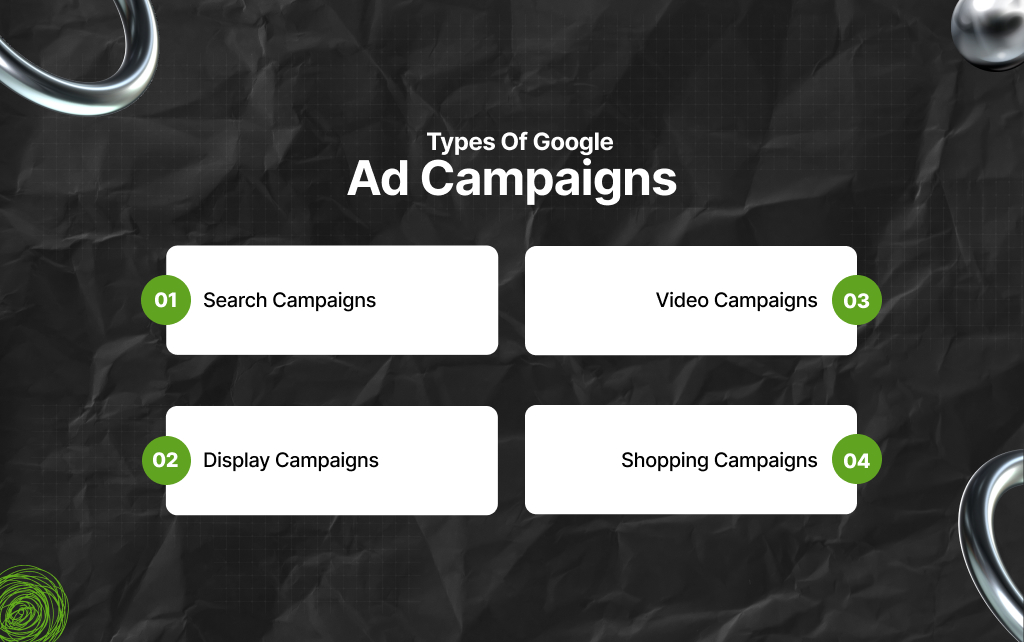
Google Ads is an advertising platform that allows businesses to display ads on Google Search and other Google properties. There are four main types of Google ad campaigns: search, display, video, and shopping. Search campaigns are the most common type of campaign and are targeted at users who are actively searching for a specific keyword or phrase.
Display campaigns are targeted at users who are visiting websites in a specific category or who have recently been to a website in a specific category. Video campaigns are targeted at users who are watching videos on YouTube or other video-sharing websites.
Shopping campaigns are targeted at users who are searching for products on Google Shopping or other e-commerce websites. Each type of campaign has its own strengths and weaknesses, and businesses should choose the type of campaign that best fits their needs.
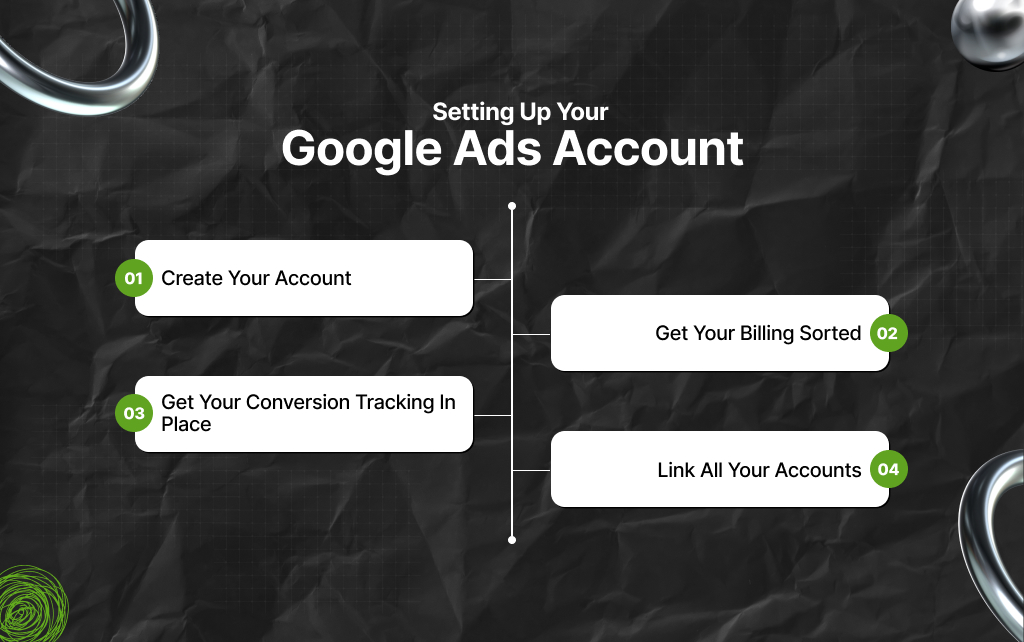
So, let’s get started with setting up your Google Ads account. I’ve discussed all the essential steps below while keeping things simple and easy to follow.
For starters, you need a Google account. So, if you have a Gmail account, then you are already halfway there.
Now, just visit ads.google.com to sign up.
On this note, there’s something you need to understand – when Google will walk your though the whole setup process, it will try to make you send out your first campaign.
You have to avoid doing this at all costs.
Instead, create your account without sending any campaign. Why? Because it is always safer to set up your account properly before you spend money and send campaigns.
This is a very simple step. You just need to add your preferred payment method – I will always recommend using a credit card for this step.
Also, choose your time zone and currency while setting up your billing. Don’t get to double-check everything because you will not be able to change these details later.
This is hands down the most crucial step, and the worst part is that most marketing professionals tend to skip it while starting out.
So, if you don’t set up your conversion tracking, then you are just aiming in the dark. Moreover, you won’t know which ads, campaigns, or keywords are making money.
As a result, you have to install the specific tag for Google Ads on your site. Also, you need to set up different conversion actions specifically in alignment with your business goals. That could be phone calls, email signups, form submissions, or purchases.
TBH, I can’t stress this point enough!
Without setting up conversion tracking on your site, you are working on a foundation of guesswork. And you can’t just invest your entire ad budget in guesswork.
Connect your Google Business Profile, YouTube channel, and Google Analytics to your ads account.
This, in turn, will give you more insights, better data, and many more targeting alternatives – you will have better awareness of what is actually working for you.
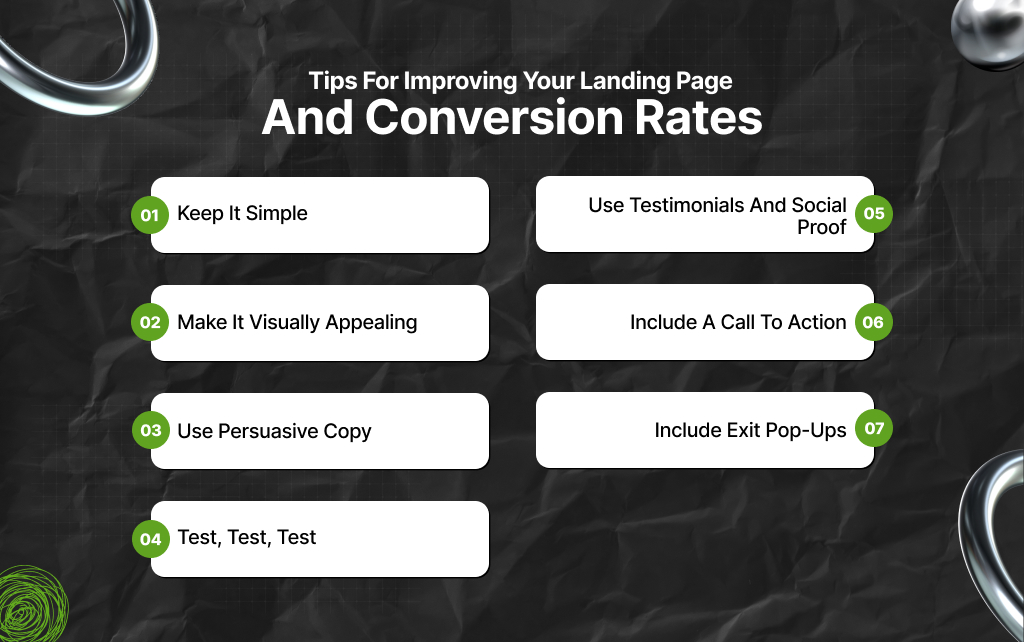
If you’re looking to improve your website’s conversion rate, one of the first places you should start is by improving your landing page.
Your landing page is the first thing that potential customers see when they visit your site, so it’s important to make a good impression. Here are a few tips to help you create an effective landing page:
Don’t try to cram too much information onto your landing page. Stick to the essentials and make sure it’s easy for visitors to find what they’re looking for.
Use strong visuals to grab people’s attention and help them understand your message at a glance.
Write headlines and body copy that persuade visitors to take the desired action, whether that’s signing up for a free trial or making a purchase.
And what does persuasive copy look like? It is clear, concise, and easy to read.
It uses strong visuals to grab people’s attention, and the headlines and body copy are written in a way that persuades visitors to take the desired action.
Always experiment with multiple versions of your landing page to determine what performs best.
Any internet marketing plan must include testing. You can evaluate which version of your landing page is most effective at turning visitors into buyers by testing several versions.
On your landing page, you may experiment with various elements such as the headline, body content, images, and call-to-action buttons.
You may also experiment with other variations of your offer, pricing point, and delivery method.
Include testimonials from satisfied customers on your landing page to build trust and show potential customers that others have had success with your product or service.
You can also include social proof, such as the number of people who have already signed up for your email list or purchased your product.
Make it easy for visitors to take the next step by including a clear call-to-action on your landing page. Use actionable language and make sure the button is visible and easy to click on.
Exit pop-ups are a great way to capture leads as they’re leaving your site.
Include an exit pop-up on your landing page that offers visitors something of value, such as a discount or a free e-book, in exchange for their contact information.
By following these tips, you can create a landing page that will improve your conversion rate and help you achieve your business goals.
Measuring the performance of your Google advertising campaign can be difficult. There are several aspects to consider, and knowing where to begin might be challenging.
Taking the effort to track critical indicators, on the other hand, may give you a fair notion of whether your campaign is on track.
The click-through rate (CTR) is an important indicator to monitor (CTR). This metric tracks how often individuals who view your ad click on it.
A high CTR implies that your ad is relevant and interesting, which increases the likelihood of conversions.
Another measure to monitor is the cost per click (CPC). This is the amount you spend for each click on your ad. A lower CPC indicates that you are receiving more value for your money and is a sign of a successful campaign.
The conversion rate is an important measure. This metric counts the number of individuals who click on your ad and subsequently complete the targeted action, such as completing a purchase or subscribing to a newsletter.
You can get a fair notion of the performance of your Google ad campaign by following these important metrics. Managing these metrics and making sense of the data can get overwhelming quickly. Many business owners find that they do not have the time to monitor these numbers every day. Working with an experienced agency can help you get the most out of your budget without the stress. You can read more here about how professional management keeps your campaigns on track. This lets you focus on running your business while experts handle the technical side of your search ads.
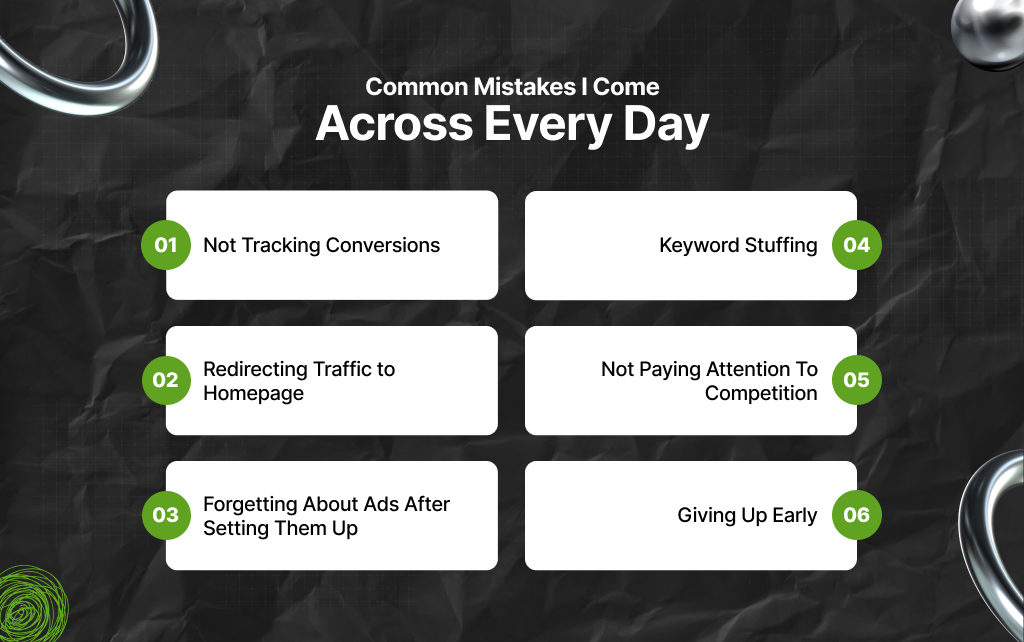
After working in digital marketing, primarily as a content and SEO strategist for eight years, I can tell you that people usually make the same mistakes.
On that note, here are six common mistakes that I come across frequently.
Many people don’t track their conversions. While I’ve always spoken about this in detail before, it is worth repeating.
So, remember that if you aren’t monitoring your conversions, then you are building a strategy on the foundation of guesswork.
Sending any traffic to your website’s homepage is a dumb mistake, frankly. Instead, your Google ads should send traffic to specific landing pages to match search intent.
Remember, you don’t traffic on your ‘About Us’ page or homepage. Instead, you need a dedicated page for conversion.
You cannot set up Google Ads only to forget all about it. I mean, setting up an ad isn’t your only job – rather, it will need optimization and regular monitoring, especially in the initial weeks.
You cannot have too many keywords, and that too within one set of ads. As a result, you need to ensure your ad strategy is right.
So, it is best to use five to ten keywords for every group of ads. This will allow you to create relevant ad copies for each individual group.
Ignoring competition is perhaps the stupidest thing you can do in this context. As a result, make use of your Auction Insights to access reports on your competition.
That way, you can study the Google ads and related landing pages your competition is running. Moreover, you will be able to find the gaps and improve your ads.
Giving up way too soon is not the right thing to do.
So, you will see that a majority of ad campaigns require between two and four weeks of information before any changes can be incorporated.
As a result, don’t panic if the campaign doesn’t work within the first few weeks.
Instead, wait it out and give it a few weeks to understand what is working and more importantly what isn’t working.
Every few years, I hear someone or the other saying Google Ads don’t matter anymore – it’s a dead industry and SEO is the only thing you need.
Some even go to the extent of saying it is much more affordable to run ads on social media. And then there’s the whole AI debate and how it’s going to replace everything.
Meanwhile, Google witnesses more than 8.5 billion searches every day – take a moment to grasp that.
Drawing from this, I can tell you something – with Google Ads, you can actually reach your audience exactly when they are looking for something that you can sell.
Now, let that sink in.
On Instagram and Facebook, you are just interrupting users with ads while they are scrolling through vacation pictures of their friends.
In contrast, on Google, you are displaying ads when someone is literally looking for something they want to buy – and that, my friends, is intent. FYI, in 2026, intent is the foundation of advertising.
Barsha is a seasoned digital marketing writer with a focus on SEO, content marketing, and conversion-driven copy. With 8+ years of experience in crafting high-performing content for startups, agencies, and established brands, Barsha brings strategic insight and storytelling together to drive online growth. When not writing, Barsha spends time obsessing over conspiracy theories, the latest Google algorithm changes, and content trends.
View all Posts

How To Audit Your Search Visibility In 2026: ...
Sep 30, 2026
What Is Google Lighthouse? A Practical Guide ...
Sep 30, 2026
When Can You Save A Public Instagram Story?
Sep 30, 2026
Google Looker Studio: What It Is, How It Work...
Sep 30, 2026
What Is Google Tag Manager? A Practical Guide...
Sep 30, 2026