
Turn A Search Question Into A Watchable Explanation
Sep 16, 2026


Don’t you want to position your content higher, with more search results and traffic? What if I told you that you can easily achieve such goals with topical authority?
The world of search engines is constantly evolving, and the changes impact how your content will be ranked and displayed.
So, there should be a strategy that can help you always stay on top and ensure that your website is ranking well in your niche.
There comes the concept of topical authority. It is considered the key ranking and can easily level your ranking game. You can easily build up topical authority if you have developed the right content strategy.
This article will explain topical authority, why it matters, and how you can develop topical authority for your sites. Read on.
The idea of topical authority is mainly an SEO concept used to perceive authority and expertise on more than one topic.
If you can create high topical authority for your website content, you will be able to achieve credibility and the potential to rank for related keywords.
In simple terms, topical authority is about measuring the credibility of your website. To achieve this, you continue creating high-quality content on a given subject.
Always remember, the more informative and comprehensive the content you can provide on a specific topic, the more it will attract new readers to your site.
The topical authority also creates your identity as a subject matter expert in that particular niche.

Topical authority is crucial for successful SEO. It helps build a long-term content strategy that is sustainable for your website.
If you are successful in establishing topical authority, you should not worry.
Topical authority helps to improve website ranking, increase organic traffic, improve credibility, and more.
When creating your content and managing your website, you must ensure that your website is building authority. In this way, they will be able to stay competitive. So, you can make your brand more relatable to the keywords.
Always remember that if you can make your site more authoritative on a specific topic, it will be more profitable for you to rank your site higher in SERPs.
Even a new website can rank higher on the search engine results page with the help of an SEO strategy and topical authority.
Google demonstrates topical building as EEAT (Experience, Expertise, Authoritativeness, and Trustworthiness). This EEAT may not be a ranking factor, but if you follow the guidelines, it will help you achieve a good ranking.
When you are working on SEO, achieving topical authority can help you ace the strategies. This topical authority can also help improve your website visibility and marketing goals.
I will provide you with a few examples in the following that can help you understand the benefits of topical authority.
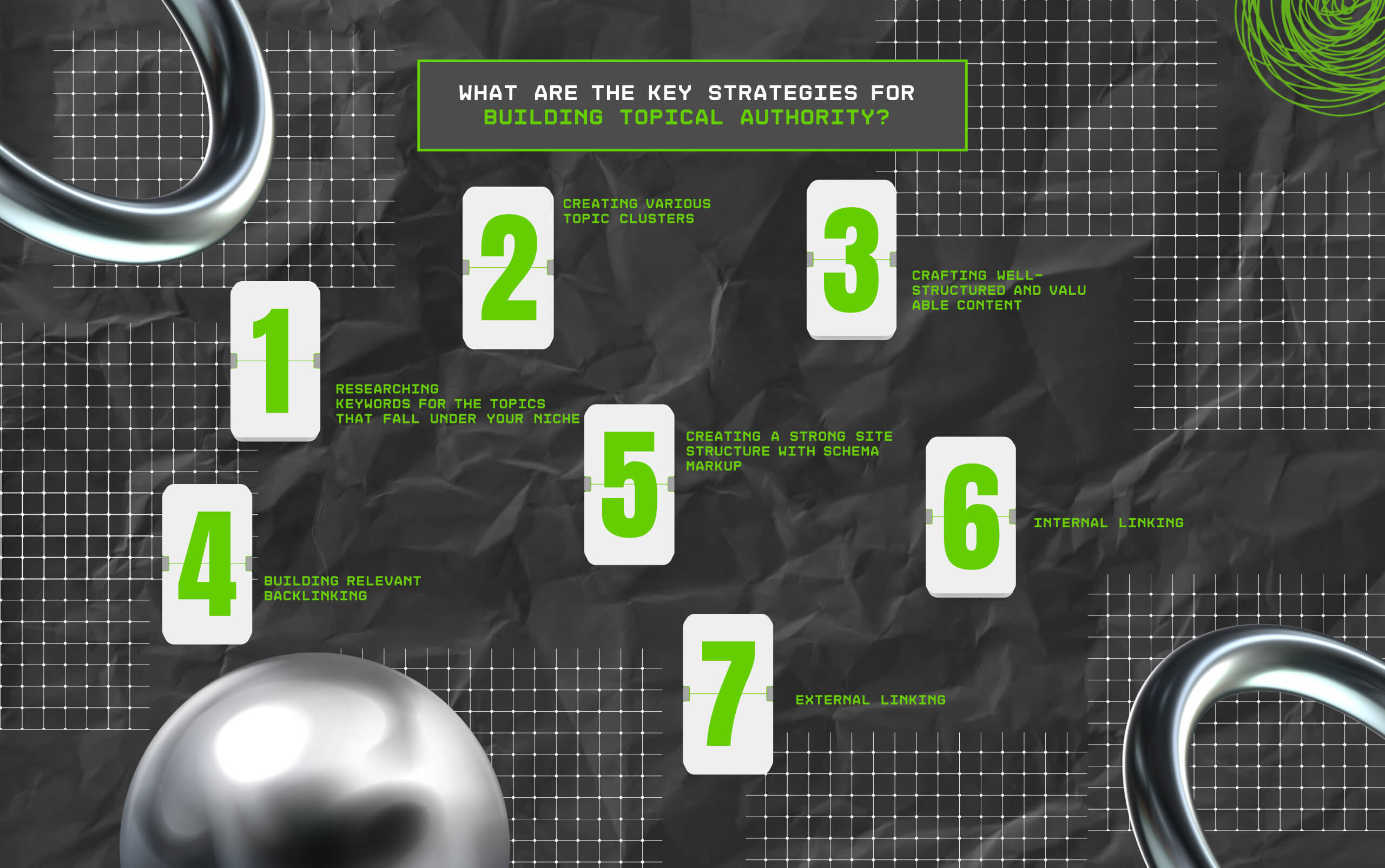
So, the main question is how do we build topical authority for a website?
Once you cover all the basics of SEO, you will see that building topical research is very straightforward. There is nothing extravagant about it.
Without any further discussion, let’s get into learning how to build topical authority.
When you are trying to improve your topical authority, your very first step would be to perform keyword research. The research should be based on the topics that fall under your niche.
Look for topics that have a high search volume with low keyword difficulties. Remember, if you choose keywords that are specific, they will have less competition than general ones with huge competition.
Moreover, more topic-specific keywords can help you establish yourself as an expert in that specific topic or niche.
So, if you are willing to achieve topical authority, you will have to cover all the issues that particularly fall under your niche.
You can also get a strong grip on specific topics with the help of long-tail keywords. These long-tail keywords help to answer a particular search query.
For example, “Where to find Vivienne Westwood heart-shaped red bags” shows that the user intended to specifically know about the store locations where that heart-shaped bag can be found.
Try to aim for these kinds of long tail keywords to address the queries and satisfy user intent.
Once you have completed the keyword research, you must start brainstorming ways to organise your topics.
Remember, your pillar page should be the most comprehensive page. Every other page related to that will be considered a cluster page.
The moment you start creating content based on the keywords, you must link the pillar page internally to those specific topics. This makes it easy for Google to relate to all your pages on your website.
It also helps to pass authority from one page to the other one.
Once you are done organizing your topics through topic clusters, you can start creating all the content based on that topic.
While creating content, you must ensure that your content includes enough information about the subject. They are relevant, and they will genuinely help the users.
Remember, providing user-friendly information while maintaining consistency will encourage users to engage more with the site.
Ultimately, your site will be able to establish itself on the Google search engine through better ranking and reach your audience.
When you begin creating your content, consider the questions that the users may have regarding the topic. You can also make yourself a user to see if the content is satisfying your search intent.
You can also refer to the “people also ask” on Google for the target keyword that you have chosen. All of these questions should be targeted under the H2 heading tag.
This way, you can help Google and your users find the information very easily.
Backlinking is considered a crucial part of SEO. These backlinks are useful to let Google know that there is other content that also finds your content valuable, and they link it to their own content.
Building backlinks can help to transfer authority from one site to another. So, if you are receiving backlinks from a certain website with higher authority, you will know that your domain rating will also improve eventually.
There are two specific kinds of backlinking: internal and external.
Unlike the common misconception, the structuring of the content, webpage, and use of schema markup can massively impact topical authority building.
That is, it helps search engines as well as users to navigate the topical cluster easily.
Moreover, it creates the structure for explaining the content flow.
Creating a hierarchical structure for the pillar content, followed by the subtopic content pages.
Also, creating the right schema markup helps search engine bots to understand the structure of the content.
So, it improves the ranking of the pages on the Google SERPs.
In addition to this, users can clear URL structures with the right tags to navigate through the subtopics of the cluster.
So, navigation through the content becomes easier.
When you are creating an internal backlink, try to link to pages already on your site. So, while creating content, always look for ideas from your own blog posts that are already related to the topic.
If you see a topic related to an already published article, connect both articles by an internal link.
External linking is a crucial factor for topical authority. Here, the links direct customers from your websites to someone else’s.
External linking is also known as outbound linking.
It is more like passing authority to your own website.
If you see that some websites with higher authority have linked to your website, it means Google will consider your website more authoritative.
But how do you receive such external linking?
Well, you may have contact websites that are more related to your niche. Look for the ones with high authority.
Choose blogs or content that can add value to your website.
Although a strong topical authority offers massive benefits for SEO performance, it comes with some limitations. So, some of these limitations include—
Firstly, to build topical authority, users need to invest intensive time and resources. So, it might require a long-term commitment to the investment.
Moreover, measuring the topical authority is not that easy.
That is, it requires mixing and integrating diverse metrics to measure the topical authority, since there is no single metric.
Additionally, creating topical authority with a high focus on any niche areas can lead to over-specialization.
That is, the audience base can become narrow and difficult to build credibility or expertise on Google.
Since the content market is constantly evolving, today’s relevant topic might not be relevant tomorrow.
So, updating the content clusters and modifying the older topic coverage is important to stay relevant in the content market.
Finally, creating too much content around the related topics can lead to content cannibalization.
That is, more and more content from the same cluster might end up competing with each other for the same keywords.

In conclusion, you can craft a vast number of high-quality contents based on a broad subject.
But once you start interlinking them, you actually increase the topical authority.
Creating topical authority helps to show your expertise in a specific topic. It will also make you a trusted source.
These are the SEO efforts that can boost your rankings and website traffic and achieve overall business growth for long-term success.
Here are some of the frequently asked questions about topical authority that most users look for.
Since there is no single metric to measure the topical authority for a site, you need to combine and integrate other metrics to identify the topical authority.
So, here is how to measure it indirectly—
• Identifying the number of ranking keywords that the website covers for maximum topic coverage.
• Measuring the long-tail keyword ranking pages from the topic cluster.
• Finding the topic-to-content ratio to evaluate the depth of the topic covered in the web content.
• Measuring the internal linkings and topic-related highly authoritative external linkings to measure the rising authority of the site.
Unlike other linking strategies, backlinks help in building trust and credibility in the niche field.
That is, backlinks from high authority pages in the niche help signal search engine bots that the page is credible, relevant, and reliable.
So, it ranks the page for the keyword searches.
Although most users confuse topical authority with domain authority, they are not the same.
That is, topical authority helps sites to show their expertise in a specific subject or niche field.
But, on the other hand, domain authority refers to the overall credibility of the site in the niche industry.
That is, it provides a holistic overview of the site’s authority. So, both play a crucial role in contributing to the SEO performance of the site.
Chandrima is a seasoned digital marketing professional who works with multiple brands and agencies to create compelling web content for boosting digital presence. With 3 years of experience in SEO, content marketing, and ROI-driven content, she brings effective strategies to life. Outside blogging, you can find her scrolling Instagram, obsessing over Google's algorithm changes, and keeping up with current content trends.
View all Posts

Turn A Search Question Into A Watchable Expla...
Sep 16, 2026
Agency Guide To YouTube Growth: Wholesale Pri...
Sep 15, 2026
Top 5 Reputed SMM Panels To Buy Social Media ...
Sep 15, 2026
How Is Social Media Marketing Changing The Wa...
Sep 15, 2026
Structured Data SEO: How Schema Markup Helps ...
Sep 12, 2026