PoE Switch For CCTV: A Complete Guide For Filipino Homes And Businesses
Aug 13, 2026
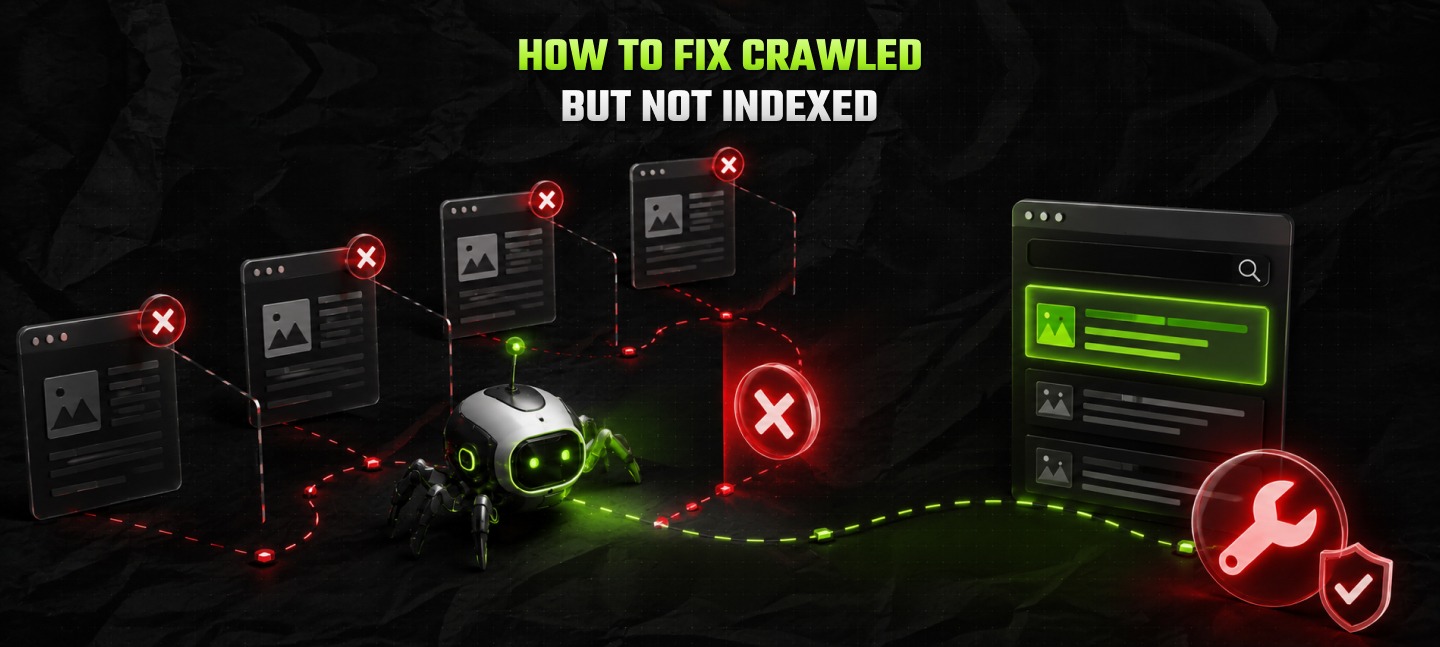

Let me be honest with you. I am a writer for Search Engine Magazine and have published hundreds of SEO articles so far.
Yet some of my articles were marked by the Google Search Console as “crawled but not indexed.” It never happened before. Therefore, I had no defense strategy or backup plan.
After the March 2026 core update, the crawled-but-not-indexed problem has become far more brutal than it used to be.
Google isn’t just skipping low-effort pages anymore. It’s skipping pages that look perfectly fine on the surface.
So how did I recover from this slump? I had to do a lot more than just the standard checklist. I’m going to share what actually happened to us, what we changed, and what’s working now.
If you are also thinking how to fix crawled but not indexed problem, this is the fix you need. I tested it myself, and it works!
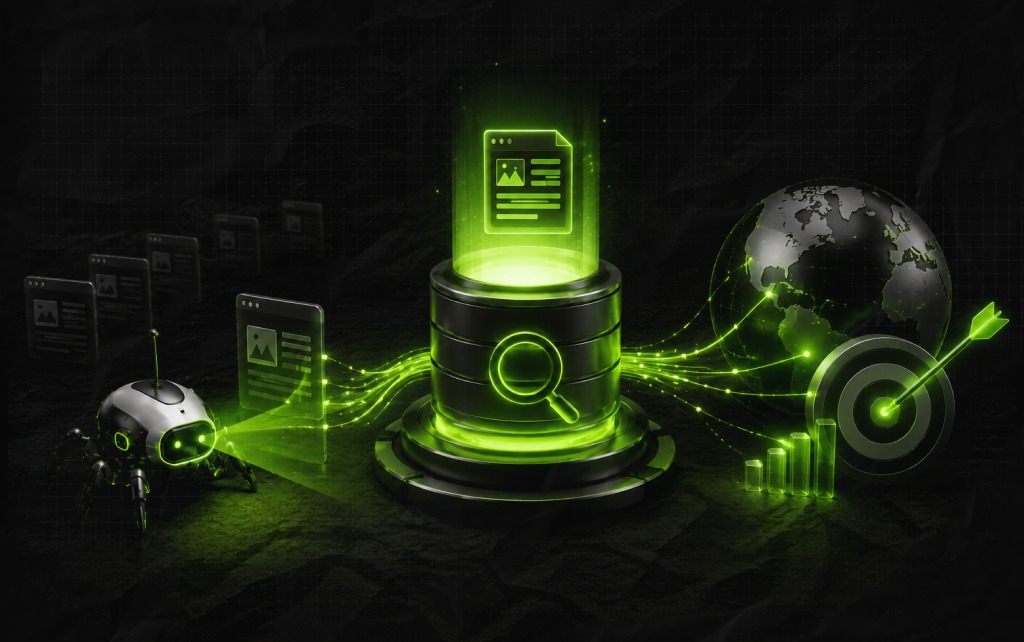
Indexing is something your website will need to become visible. This means that if pages on the website aren’t indexed, they won’t appear in search results, and potential visitors will be unable to find them – potentially lowering traffic and other engagement or sales opportunities.
So, knowing how to fix crawled but not indexed issues is important for the success of your website.
When the June 2025 and December 2025 core updates hit back-to-back, I noticed something in Search Console. By all means, it was hard to ignore.
Dozens of our pages were crawled but never indexed. I wrote them, and I know they were not of poor quality, by traditional standards.
Here are some parameters that I used on each of those articles:
The problem was simpler and more uncomfortable: According to Google, my pages weren’t adding anything new.
Every article we published on crawled-but-not-indexed covered the same steps as every other site:
However, Google was tagging my articles as duplicate or passive content. Whatever I tried did not help. At one point, I decided to stop working on this website.
The March 2026 core update made it more challenging for me. Early observations from SEO professionals during the May 2026 rollout confirm that thin content is losing visibility quickly.
On the other hand, the sites with solid topical authority and credibility are benefiting most. That’s when I changed our entire approach.
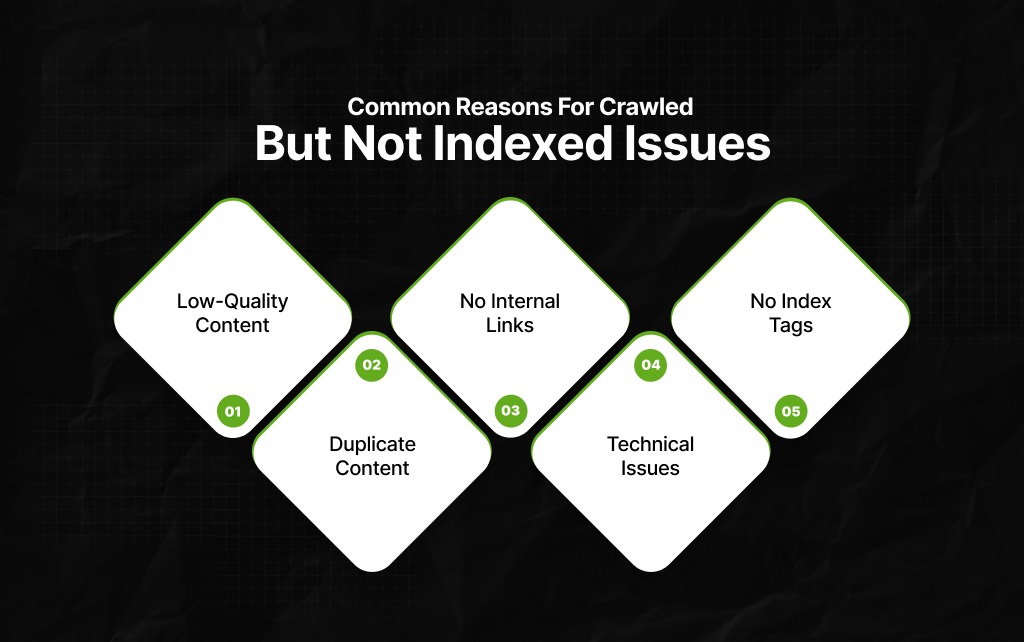
To help solve this problem you need to know why in the first place. Here are some common reasons why your pages might be crawled but not indexed:
If you are providing little value, if the content is very there is not much information, search engines might just decide not to index it.
The same content on multiple pages might make search engines skip indexing to avoid redundancy.
Search engines could find it hard to index If you haven’t linked your page from any other part of your site.
Slow loading time, server errors, and bad configurations can hinder the website’s indexing ability.
Sometimes, webmasters inadvertently put no index tags on their pages and specify to the search engines that they do not want those pages crawled and indexed.
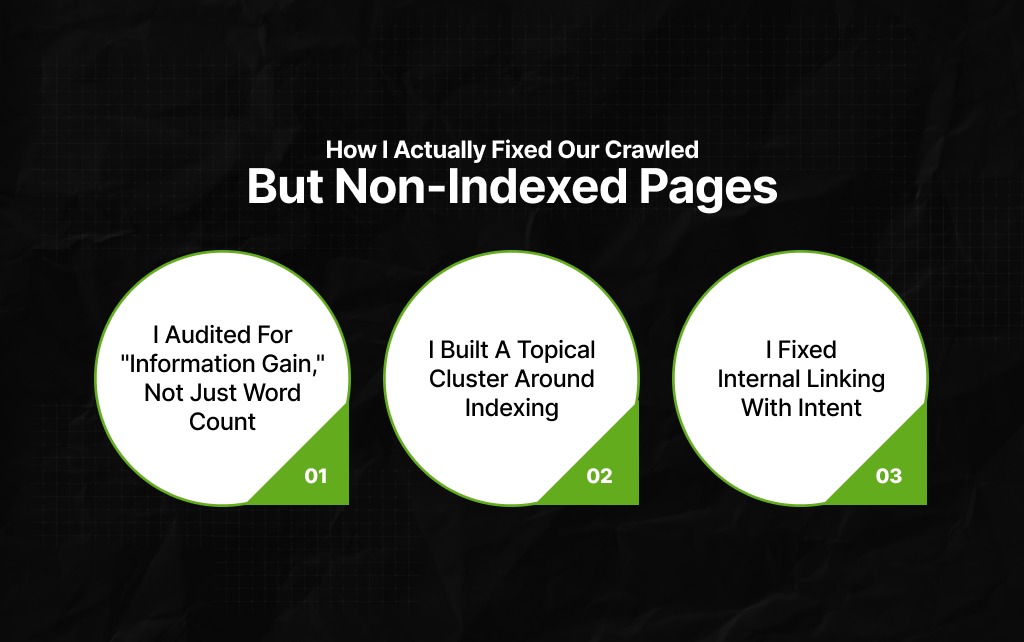
I’m going to be specific here. Do you remember that generic advice is what got us into trouble in the first place?
I stopped asking “is this article long enough?” and started asking “does this say something that isn’t already ranking?”
For every crawled-but-not-indexed page, I ran the top 5 ranking results and identified what angle they all missed. Then I rewrote our pages around that gap.
Google’s information gain metric rewards content that adds:
It helps differentiate high-quality pages from repetitive or rewritten content.
I published supporting articles around “how to fix crawled but not indexed”. At the same time, I covered these cluster topics separately:
This approach gave each article a distinct reason to exist.
Google evaluates topical authority based on the depth of your content across a subject. To clarify, Google looks for Pillar pages with supporting articles that cover subtopics comprehensively, which are what get rewarded.
This wasn’t about adding more links. Rather, I had to make sure that every new piece I published pointed back to our stronger, already-indexed pages on related topics, and vice versa.
This sends clear topical signals to Googlebot on every crawl.
Keep track of your progress as you work to fix crawled-but-not-indexed issues. Here is how to do it:

Google’s own guidance on core updates is clear: write helpful content for people, not for search engines. There’s nothing special you need to do as long as you’ve been making satisfying content people actually want.
The problem is that most crawled-but-not-indexed pages were never really made for people. They were made to rank. Here’s what I’m actively doing right now as the May 2026 update rolls out:
I’m not making structural changes mid-rollout. I’m identifying which content clusters lost indexing momentum and where our topical gaps are.
Moreover, I’m prioritizing pages that rank but are thin. To clarify, I am strengthening them before they fall into the crawled-but-not-indexed category.
If a core update has noticeably hit you, it’s probably not just one issue. There’s usually a combination of problems. For example:
Therefore, you need to solve all of these issues together. Start by treating indexing as a quality signal. In simple words, if it’s not indexed, your article does not add value. That’s it!
Here’s the takeaway from everything I’ve learned managing Search Engine Magazine through multiple Google updates.
Firstly, the crawled but not indexed issue is rarely a technical problem. On the contrary, it indicates a gap in content value.
But first, address the technical issues your site suffers from. For my site, I did the same. To clarify, you need to remove all noindex tags, update the sitemap, and either delete broken links or replace them!
But if your page doesn’t give Google a clear reason to index it over the 50 other pages saying the same thing, those fixes won’t move the needle.
If you are wondering how to fix crawled but not indexed issue, ask yourself:
“What does my page say that nobody else is saying? What firsthand experience, original example, or unique angle makes my work worth a slot in Google’s index?”
Barsha is a seasoned digital marketing writer with a focus on SEO, content marketing, and conversion-driven copy. With 8+ years of experience in crafting high-performing content for startups, agencies, and established brands, Barsha brings strategic insight and storytelling together to drive online growth. When not writing, Barsha spends time obsessing over conspiracy theories, the latest Google algorithm changes, and content trends.
View all Posts

PoE Switch For CCTV: A Complete Guide For Fil...
Aug 13, 2026
How To Scale To 20,000 Subscribers For $0: My...
Aug 13, 2026
What Is Content Velocity? How To Calculate It...
Aug 12, 2026
How To Index Backlinks Fast (Without Wasting ...
Aug 11, 2026
Top Agencies For AI SEO And Generative Engine...
Aug 10, 2026