How To Get Your Brand Cited In AI Search Results In 2026
Oct 22, 2026

If you are anything like me, you probably spend a slightly unhealthy amount of time tracking Google’s volatile algorithm updates and obsessing over where content trends are moving next.
Let me tell you the truth: traditional SEO is officially dead.
For the past eight years, I’ve been in the trenches crafting high-performing content for startups and agencies.
We played a comfortable, predictable game: map the keywords, optimize the headers, build the backlinks, and watch the site rank on a flat page of Google’s blue links.
Today? That old strategy won’t save you.
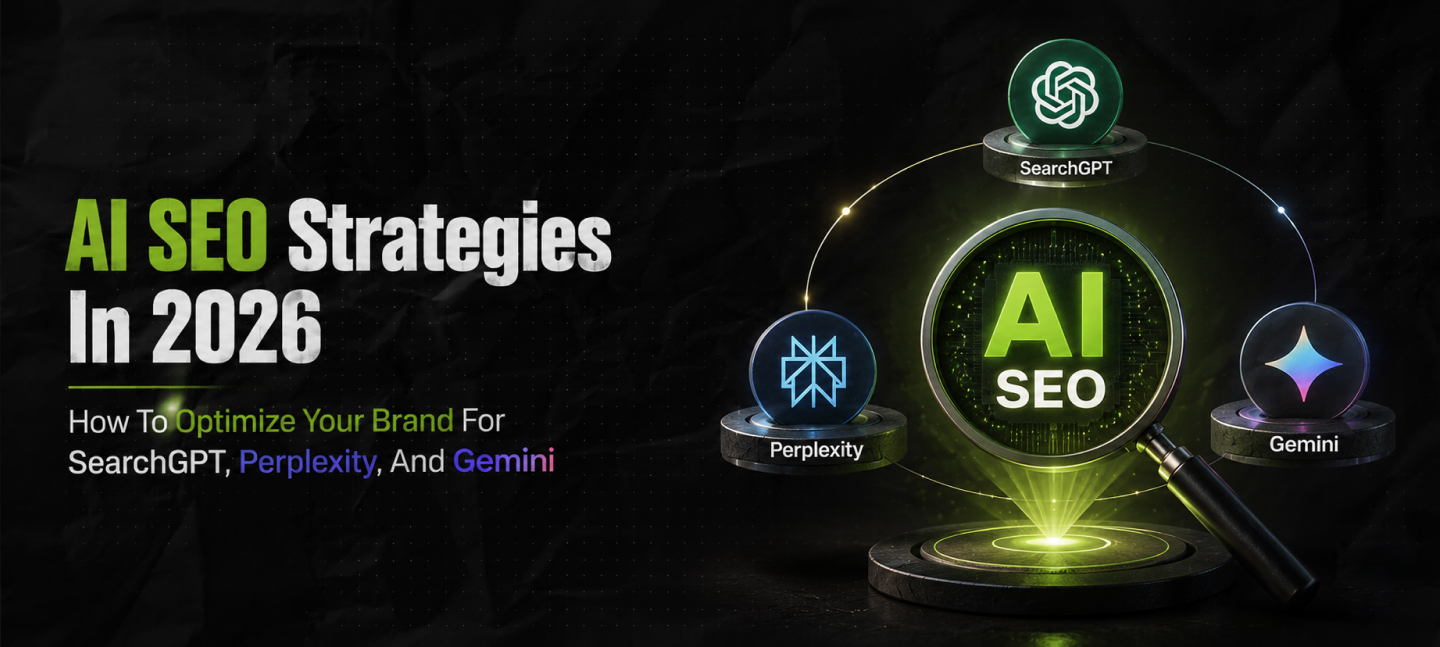
We are living in a fast-evolving search landscape completely dominated by conversational ecosystems like SearchGPT, Perplexity, Google Gemini, and Apple Intelligence. So you need AI SEO strategies in 2026
What is fundamentally different right now is that AI is no longer just a slick writing assistant for marketers. It is the absolute brain running the search engines themselves. It acts as the ultimate judge of your content’s relevance.
If you are still churning out generic, long-form content just to hit an arbitrary word count, you are essentially invisible to modern algorithms. To drive real online growth today, you have to blend sharp strategic insight with distinct storytelling that machines can actually parse.
AI has dramatically reshaped the search landscape, moving it towards a more personalized and intent-driven experience in the following ways:
Search engines like Google, Bing, and Baidu now use advanced machine learning models such as MUM (Multitask Unified Model) and GPT-based architectures to understand search intent across languages, formats, and contexts.
As Laura Kim, Head of Search Intelligence at RankVision Labs, states at present “SEO is about optimizing for AI’s understanding of user intent, not just matching keywords.”
Voice search, image recognition, and video content indexing have become mainstream. AI now processes queries that mix text, voice, and visuals, so brands must ensure their content is optimized across multiple formats.
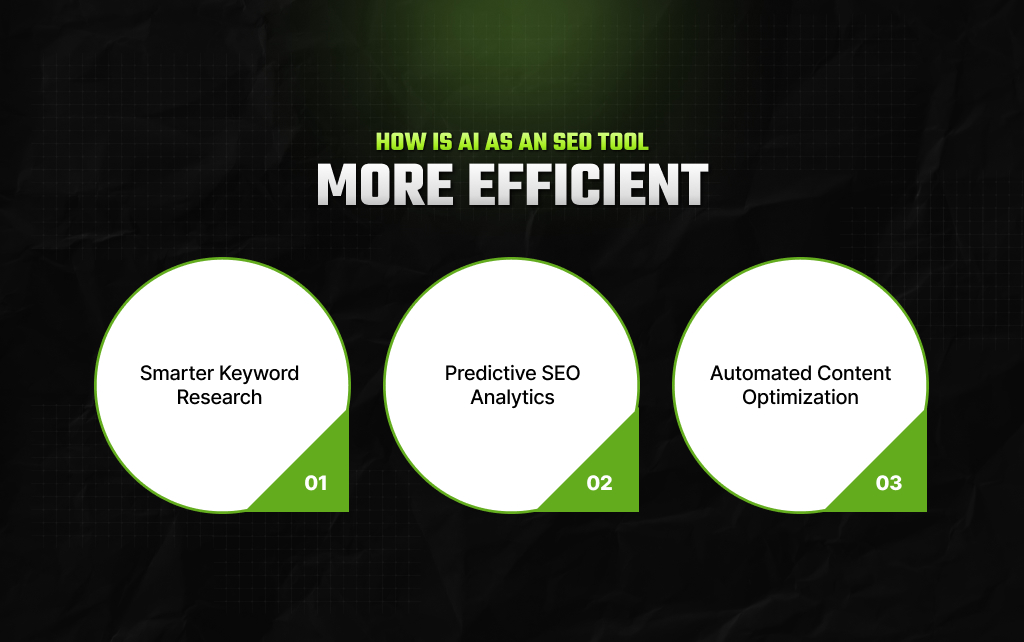
Using AI for SEO has abundant benefits. AI tools enable the efficient scaling of SEO efforts across extensive web properties.
AI-powered tools analyze billions of search queries to uncover hidden keyword opportunities, clustering them by topic relevance and ranking difficulty. This goes beyond traditional keyword volume metrics, incorporating intent and competitive context.
Machine learning models predict which keywords are likely to trend based on seasonal behavior and emerging topics.
Additionally, it can also be based on real-time social signals. So, Marketers can build content in advance to capture traffic before competitors even notice the shift.
Natural Language Processing (NLP) models assess the semantic depth of content, suggesting ways to improve topical authority. AI can identify gaps in coverage, recommend related topics, and optimize structure for featured snippets.
From my personal experience in this industry, here’s something that I can say for sure: navigating SEO in 2026 requires an entirely different operational blueprint.
You are no longer just fighting for traditional keyword rankings on a flat Google results page. Instead, your primary goal is to anchor your brand inside the real-time knowledge graphs of platforms.
So, naturally, to win this game, you haveto go beyond your traditional SoPs. You must adapt your on-page and technical optimization to match how large language models process data.
Firstly, AI engines do not parse sites like old web crawlers; they hunt for verified nodes and distinct relationships.
Secondly, modern conversational engines value immediate answers over long, narrative introductions.
Start every major content block with a single, punchy, one-sentence direct answer to an explicit question.
Content frameworks outlined in LinkedIn’s Searchable Optimization Studies reveal that nearly 45% of all generative AI search citations originate directly from the top 30% of a web page’s text block.
Basically, you need to optimize for easy synthesis. Use the BLUF principle – a “Bottom Line Up Front” formatting strategy. This clean text structure makes your content the easiest snippet for an AI engine to grab, digest, and cite as its definitive source. [Source: Google Search Central]
How could we leave out AI SEO strategies in 2026 when it comes to technical SEO?
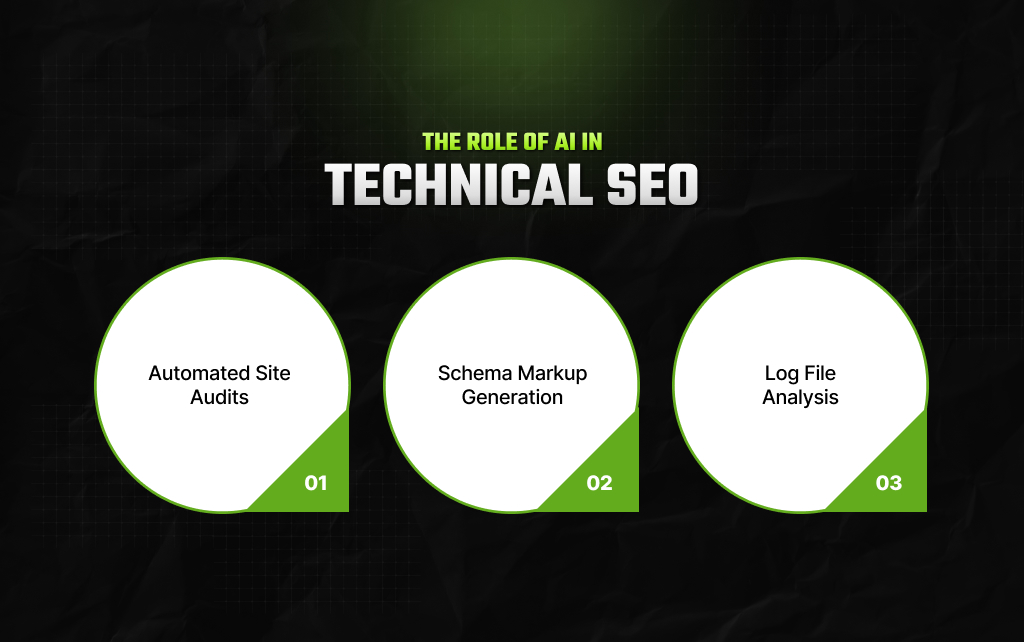
AI is transforming technical SEO by automating tasks, enhancing data analysis, improving website performance, and in many other ways, as mentioned below:
Firstly, AI crawlers now go beyond broken link detection, evaluating site architecture, Core Web Vitals, accessibility compliance, and structured data usage – all in one pass.
AI tools can automatically generate and validate schema markup for rich results, increasing click-through rates without manual coding.
Finally, AI interprets server log data to reveal how search engines crawl a site, identifying under-indexed pages and suggesting crawl budget optimizations.
AI in SEO significantly enhances personalized search and user intent by giving a significant boost to your SEO input:
Search results are now heavily influenced by individual user behavior, location, and preferences. AI-driven personalization means that ranking #1 for one user may not guarantee the same for another.
Some websites are experimenting with AI-generated dynamic content that changes headlines, CTAs, and even article sections based on the visitor’s intent profile.
For instance, an SEO team could integrate OverChat AI response generator into their workflow to analyze visitor behavior, predict search intent, and adapt on-page content dynamically — improving both rankings and conversion rates.
AI-powered tools can analyze vast amounts of data to identify high-quality backlink opportunities and personalize outreach. let’s see how:
AI analyzes backlink profiles, niche relevance, and domain authority to identify the most valuable link opportunities. This reduces manual outreach guesswork.
By mapping competitors’ backlink sources and comparing them with your own content coverage, AI suggests linkable assets you should create.
These are the two top success stories of AI in SEO. Let’s see what they talk about:
A fashion retailer used AI to identify micro-trends and created content targeting those keywords before competitors. Result: 40% increase in organic traffic in three months.
A SaaS company deployed AI to detect indexation issues caused by dynamic content. Fixing these errors improved their visibility for high-value commercial keywords by 25%.
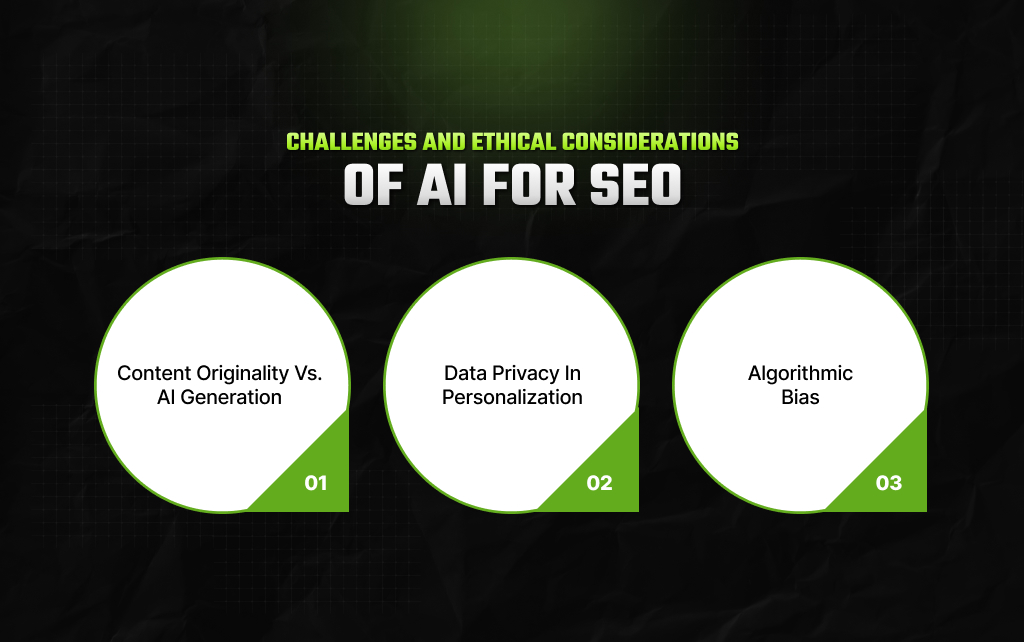
Of course, you all saw it coming. Just like every good thing has its cons, AI in SEO has its own share of challenges. Let’s see what they are:
Search engines are becoming better at detecting over-reliance on AI-generated content without human refinement. So, pure machine output risks lower rankings.
Hyper-personalized SEO strategies must balance optimization with compliance to GDPR, CCPA, and other data privacy regulations.
If AI models are trained on biased datasets, the resulting search rankings may reinforce existing inequities in visibility.
Let’s be completely real: traditional SEO is undergoing a massive shift. For decades, we focused entirely on gaming keywords to rank on Google’s first page of blue links.
Today, that old playbook is breaking. Instead, you need to optimize your content for conversational AI engines like SearchGPT, Perplexity, Google Gemini, and Apple Intelligence. [Source: Semrush]
This radical shift requires a brand-new framework called Generative Engine Optimization (GEO).
If you want your brand to be cited as a source inside an AI chat answer, you cannot just rewrite what already exists on the web. Instead, your content must emphasize a metric called Information Gain.
This means you need to inject unique statistics, direct quotes from industry experts, and primary data. AI models crave original proof vectors. By feeding them fresh insights, you force the algorithms to choose your site as their primary citation source.
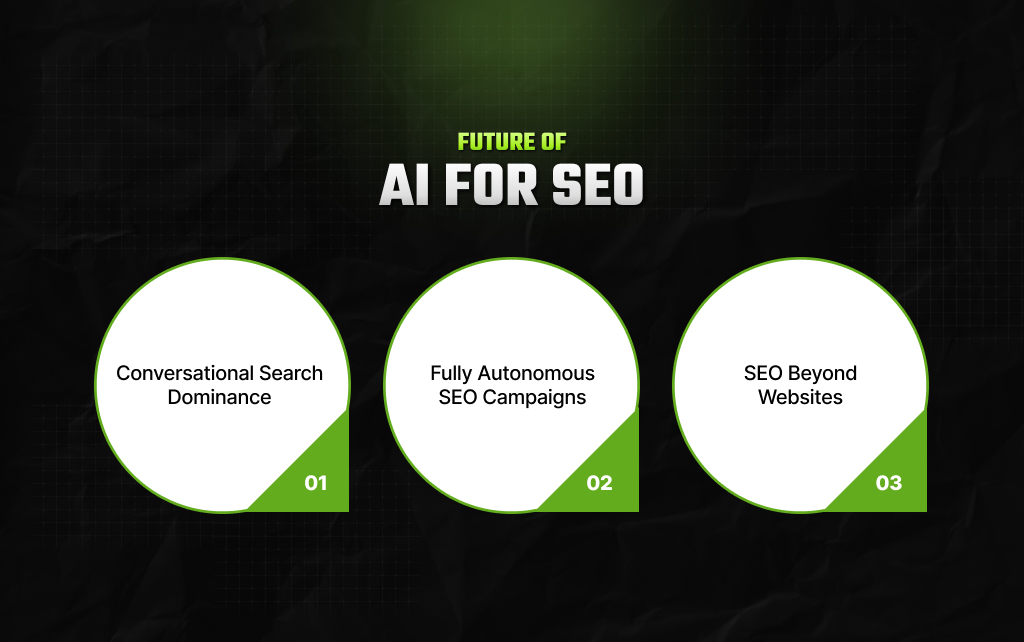
Well, after all these speculations, I believe it’s worth knowing what the future will look like if we continue to use AI in SEO.
By 2030, conversational AI search assistants may replace traditional SERPs for many queries. So this means SEO will be about becoming the “spoken” answer.
AI could soon run SEO campaigns end-to-end. So, it does it all from keyword research to content creation and link building.
Additionally, it uses human oversight for brand alignment.
As AI-driven search expands to AR/VR environments and IoT devices, optimization will include 3D content and voice-enabled experiences.
Also, it might include even smart home integrations.
In 2026, AI will not just influence SEO. It is SEO. So, from understanding user intent to automating optimization tasks, AI is both the challenge and the solution for digital marketers.
The key for SEO professionals is to master AI tools and understand how search engine algorithms use AI.
Additionally, you can also create strategies that align with both human and machine audiences.
As Laura Kim summarizes: “SEO success now comes from thinking like the AI that runs search — and like the human who’s typing the query.”
Read Also:
Barsha is a seasoned digital marketing writer with a focus on SEO, content marketing, and conversion-driven copy. With 8+ years of experience in crafting high-performing content for startups, agencies, and established brands, Barsha brings strategic insight and storytelling together to drive online growth. When not writing, Barsha spends time obsessing over conspiracy theories, the latest Google algorithm changes, and content trends.
View all Posts

How To Get Your Brand Cited In AI Search Resu...
Oct 22, 2026
The Ultimate Blueprint For Broken Link Buildi...
Oct 16, 2026
The Ultimate Guide To Stealing Your Competito...
Oct 15, 2026
Beyond The Basics: Master Guest Posting For H...
Oct 15, 2026
Best Generative Engine Optimization (GEO) Com...
Oct 14, 2026