PRNEWS Rewards Adds Rankfor.AI To Track How Brands Show Up In AI Assistants
Oct 10, 2026

SEO used to have a fairly simple goal.
Someone searched for something on Google. Your page appeared in the results. They clicked through to your website. That model still matters.
But search has changed.
People now ask longer questions, use conversational search, and increasingly rely on AI-powered systems to summarize information and provide direct answers.
This has brought Answer Engine Optimization, or AEO, into the conversation.
You may have seen claims that AEO is replacing SEO. It isn’t. AEO and SEO overlap, but they focus on different parts of the search experience.
SEO helps people discover your content.
But AEO focuses on making your information useful and understandable when systems provide answers. The distinction sounds small.
However, for content teams, it can change how you plan and structure content.
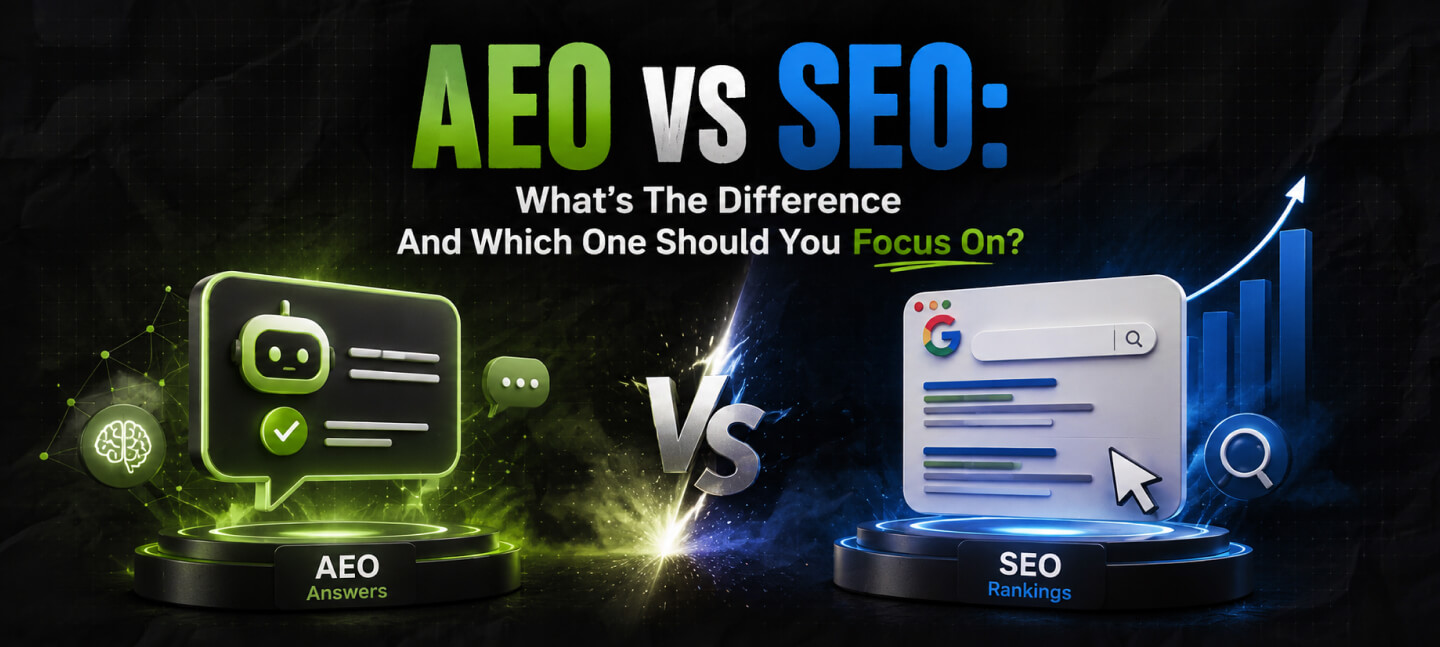
Today, I’ll break down AEO vs SEO and find out the core differences between the two – that way, you will know which one to focus on in 2026.
In this section, I’ve made a table highlighting the differences between AEO and SEO for giving you some much-needed clarity.
| Aspect | SEO | AEO |
|---|---|---|
| Main goal | Improve search visibility | Make information answer-ready |
| Primary focus | Search results and organic visibility | Direct answers and AI-assisted search |
| Core question | Can people find this page? | Can a system understand and use this answer? |
| Important factors | Relevance, technical health, links, content quality | Clear answers, context, structure, relevance, trustworthy information |
| Typical format | Articles, landing pages, category pages, product pages | Definitions, explanations, comparisons, lists, FAQs, supporting content |
| Main audience | Search users | Search users and answer systems |
| Relationship | Broad search optimization | A complementary layer of search optimization |
This table is useful as a starting point. But the real relationship between the two is more nuanced.
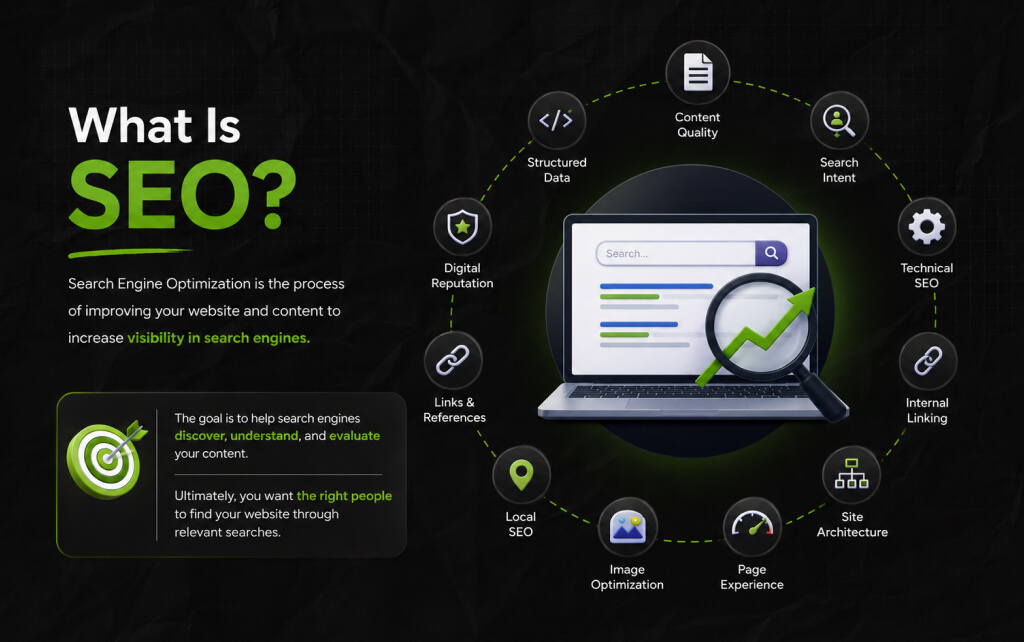
Search Engine Optimization is the process of improving a website and its content to increase its visibility in search engines.
SEO covers much more than keywords.
It can include:
The goal is to help search engines discover, understand, and evaluate your content. Ultimately, you want the right people to find your website through relevant searches.
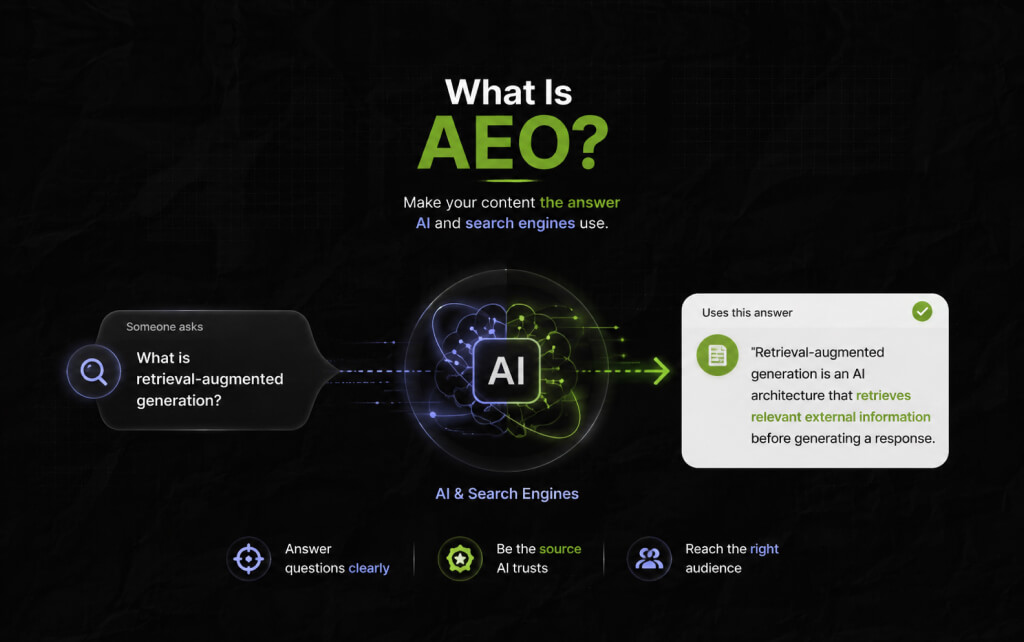
Answer Engine Optimization focuses on creating information that search and AI systems can understand and potentially use when answering questions.
Imagine someone asks, ‘What is retrieval-augmented generation?’
An SEO-focused approach might create a comprehensive article targeting that topic.
However, an AEO-focused approach would make sure the article clearly answers: Retrieval-augmented generation is an AI architecture that retrieves relevant external information before generating a response.
Then it would explain:
So, the important distinction is this: The answer is immediately understandable, but the page still provides depth. That’s good AEO and good SEO at the same time.
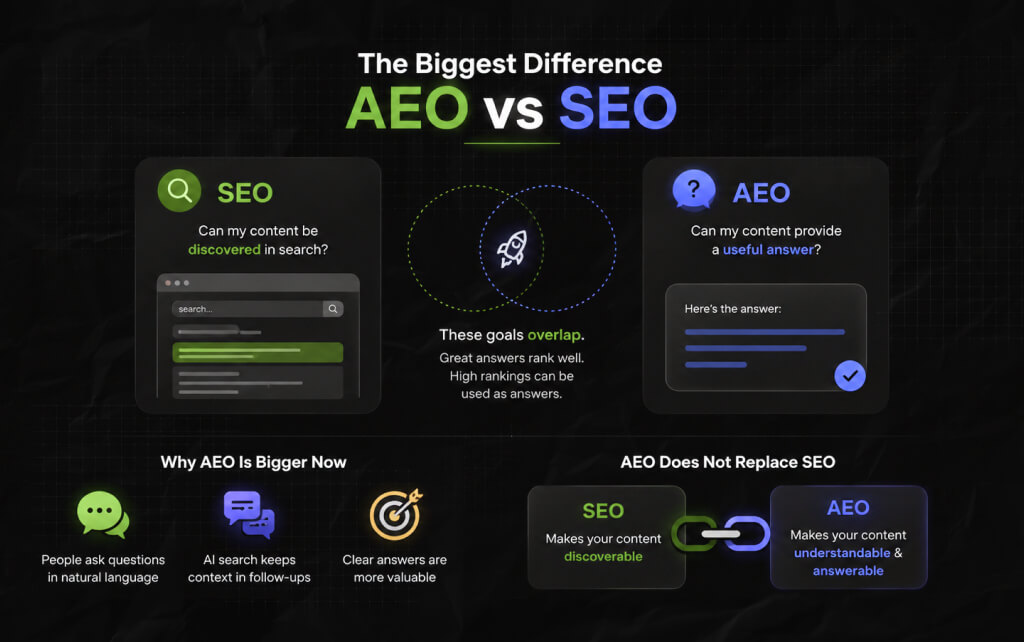
The easiest way to understand the difference is to look at the desired outcome.
So, while SEO asks, ‘Can my content be discovered in search?’ AEO asks, ‘Can my content provide a useful answer to the question?’
These goals overlap.
A page that provides an excellent answer can rank well. A page that ranks well can also become a source for an answer.
But ranking and being used as an answer are not exactly the same thing.
Search behavior is changing.
People increasingly ask questions in natural language. Instead of searching ‘NLP SEO,’ someone might ask, ‘How does natural language processing affect SEO?’
Instead of ‘best CRM small business,’ they might ask, ‘What’s the best CRM for a small business with five salespeople?’
These queries contain more context. AI-powered search can also maintain context across follow-up questions like:
The search experience becomes conversational. That makes content that clearly answers specific questions more valuable.
This is probably the most important point in the entire article. You don’t need to choose between SEO and AEO. AEO works alongside SEO.
Think about the journey.
So, while SEO helps your content become discoverable, AEO helps its information become understandable and answerable. Neither one eliminates the other.
A technically excellent page with poor answers won’t suddenly become useful because you added FAQ headings.
Likewise, an excellent answer won’t help much if search engines cannot access or understand the page.
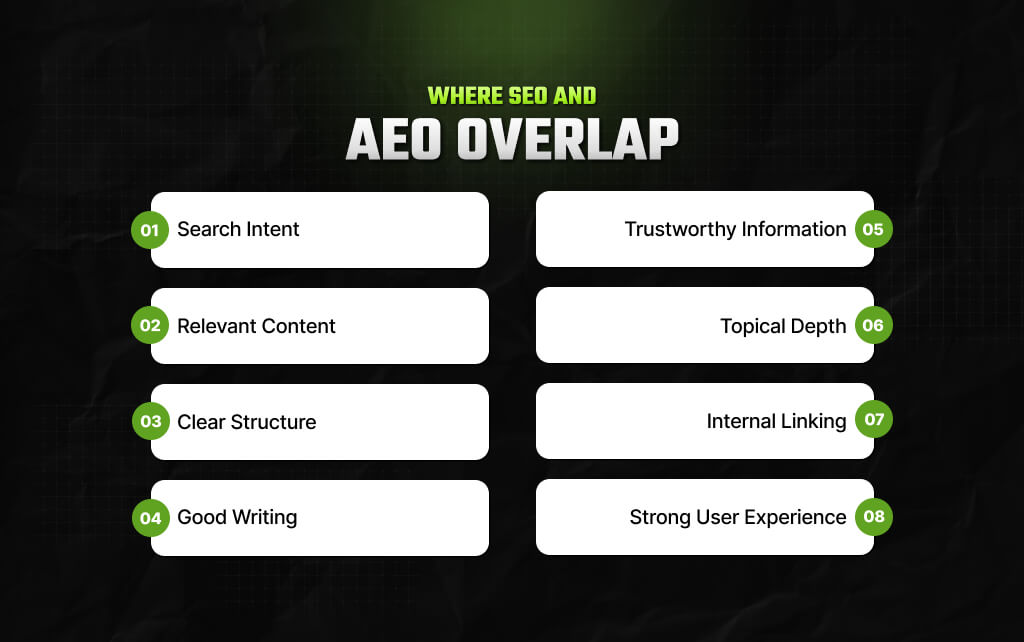
There is a large middle ground. Both benefit from:
1. Search intent: You need to understand what the user wants.
2. Relevant content: The page should address the topic properly.
3. Clear structure: Headings, sections, and logical organization help readers navigate information.
4. Good writing: Clear language benefits everyone.
5. Trustworthy information: Accurate content matters whether someone reads it directly or encounters it through an answer.
6. Topical depth: Important questions should be addressed rather than ignored.
7. Internal linking: Related pages can help users and search systems understand your site’s information structure.
8. Strong user experience: Nobody benefits from a page that is difficult to use.
So there is no reason to create two completely separate content strategies.
The difference becomes clearer when you consider the format of the user’s interaction.
Traditional search often involves: Query → Results → Click → Page
Answer-focused search can look more like: Question → Retrieved information → Answer → Follow-up
That means AEO places greater emphasis on making individual pieces of information easy to identify. For example:
Then you can explain the details. The core answer is easy to find.
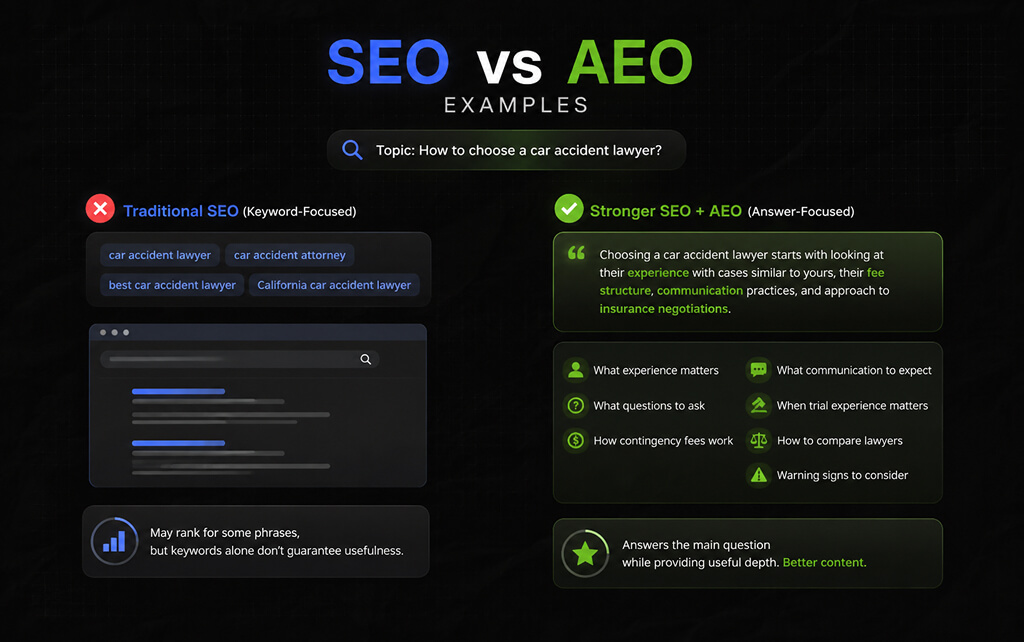
Let’s say the topic is: How to choose a car accident lawyer?
In case of a traditional keyword-focused approach, the writer might focus heavily on:
The article may rank for some of these phrases.
But keywords alone don’t guarantee usefulness – and if you can’t make it into non-commodity content, then chances are your content won’t perform.
However, in the case of a stronger SEO and AEO approach, the article might begin with:
“Choosing a car accident lawyer starts with looking at their experience with cases similar to yours, their fee structure, communication practices, and approach to insurance negotiations.”
Then it explains:
Now the article answers the main question while providing useful depth. And that is better content.
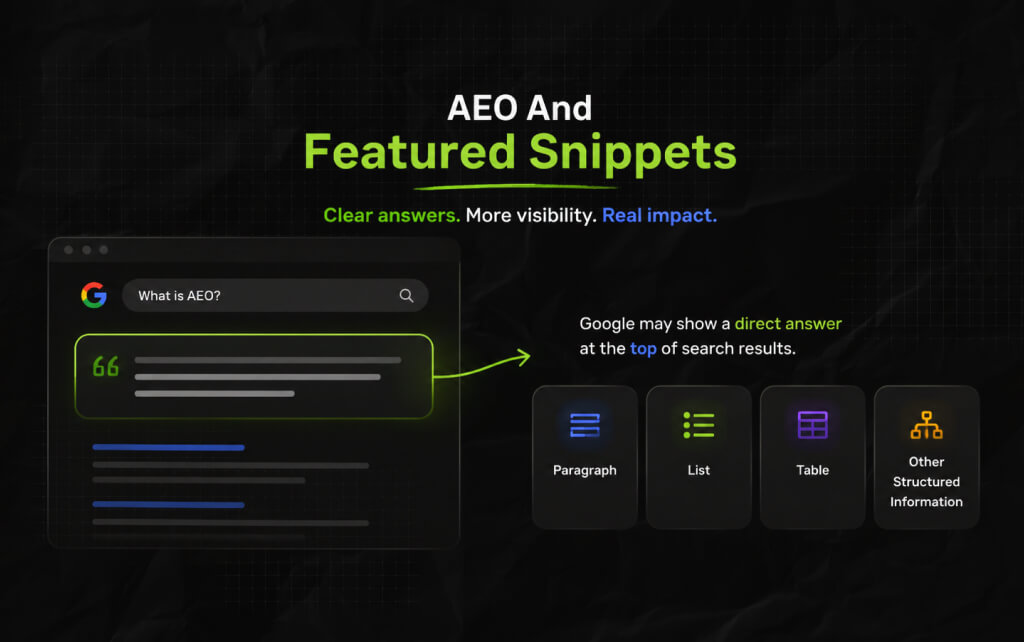
Featured snippets are one reason AEO became popular among SEOs. Google sometimes displays a direct answer above or alongside traditional results.
The answer may take the form of:
Clear formatting can make information easier for search engines to process. But there is no guaranteed “featured snippet format.”
You should not write solely to capture one. Instead, make your answer clear enough that users can quickly understand it. And if Google chooses to display it, that’s a bonus.
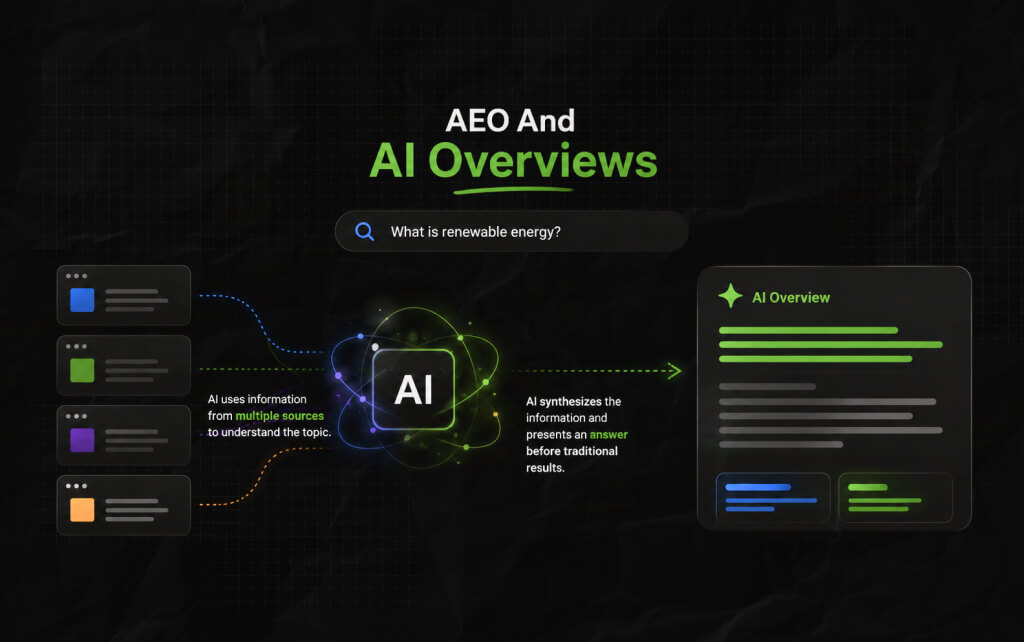
AI-powered search adds another layer.
A search system may synthesize information from multiple sources and present an answer before showing traditional results.
That creates a different visibility opportunity.
Your page may not be the only source behind an answer. The system may combine information from several pages. This makes originality and information quality especially important.
If your article merely repeats what hundreds of other pages already say, it gives the system little reason to prefer your information.
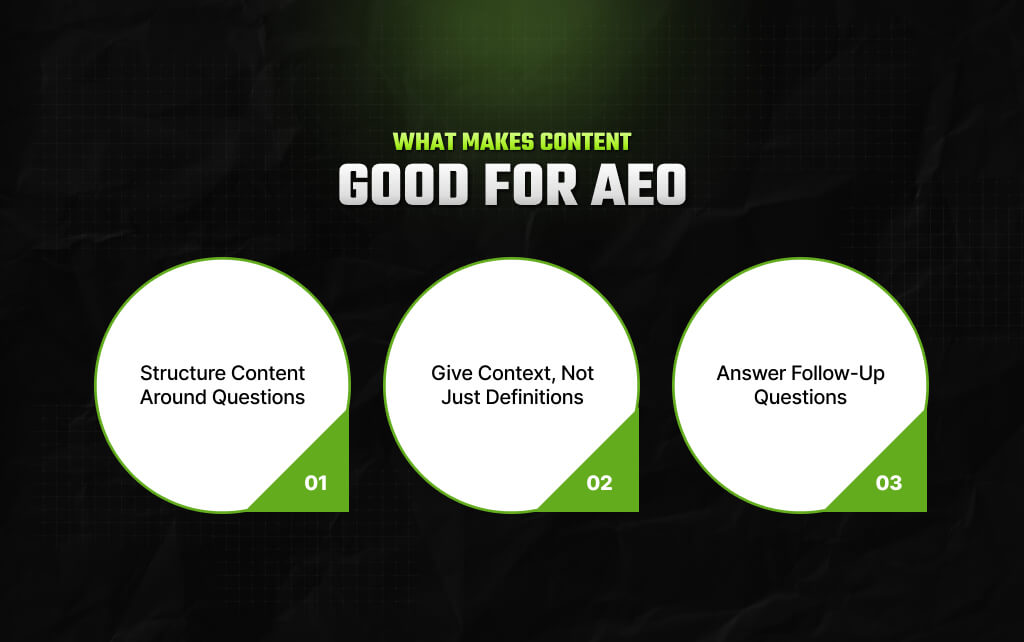
Start with the same question you’d ask for good SEO: What does the user actually need? Then make the answer easy to identify.
For example: What Is Answer Engine Optimization?
“Answer Engine Optimization is the practice of creating content that makes information easier for search and AI systems to understand and use when answering questions.”
Then provide context.
This works because the reader doesn’t have to dig through an introduction before getting the basic definition.
AEO-friendly content often benefits from question-led organization.
For example:
The structure makes the information easy to navigate. But don’t force every heading into a question. Use descriptive headings whenever they communicate the topic better.
AEO content shouldn’t become a dictionary. Suppose you define ‘Domain authority is a third-party metric used to estimate the ranking strength of a website.’
That’s useful. But readers may also need to know:
That context makes the answer more useful. The same principle applies to almost every topic.
A good answer often creates another question.
For example, ‘What is AEO?’ naturally leads to ‘How does AEO differ from SEO?’ Then it moves to ‘Does AEO replace SEO?’ and How do I optimize my website for AEO?’
You can anticipate those questions in the same resource. This creates a more complete information journey.
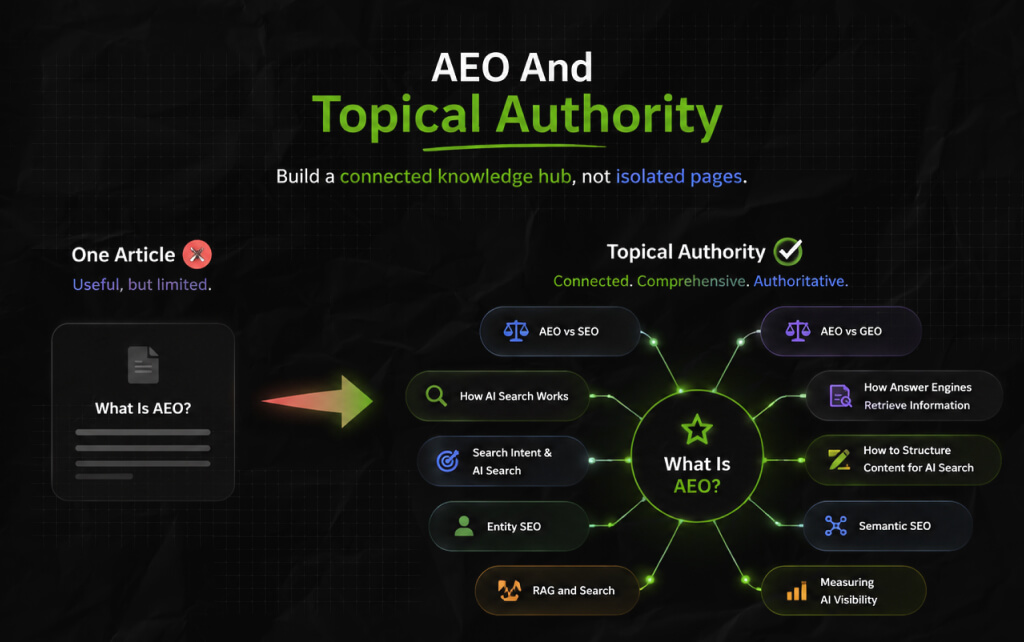
This is where your broader content strategy matters. So, suppose your website has one article called ‘What Is AEO?’ That’s useful.
But imagine the site also has:
Now the site provides a connected body of information. That is much stronger than producing isolated articles for individual keywords.
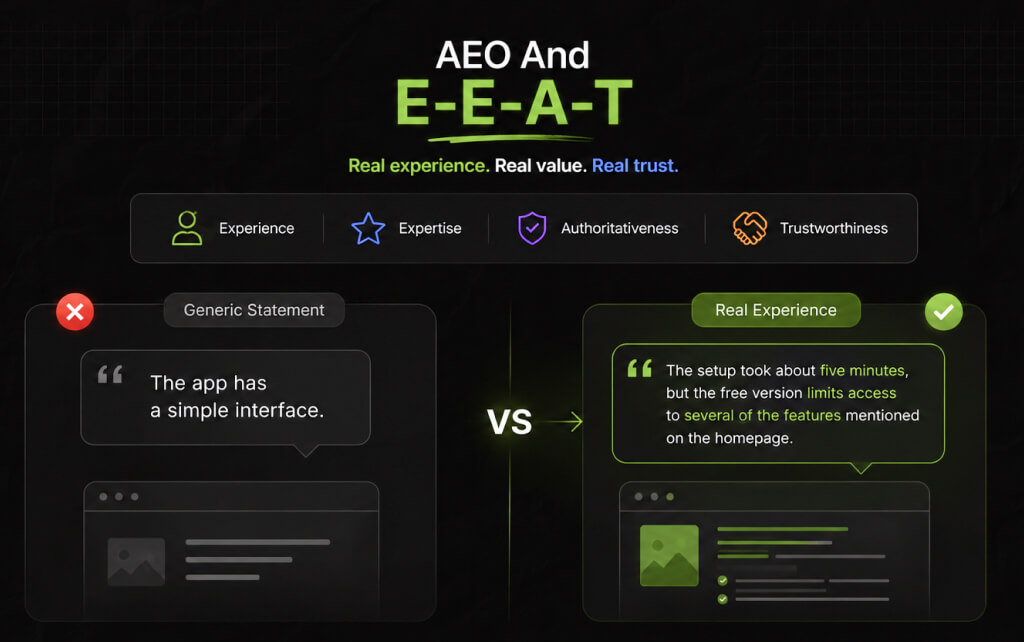
Google’s E-E-A-T framework considers:
These qualities remain relevant when creating helpful content. For some subjects, first-hand experience is particularly important.
Imagine two product reviews.
The second provides actual information that helps someone make a decision.
That’s valuable regardless of whether the reader arrives through Google or an AI-generated answer.
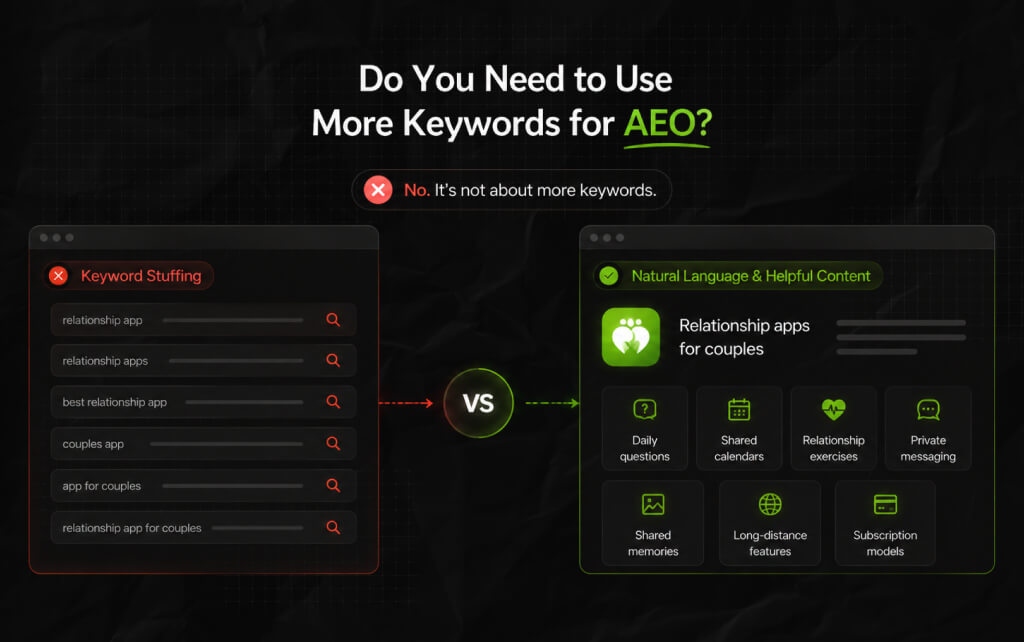
No.
This is one of the worst ways to approach AEO. So, suppose you’re writing about ‘relationship apps for couples.’ You don’t need to force every variation into the article:
Use natural language. Then explain the concepts that matter:
The topic vocabulary appears naturally because you’re actually discussing the subject.
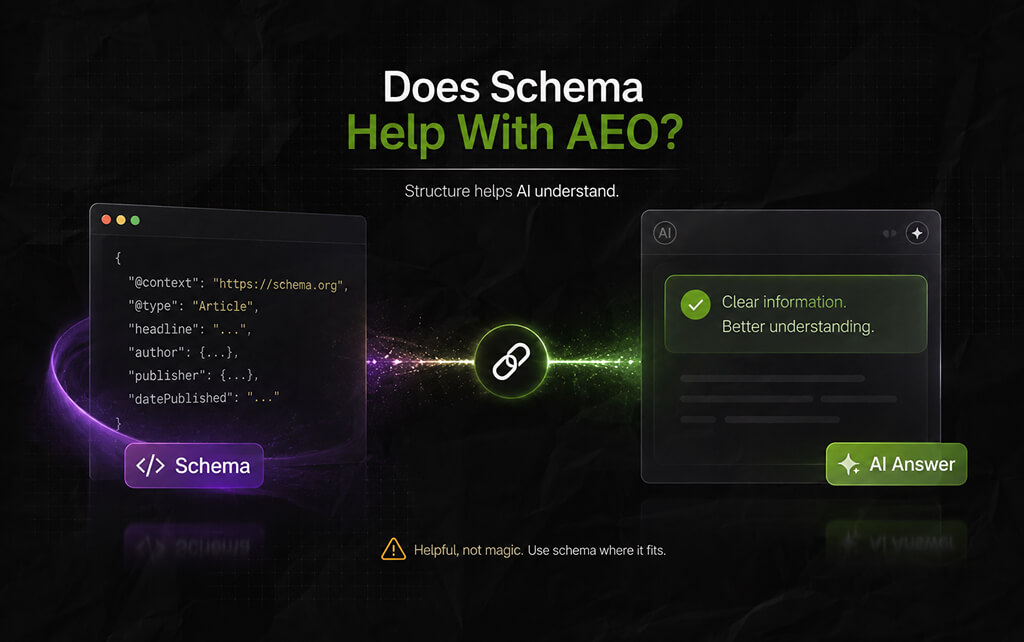
Structured data can help search engines understand certain types of information. Depending on the page, you may use structured data for things such as:
But schema is not a magic AEO switch. Adding structured data does not guarantee an AI citation or recommendation.
As a result, it is best to use it where it accurately describes the page and follows search-engine requirements.
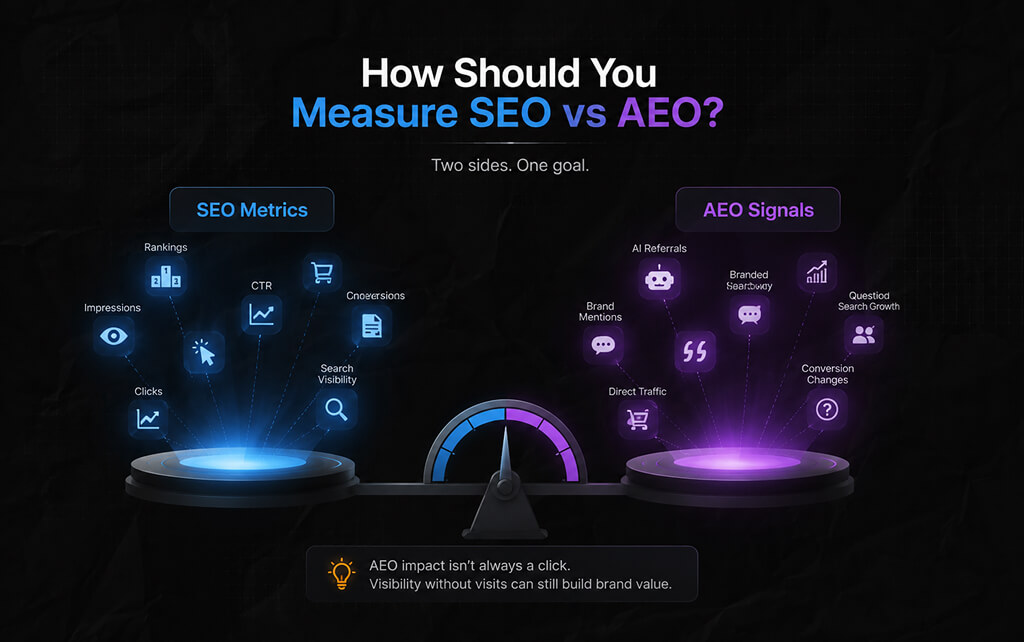
The metrics differ somewhat.
So, you can monitor:
You may also monitor:
Measurement is harder for AEO because not every answer interaction produces a website visit.
Also, someone might see your brand mentioned in an AI answer and never click through. That doesn’t necessarily mean the exposure had no value.
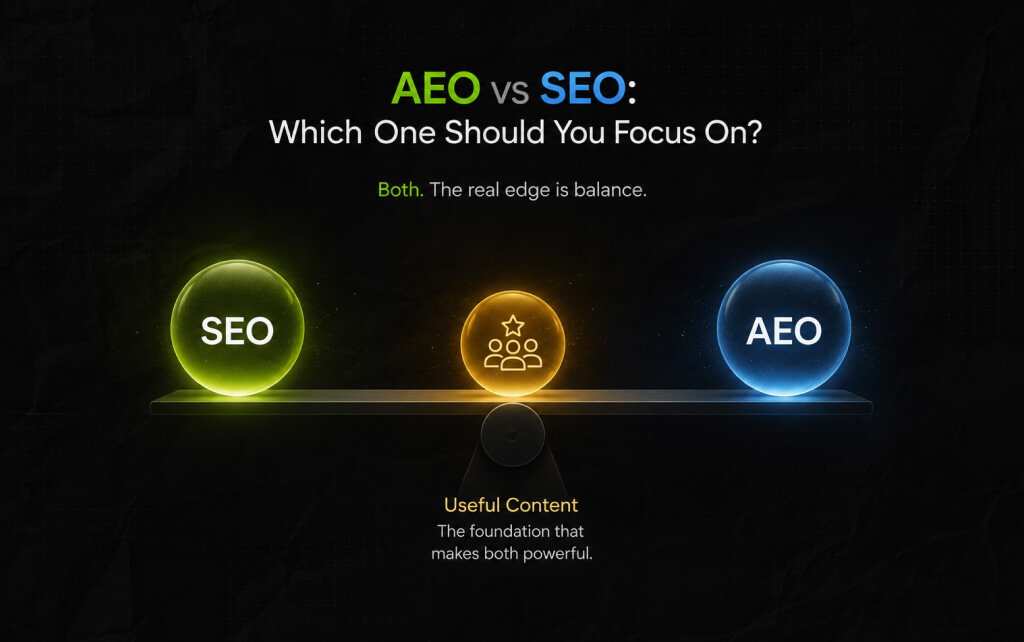
Both.
But the balance depends on your business.
As a result, if your website relies heavily on organic search traffic, traditional SEO remains essential.
If your audience asks complex questions and your industry is increasingly affected by AI-assisted search, AEO deserves more attention.
For most businesses, the smartest approach isn’t SEO or AEO. It’s SEO, AEO, and genuinely useful content.
The third part is what makes the first two worthwhile.
The debate makes it sound like one discipline will replace another. Search rarely works that neatly.
SEO has already evolved many times.
It moved from ‘Keywords’ to ‘Intent’ to ‘Topics and entities’, to increasingly sophisticated systems that interpret language and information.
AEO is another part of that evolution.
The fundamental goal remains the same: Help people find useful information. The difference is that the path between the question and the information is changing.
Sometimes the user will click a search result. Sometimes they will read an AI-generated answer. And sometimes they will do both.
Your content needs to be useful in all three situations.
Barsha is a seasoned digital marketing writer with a focus on SEO, content marketing, and conversion-driven copy. With 8+ years of experience in crafting high-performing content for startups, agencies, and established brands, Barsha brings strategic insight and storytelling together to drive online growth. When not writing, Barsha spends time obsessing over conspiracy theories, the latest Google algorithm changes, and content trends.
View all Posts

PRNEWS Rewards Adds Rankfor.AI To Track How B...
Oct 10, 2026
Is Serpstat Worth It? A Deep Dive Into Pricin...
Oct 09, 2026
How To Use Screaming Frog: The Definitive Tec...
Oct 09, 2026
Master The Rich Result Test: Fix Your Broken ...
Oct 08, 2026
Does vnROM Bypass Still Work? A Realistic 202...
Oct 08, 2026