

What Is Content Intelligence, And How Can It Help Your Site Grow In 2026? Best Practices Explained
Aug 08, 2026
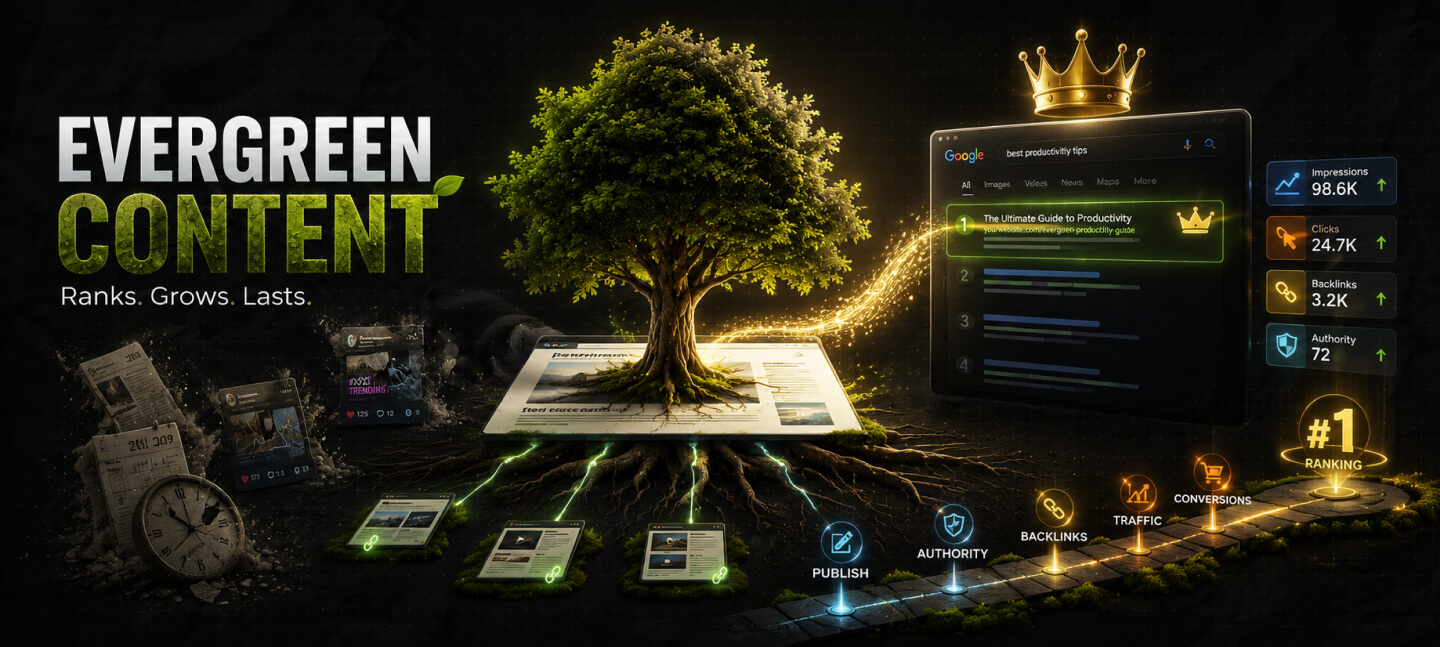

Social media caption: Still chasing viral trends? Here is why timeless content always wins.
In 2026, AI search engines and algorithms change daily. Yet, one SEO strategy remains undefeated: Evergreen Content.
While trending topics spike and die, evergreen posts quietly rack up compounding traffic, high-quality backlinks, and consistent leads month after month. They form the ultimate foundation of a resilient digital footprint.
Want to build content that outlasts the algorithm? Drop your biggest SEO challenge below!
Some contents age like milk. And some age like wine. Evergreen content is that wine.
These are the guides that rank in year one and still pull clicks, even in year five! Maybe even outperforming the trendy posts your team has published last quarter, quietly.
I have spent over 8 years in this domain, simplifying SEO, AEO, and GEO content for a living.
I can tell you it is one of the few strategies that has not been upended by every algorithm shake-up, not even the massive 2024 Google March update.
Let’s get into what it actually is, how real companies (including a search publication you’ve probably already read today) have used it, and how to build it properly.
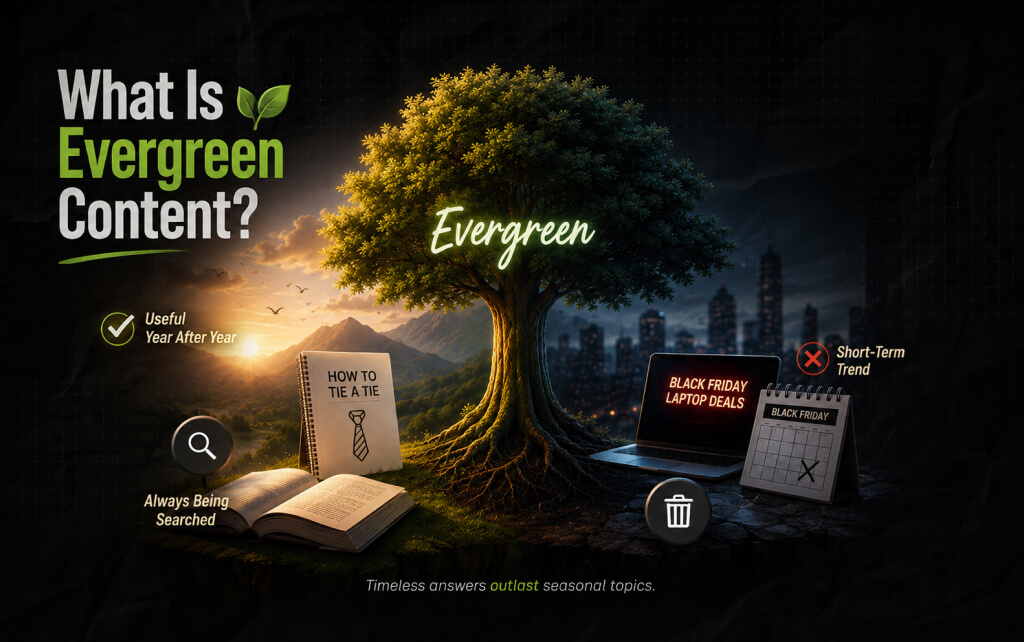
Evergreen content is anything you create: an article, a guide, a video, or a landing page- anything.
The evergreen content stays accurate, useful, and searchable long after you hit publish. It answers a question that people never stop asking.
This is more like “how to tie a tie” versus “best Black Friday laptop deals.” One of those gets typed into Google every single day of the year without fail. The other has a shelf life of about a week.
To count as genuinely evergreen, a piece needs to clear three bars:
If you miss any of these, you’ll likely end up with something that looks evergreen on the surface but decays anyway. I’ve seen it happen plenty of times.
Here’s the thing a lot of writers get wrong. They assume AI Overviews and generative search completely killed the evergreen strategy.
It didn’t. If anything, it just raised the stakes.
According to Ahrefs data, roughly 96.55% of web pages receive absolutely zero organic traffic from Google.
No, that is not a typo. The overwhelming majority of everything published online never ranks at all.
Evergreen content sits inside that tiny surviving sliver because it keeps earning impressions long after the initial buzz of a new post dies down.
Ahrefs’ research highlights another massive point: for many websites, evergreen content alone drives more than a third of their total organic traffic.
It is a compounding asset working for you every single day, not a one-time spike.
On the flip side, a citation study reviewed by XICTRON found that websites restructured around clear pillar-and-cluster setups saw their AI citation rates jump from 12% to 41% after the rework.
AI search optimization isn’t a completely separate discipline from evergreen writing. It’s just the exact same skill wearing a new label.
Numbers in a glossary are one thing. Watching them play out on a real website is another. Here are two real-world examples I keep coming back to.
HubSpot discovered that a massive 76% of their blog views and 92% of their leads actually came from old posts.
They polished up their historical content by updating old stats and refreshing keywords to capitalize on this. The result? A massive 106% boost in organic views. It was a total jackpot.
But there is a catch. Google tweaked its algorithm, and HubSpot’s blog visibility tanked significantly.
Why? They had strayed too far from their core marketing topics and let their older pages go completely stale.
The big takeaway here is that updating old content works wonders, but “evergreen” doesn’t mean you can just set it and forget it.
You have to actively maintain your posts and stick strictly to the topics you actually know.
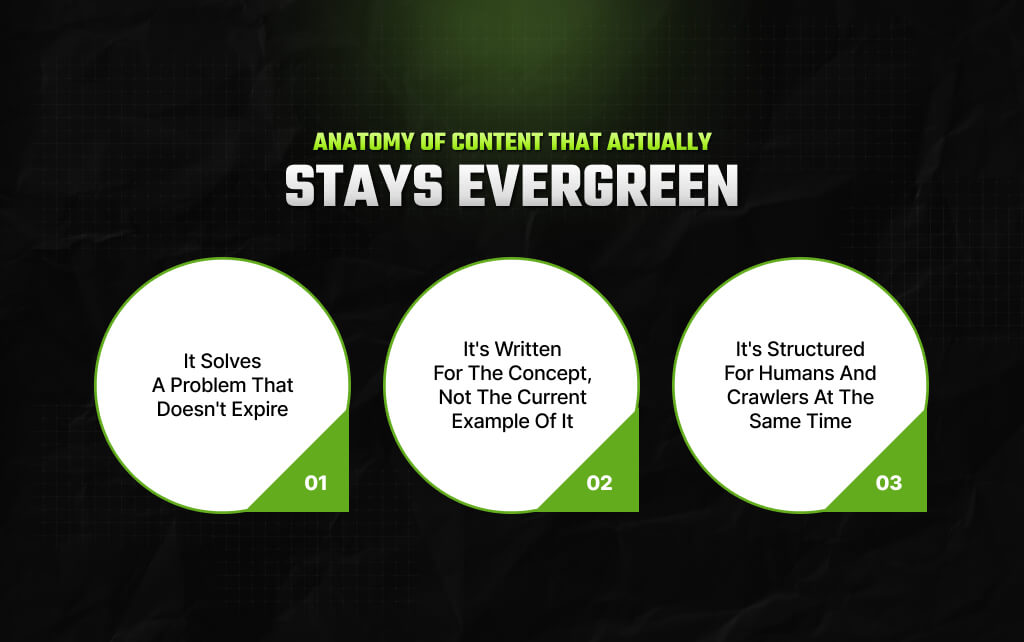
Creating content that brings in traffic years after publication requires a specific framework focused on foundational, non-time-sensitive topics that solve lasting problems.
Successful evergreen content is written around underlying principles rather than current examples, and structured for scannability to signal value to both humans and search engines.
True evergreen topics focus on foundational principles rather than fleeting situations.
This includes defining “compound interest” rather than listing the “best mortgage rates this quarter.”
You are dealing with time-sensitive material if a keyword requires a specific year to remain relevant. Distinguish this from truly durable, foundational content.
This trap catches many writers, as you can choose an enduring topic but ruin its longevity by anchoring it to a passing trend.
Focus your writing on the core principle itself rather than creating a “what marketers can learn from this week’s viral ad campaign” article.
This loses value immediately after the trend fades.
It is essential to maintain clean H2/H3 headings, scannable lists, and a logical flow. This can help you to reduce bounce rates.
Proper formatting keeps readers on the page longer. Moreover, this signals to search engines the quality of the content and helps ensure long-term rankings.
The term evergreen content is often misused because people do not understand the concept. So, here’s an easy way to help you understand what does not fall under the evergreen content category.
First come the news and trend pieces. These are useful for a short traffic spike, but built to fade.
Product roundups tied to a specific year — these can behave like evergreen content if refreshed regularly, but left untouched, they rot fast.
Anything referencing “last month,” “this year,” or a specific tool version — even a single throwaway timestamp can quietly date an otherwise timeless piece.
That last one matters more than people think. A truly evergreen article should still feel accurate two years from now.
If it name-drops a software version or a “recent” event, it’s already got an expiration sticker on it.
Here are the simple steps I’ve picked up over the years. Let’s break them down so you can use them right away.
Before you write a single word, check the search intent. Does it change with the seasons, or does it stay steady?
A quick glance at the search results page will give you the answer. If the top rankings constantly shuffle with fresh dates, that intent is volatile. Run.
But if the same core answers have held their ground for years, you’ve found evergreen territory.
Stop publishing standalone pages. It doesn’t work. Instead, group your articles together.
Think of it like a wheel. Use one central pillar page to cover the broad topic.
Then, surround it with smaller cluster posts that answer specific, narrow questions. This setup does two things at once:
Look, everyone says this. It’s a total cliché. But it’s still the single biggest trust signal you can send.
Write the piece to actually help someone. That’s it. Once you’re done, go back and drop in your keywords, headers, and metadata.
Moreover, when you build a piece keyword-first, it ends up reading hollow. Trust me, readers notice long before Google does.
This is where most strategies quietly fail. It’s the exact trap that tripped up HubSpot’s blog.
People publish a piece, walk away, and assume “evergreen” means “permanent.” It doesn’t.
You need a schedule. Review standard blogs every 6 to 12 months. Move faster, every 1 to 3 months, if you’re in a fast-moving niche.
Furthermore, you can replace broken links, update outdated stats, and add sections for any new subtopics that have popped up.
Do not obsess over one single ranking position.
A great evergreen article will not just rank for its main keyword. It will naturally pick up dozens, sometimes hundreds, of random long-tail phrases over time.
That broad traffic spread is a much healthier sign than watching one keyword bounce around week to week.
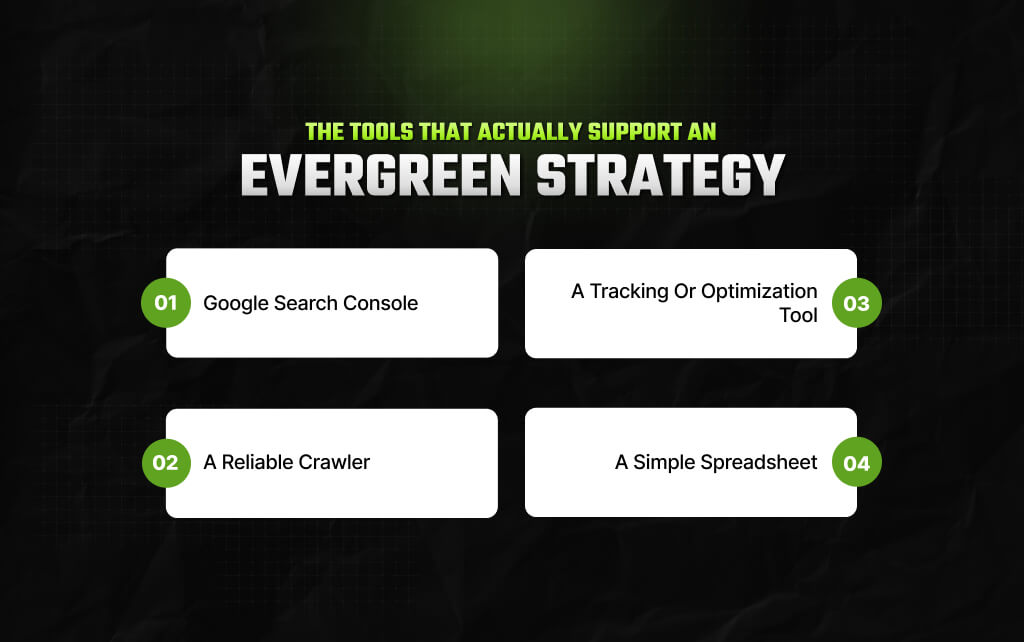
You do not need a massive tech stack of a dozen platforms. A handful of basic tools will easily cover most of your evergreen content maintenance.
This is your baseline. It’s a free, first-party tool that shows exactly which queries your page ranks for and how those rankings shift over time.
This one is completely non-negotiable.
You need a crawler to SEO content audit your entire archive in one go. It quickly highlights word counts, indexation status, and broken links without you having to click through every single page.
Tools like Ahrefs, Semrush, Clearscope, or Surfer are great for spotting traffic decay early.
They let you benchmark your content against whatever is currently ranking at the top.
Just remember: none of these platforms can replace your own judgment on what is actually useful to a real reader.
Spreadsheets are genuinely underrated. In fact, most serious historical optimization programs start as simple sheets mapping out traffic trends.
Use them to track your original publish dates and last-updated dates across your whole archive. It keeps everything organized in one place.
Tools speed up detection. That’s it. They do not do the writing, and they don’t make the judgment calls. That part stays human.
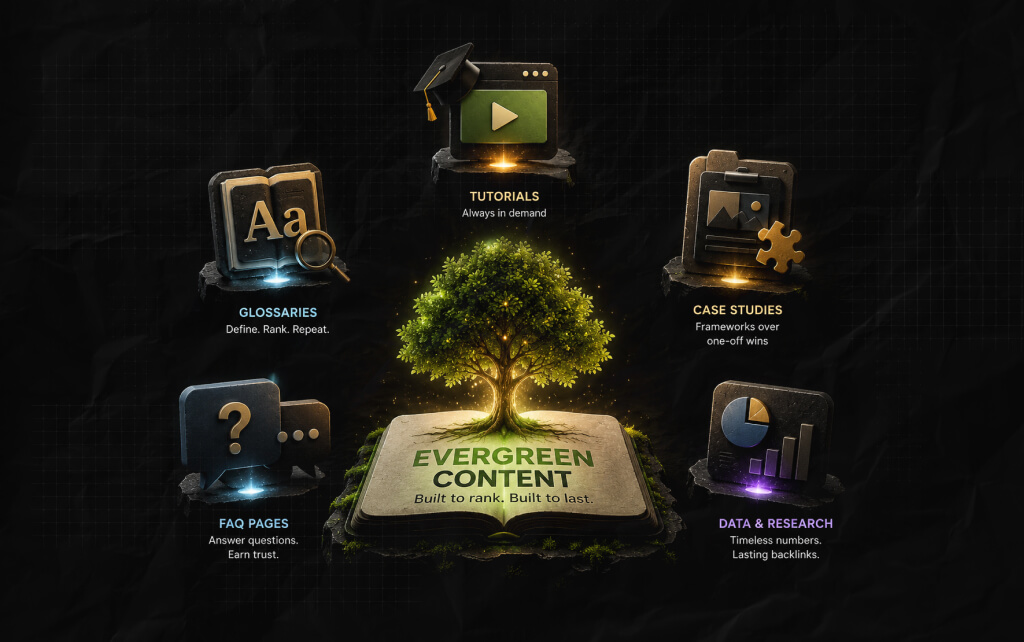
Here are the absolute backbone of most evergreen strategies. People never stop searching for how to do a specific task, so these tutorials never lose value. Keep your glossaries short, clear, and direct.
They are incredibly friendly to AI answer boxes and featured snippets because they focus on defining core industry terms.
The trick with case studies is to build them around a repeatable framework rather than a single, dated event.
Moreover, you need to focus entirely on the process so the underlying lesson stays relevant for years.
Lastly, the FAQ resource pages are built to answer specific, burning questions. They are perfectly tailored for voice search and generative search citations because of their natural Q&A layout.
Data ages much slower than opinion pieces. If you publish original research or unique stats, your pages will naturally attract high-quality backlinks for years to come.
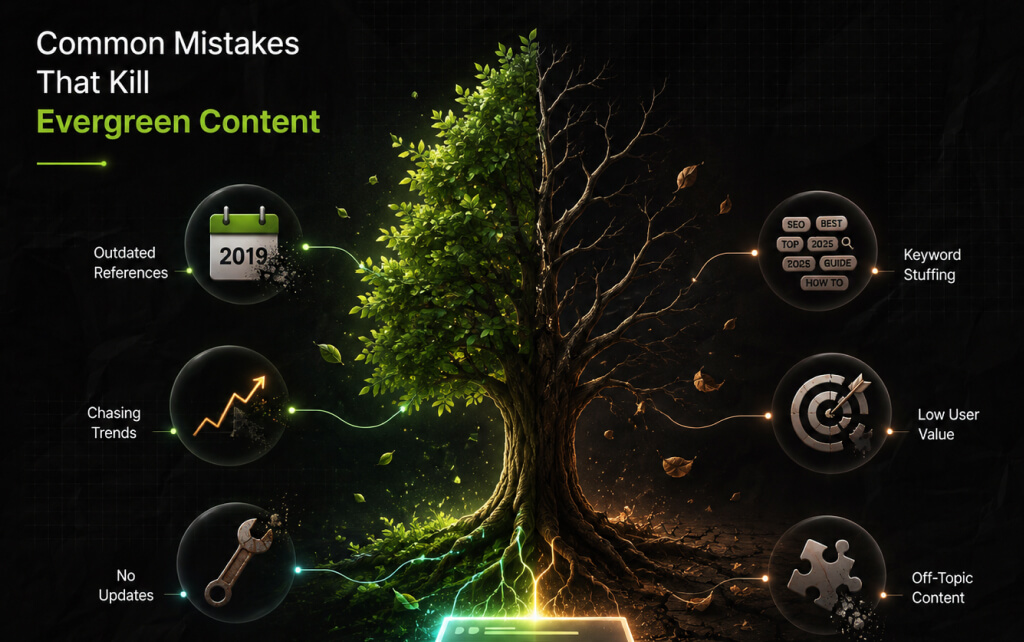
Letting timestamps creep into your text is a huge mistake. Phrases like “earlier this year” or “as of writing” immediately date your work and undercut the whole point.
Chasing a trending hook for an otherwise timeless topic is another trap. The core topic might survive, but your framing will die out fast.
You cannot treat publish day as the finish line. Evergreen content needs light, ongoing maintenance and a coherent topical home to actually stay alive.
You also need to stop overloading your pages for keywords. Instead, you can focus on actual usefulness.
Search engines have gotten incredibly good at spotting the difference, and readers notice it even faster.
Finally, don’t publish broadly outside your core expertise just because you think a phrase might rank.
Thin, off-topic content simply dilutes the authority of the pieces that actually matter.
There’s no single universal number, but a reasonable pattern has emerged across most SEO teams:
High-volume, competitive niches: review every 1–3 months.
Standard blogs and smaller sites: a thorough pass every 6–12 months is usually enough. After any major Google algorithm update: review immediately, regardless of your regular schedule.
Waiting for your usual cadence when visibility has already dropped is a costly delay.
Moreover, you can also conduct a content pruning SEO. This can help you to find out the dead, expired contents and keep the high performing ones for steady traffic.
Two shifts are worth watching. First, AEO and GEO are pushing evergreen writers toward more modular structure, clear, self-contained answers that an AI system can lift and cite without needing the whole page for context.
Second, “evergreen” is increasingly judged at the domain level, not just the page level, as HubSpot’s 2024 experience showed.
A well-written evergreen page sitting on a site with hundreds of thin, off-topic ones doesn’t get the same benefit of the doubt it used to.
Neither shift changes the core idea. It just raises the bar for what “well made” actually means.
Barsha is a seasoned digital marketing writer with a focus on SEO, content marketing, and conversion-driven copy. With 8+ years of experience in crafting high-performing content for startups, agencies, and established brands, Barsha brings strategic insight and storytelling together to drive online growth. When not writing, Barsha spends time obsessing over conspiracy theories, the latest Google algorithm changes, and content trends.
View all Posts