How To Get Your Brand Cited In AI Search Results In 2026
Oct 22, 2026
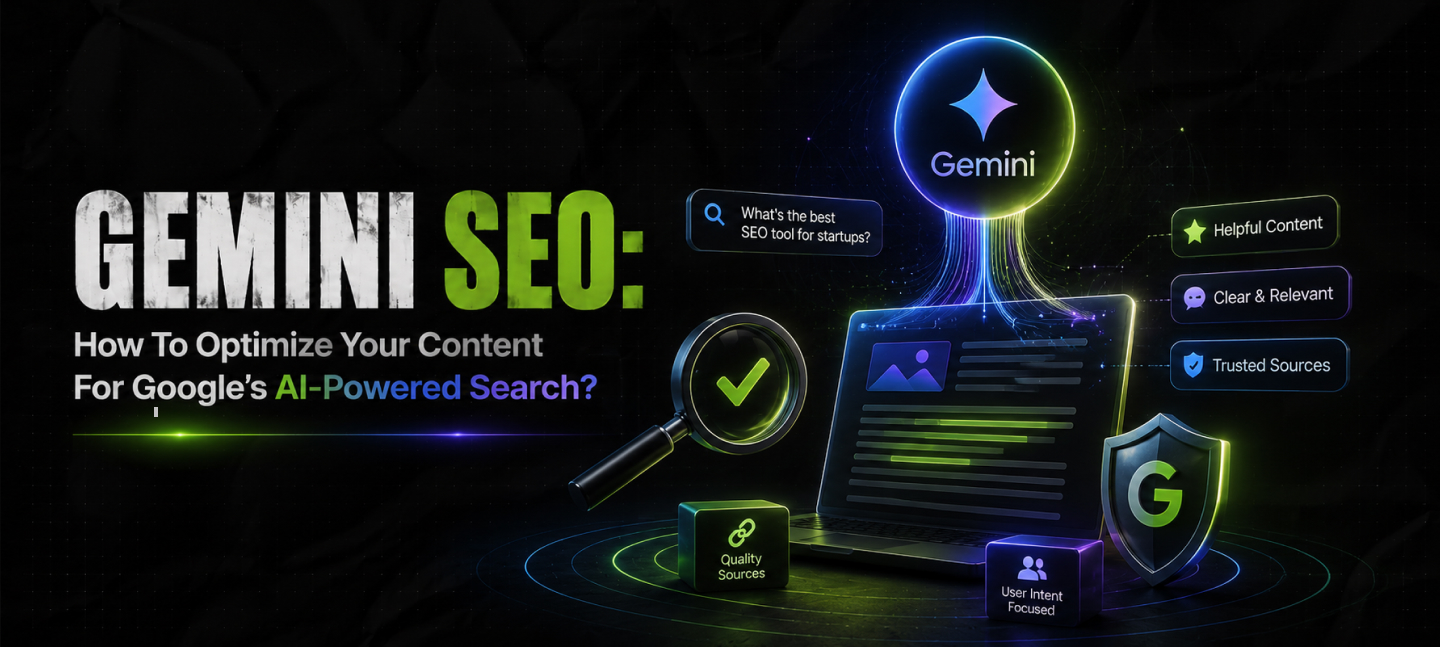

Google search is no longer just a page of links, and you already know that – I mean, anyone working in the digital marketing industry knows how fast search is evolving.
FYI, depending on your search query, Google can now give you an AI-generated response before you reach the traditional SERPs.
And this response is usually a summary of information from different sources. Also, it generally comes with suggested next steps and tries to help users explore the topic via relevant follow-up questions.
Google uses Gemini models to power parts of these AI experiences. Obviously, that has led to the emergence of a new dilemma for publishers, marketing professionals, and website owners: do we need a separate SEO strategy just for Gemini? Is there any need for a Gemini SEO strategy?
Frankly, not really!
In my experience, I’ve not been able to come across any official SEO checklist for the search engine giant’s Gemini model. Google’s content guidelines still recommend that people focus on creating people-first, helpful content, instead of optimizing content for any specific AI model.
However, the way in which AI search actually works does change how visibility can actually look in the present landscape.
Your page might rank for a specific query without being used for any AI-generated response. Another page might get cited because it is able to offer a valuable explanation or perspective that aligns with the search query.
As a result, Gemini SEO is an extension of effective search optimization – here, the attention is more on how clearly a piece of content answers a query and how easily search systems are able to understand the answer.
On that note, today, I’ll break down Gemini SEO for you and highlight how you can optimize your content for Google’s AI-powered search.
Stay tuned.
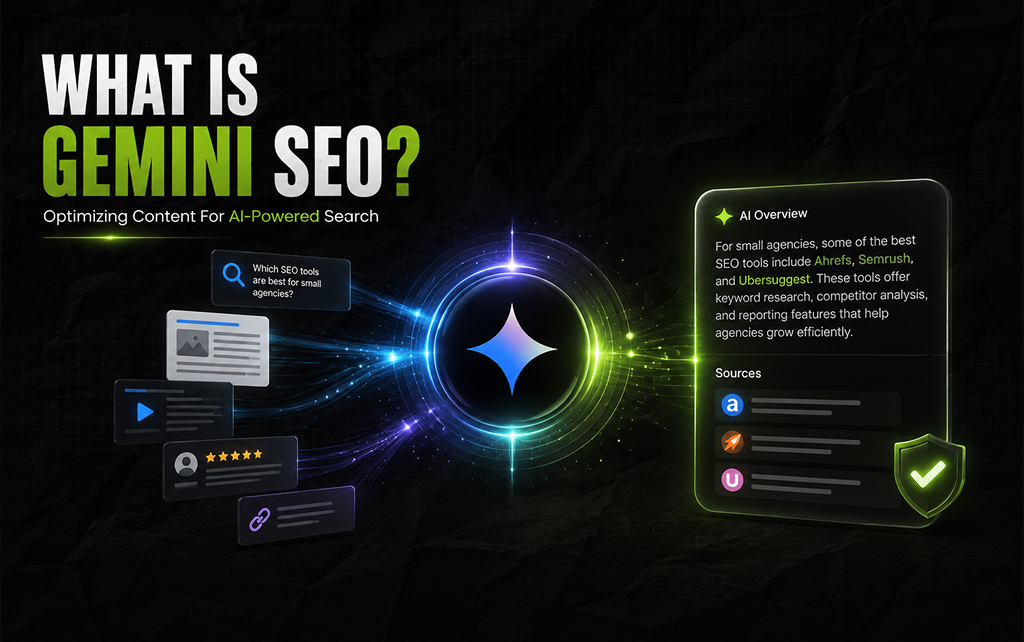
Gemini SEO refers to the practices used to improve the likelihood that your content will be understood, surfaced, or referenced in Google’s AI-powered search experiences that use Gemini models.
The term is relatively new.
Google itself does not present “Gemini SEO” as a separate optimization discipline with a fixed set of ranking factors.
That distinction is important.
As a result, you won’t find a legitimate Google formula saying, “Use this many headings and your page will rank in Gemini.”
Instead, the fundamentals remain familiar.
Google recommends creating content that is useful, original, reliable, and made primarily to help people.
The difference is that AI-powered search can interpret a more conversational question and generate a response from information it retrieves.
That makes retrievability, clarity, context, and source quality especially important.
Traditional search usually works like this: Query → search results → user chooses a page
However, AI-powered search has introduced another step: Question → AI-generated response → supporting sources → deeper exploration.
This changes the user’s experience.
So, someone searching for ‘How much does it cost to renovate a kitchen?’ might previously have received a collection of articles.
Instead, an AI-generated response can summarize typical costs, explain the variables, and point users toward sources for further reading.
The user may not need to open several pages just to understand the basics. That creates a new visibility opportunity. Also, it creates a new challenge.
No.
This is probably the biggest misconception surrounding Gemini SEO.
Google’s AI search experiences still depend on information from the web. Traditional SEO helps search systems discover, crawl, index, and understand that information.
Your technical SEO still matters. Your site architecture still matters. And your content quality still matters.
But what changes is the number of ways users can encounter your information.
A page can now contribute to an AI-generated answer as well as appear in traditional search results.
So don’t abandon SEO to chase AI. Instead, build a strong search foundation first.
There isn’t a public formula that tells us exactly why one page gets cited and another doesn’t.
Google’s AI systems can use search and retrieval processes to gather information relevant to a query before generating an answer.
That means your content needs to do more than contain a keyword. It needs to provide information that fits the question.
For example, suppose someone asks, ‘What is the difference between a Roth IRA and a traditional IRA?’
A page that gives a clear comparison of tax treatment, contributions, withdrawals, income considerations, eligibility, and common use cases gives the system much more useful material than a page that repeatedly uses the phrase “Roth IRA vs traditional IRA.”
This is where depth beats repetition.
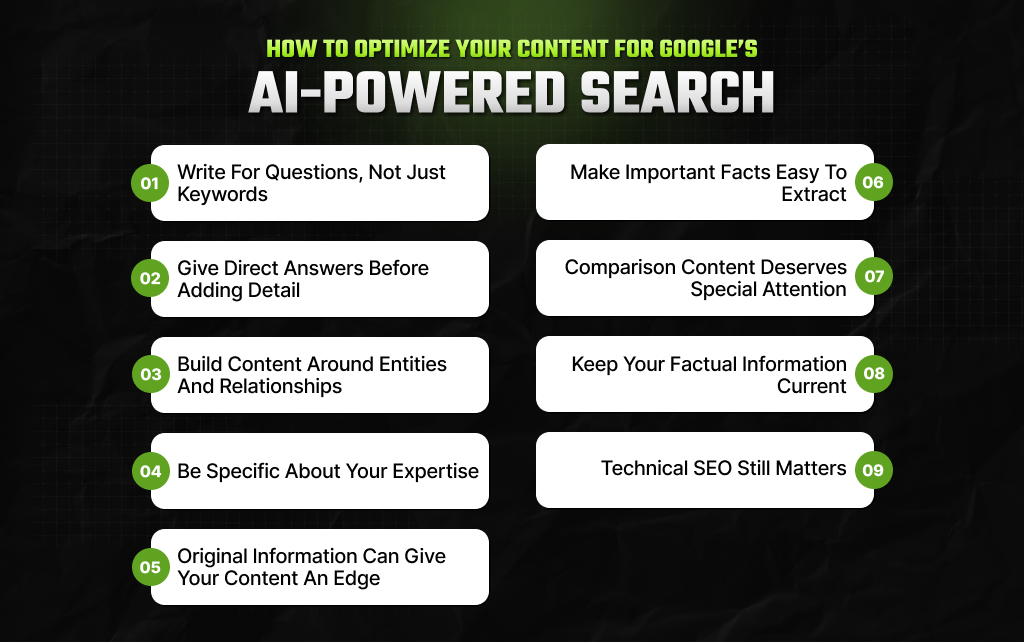
AI search makes conversational queries more important. TBH, people don’t always search with ‘best CRM software.’
Instead, they may ask, ‘What CRM is best for a small sales team that needs something easy to set up?’ That second question contains more information.
It tells you several things, including the category of the product, the audience, the size of the team, the problem, and most importantly, the buying criteria.
Good content should address those details. This does not mean creating a separate page for every possible question. Instead, build pages that answer the important questions within a topic.
AI systems need to understand what your page is saying. Readers do too. So, if someone asks, ‘What is vector search?’ then don’t make them read 500 words before finding the definition.
Instead, start with it.
For instance, say something like, ‘vector search finds information based on meaning and similarity rather than relying only on exact words.’
Then explain how it works. Then discuss applications, limitations, and examples. This structure helps users scan the page and gives search systems clear information to interpret.
Keywords tell search engines what words appear on a page, whereas entities provide more context.
So, suppose you’re writing about electric vehicles. Any useful page might naturally discuss:
These concepts are connected. Together, they help establish what the page is actually about. This is much more useful than repeatedly writing “electric vehicle” in every paragraph.
Generic content is everywhere.
So, if you want your website to become a useful source, give readers information that reflects real knowledge.
That might include:
Now, suppose you’re reviewing an SEO tool. Don’t simply rewrite its feature page. Instead, show how you used it, explain where it worked well, and point out where it fell short.
Also, consider comparing its workflow with alternatives. The point? To tell the reader who should and shouldn’t use it. That creates information that is harder to replace with a generic summary.
AI systems can summarize existing information very efficiently. That makes original information more valuable.
So, think about the difference between these two articles:
Article A: Here are 10 benefits of email marketing.
Article B: We analyzed 500 ecommerce email campaigns and found that abandoned-cart emails generated the highest conversion rate among the campaigns we studied.
The second article contributes something new.
Original data, testing, research, interviews, and first-hand observations give other websites something worth referencing.
Also, they can give AI systems stronger source material.
So, if your page contains an important fact, don’t hide it. Instead, make your content easy to read, and to do that, use:
Don’t bury that limitation in a footnote. Why? Because clear information helps readers make decisions and makes your content easier to interpret.
AI-generated answers often help users compare options. That makes comparison pages useful when they’re genuinely informative.
Good comparison content should answer:
Avoid turning comparisons into disguised advertisements.
Also, if your product is genuinely better for one use case but worse for another, say so. Readers trust balanced information more than endless praise.
AI search can make outdated information particularly frustrating.
So, imagine an AI answer recommends a software product based on a feature that disappeared two years ago.
The underlying source may still exist. But the information is simply no longer accurate. In that case, review important pages regularly.
And while doing so, pay particular attention to:
For fast-changing topics, freshness becomes part of usefulness.
Gemini doesn’t give you permission to ignore your website’s technical health. Search engines still need to access and understand your pages.
As a result, check the basics:
Structured data can also help Google understand certain types of content.
But don’t treat schema as a shortcut into AI answers. Structured data helps machines interpret information.
However, it doesn’t guarantee inclusion in an AI response.
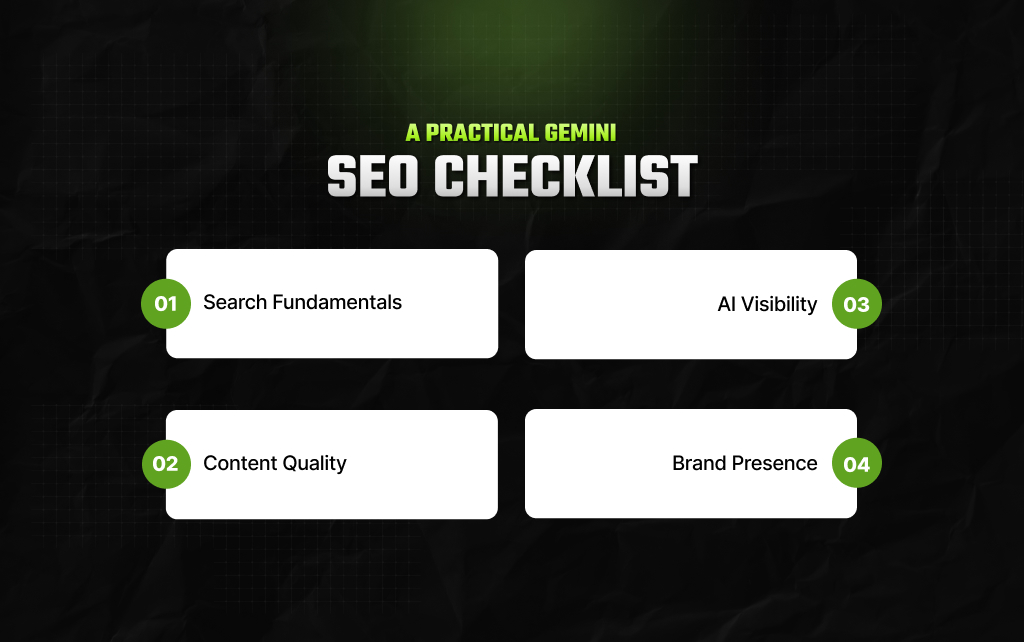
Before publishing an important page, ask:
As a result, if most of these answers are yes, you’re doing something more valuable than optimizing for a single AI system.
You are building a website that search systems can understand, and people can trust.
The phrase “Gemini SEO” makes it sound like you need to optimize for a machine called Gemini. And that’s too narrow.
Google’s AI search experiences will continue to change – the models, interfaces, retrieval systems, and search features can all evolve.
Your content strategy should survive those changes. So, build pages that explain things clearly, answer questions people genuinely ask, and add information that competitors don’t have.
Also, don’t forget to show your experience, support important claims, keep facts current, and build a reputation beyond your own website.
Then measure how your brand appears across both traditional and AI-powered search. That’s a more durable approach to Gemini SEO than chasing a list of supposed AI ranking tricks.
Barsha is a seasoned digital marketing writer with a focus on SEO, content marketing, and conversion-driven copy. With 8+ years of experience in crafting high-performing content for startups, agencies, and established brands, Barsha brings strategic insight and storytelling together to drive online growth. When not writing, Barsha spends time obsessing over conspiracy theories, the latest Google algorithm changes, and content trends.
View all Posts

How To Get Your Brand Cited In AI Search Resu...
Oct 22, 2026
The Ultimate Blueprint For Broken Link Buildi...
Oct 16, 2026
The Ultimate Guide To Stealing Your Competito...
Oct 15, 2026
Beyond The Basics: Master Guest Posting For H...
Oct 15, 2026
Best Generative Engine Optimization (GEO) Com...
Oct 14, 2026