Google Looker Studio: What It Is, How It Works, And How To Use It For Better Reporting
Sep 30, 2026
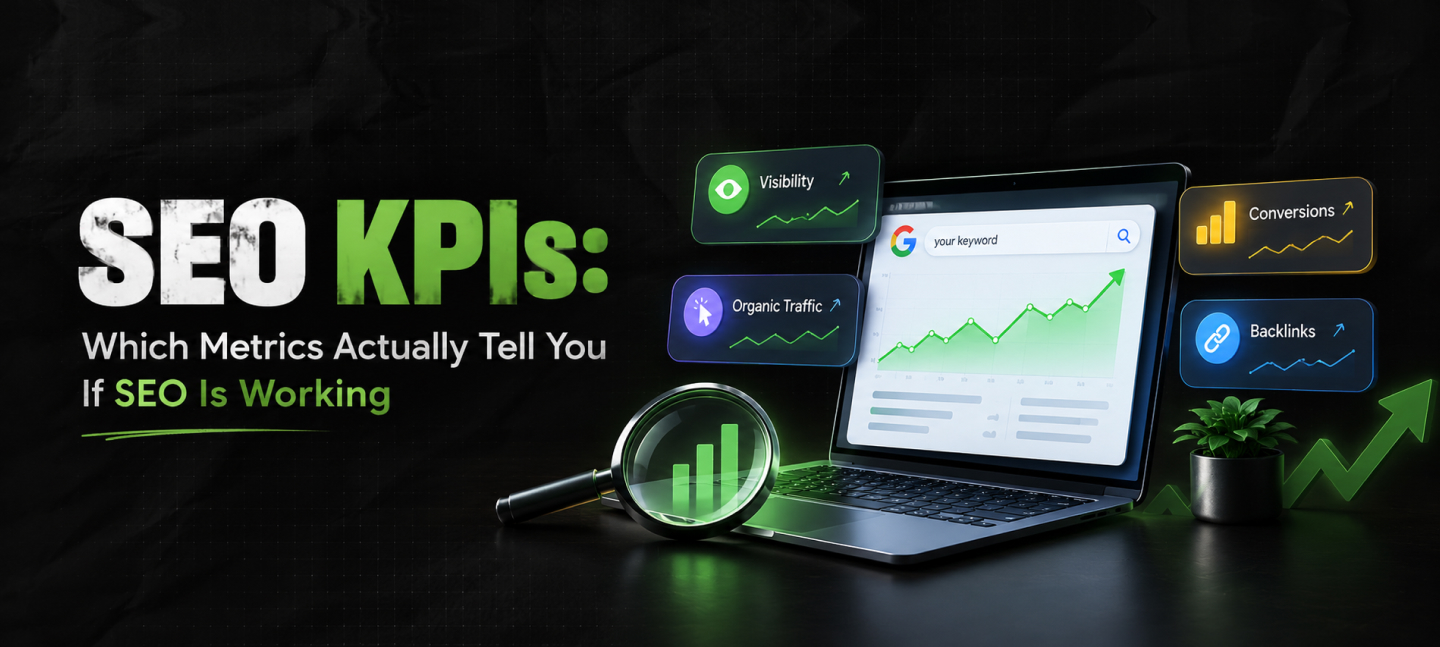

SEO generates a lot of numbers.
Organic traffic. Keyword rankings. Impressions. Clicks. Backlinks. Domain ratings. Conversion rates.
In that case, the issue is not data-related. Instead, it is more about knowing which data is relevant – which numbers deserve your time and attention.
Now, a site can easily gain 40% more organic traffic and still end up generating a handful of leads. Similarly, a page can rank on top of SERPs and still fail to bring home any business value.
And a website can have multiple backlinks and still become less relevant to Google search. This is precisely why you should not look at SEO KPIs like a standard checklist.
Frankly, the right KPI will always depend on what you want to achieve. On that note, today, I’ll break down SEO KPIs and highlight which metrics actually tell you if your SEO strategy is working.
Stay tuned.
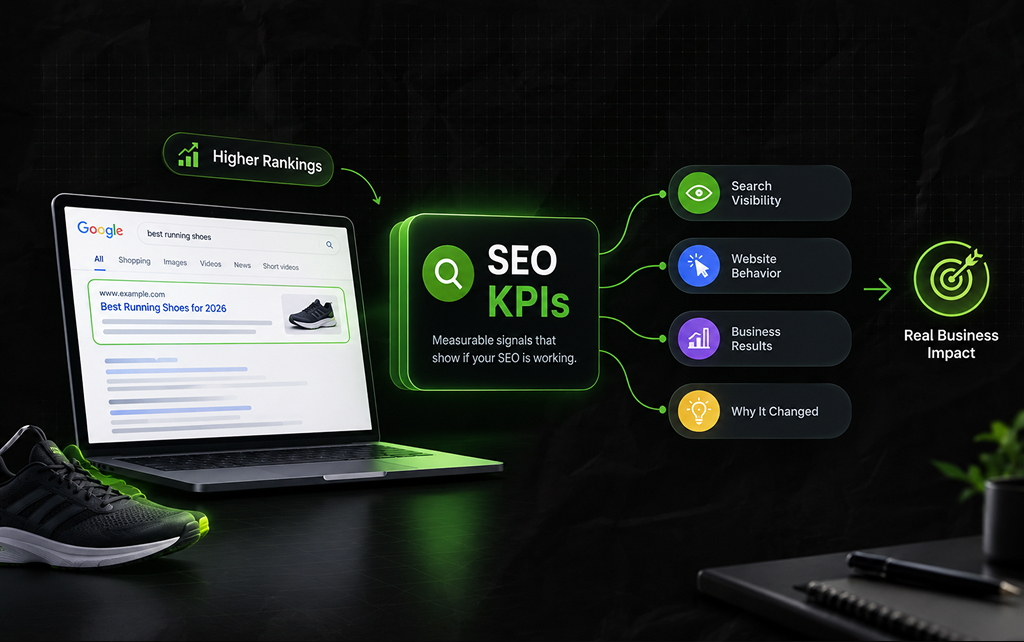
SEO KPIs, or key performance indicators, are measurable signals used to evaluate whether your SEO work is achieving its intended outcome.
Some KPIs measure search visibility. Others measure website behavior. Others measure business results. And some help explain why performance changed.
That distinction matters. A ranking is an SEO metric. It is not automatically a business KPI.
Now, imagine an ecommerce web page moves from the second page on Google search to the top of SERPs. That is a meaningful SEO improvement. But if the keyword has little commercial value, the improvement may not matter much to the business.
As a result, it is always better to ask what really changed in the search landscape, what your target audience did next, and whether that action supported your business goal.
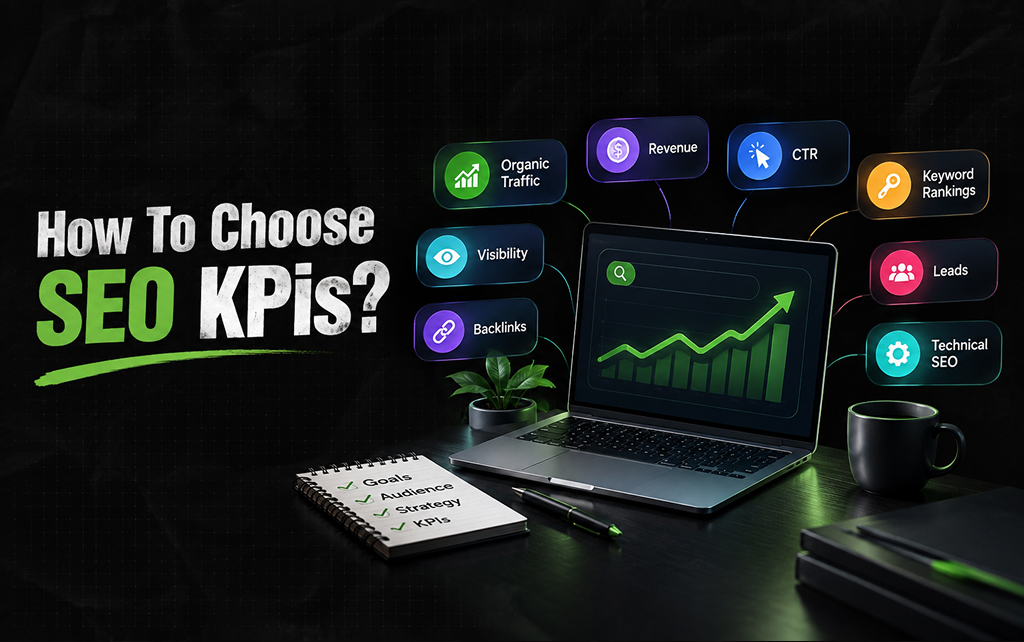
Before you choose your top SEO KPIs, it is essential to take time and define what your SEO strategy is supposed to accomplish for your site.
For one company, the goal might be qualified leads. For another, it might be ecommerce revenue.
Also, a publisher may care about organic pageviews and returning visitors, a SaaS company may care about product signups, and a local business may care about calls, direction requests, and bookings.
This changes what you should measure.
A simple hierarchy looks like this: Business outcome → SEO outcome → search signal → diagnostic metric.
This keeps your reporting connected to an actual objective.
Without that connection, SEO reporting can become a monthly exercise in explaining numbers rather than improving performance.
On that note, let’s look at some of the most important SEO KPIs relevant in 2026.
For many businesses, this should sit near the top of the SEO KPI list.
An organic conversion is an action taken by a visitor who arrived through organic search and then completed a valuable business action.
As a result, depending on the website, that could be a:
But there is an important distinction – do not treat every conversion as equally valuable.
Ten newsletter signups and ten enterprise demo requests are both conversions. They may have completely different business value.
Also, where possible, segment organic conversions by type and quality. Then, you can answer a much better question than “Did organic traffic increase?”
You can ask: Did SEO bring more of the people we actually want?
For ecommerce businesses and companies with reliable attribution, organic revenue is one of the clearest SEO KPIs. It connects search acquisition to money rather than stopping at traffic.
But revenue attribution can become complicated.
Moreover, a customer may discover your brand through Google, return through direct traffic, read an email, and eventually purchase.
So organic revenue should not automatically be interpreted as SEO’s complete contribution to the sale.
As a result, it’s best to use it alongside other acquisition and attribution data rather than treating it as a perfect measurement of SEO impact.
Organic traffic is useful. Also, it is one of the easiest SEO metrics to misuse. An increase in organic sessions does not necessarily mean SEO improved.
Traffic can rise because:
That is why total organic traffic is better treated as a headline KPI, not a diagnosis. Moreover, it is best to always ask where the traffic came from. As a result, you can look at:
A 30% increase in traffic means very little until you know which 30% increased.
Organic CTR tells you how often people clicked your result after seeing it in search. It can help identify pages that have visibility but are not attracting enough clicks.
But avoid using a universal CTR target.
A result ranking first for a branded query behaves very differently from a result appearing at position eight for a broad informational query.
Also, CTR varies by:
Instead of asking whether your CTR is good, look for unexpected changes. So, if impressions remain stable but clicks suddenly fall, investigate.
However, if impressions rise while CTR falls slightly but total clicks increase substantially, the situation may be very different. Context matters more than a benchmark.
Rankings remain useful. They just should not become the entire SEO report.
As a result, a keyword moving from position 50 to position 15 tells you something different from a move from position 4 to position 2.
More importantly, not every keyword deserves equal attention. In that case, you need to track rankings by groups such as:
Then look at movement across groups. This gives you a better view of whether your SEO strategy is gaining visibility where it matters.
Individual keyword rankings can hide the bigger picture.
Now, imagine you target 100 keywords around a topic. Five keywords move into the top three while another 20 move from page five to page two.
A single average position may flatten those changes into a meaningless number. Also, topic-level visibility gives you another way to evaluate progress.
Instead of asking “How many keywords do we rank for?” ask “How visible are we across the searches that define this topic?”
This becomes particularly useful for large websites with hundreds or thousands of keywords.
Indexation is not a success KPI for every website. Why? Because having more pages indexed does not automatically make a site better.
But indexation can be an important technical health indicator.
For example, you may discover that:
So rather than tracking ‘number of indexed pages’ as a goal, track whether the right pages are available for search engines to index. And that is a much more useful question.
SEO happens at the page level.
Your website might have strong overall traffic while dozens of important pages receive almost no organic visits.
As a result, it is best to review your landing pages based on:
This can expose opportunities that site-wide reporting hides.
Organic conversion rate helps connect search visits with actions. But this metric needs context too.
A blog post designed to answer an early-stage question may naturally convert at a lower rate than a product page. That does not make the blog unsuccessful.
Instead, evaluate conversion performance against the page’s role in the customer journey.
Additionally, a useful approach is to separate pages into groups such as:
Then evaluate each group according to what it is supposed to accomplish.
Lead volume alone can create misleading SEO reports.
So, suppose SEO generates 200 leads this month. Now, if only five are relevant to your sales team, the number does not tell the whole story.
Where possible, connect organic leads with downstream sales information. In that case, you need to track: Organic visits → leads → qualified leads → opportunities → customers.
This helps SEO teams understand whether they are attracting the right search audience rather than simply increasing form submissions.
Backlinks still matter, but raw backlink counts are weak KPIs on their own.
One website can create hundreds of backlinks. But that does not necessarily represent hundreds of independent endorsements.
Moreover, for authority-focused SEO, referring domains can provide a more useful view. Also, you can segment links by:
In that case, the useful question is not “How many links did we build?” It is “Did we gain external recognition from relevant sources that support the pages and topics we care about?”
For competitive SEO programs, your own metrics are only half the story. Also, you need to understand how your visibility compares with competitors.
In this context, it is essential to track important search topics and compare:
This can reveal a problem that traffic alone will miss.
You may be growing steadily while a competitor is growing much faster. Now, the absolute number looks positive. But the competitive position tells a different story.
Search behavior is expanding beyond traditional blue links.
Today, users on the internet don’t spend hours going through hundreds of links to figure out the correct answer.
Instead, they are increasingly using AI-backed search to gain information, compare different options, research products, and more.
Now, that creates another measurement layer. As a result, depending on the platforms and tools available to you, useful AI-search indicators can include:
This data should not replace traditional SEO KPIs.
Instead, it adds another question: When someone asks an AI system about the topic, category, problem, or brand we care about, are we present and represented accurately?
One of the most useful SEO KPI shifts is moving from website-level reporting to page-level analysis.
Instead of saying “Organic traffic fell 8%”, you should be able to say “Traffic fell mainly because three high-value commercial pages lost visibility after competitors gained rankings.”
That second statement is actionable.
Also, a useful SEO report should help you move from ‘Metric → change → explanation → action’ rather than stopping at the metric.
Technical SEO metrics are usually diagnostic rather than business KPIs. In this context, the most useful indicators can include:
But do not turn every technical metric into a target.
Because the real objective might be to make important pages accessible, indexable, and technically usable for search engines and visitors.
The metric simply helps you verify whether you are getting there.
Average position looks precise. It often isn’t as useful as it appears.
For instance, a website can rank for thousands of queries. Some are highly valuable. Others are irrelevant or extremely low volume.
An average can hide those differences.
Moreover, the same problem appears when teams report “Our average ranking improved from 18 to 12.”
That sounds positive. But you still do not know:
Additionally, use ranking data to investigate performance rather than treating one average number as the answer.
Your KPI set should not remain frozen for years.
Now, a new website may focus heavily on:
However, a mature SEO program may focus more on:
Similarly, an authority-building program may emphasize:
So, the point? The KPIs should follow the job SEO is expected to do.
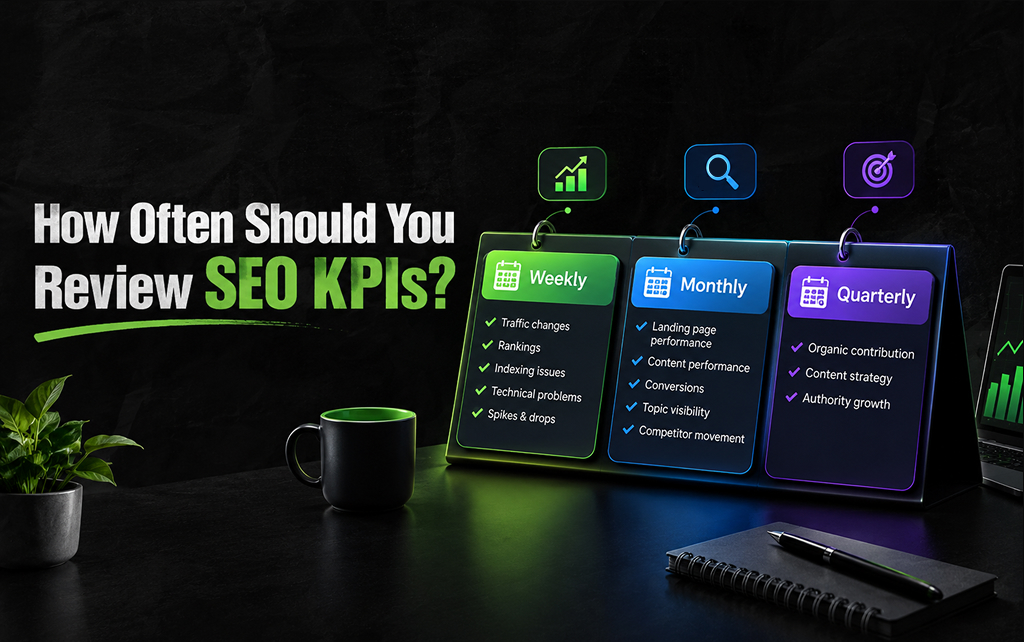
Not every KPI needs to be checked every day. TBH, a practical rhythm looks like this:
A useful SEO dashboard can be divided into five layers.
| Layer | What To Track | What It Tells You |
|---|---|---|
| Business | Revenue, leads, qualified leads, purchases | Is SEO creating business value? |
| Acquisition | Organic traffic, non-branded traffic | Are we attracting search demand? |
| Visibility | Impressions, rankings, topic visibility, CTR | Are we becoming more visible |
| Authority | Referring domains, relevant links, brand mentions | Is external recognition growing? |
| Diagnostics | Indexing, technical issues, landing-page performance | What may be helping or hurting performance? |
So, to be fair, you do not need every metric on one dashboard. In fact, putting everything on one dashboard can make SEO reporting harder to understand.
Instead, a better approach is to give each audience a different view.
The focus should be on:
The focus should be on:
The focus should be on:
Therefore, the same SEO program can have several dashboards without having several definitions of success.
Barsha is a seasoned digital marketing writer with a focus on SEO, content marketing, and conversion-driven copy. With 8+ years of experience in crafting high-performing content for startups, agencies, and established brands, Barsha brings strategic insight and storytelling together to drive online growth. When not writing, Barsha spends time obsessing over conspiracy theories, the latest Google algorithm changes, and content trends.
View all Posts

Google Looker Studio: What It Is, How It Work...
Sep 30, 2026
What Is Google Tag Manager? A Practical Guide...
Sep 30, 2026
SEO Dashboard: What To Track, What To Ignore,...
Sep 25, 2026
Analytics SEO: How To Turn Search Data Into B...
Sep 25, 2026
AI Search Tools: What They Actually Measure A...
Sep 25, 2026