The Ultimate Guide To Competitor Backlink Analysis: An Actionable SEO Blueprint To Steal Your Rivals’ Traffic
Oct 23, 2026
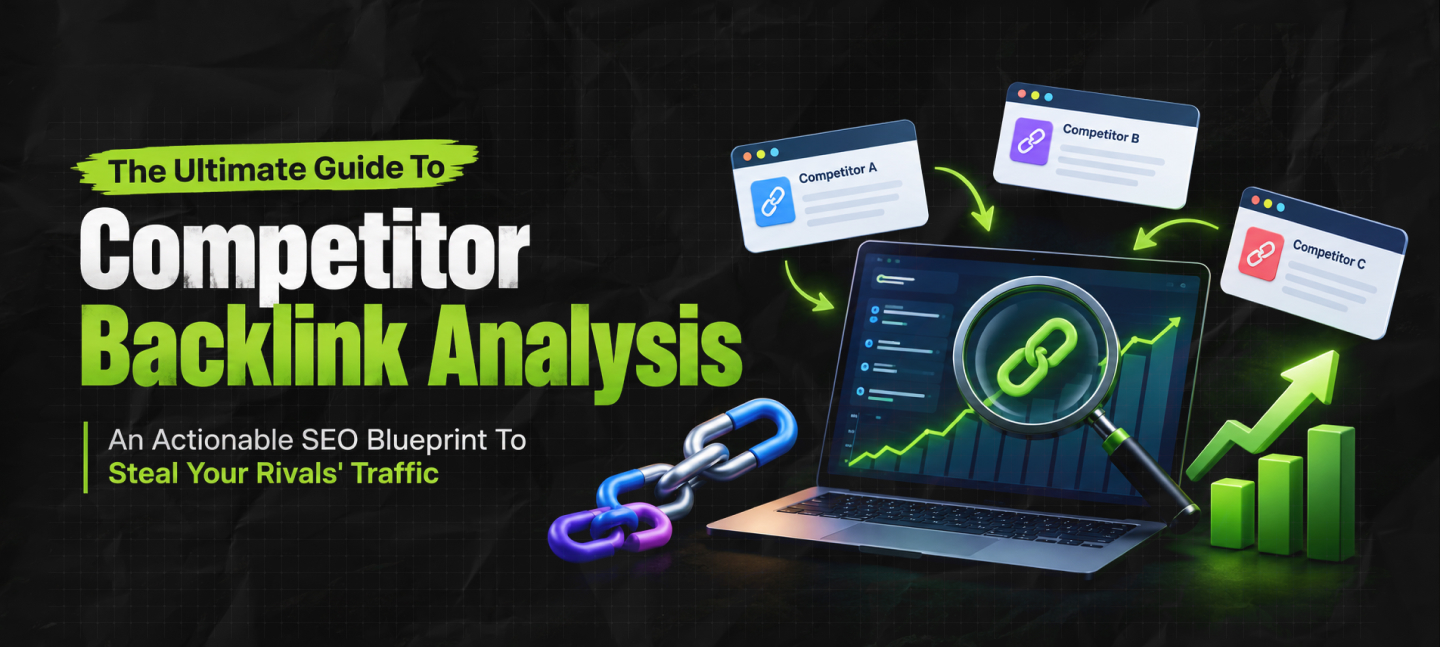

To improve your positioning over competitors, don’t build links in isolation.
So, what should we do then? Competitive backlink analysis can be a strong option.
A competitive backlink analysis helps you identify sites already linking to your competitors.
Wait, that is not it! It also helps you understand what attracts publishers to link to similar resources, and how we can counter that with your own opportunities.
Prioritise popular pages with a high volume of mentions and classify the link acquisition strategies used.
Then act using broken-link building, guest post opportunities, or digital PR.
Let’s be honest for a second. Most SEO pros approach link analysis from a fundamentally wrong perspective.
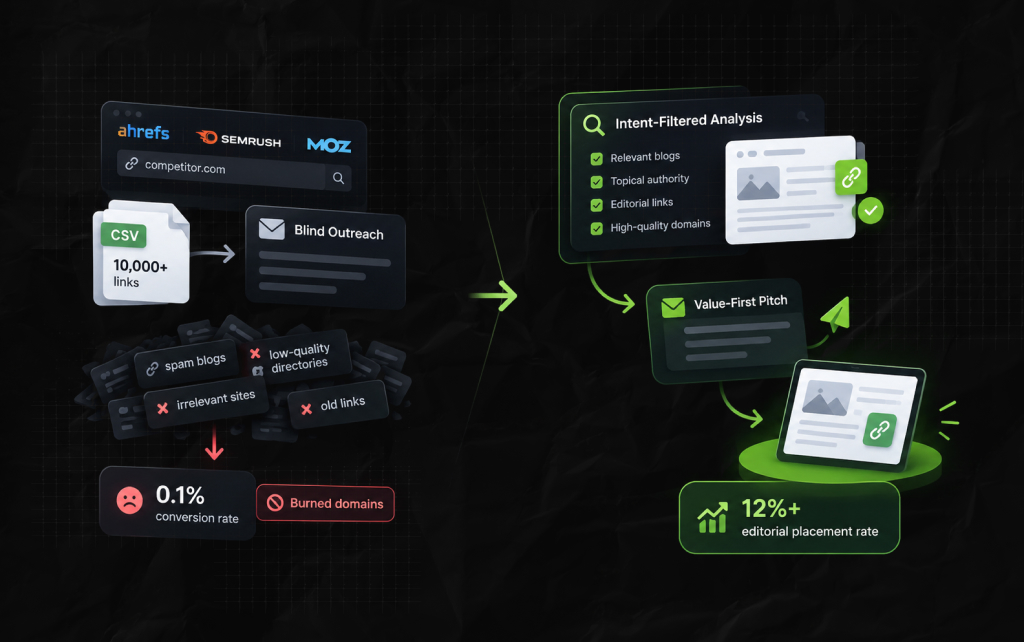
You open Ahrefs, Semrush, or Moz, paste in a competitor’s URL, export a CSV with 10,000 links, and toss it over the fence for a junior VA to spam a blind outreach campaign.
That’s not a link building strategy. That’s just lazy spam that will get you banned from hundreds of domains, and here’s why.
[Raw Competitor Export] ➔ [Blind Outreach Spam] ➔ [0.1% Conversion + Burned Domains]
VS.
[Intent-Filtered Analysis] ➔ [Value-First Pitch] ➔ [12%+ Editorial Placement Rate]
When you do the competitor backlink analysis, the focus should not be on recreating every single spammy scraper or low-tier directory your competitor used 5 years ago.
Focus on harvesting the repeatable, editorial relationships that still move the needle for them today.
If you can’t explain why a particular publication linked to your competitor, you’re wasting your time before you even start outreach.
Reverse-engineer their strategy at a high level to see whether they’re building topical authority through guest posting.
This can help you earn high-quality contextual links through digital PR for link-building services or by leveraging resource pages.
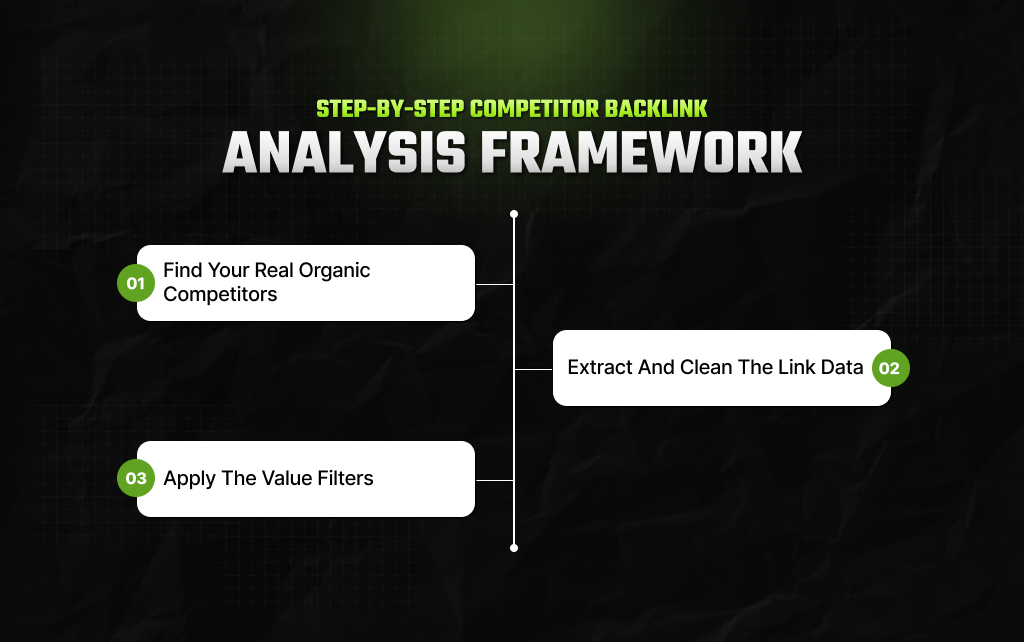
To get real data, you need a repeatable system that works every time.
Here is the exact process I use to audit, filter, and extract goldmines from competitor profiles.
Don’t rely on the names your sales team throws at you – your market competitors are rarely your exact search competitors.
Take your top 5 target commercial keywords (based on value) and plug them into Google.
Search them in Google using clean incognito windows (or your local rank tracker). Find the ones that consistently show up on positions 1-5.
If you are a boutique project management software provider, your commercial rival may be Asana.
However, the SERPs for your target keywords may be flooded with Monday.com, ClickUp, and niche review blogs. Those are the ones that need to be on your list.
Plug your target search competitor into your preferred backlink index now and then run an export.
You can apply these first filters inside the tool before you download the file to save yourself hours of cleaning the dataset:
Once the spreadsheet is ready, apply the next set of filters ruthlessly. We’re removing noise by establishing baseline metrics.
Domain metrics are often inflated, but they’re a good starting point when paired with traffic data.
| Metric Filter | Minimum Baseline | Purpose |
| Domain Rating (DR) / Authority (DA) | > 30 | Filters out brand-new domains and low-quality PBNs. |
| Estimated Monthly Organic Traffic | > 1,000 visits | Ensures the linking site is genuinely indexed and trusted by Google. |
| Language | Matches target market | Prevents irrelevant out-of-region outreach placements. |
Related Article: SERP Insight Link Insertion: What It Is & Why It Matters?
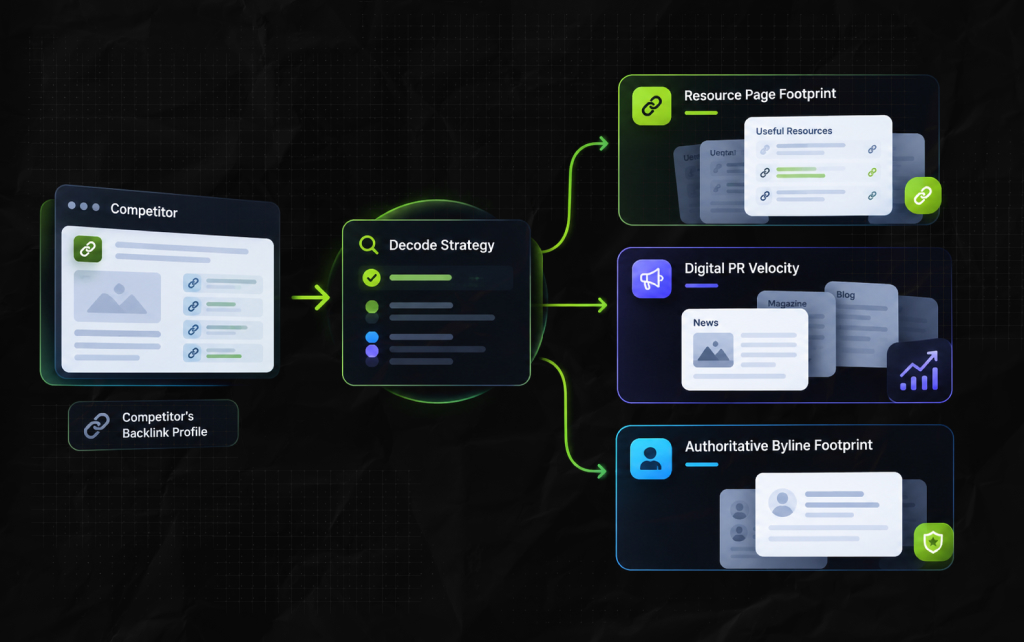
Now that you have filtered out some low-quality resources, examine the remaining ones more closely.
And you will see that competitors use a set of methods that let them gain backlinks faster. To match and beat their rate, use the following clues.
If you find that competitors’ articles are regularly featured on pages with similar titles (“Useful Resources,” “Tools for Marketers,” etc.), they are using resource pages to build relationships.
In those cases, analyze the target page’s content to see whether it has expired links or irrelevant resources.
If it has, you may want to contact the webmaster and offer an exclusive partnership.
Check whether competitors regularly get high-DR backlinks from newspapers, magazines, and influential websites over short periods.
If you see these patterns, they’re likely using a digital PR strategy.
Essentially, it enables publishers to share their resources (data studies, calculators, op-eds) and report on a topic as an expert.
To counter this strategy, invest in content that resonates with target publishers, not just a regular article or blog post.
If you suspect that competitors are publishing numerous articles in the same niche, double-check if they have an extensive list of bylines on external websites.
If you detect such a footprint, you can use the competitor’s publishing opportunities.
Specifically, if a publication has agreed to work with a competitor, it is a safe bet that they will accept your outreach email.
Just make sure that your content quality matches the publisher’s standards.
Finding the links is only part of the puzzle. You have to take the right decisions in terms of leveraging this knowledge base for active outreach.
The campaigns need to focus on conversion, with double-digit effectiveness rates.
When analyzing backlinks in the context of your competitors, look for target pages that host many external links that already return a 404-status code on the competitor’s website.
This situation is common for any website with a high number of incoming links.
Webmasters need time to update all dead ends when domains are rebranded, redesigned, or redirected.
Take this URL pointing to nothing on the competitor’s domain and extract a list of websites linking to it. Then, contact all the publishers with a brief note:
Hi [Name],
Noticed that on your resource page about [Topic], you have a link pointing to [Competitor Tool/Article]. This URL appears dead, as it returns a 404 error code on the competitor’s website. We recently created an updated guide about [Topic] that may be a good replacement for the dead link in your resource list. Not a priority, but something you may want to consider fixing.
When your competitor is featured in a listicle or roundup, review the options presented more closely.
Contact the author and ask them not to remove the mention of your competitor, but request that they add your product as a preferred option.
Piyasa is a search engine marketing strategist who has spent the last six years decoding Google's ever-changing mind. From corporate giants to neighborhood storefronts, she helps businesses cut through the digital noise and actually get noticed online. When she isn’t building SEO strategies or writing the latest search industry breakdowns for Search Engine Magazine, you can usually find her hanging out with friends - and gently reminding them that no, she cannot personally fix the latest algorithm update for them.
View all Posts

How To Land High-Authority Editorial Backlink...
Oct 23, 2026
Why Your Website Traffic Dropped Suddenly And...
Oct 23, 2026
How Do The Physical Google Review Tools Redef...
Oct 23, 2026
How To Get Your Brand Cited In AI Search Resu...
Oct 22, 2026
The Ultimate Blueprint For Broken Link Buildi...
Oct 16, 2026