How To Get Your Brand Cited In AI Search Results In 2026
Oct 22, 2026

Running an SEO publication sounds like it has a built-in advantage. You write and rank on Google for a living. You know what a core update does, what E-E-A-T means, and why thin content gets penalized.
But then your own site gets hit.
That’s what happened to searchenginemagazine.com. Not because we didn’t know SEO. But the problem was that knowing it and honestly practicing it are two different things.
We had some content written to rank, not to help. We had comparison articles missing angles that readers were clearly asking for.
Moreover, we did not stop to check whether what we were doing was right. We noticed when the traffic fell to almost 0.
When the drop hit, three tools became the instruments I depended on to understand what had happened and what to do next: Ahrefs, SEMrush, and Moz.
Each showed me something different. No, I didn’t use the free versions!. But how can you tell which one is best for you: ahrefs vs semrush vs moz?
People in the blogging industry are all acquainted with the 3 tools. But the real importance of these tools goes deeper.
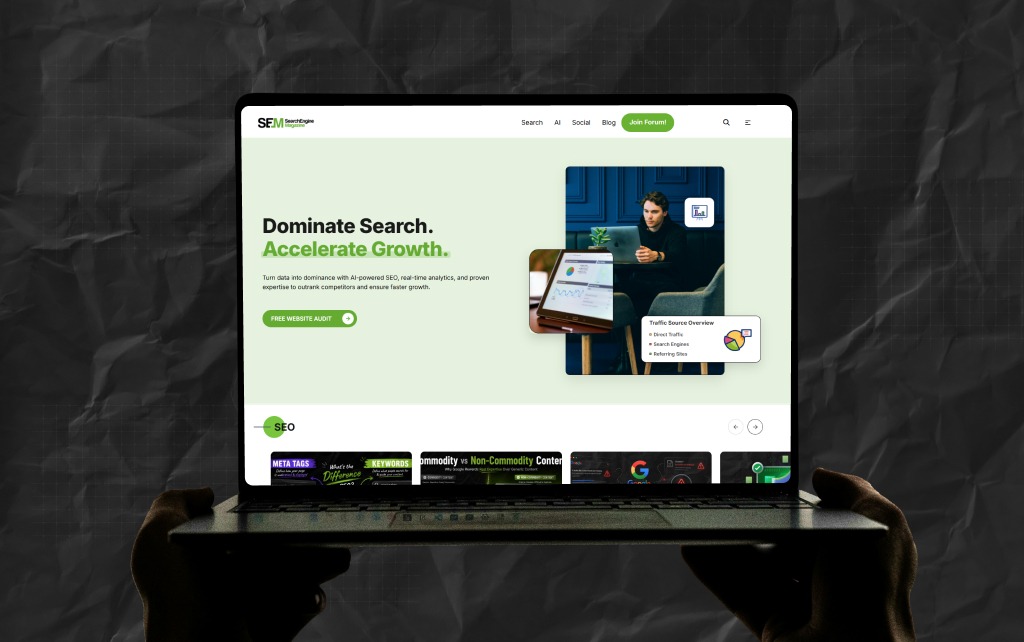
In my honest opinion, let me share how these tools helped me save my website searchenginemagazine.com from Google Updates: ahrefs vs semrush vs moz:
In 2024 and into 2025, searchenginemagazine.com got hit. Honestly, I was creating content on this site to rank rather than genuinely discuss search engines and how to improve organic search visibility.
To clarify, some comparison articles, including an earlier version of this one, were missing key angles readers actually wanted. Google’s Helpful Content Update introduced a site-wide signal:
“If enough of your content was considered unhelpful, the entire domain suffered. Thin content lacking original analysis saw 71% traffic drop across the industry. In addition, the Generic keyword-optimized articles experienced a 63% ranking loss.”
Ahrefs showed me the exact pages losing rankings. It also showed which competitors had picked up what I’d dropped. As a result, I could start planning on what I needed to do differently.
SEMrush surfaced on-page issues I’d overlooked. Furthermore, it showed me what content was performing in my niche.
On the other hand, Moz showed me that my Domain Authority had softened. Simultaneously, the platform signaled that my backlink exchange wasn’t keeping pace.
Together, they gave me the full picture. However, I could not have understood the whole scenario if I had focused on one tool rather than the others.
That’s the most honest framing I can give you for this comparison of ahrefs vs semrush vs moz:
“These tools are most valuable when you know what each one is genuinely best at.”
Before getting into a head-to-head comparison of the tools, you ned to know what these tools individually stand for:
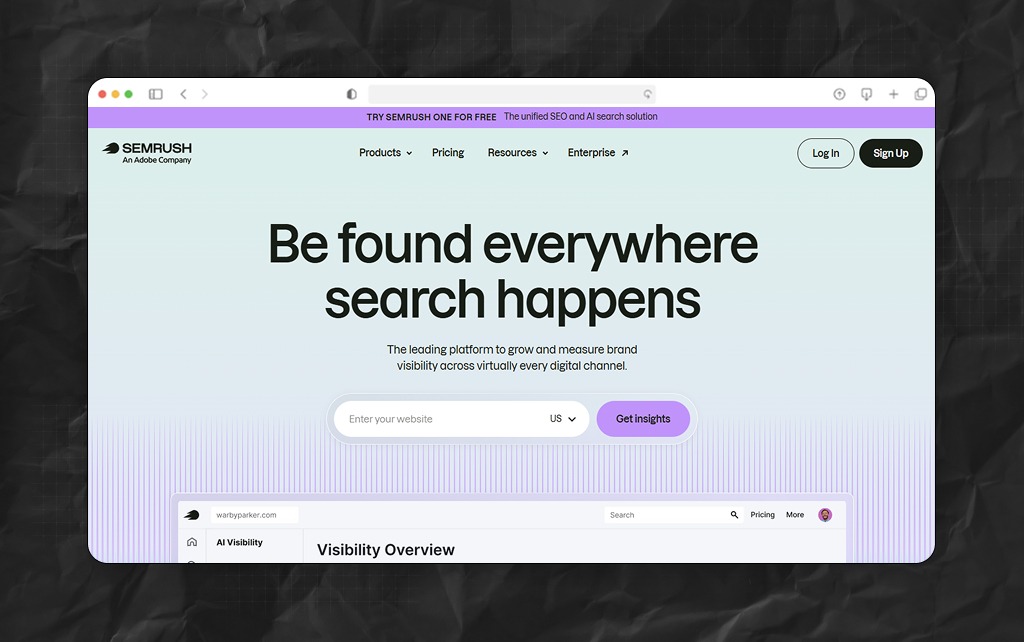
Out of the 3 tools, ahrefs vs semrush vs moz, SEMrush is the all-in-one platform. I used it for keyword research, competitive analysis, site audits, backlinks, PPC, and social.
In late 2025, it launched Semrush One, adding:
As a result, it is now the the broadest tool of the three.
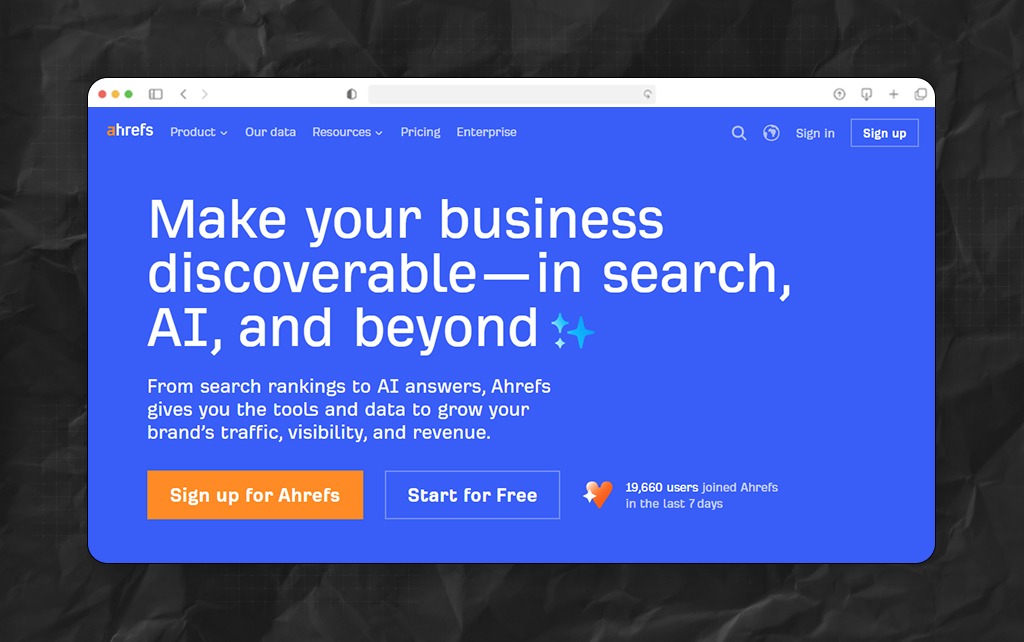
If you ask me, Ahrefs is the specialist. Founded in 2011, it crawls over 8 billion pages daily. That makes it the second most active crawler after Google.
That’s not all. Ahrefs has built its reputation on having the:
Over 500,000 SEO professionals rely on it. Meanwhile, most of them use it specifically for link intelligence. I also did the same.
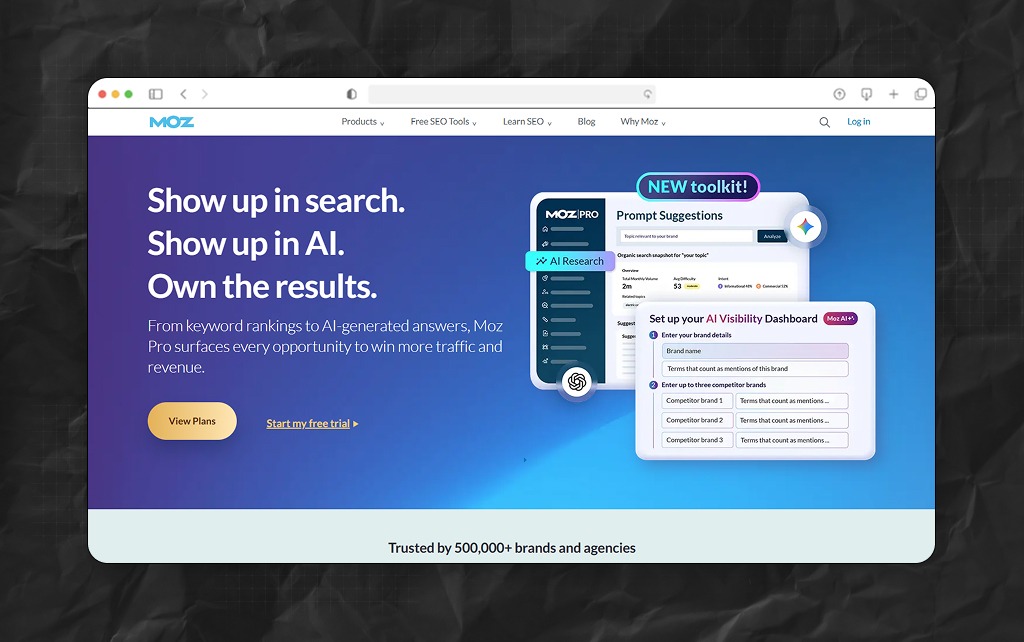
Moz started as an SEO community and evolved into a toolset centered on simplicity and education. It invented Domain Authority (DA)
Today, DA is used as an industry-wide metric. Guess what, it is used even by people who use Ahrefs or SEMrush for everything else.
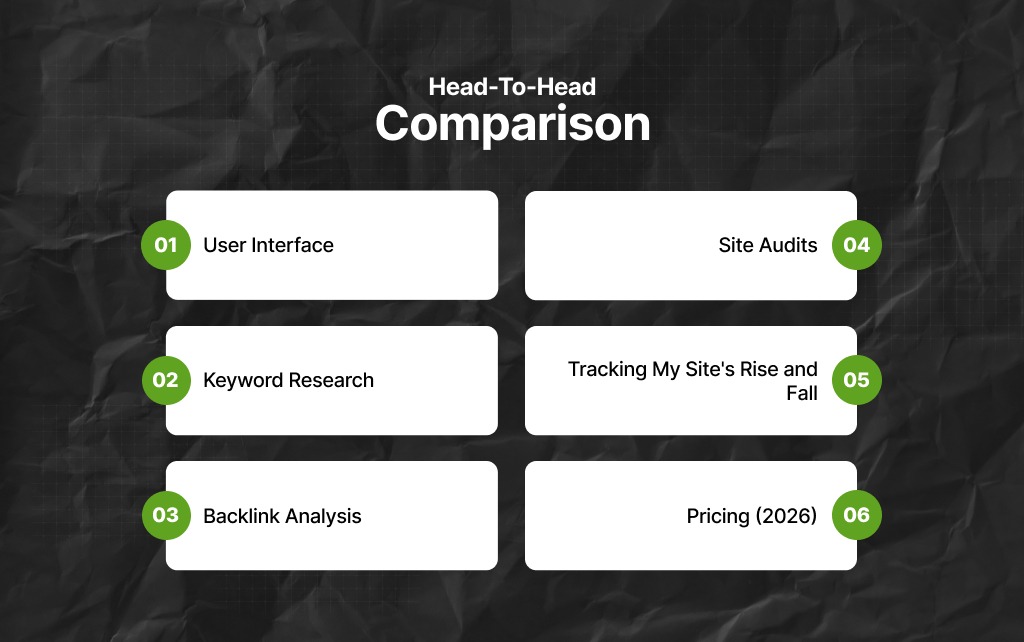
Do you want to know which tools claim the #1 spot on most parameters in the comparison of ahrefs vs semrush vs moz? After all, that decides which tool you should not miss in 2026:
SEMrush is powerful but complex. I am talking about its steep learning curve, but high-rewards approach.
On the other hand, Ahrefs is cleaner and more logically organized. To clarify, most experienced SEOs find it the most intuitive of the serious tools.
Lastly, Moz is the simplest of the three. It is built for people who want insight without friction, backed by its Moz Academy tutorials.
SEMrush has the largest database, with 25 billion keywords and an 89% difficulty-score correlation with actual Google rankings. Above all, the Keyword Magic Tool is excellent for surfacing long-tail variations at scale.
Ahrefs has 28.7 billion keywords and edges out SEMrush in accuracy, with a 91% volume correlation. Its standout feature is the “Clicks” metric.
To clarify, it adjusts traffic estimates based on SERP features like AI Overviews. This features heos you the actual expected clicks rather than raw search volume. In 2026, that distinction is the key if you want to write content that renders actual value.
Moz caps keyword suggestions at 1,000 per query, regardless of plan. I found it to be a real practical limitation, while comparing ahrefs vs semrush vs moz.
Use SEMrush for a better link ecosystem. But while developing and upgrading content, you need click-adjusted reality checks.
That’s the thing that helped me to identify, and upgrade or delete thin content across my site.
Again, I used Moz for basic research without data overload. Given its limitations, that’s the best you can use it for.
This is where the gap between these 3 tools is most meaningful.
Ahrefs picks up new backlinks within hours. Meanwhile, SEMrush takes days. On the other hand, Moz sometimes takes a week.
For active link-building campaigns, Ahrefs is non-negotiable. Its Domain Rating (DR) is also the most operationally trusted authority metric among practitioners.
SEMrush surfaces more referring domains in head-to-head tests across popular sites. That, however, makes it a strong tool for competitive backlink research and seo content gap analysis.
Moz has the smallest dataset. But its DA metric is so widely adopted that it remains a meaningful reference point, regardless of which tool you use day-to-day.
You must use Ahrefs for live link monitoring and building. On a greater scale, use SEMrush for competitive backlink research. In parallel, use Moz for the DA benchmark that everyone still checks.
SEMrush runs the most comprehensive audit, including a local seo audit. When my site searchenginemagazine.com took the hit, I used it every day to check:
It’s what I turned to first when diagnosing our traffic drops.
Ahrefs is more precise on technical issues and faster on large sites. Many practitioners trust it more for catching real errors without noise. Meanwhile, Moz covers the basics but isn’t built for deep technical work.
During your site audit, you already have a lot in your head. Therefore, toggling from one tool to another just adds another headache. Therefore, I recommend sticking with SEMrush.
During a site audit, this remains the best tool for content-related recommendations. Around the end, you can use Ahrefs for technical precision. That rest my suggestions after comparing ahrefs vs semrush vs moz.
Each tool shows my site’s trajectory differently. Therefore, I feel that knowing which to use for which question is the real skill.
Ahrefs’ Site Explorer shows organic traffic over time, which can be mapped against known update dates. As a result, I used it to see exactly when rankings fell. I also check where they went. That is how I developed my crisis management plan.
Again, I relied more on SEMrush when my site was recovering. SEMrush Position Tracking refreshes daily (vs. Ahrefs’ weekly default). That’s why it is the better tool for monitoring your site’s recovery inch by inch.
As I made some changes, I could see how that affected my site on Ahrefs. Meanwhile, Moz’s Domain Authority is a broad indicator, if you ask me.
Therefore, I could not use it for crisis diagnosis. However, I could easily rely on it for traffic analysis over a long term. The combined use of these two helped me to stablize the traffic of Search Engine Magazine.
If you are a small entrepreneurial site like mine, the cost becomes one of the strategic instruments and parameters for comparing ahrefs vs semrush vs moz.
| Plan | Price/month | Projects | Keywords |
|---|---|---|---|
| Pro | $139.95 | 5 | 500 |
| Guru | $249.95 | 15 | 1,500 |
| Business | $499.95 | 40 | 5,000 |
| Plan | Price/month |
|---|---|
| Standard | $99 |
| Medium | $179 |
| Large | $299 |
| Premium | $599 |
| Plan | Price/month | Projects |
|---|---|---|
| Starter | $29 (monthly only) | 1 |
| Lite | ~$108 | 5 |
| Standard | ~$208 | 20 |
| Advanced | ~$374 | 50 |
| Enterprise | ~$1,249 | 100 |
Pro Tip: Ahrefs doesn’t offer a free trial. Meanwhile, Ahrefs Webmaster Tools is free for verified site owners and covers your own domain. However, remember that each plan includes one user seat. On the other hand, the team seats cost extra.
Who wins the comparison of ahrefs vs semrush vs moz?
Moz is the most affordable. But you can’t work without Ahrefs. It has the widest range with a useful free tier. Lastly, SEMrush is the most expensive, but it is also the one-stop tool.
After the traffic drops, here’s what changed and how each tool supported the recovery. I stopped writing to rank and started writing to actually answer.
That said, I used Ahrefs’ Content Gap tool to find questions readers were asking that I hadn’t genuinely addressed. At the same time, I used SEMrush’s daily rank tracking to measure whether content updates were working.
For example, I was watching a page climb from position 14 to position 8 after a revision. Now I believe that is the kind of feedback loop I needed earlier.
Again, Moz is not completely off the radar. I still use Moz’s Domain Authority to confirm I have sustainable authority, not just short-term spikes.
In my website’s case, recovery took about three months of consistent work. However, I must admit that having all three tools made the process systematic.
The best SEO tool in 2026 isn’t the one with the most features. I would prefer the one that matches how you actually work.
Use Moz just for fundamentals and simplicity. Meanwhile, SEMrush provides breadth and AI search visibility.
Ahrefs stands out as the best tool for backlink accuracy and competitive intelligence. Used together, they give you a complete picture. However, Ahrefs helped me more than any other tool.
But all 3 tools helped me out when I had to measure what was failing and simultaneously make improvements in real time. I had data when our traffic dropped.
What I lacked was the willingness to ask the right questions of it. I needed to ask whether our content actually deserved to rank.
At the same time, I had to find out whether our backlink profile reflected genuine authority, and whether readers were finding what they came for.
The Updates of 2025 and 2026 had Google Alerts that made it harder to game the algorithm and easier to understand what it rewards:
Use Ahrefs, SEMrush, and Moz yourself to see clearly. Then optimize for the person reading, not just the algorithm indexing.
Barsha is a seasoned digital marketing writer with a focus on SEO, content marketing, and conversion-driven copy. With 8+ years of experience in crafting high-performing content for startups, agencies, and established brands, Barsha brings strategic insight and storytelling together to drive online growth. When not writing, Barsha spends time obsessing over conspiracy theories, the latest Google algorithm changes, and content trends.
View all Posts

How To Get Your Brand Cited In AI Search Resu...
Oct 22, 2026
The Ultimate Blueprint For Broken Link Buildi...
Oct 16, 2026
The Ultimate Guide To Stealing Your Competito...
Oct 15, 2026
Beyond The Basics: Master Guest Posting For H...
Oct 15, 2026
Best Generative Engine Optimization (GEO) Com...
Oct 14, 2026