
Structured Data SEO: How Schema Markup Helps Search Engines Understand Your Website
Sep 12, 2026

As digital education is slowly turning the tide on traditional systems, learning models are becoming intuitive and interactive. And, gamified teaching is becoming the new norm.
That is, turning quizzes and Q/A assignments into interactive games. Making learning fun and interesting for students. So, they can grasp the ideas and concepts faster.
Moreover, this gamified learning helps assess the students’ performance in real-time while inspiring them to learn passionately.
Now, among the various game hosting platforms, Gimkit Host is taking the spotlight for its unique features, customization options, and dynamic tools. Making it the trending tool in gamified digital learning.
But the real question is — “Is this game hosting tool worth the hype?”
Well, that’s exactly what I will be exploring today. In this blog, I am going to delve into the diverse aspects of Gimkit Host by focusing on:
Stay tuned!
To explain in simple terms, the Gimkit Host refers to the person who launches a new online game on the platform. That is, they can set up, introduce, and even manage access to the Gimkit game as a host.
Now, trainers, educators, or teachers can create interactive games for their students to learn the concepts and engage with the learning actively. So, helping them learn through the interactive sessions.
Moreover, the Gimkit Host allows the hosts to launch live gaming sessions and assign games as assignments.
So, the students can take their time to learn while playing the games online. Making it both a fun and flexible way to teach educational concepts.

Most of the popularity of the Gimkit Host lies in its diverse range of features and tools. So, some of these key features include:
Firstly, it offers real-time dashboards to track the students’ and players’ performance in the game. This makes it easier to monitor their learning capabilities and conceptual understandings.
Moreover, it allows the host to customize the settings for various games. So, based on the learning capabilities of the students, the teachers can adjust the games.
In addition to this, it technically offers three game modes to players — “Trust No One”, “Infinity Mode”, and “Classic”. So, the students can enjoy playing games in a variety of modes.
Apart from this, it allows students to play the games in groups. So, teachers can create group activity games to help the students collaborate and solve the games together.
Finally, it provides an analytical report of each player from the game. So, the teachers can analyze these performance reports to understand the learning outcomes.
To understand why this hosting model outperforms standard paper reviews, consider a recent diagnostic study conducted in an 8th-grade physical science classroom.
Over a two-week testing window, the instructor split two identical classes covering cellular biology into separate review groups:
Group A (Traditional): Received standard flashcard drills and whiteboard quiz questions.
Group B (Gimkit Hosted): Played two 10-minute live sessions of “Classic” and “KitCollab” modes per week.
Data from the host dashboard revealed an immediate behavioral and academic shift.
Group B demonstrated a 23% higher test-retention score on the final unit exam compared to Group A.
More importantly, the real-time analytics panel allowed the teacher to notice mid-game that 72% of the class was missing questions related to “mitochondria function.”
Because this knowledge gap was identified instantly on the host screen, the teacher paused the game mid-session, spent three minutes clarifying the concept, and resumed play.
This adaptive, real-time intervention is exactly what makes the hosting setup so valuable compared to grading traditional homework assignments days later.
Because Gimkit is used widely in K-12 education, its hosting mechanics align closely with student data privacy frameworks.
When launching a game, hosts can opt to use “Gimkit Accounts” for verified rosters or open a quick lobby via temporary join codes.
The platform restricts third-party tracking on student profiles, ensuring an ad-free, COPPA- and FERPA-compliant environment during live classroom hours.
From an administrative standpoint, hosting is managed entirely through a centralized web console.
Unlike the student interface, which is high-energy and heavily gamified, the host panel acts as a sterile command center.
Here, the instructor retains full oversight, meaning you can view live accuracy percentages, monitor real-time leaderboard shifts, and pause the entire ecosystem instantly if classroom noise levels get out of hand.
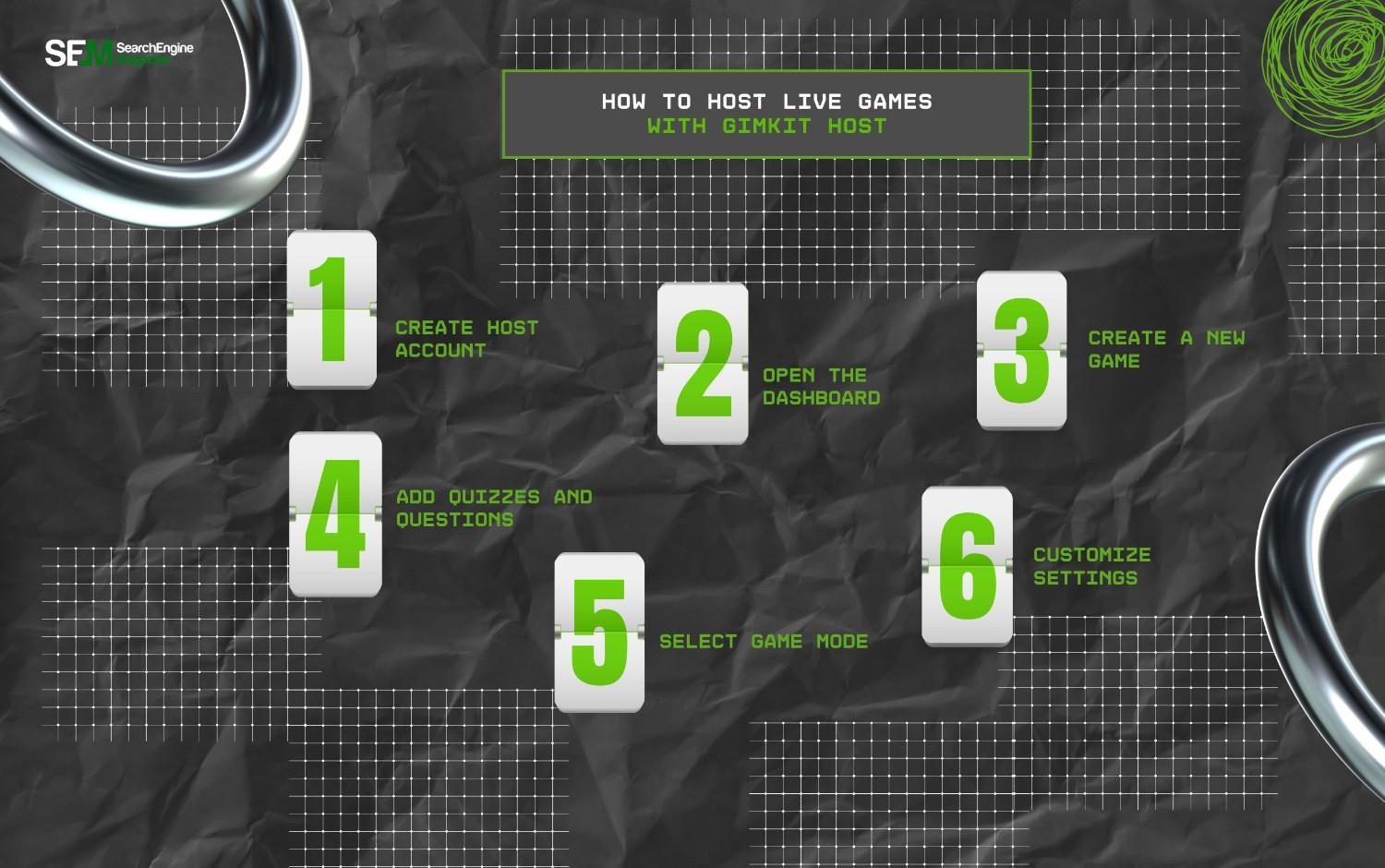
Given that gamified learning is rapidly growing, educators are looking for guides on how to use it. So, here is a step-by-step guide for hosting games on Gimkit Host:
Firstly, you need to create a Host account by visiting the official site of Gimkit. That is, go to https://www.gimkit.com/ and select the Sign Up option.
Then, put all the personal information in and choose a paid subscription plan. This will complete the account creation process.
Then, open the profile dashboard and explore the My Kits, Assignments, and Classes. This will show all the interactive games that you post on the platform.
Now, from the dashboard, select the New Kit option and provide the necessary details. That is, choose a Name for the game kit, select the Language, and the Subject of the kit.
After that, manually add the questions and the multiple-choice options. Then, you can customize the gaming with Flashcards or images, videos, and more.
Remember, the goal is to make the game interactive and knowledgeable at the same time. So, ensure the design is not too distracting, or else the students won’t learn anything.
Once the design of the game is done, select the gaming mode from Classic, Trust No One, and more. This will help set the complexity level of the game.
Then, from the settings, mention the Time Limit, Upgrade options, and Objectives. This way, your students can play the game to achieve the mentioned goals.
Finally, click on the Finish Kit option to complete the game and publish it on the platform. Now, it is ready for your students to play and learn interesting concepts.
If you want to host the creative map on Gimkit, it’s better to create the design, then choose the hosting options. So, just follow these steps below to create and host the creative maps on Gimkit Host—
Even though Gimkit provides a simple interface for users to create and enjoy games while learning new concepts, it has its own issues. So, resolve these issues, just follow these troubleshooting methods—
The single most frequent failure point when hosting live classroom games is an institutional firewall blockage.
School web filters often mistake Gimkit’s real-time WebSockets traffic for unauthorized gaming streams, resulting in a perpetual loading wheel for students.
To bypass this, have your district’s IT administrator whitelist the subdomains `*.gimkit.com` and allow traffic through secure ports 443 and 80 before running a multi-user session.
Creating an interactive game for the students is not a simple task. That is, you need to host an interesting game with easy gameplay and interactive activities. So, here are some tips to effectively host a game on Gimkit:
Now, teaching these little geniuses in the era of digitalization is not easy-peasy. So, tweak their experience with the various concepts with the right kind of games on Gimkit Host today!
A core factor in assessing the tool’s absolute value is understanding its tier limitations. The platform operates on a freemium model:
Gimkit Basic: Completely free. It grants unlimited access to core modes like “Classic” and “Team Mode,” with no cap on student participation.
Gimkit Pro: Paid subscription. Unlocks advanced, rotated limited-time modes (such as “Trust No One”) and allows assignments to remain open indefinitely.
For standard weekly reviews, the free Basic tier offers more than enough utility to run a highly interactive classroom without spending a dime.
Read Also:
Barsha is a seasoned digital marketing writer with a focus on SEO, content marketing, and conversion-driven copy. With 8+ years of experience in crafting high-performing content for startups, agencies, and established brands, Barsha brings strategic insight and storytelling together to drive online growth. When not writing, Barsha spends time obsessing over conspiracy theories, the latest Google algorithm changes, and content trends.
View all Posts

Structured Data SEO: How Schema Markup Helps ...
Sep 12, 2026
TikTok Downloader For Content Marketing Resea...
Sep 12, 2026
AI Content Optimization: How To Make Your Con...
Sep 11, 2026
AI Citations: How To Get Your Content Referen...
Sep 10, 2026
Top Enterprise AI Cloud Platforms for RAG, AI...
Sep 08, 2026