
Is Serpstat Worth It? A Deep Dive Into Pricing, Data Accuracy, And Features
Oct 09, 2026


The Google Hummingbird Update was the result of Google rewriting its algorithm to consciously anticipate what users are searching for on their mobile devices.
How? By making conversational search a reality.
As a result, even beginners can understand one thing from this: Google wanted to create a space for implementing dramatic innovations in search results, and the Hummingbird update was a start.
However, the strangest thing about this update was that Google never came clean about what this update was all about – there’s no explainer from Google on this one.
I could only find a few records of professionals from Google who have explained what the Hummingbird update was all about.
Based on that, my professional experience of working as a digital marketing expert, and industry insights, I am here to discuss the Hummingbird update in detail.
My primary focus? How did this update change search forever – how did the Hummingbird update impact natural conversational search?
Stay tuned.
The basics of search engine optimization at the beginning of 2013 were pretty similar to what it is today.
Even then, the content was considered king, people were embracing the concept of earning links instead of paying for them, and the goal was still to answer queries that mattered.
However, the world of search engine results was severely different, even a year ago before the Google Hummingbird update was announced.
One year before people had any idea of what the Google Hummingbird update was, search engines were pretty underdeveloped compared to what we get today.
For instance, search results would show exactly whatever you would type – from long-tailed keywords or a single word to popular abbreviations.
The biggest issue with this kind of search results was that the answers would never provide any scope for in-depth research.
Thus, it was evident that Google could not differentiate between two similar questions that differed slightly from each other.
For instance, if you type ‘Globe’ on Google now, you will come across search results related to Shakespeare’s Globe theatre.
In the early days of the Google Hummingbird update, the algorithm did its best to answer questions depending on the available content on the internet.
During this time, Google experimented with directing search results towards content created by reliable sources. The reliable sources were determined by Google’s Agent Rank Patent of 2009.
When Google combined this move with an organized data markup, a short program by the name of Google Authorship was born.
The Google Authorship update and Google + went live almost together, enabling content creators to utilize an internal system linking publications with publishers.
However, by 2014 the concept of Authorship had failed.
Most Google insiders and industry experts blamed a low rate of adoption, small changes in end-user behavior on search engine result pages, and Google’s constant habit of experimenting with new updates as the primary reasons for the failure of Authorship.
The revolutionary update came to be known as the Hummingbird Update mostly because the update came with a promise: to improve Google search by making it faster and more precise. When we say fast, you can understand what it means but what about being precise?
Google search for the first time became precise, that is, more accurate as well as exact.
Google search, with the help of the Hummingbird update, was becoming more precise as to what a query means, instead of displaying all kinds of content related to the keyword.
The then CEO of Google, Matt Cutts even spoke at length about the update in an interview in 2013,
“Hummingbird is a rewrite of the core search algorithm. Just to do a better job of matching the user's queries with documents, especially for natural language queries, you know the queries get longer, they have more words in them, and sometimes those words matter, and sometimes they don’t.”
The whole concept of keyword research after the Google Hummingbird Update became what every content marketer wished for!
After Google’s Caffeine update of 2010, the next revolutionary announcement was the Google Hummingbird update in September 2013.
This was revolutionary in creating a powerful impact on how users reacted and interacted with SERPs.
A solid 90% of Google searches were influenced across the world after Hummingbird was introduced, as shared by Matt Cutts on X at the time.
In this context, Cutts shared online, “And so Hummingbird affects 90% of all searches. But usually just to a small degree because we’re saying this particular document isn’t really about what the user searched for because maybe they said, ‘Okay Google, now how do I put a rutabaga up into space, what really matters is rutabaga and space and not how do I’.”
If you have been looking for google hummingbird update goals then you have come to the right place! Thus, keep scrolling to find out what was the purpose of the Google Hummingbird algorithm update!
Search results were now taking the help of ‘natural language processing’ for computing niche solutions for questions at both long-tailed and head levels.
For the first time, users were able to look for topics and related topics confidently on Google without relying on creating questions with the help of Google-fu.
Old users of search engines will understand how challenging it used to be before when finding something on the Internet would require users to know something about the topic.
The Google Hummingbird update wanted to fix this by prioritizing both synonyms and topics related to the themes.
Thus, Hummingbird helped Google become a little human when it enabled users to accurately find what they were looking for and let them know what they didn’t know.
The best part about the Google Hummingbird update was how it combined a user’s needs with both intent and context for getting the best results.
So naturally, this combination proved to be an incredibly successful strategy and ended up improving local searches considerably.
For instance, if you were trying to find a great Italian restaurant in the United States before, you would have to be so careful while typing out your query, otherwise, you might just be stuck with recommendations in Europe or some other continent.
So, of course, on the surface, the different results will also be great for Italian food, but that is not what you were looking for.
Thus, it was the brilliant combination of ‘conversational language processing’ and comprehending human intent based on location-related information that led to the beginnings of something as precise as voice search.
The Hummingbird, of course, changed a lot of things, including the whole concept of local search.
For the first time, local searches became more precise than ever when Google brought together context and intent for improving search results considerably.
Simply put, local searches became more precise than ever before.
While most local business owners might have experienced temporary issues, it is unlikely that several websites were affected.
Of course, temporary problems mostly pertained to spammy one-boxes that decreased the site’s local visibility on Google.
As a result, if your site witnessed any drop in rankings or traffic that is related to the Hummingbird update, then you should check out and go deeper into the impacts of other updates.
This is because it is highly possible that it might be another update, such as Penguin or Panda, that might be responsible for the drop in rankings and traffic.
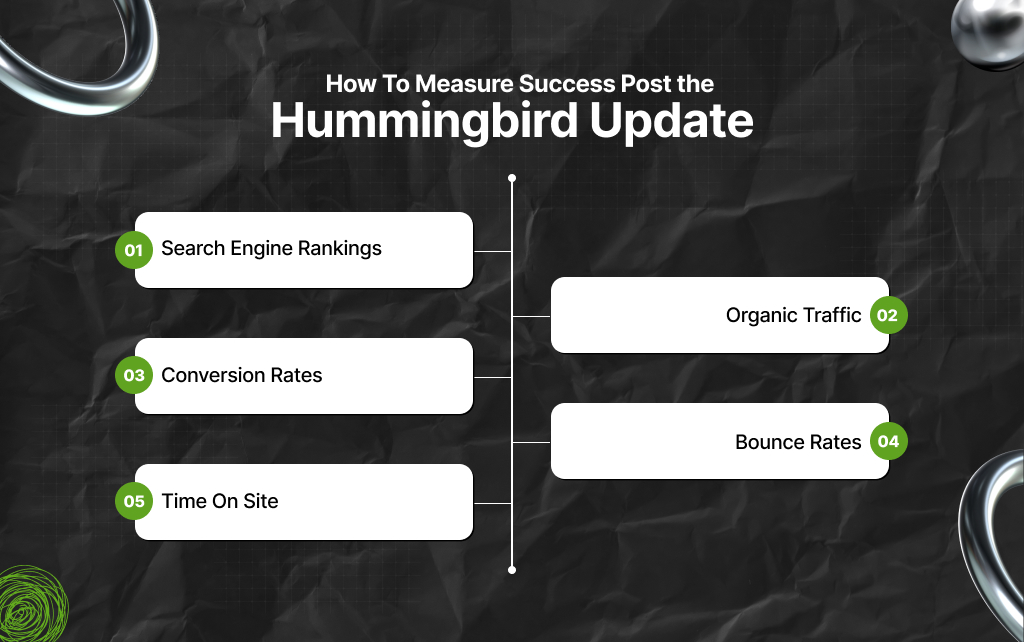
In order to measure your success post the Hummingbird update, prioritize the concept of monitoring your metrics, especially the ones that align well with the context and intent of search queries.
On that note, I’ve discussed the most significant metrics that you need to monitor.
Monitor your rankings on SERPs for relevant keyphrases to check how your site content is doing – is it performing on search results or is it failing to do so?
This, in turn, will help you understand how well Google is receiving your content.
Track your website’s organic traffic with the help of tools like Ahrefs to find out how many people have been coming to your site directly from Google and other search engines.
Moreover, understand that if your organic traffic is on the rise, it is a positive indicator that your site’s content has been adding value to your audience.
Track your website’s conversion rates to understand how many people are following your call-to-action buttons.
FYI, this is applicable for people making purchases, signing up for newsletters, or anything else that translates to conversion for you.
This one’s more important than we usually give credit to. As a result, track your website’s bounce rate to find out how many people are coming to your website and leaving quickly.
Moreover, you will also find out how many people are leaving your site after not taking action.
This is because an increase in a site’s bounce rate indicates that the content is failing to meet the expectations of users.
Measure how much time users are spending on your site to find out how engaged users are with the site’s content.
So, if someone is spending a longer time on a site, it generally shows that they find the site’s content engaging and valuable.
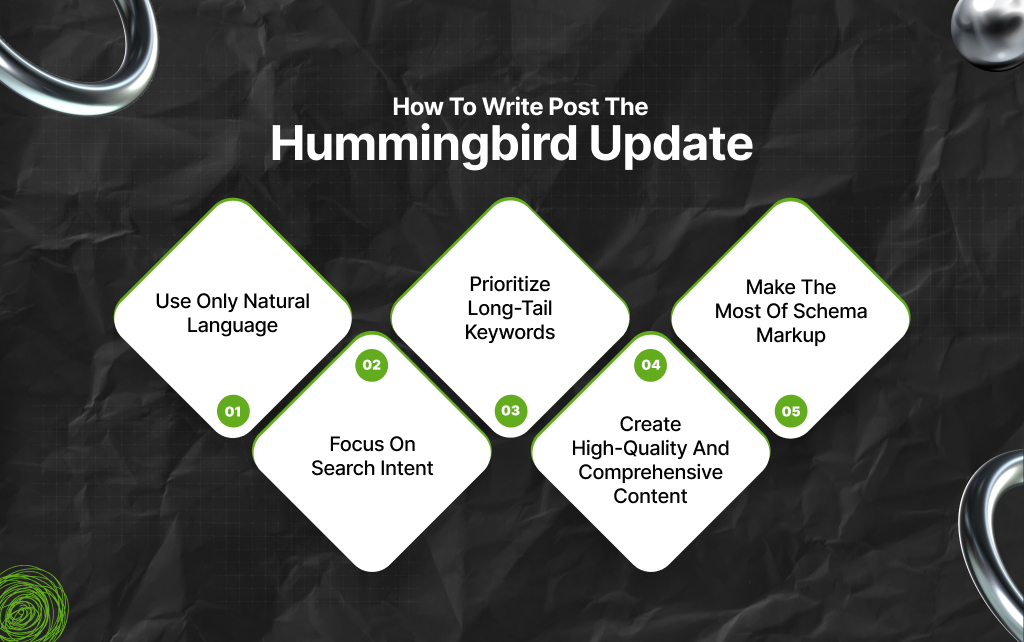
As a content writer and digital marketing professional for eight years, I can tell you that writing post the Hummingbird update has changed.
Currently, the focus for every writer should be to create content that is high-quality, helpful, and user-friendly – the priority has shifted from search engines to people-first content.
Moreover, the point is to create content on your website that aligns with the context and intent of search queries.
On that note, I have a few tips at my disposal that I want to share to help you understand content writing effectively post the Google Hummingbird update.
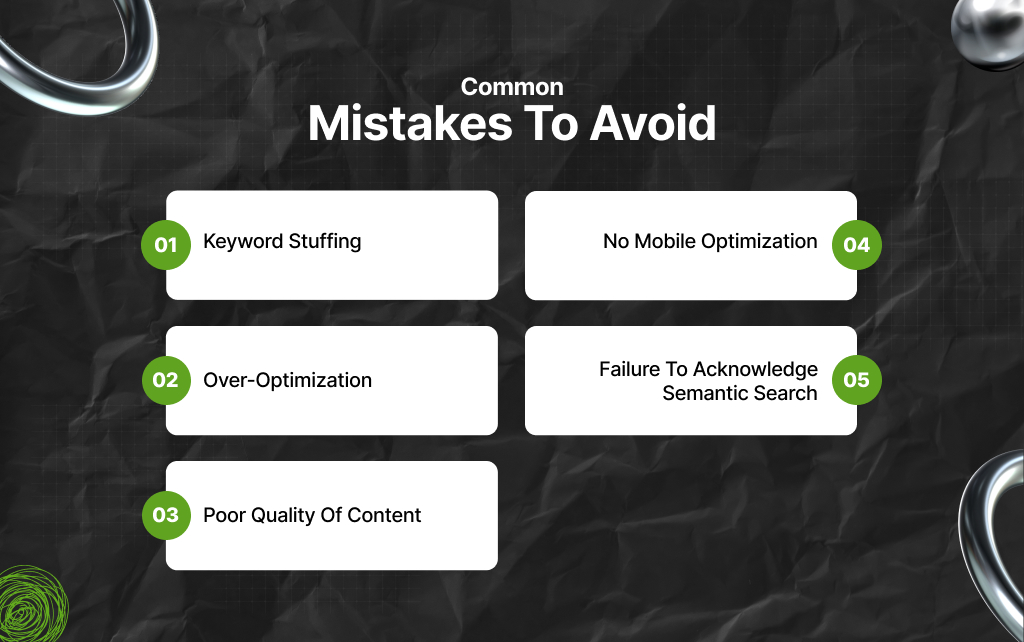
While optimizing your content for Hummingbird, it is crucial to avoid making common mistakes that can end up hindering your success.
On that note, I’ve highlighted some common mistakes that you should avoid.
It is best to avoid stuffing your content with keywords, considering Hummingbird was designed to comprehend both context and natural language.
As a result, filling your content with search phrases and keywords will make it appear unnatural, reducing its overall effectiveness.
Much like keyword stuffing, avoid over-optimization, considering Hummingbird wants to offer relevant and accurate results.
Also, it is best to prioritize creating valuable and high-quality content to address user intent instead of playing with the system.
Do not create low-quality and thin content because Hummingbird makes high-quality and relevant content a priority.
Moreover, it is best to invest your efforts and time into creating helpful content that adds value to your audience.
Ensure your site has been optimized to work on mobile devices, considering Hummingbird was able to improve the overall search experience for mobiles.
Moreover, a website that is mobile-friendly is vital for reaching any user who is on-the-go!
Never ignore semantic search, considering Hummingbird was designed for an understanding of the context and meaning behind search queries.
Moreover, when you are able to embrace the principles of semantic seach, you can easily create content that easily aligns with context and user intent.
So, by following all the necessary guidelines while avoiding the common mistakes as mentioned above, you can optimize your site specifically for Hummingbird.
Moreover, you can also refine your ranking potential on Google’s search engine result pages.
The Google Hummingbird update is considered by many as the move that changed the whole search engine game forever.
But the question is, did it? All of it relies upon how users see it and how did it benefits users and the organic search world.
While the updates’ forerunners, Penguin and Panda, caused plenty of chaos on search engine result pages, Hummingbird failed to cause any similar noise.
Moreover, it was also not the first time an information-related method was being put to use for providing reliable solutions to questions.
However, all this does not mean Hummingbird did not make any significant contribution to how search results work today.
The Caffeine update, Knowledge Graph, and even Authorship had all failed.
Hummingbird was standing on the shoulders of three major duds and still managed to be this popular.
After all, Google just did not change the air filter of the search engine with Hummingbird, but ended up changing the complete search engine block!
Barsha is a seasoned digital marketing writer with a focus on SEO, content marketing, and conversion-driven copy. With 8+ years of experience in crafting high-performing content for startups, agencies, and established brands, Barsha brings strategic insight and storytelling together to drive online growth. When not writing, Barsha spends time obsessing over conspiracy theories, the latest Google algorithm changes, and content trends.
View all Posts

Is Serpstat Worth It? A Deep Dive Into Pricin...
Oct 09, 2026
How To Use Screaming Frog: The Definitive Tec...
Oct 09, 2026
Master The Rich Result Test: Fix Your Broken ...
Oct 08, 2026
Does vnROM Bypass Still Work? A Realistic 202...
Oct 08, 2026
Event Pages That Rank And Convert: A Practica...
Oct 06, 2026