The Automated Bidding Systems Promising Efficiency Are Also The Primary Mechanism Driving Cost Escalation
Jun 17, 2026

I have worked as a content manager and SEO expert for 8 years in the blogging business. And if there is one thing I can tell you about a Google penalty, it’s don’t take it casually.
Frankly, the search engine giant does its job with a lot of seriousness, especially when it comes to answering search queries and adding value.
To guarantee its SERPs always offer helpful information, Google keeps updating its algorithm.
The result? Penalties for any website that uses black hat SEO and tries to manipulate rankings with traffic-fishing content.
And my website, Search Engine Magazine, had fallen prey to multiple penalties in the past, thanks to greedy interns I trusted.
At the time, I was young, and I thought everyone was going to be ethical about their strategies – turns out they converted my site into a content farm.
After the Google March Update of 2024, we were at an all-time low with 0 organic traffic on our site, thanks to a strict penalty.
And that is how my journey of fixing my site started – today, I’m standing with 24K organic traffic.
Obviously, it took me 9 months just to get some traction on the site, and the next 15 months went behind significant rebuilding.
So, while a lot of authority blogs can tell you about Google Penalties and promise you a resolution, nobody has actually faced it, not like me.
And I am here to share my experience with anyone who wants to ignore all the big names and really know how to fix their website.
Stay tuned.
In simple terms, Google penalties are a sort of punishment that Google gives to sites for incorporating black hat SEO and violating the search engine giant’s spam guidelines.
Once penalized, a site might experience a significant drop in organic traffic and rankings in search results.
In this context, I would also like to share what Google has to say, “We detect policy-violating content and behaviors both through automated systems and, as needed, human review that can result in a manual action. Sites that violate our policies may rank lower in results or not appear in results at all.” (source: Google Search Central)
So, there are two broad categories of Google penalties:
Before I discuss the two kinds of penalties in detail, here’s a table comparing the two for a better understanding of the distinction between them.
| Manual Action | Algorithmic Demotion |
|---|---|
| Human review | Automated |
| Seen in GSC | Usually can’t be seen in GSC |
| Reconsideration possible | No reconsideration |
| Can be sitewide or partial | Usually ranking suppression |
Algorithmic penalties are all automated sanctions that result from Google’s algorithmic changes, and it specially impacts websites with a significant drop in rankings.
Moreover, these penalties usually happen when a major update impacts a specific website. In this context, some of the most crucial algorithm updates that have impacted websites are:
Algorithmic penalties usually require sites to comply with the search engine’s algorithm changes.
As a result, when Google’s crawlers visit a site and spot all the differences, the site will automatically see an improvement in ranking.
Google has a team of experts responsible for manually reviewing websites and imposing penalties if any site violates its Search Essentials.
Moreover, it is crucial to point out that manual Google penalties might impact an entire website or specific pages.
In this context, here’s what Google has to say: “Google issues a manual action against a site when a human reviewer at Google has determined that pages on the site are not compliant with Google’s spam policies.” (Source: Google Search Console)
After receiving a manual penalty, you need to incorporate quick fixes and submit requests for reconsideration.
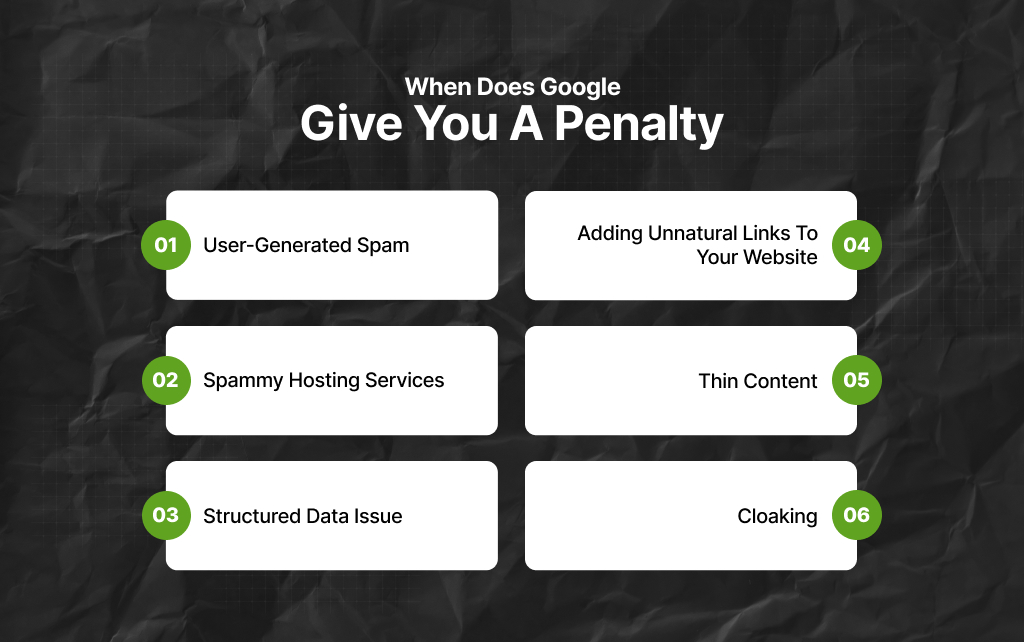
There are specific reasons why Google charges you a penalty for your site. Let’s dig deeper into the details to get a better idea.
Some of the core reasons for corrections that Google Charges are as follows:
The manual Google penalties do not occur as the site owner tries to violate the webmaster guidelines, but the presence of malicious website visitors can spam the website. The visitor can spam your website by sharing irrelevant links to your website content.
Some of the spammy content that visitors could generate are as follows:
Depend on platforms for comment moderation and filter out spam. Also, you can incorporate CAPTCHA and authentication to prevent spambots from swarming your comments.
Moreover, if you do not have any resources for moderating your comments, then turn them off entirely for your website.
When the hosting provider spams during the hosting of the websites, it increases the chances of a Google penalty to dislodge your website.
Now, suppose you have availed of the free hosting services.
In that case, the hosting service provider will face the problem as Google will discover your free hosting provider and penalize your website’s hosting services.
Again, Google penalty checker tools can help in this regard.
Here, the fault may be due to the presence of the spammy hosting service provider.
However, it can make things more complicated on your end. If the Google penalty hits you, then it is recommended that you seek the assistance of a free hosting service provider.
If your website has mismatched content, then the Google penalty will occur. However, it can make things easier to get things done correctly within a shorter period.
If the structured data guidelines are violated by your website, then your website will also face a penalty. However, proper application of the strategy can make things work well in your way.
Try to use the structured data testing tool before you go for the live code changes.
You need to identify these factors while you want to avoid the scope of Google penalty occurring on your website.
To outrank their competitors, some SEO practitioners make use of unnatural links. Unfortunately, it can result in damage to your website’s authenticity.
Google Algorithm Updates keep changing all the time. So you need to keep track of these factors while using any links to your website.
Manipulative links or participation in link exchanges can harm your website. Some of the ways you can adopt to avoid the Google penalty are as follows:
Ensure you are using White Hat SEO strategies only for your link-building. That way, you can ensure that zero low-quality sites link to your site.
Moreover, you need to audit all your backlinks regularly with the help of Ahrefs, GSC, or some other effective tool.
Additionally, if you come across suspicious links or have received a Google penalty already for spammy links, you can:
Also, you can disavow the links with the help of the Disavow tool from Google’s toolbox.
Contact the webmaster and ask them to delete the spammy links.
Google updates keep on changing with time and in response to the demands of its users.
You have to understand these factors while you want to get things done your way. Ensure that the content of your website provides value to your visitors.
It must not be spammy. Google detects low-quality content quickly, and you can receive a content penalty if you are not ready with it.
Some of the examples of thin content are as follows:-
A content audit can help you periodically edit the low-quality and thin content on your website. It can make things easier for you to detect the reasons for a Google Penalty.
You need a complete new White Hat strategy to fix the content on your site – the point? To offer long-term value. Moreover, avoid publishing mass volumes of AI-generated content on your website.
On that note, here are three tips that you need to follow:
If your website offers different types of content to its users, your website will have a high chance of receiving a penalty. But, on the other hand, it can make things work well in your way.
Proper application of the strategies can help you reduce the Google Penalty’s scope for your website.
Ensure that you do not make your choices in the wrong way within a stipulated period. The more vigilant you can stay in this regard, the better you can achieve your objectives.
Firstly, never use this black hat strategy deliberately. So, if you have already used cloaking intentionally, here’s how you can try reversing the damage:
I have always checked the Manual Actions Page on Google Search Console for clarity.
It is hands down the easiest method to find out whether your site has been hit by any penalty, apart from any significant drop in ranking and traffic.
This is precisely why the search engine giant has added the tab for Manual Actions – that way, you can obtain clarity on your website’s relationship with penalties.
The other thing that I always do is cross-reference the timelines of any major traffic fluctuations with those of Google updates.
In case you are just starting out and are not able to figure out how to proceed after a penalty, I suggest getting in touch with professionals to improve your website.
Barsha is a seasoned digital marketing writer with a focus on SEO, content marketing, and conversion-driven copy. With 8+ years of experience in crafting high-performing content for startups, agencies, and established brands, Barsha brings strategic insight and storytelling together to drive online growth. When not writing, Barsha spends time obsessing over conspiracy theories, the latest Google algorithm changes, and content trends.
View all Posts

The Automated Bidding Systems Promising Effic...
Jun 17, 2026
MobileCreativeOrg Review: Is This Emerging Mo...
Jun 17, 2026
Why Does Google Celebrate Different Birthdays...
Jun 17, 2026
How Mobile Voice Search Is Reshaping Local SE...
Jun 17, 2026
Achieve More Natural Shadows And Reflections ...
Jun 15, 2026