The Ultimate Guide To Stealing Your Competitors’ Backlinks Using Curated Resource Lists
Oct 15, 2026


Keyword research is one of the foundational factors of any SEO strategy. They are the connecting elements between the website content and user search queries.
So, when the content is filled with the right keywords and phrases, it reaches the target audience without losing its track. Making it easier to find the web content via keyword searches.
Now, it might sound easy, but finding the right keywords is not a piece of cake.
Rather, it is quite difficult to choose the exact keywords that align with what the target audience is looking for. Making the content relevant for them.
Now, sometimes it can be obvious for the specific topic. But what about the non-obvious ones or niche-specific ones? That’s where the complexity lies.
Moreover, simply scattering the keywords across the entire content is not the right way. So, marketers need an effective plan or framework to actually improve the SEO performance.
So, in this blog, I am going to explore the diverse keyword mapping frameworks for boosting the site’s SEO by focusing on—
Stay tuned!

First things first, keyword mapping is a process of assigning a specific keyword to a specific page. So, it is easier to categorize the content using the keywords as tags.
Moreover, the keywords can be arranged into clusters, creating a topical architecture for the site. So, it is easier for both the audience and Google to read through the structured content to understand the context.
In addition to this, the target keywords are documented in a map for better tracking of how each keyword is performing for the site. Auditing the entire SEO landscape for the site.
As the expert opinion of Neil Patel highlights—
“In essence, you’re creating distinct groups of keywords for each page. This helps you avoid keyword cannibalization (more on that later). I like to think of these as keyword clusters that structure your pages. Keyword mapping also boosts SEO by improving your site’s structure and optimizing content.”
Getting noticed on the internet is not easy. But with the right keyword mapping, it is not impossible to achieve. So, here are some of the benefits of implementing keyword mapping for SEO—
As the report from Search Engine Journal highlights the benefits of keyword mapping—
“Ideally, you want your pages to contextually link from one to another. This helps search engine crawlers index your pages while helping visitors find what they’re looking for. Keyword mapping also provides you with an effective way to measure your SEO efforts. It will help alert you to problems with your SEO, allowing you to react faster.”
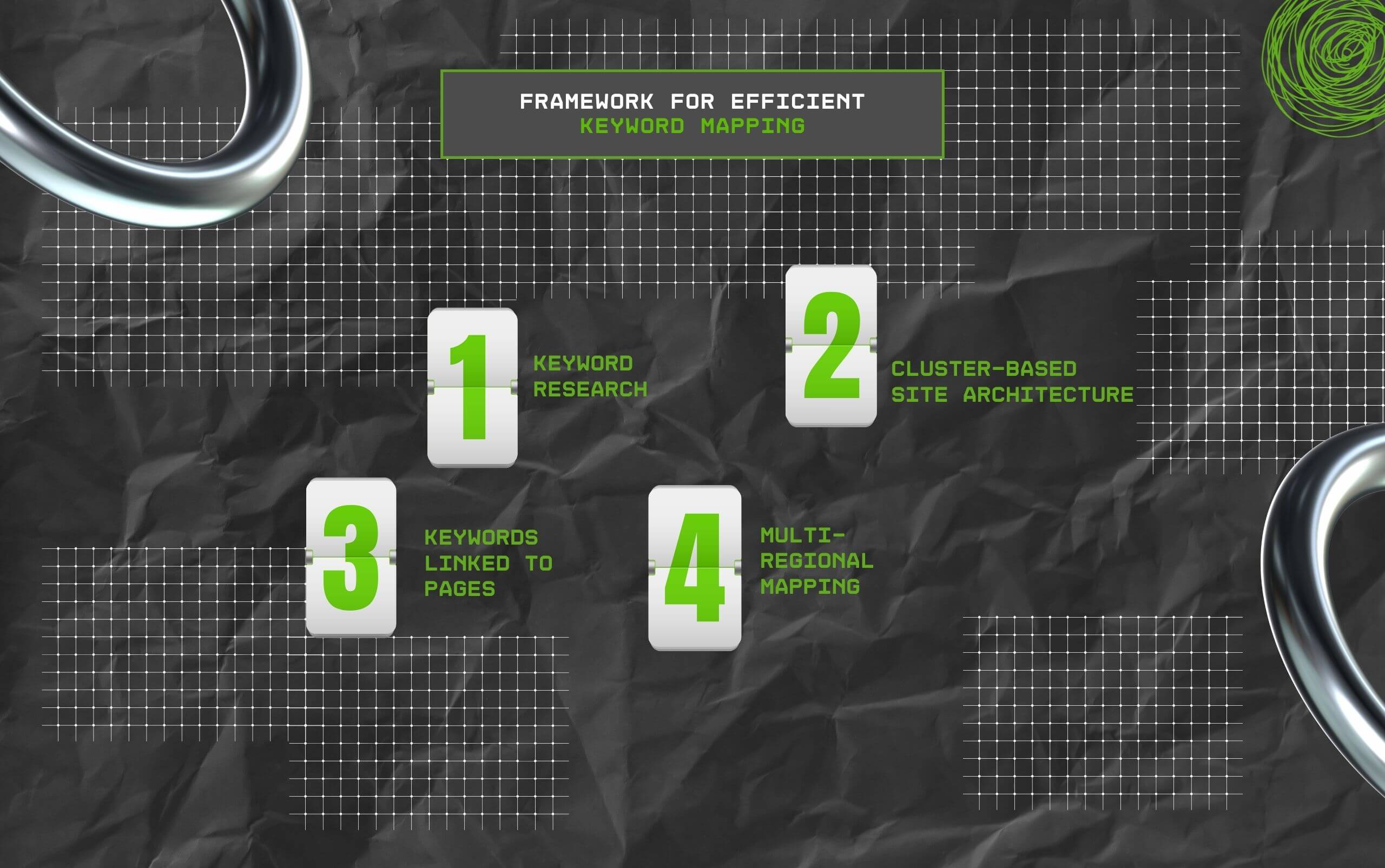
Given that a proper keyword mapping can remarkably amplify the SEO performance of the site, here is a framework with the best techniques.
The very first step to creating a keyword map is to start with keyword research. That is, finding relevant keywords that create a bridge between the content and the intent of the target audience.
So, marketers can use seed keywords to create topical clusters and expand them with relevant long-tailed keywords. This way, grouping the pages becomes easier based on the search intent.
Grouping keywords based on their relevance in the categories can help with reorganizing the structure of the site. Moreover, this can help search engines to better index the pages and create a hierarchical mapping.
According to the SEMrush blog—
“A topic cluster is a group of related pages interconnected by internal links that includes a pillar page (the main page) and related subpages focused on subtopics. Both pillar pages and subpages can be created around a keyword cluster—a group of similar search terms that can be targeted on the same page.”
Apart from grouping, it is vital to plan the content flow. That is, marketers can incorporate relevant keywords on already covered topics from the clusters.
Moreover, this can help in finding keyword opportunities. So, they can create new content around the topic. Covering the relevant elements for better audience engagement.
Finally, structuring the content based on the regionality of the target audience can improve the SEO performance. So, the keyword mapping should highlight regional keywords for multi-lingual or multi-regional sites.
Even though there are countless keyword research tools, the ones that provide the best platforms for keyword mapping are—
Out of the many tools, SEMrush allows users to group topics, conduct keyword research, analyse the user intent, and compare the competitiveness of the keywords. So, it provides an all-in-one tool for keyword mapping.
Similarly, Ahrefs comes with a massive collection of keywords along with their search volume, difficulty, and competitiveness. So, users can plan the strategy easily.
Unlike other tools, Moz has an edge for keyword mapping. That is, it offers analytical insights into the keywords, identifying the backlink opportunities, and domain authority metrics.
From the free tools list, Google Console allows users to find ranking keywords and internal linking opportunities. So, it is easier to create a topic cluster with relevant keywords.
Finally, Google’s Keyword Planner is designed to find the right kind of keywords without spending dimes. That is, users can look through the trends and the basic analytics of keywords for mapping the structure.
Now, here is a simple step-by-step guide for implementing the keyword mapping strategy for enhanced SEO performance.
As the digital marketing space is constantly evolving, keyword mapping is also visualizing a promising future with AI and LLM-powered search engine algorithms.
That is, with the AI technology in the search engine models, they are better equipped to decipher the context of the content. Making keyword mapping more prominent.
Moreover, semantic entities further help these models to understand the context behind the content. So, using semantically attuned keywords can improve the SEO performance.
Now, implementing keyword mapping within the SEO strategy is quite straightforward. So, go ahead and incorporate it to boost the site’s performance to the next level.
Here are some of the common questions around keyword mapping that most marketers look for.
Keyword cannibalization or over-optimizing the keyword can adversely impact the SEO performance of the site. So, to prevent it, creating and implementing a clear content strategy with unique keywords is highly recommended. Moreover, users can switch from using regular keywords to niche-specific keywords for better mapping.
Absolutely not. User search intent is a core factor for improving the SEO performance of the site. So, ignoring it can adversely impact the overall performance of the keywords used in the content. Moreover, updating the keyword research based on the search intent can lead to improved conversion rates and higher engagement metrics.
One of the best ways to deal with ambiguous keywords is to clarify the user intent. So, using negative keywords and long-tailed keywords, marketers can filter out irrelevant contexts, match with the target audience’s intent, and create content with diverse meanings. That is, providing a clarified context to the ambiguous keyword is the key to dealing with these kinds of confusions.
Chandrima is a seasoned digital marketing professional who works with multiple brands and agencies to create compelling web content for boosting digital presence. With 3 years of experience in SEO, content marketing, and ROI-driven content, she brings effective strategies to life. Outside blogging, you can find her scrolling Instagram, obsessing over Google's algorithm changes, and keeping up with current content trends.
View all Posts

The Ultimate Guide To Stealing Your Competito...
Oct 15, 2026
Beyond The Basics: Master Guest Posting For H...
Oct 15, 2026
Best Generative Engine Optimization (GEO) Com...
Oct 14, 2026
Digital PR for Link Building: How To Earn Hig...
Oct 13, 2026
Cracking The Code Of The Social Media Saga Si...
Oct 13, 2026